 1500+ reviews


Preventive Maintenance Plan for Magnolia, Texas Properties

A preventive maintenance plan for pest control is recurring inspection, monitoring, targeted treatment, exclusion, and documentation designed to stop infestations before they take hold. In Magnolia, that discipline matters more as the city reports 147.4% population growth from 2020 to 2024, adding homes, yards, and commercial buildings where Gulf Coast heat, humidity, and rainfall can turn a small gap or standing-water spot into an active problem. You're probably reading this after a familiar moment. Ants return to the kitchen a few weeks after a spray. You hear scratching in the attic at night. A tenant sends a photo of a roach and asks what you're going to do differently this time. A plan answers that question before the next sighting, not after it. What a Preventive Maintenance Plan Actually Means for Pest Control Preventive maintenance didn't start with pest control. It became a formal reliability discipline in the mid-20th century as organizations moved away from waiting for failure and toward scheduled inspection, servicing, and replacement, a shift traced in the reliability history covering the 1950 Department of Defense committee and its 1952 successor, AGREE. That same account notes the first national reliability symposium in 1954 and MIL-R-25717 in 1957, described as the first military specification for a reliability-assurance program. The language sounds industrial, but the logic transfers directly to a house or small business. You identify where deterioration starts, you inspect on a set interval, and you intervene before a small defect becomes a costly failure. What That Looks Like on a Magnolia Property For pest work, deterioration isn't a worn bearing. It's a door sweep that no longer seals, mulch holding moisture against a slab, a torn vent screen, or irrigation overspray keeping a foundation damp. A preventive plan schedules people to look for those conditions, refresh barriers where needed, and record what changed. Inspection comes first: A technician maps entry points, harborage, food and water sources, and prior activity. Monitoring continues between treatments: Traps, termite stations, and visual checks show whether pressure is rising or falling. Intervention stays targeted: Treatment, exclusion, or sanitation work follows what the inspection found. A subscription that only puts a truck in your driveway isn't prevention. Prevention is the documented loop that catches a conducive condition before pests use it. Magnolia's growth makes that loop practical, not theoretical. New subdivisions add shared fence lines, fresh landscaping, construction debris, and builder-grade gaps around utility penetrations. Established properties add mature trees, stored items, and aging seals. Both create routes for termites, rodents, mosquitoes, and seasonal invaders, and both benefit from scheduled attention instead of waiting for visible damage. Why Scheduled Service Beats Reactive Callouts The clearest way to understand scheduled service is to compare the timing of the work. A reactive callout starts after you've seen the pest, the droppings, or the damage. A preventive visit starts earlier, while the problem is still a condition you can correct. The stress of that late call is familiar to many homeowners, as shown below. A 2022 peer-reviewed reliability study gives this idea a measurable example. Reliability at six time units rose from R(6) = 0.45963 before preventive maintenance to R(6) = 0.55756 after it was introduced, an improvement of approximately 21%, according to the Alba 26 machine reliability study. That research studied machinery, not pests, so don't treat the number as a pest-control promise. Treat it as evidence for the operating principle. Repeated inspection and timely correction reduce the chance that a developing fault becomes a disruptive failure. Translating Reliability Into Pest Decisions In a Magnolia kitchen, early monitoring can reveal German roach activity in a hinge or appliance void before reproduction spreads through cabinets. Along a slab edge, termite monitoring can flag activity while treatment remains focused. In an attic, fresh rodent sign found during a scheduled check leads to exclusion before insulation and wiring face extended exposure. The short video below illustrates the broader scheduled-service mindset behind that timing advantage. Scheduled work also changes what you can prove. You'll have dates, findings, products, locations treated, and follow-up notes. That record helps a homeowner budget predictably, helps a property manager answer a tenant complaint, and gives buyers and sellers clearer evidence during a transaction. Reactive service may solve today's sighting, but it rarely shows whether the underlying route, moisture source, or harborage still remains. The IPM Foundation Behind Every Strong Plan A strong pest preventive maintenance plan is built as an Integrated Pest Management, or IPM, control loop. It's not a promise to avoid products, and it's not a fixed calendar of sprays. The EPA specifically identifies monitoring, accurate identification, action thresholds, lower-risk control selection, and plan updates as core principles in its IPM principles guidance. That sequence matters because the wrong identification leads to the wrong treatment. A few outdoor ants trailing to a tree don't carry the same meaning as German roaches breeding near a dishwasher. IPM forces the technician to name the pest, measure the pressure, and decide whether action is justified. How the Five Principles Show Up During a Visit Monitoring means checking traps, stations, droppings, mud tubes, webbing, standing water, and fresh damage. During a humid Magnolia summer, that includes shaded mosquito harborage and moisture-prone foundation areas. In cooler months, attention shifts more toward attic entry, stored-food pests, and rodents seeking shelter. Accurate identification narrows the response. Roof rats use raised routes, while Norway rats more often pressure grade-level openings. Fire ants in turf need a different response from pharaoh ants indoors. You can see how those principles fit together in a practical overview of integrated pest management practices. Action thresholds define when risk becomes unacceptable. A warehouse may tolerate a single outdoor sighting while staff correct a door gap. A daycare kitchen shouldn't apply the same tolerance to roach activity near food preparation. The threshold should reflect health risk, nuisance, damage potential, and the setting. Lower-risk control selection: Start with exclusion, sanitation, habitat change, traps, or targeted placement when they'll solve the pressure. Plan updates: Change frequency, treatment zones,
How Long Does It Take to Get Rid of Roaches
Most visible roach activity drops within 1–2 weeks, but complete elimination typically takes 4–8 weeks for light to moderate infestations and up to 12 weeks for severe or hidden infestations. If a product kills roaches quickly, why can a Magnolia homeowner still find them after treatment? The gap is between killing exposed roaches and eliminating an established population. A treatment has to reach the right places, remain effective against the roaches present, and work alongside repairs and cleanup. In Magnolia, Texas, a useful estimate starts with an inspection, not a promise printed on a pesticide container. The Realistic Timeline for Roach Control A small, accessible infestation can show a major reduction within 1–2 weeks, while difficult infestations can take up to 12 weeks to eliminate. Many baits need at least 5 days to kill substantial numbers, and some kill approximately 70% to 90% in a week or longer, according to Utah State University Extension's cockroach management guidance. For a light or moderate German cockroach infestation, 4–8 weeks is a practical planning range for reliable control when treatment, sanitation, and monitoring work together, consistent with the integrated approach described in University of Maine Extension's cockroach guidance. These are conditional ranges, not deadlines that apply to every property. Separate relief from verified elimination Initial knockdown means fewer active roaches. Verified elimination means inspections and monitoring no longer indicate an active population, including immature stages. Those milestones aren't interchangeable. Seeing fewer adults is encouraging, but it doesn't establish that every occupied cabinet, appliance gap, or wall void has been addressed. A useful treatment plan sets expectations around observable changes: Early progress: Activity starts declining in the areas where the infestation was concentrated. Continued suppression: Monitoring shows fewer roaches without activity appearing elsewhere. Verification: Repeated checks stop finding evidence of an active population. Don't judge bait by the first sighting Bait-fed roaches may continue moving through walls, cabinets, and other hiding places before dying. Some applications also leave protected egg cases unaffected, which helps explain why early sightings don't automatically indicate failure. Practical rule: Judge a treatment by the direction of the evidence, not by whether you saw a roach after the technician left. That doesn't mean every continuing sighting is acceptable indefinitely. A technician should explain what improvement should look like, what would trigger reassessment, and which household conditions could delay progress. If someone answers “How long does it take to get rid of roaches?” with an unconditional guarantee, ask how they will verify the result. A credible answer distinguishes expected improvement from confirmed control and includes a plan for checking both. Why Roach Species Change the Timeline Species identification changes what a technician looks for and how follow-up is planned. Treating every cockroach sighting as the same problem can mean targeting the wrong locations or misreading the significance of later activity. The physical comparison below is a useful starting point for discussing identification with your technician. Development takes longer than visible knockdown The CDC describes the German cockroach life cycle from egg through nymph to adult as approximately 2–8 months, compared with about 10 months for the American cockroach, in its cockroach life-cycle description. These biological timelines aren't treatment deadlines. They explain why a population contains more than the adults a homeowner notices. An infestation can include adults, developing nymphs, and egg cases at the same time. Removing visible adults doesn't establish what remains in inaccessible spaces. Development also varies with conditions. That's why a technician shouldn't use a species' average life-cycle length as a rigid countdown or imply that every property must remain under active treatment for that entire period. Identification should guide the inspection Before cleaning up a specimen, take a clear photograph or retain it for identification if you can do so safely. A description such as “small brown bug” or “large water bug” isn't a dependable basis for selecting treatment. Use a guide to the difference between American and German roaches to support that conversation, rather than guessing from size alone. Ask for a species identification: The technician should connect that identification to the proposed inspection and treatment. Report immature roaches: Their presence helps the technician assess whether development is occurring near the monitored area. Keep location details: Finding roaches repeatedly around the same appliance provides different information from scattered sightings near entry points. The practical question isn't which species takes longer to kill. It's where that species is living, which life stages are present, and whether the treatment reaches them. A slower-developing species doesn't automatically mean a longer service program. Likewise, fast reproduction doesn't make control impossible. Identification gives the professional a better basis for deciding where to inspect and how to interpret subsequent findings. Key Factors That Speed Up or Slow Down Control A few roaches concentrated in an accessible cabinet present a different job from activity spread through appliances, wall voids, and connected units. The extent of the infestation and access to occupied spaces can matter as much as the product selected. An inspection should establish the distribution of activity before the technician gives a firm estimate. Otherwise, the estimate reflects an assumption about the infestation rather than evidence from your home. Conditions homeowners can change Sanitation isn't a judgment about housekeeping. It's a practical effort to reduce the resources that allow surviving roaches to remain active and reproduce. A clean countertop doesn't resolve grease beneath an appliance or persistent moisture inside a cabinet. Focus on the conditions closest to recorded activity. Food access: Remove crumbs, grease, open packages, and accessible food residue. Ask which areas need cleaning before treatment and which treated locations should remain undisturbed. Water access: Repair leaks and address recurring dampness. Tell the technician about condensation or plumbing problems even when no puddle is visible. Shelter and access: Reduce unnecessary stored material around affected areas so inspection and targeted placement are possible. Preparation: Follow the service instructions rather than emptying or washing every cabinet indiscriminately. These actions support treatment, but they don't replace it. Aggressive cleaning in the wrong place
Little Red Ants in Magnolia TX: The Complete Guide

You step outside after rain in Magnolia and spot a loose trail of reddish ants crossing the patio. A few are climbing the foundation, while another cluster seems to have appeared near the kitchen sink. Calling them “little red ants” feels reasonable, but color alone won't tell you whether you're dealing with a harmless nuisance, an indoor colony, or fire ants that can sting repeatedly. In Southeast Texas, the first decision is identification. The right treatment depends on where the ants nest, how workers behave, whether they form soil mounds, and whether they vary in size. A spray aimed at the wrong species can waste time, contaminate surfaces, or scatter an indoor colony. What Are Little Red Ants in Southeast Texas A Magnolia homeowner may use “little red ants” for any small reddish insect found around the house. A technician sees a classification problem. The phrase can refer to unrelated ants, including red imported fire ants outdoors, pharaoh ants indoors, and other nuisance species that follow pavement edges or enter through foundation gaps. That distinction matters because red imported fire ants, Solenopsis invicta, are common in eastern Texas, while pharaoh ants are much smaller, fairly uniform in size, and often establish colonies inside wall voids, electrical boxes, cardboard, or narrow spaces near plumbing. Texas A&M guidance warns that color isn't enough for identification, and very small ants may require microscopic examination to separate accurately. Texas A&M AgriLife's ant identification guidance is a useful reference before you choose a product. Practical rule: Treat “little red ants” as a description, not a diagnosis. Magnolia's setting creates several opportunities for ant activity. The community sits in southwest Montgomery County near FM 1774 and FM 1488, approximately 45 miles northwest of Houston and 25 miles southwest of Conroe. The broader Magnolia area extends approximately 12 miles in all directions, so a property near the city may experience different soil, drainage, landscaping, and development conditions from a home farther along those corridors. The City of Magnolia's location information provides those local geographic anchors. A mound in sunny turf points toward a different problem from tiny ants emerging around an outlet. Workers that scatter aggressively after a mound is disturbed require a different response from a slow indoor trail. Start with the species and nesting location, then select control. How to Identify Fire Ants Versus Nuisance Species Red imported fire ants have several field clues that separate them from ordinary indoor nuisance ants. Their workers vary in size, roughly 1/16 to 3/16 inch, and their bodies include two waist nodes between the thorax and abdomen. A mound often has loose soil without a visible entrance hole because workers use underground tunnels. Disturbing it can produce a rapid, aggressive response, with workers climbing nearby surfaces and stinging repeatedly. These behaviors are most dependable when temperatures are approximately 55 to 95°F. Utah State University Extension's fire-ant identification guide explains these field indicators. Read the body and the nest together Pharaoh ants present a different pattern. Workers are very small, uniformly sized, yellowish-red, and commonly have a darker abdominal tip. They prefer protected indoor locations, including wall voids, electrical boxes, cardboard, and moisture-adjacent areas. A persistent trail around a sink or appliance, with no outdoor mound and no size variation among workers, deserves suspicion of an indoor nesting species. Pavement and other nuisance ants may form long trails along concrete, foundation joints, or window edges. Their presence doesn't automatically indicate fire ants. Use a hand lens if you have one, but don't rely on a phone photograph alone when the ants are tiny. Field clue More consistent with fire ants More consistent with indoor nuisance ants Worker appearance Different worker sizes and two waist nodes Often much smaller and more uniform Nest evidence Soil mound, usually without an open entrance Wall voids, cabinets, outlets, plumbing areas, or trail edges Disturbance response Rapid climbing and repeated stinging Trail disruption or retreat without a mound eruption Main inspection area Sunny lawn margins, pavement edges, tree bases, disturbed soil Kitchens, bathrooms, utility penetrations, and wall voids For a broader comparison of fire ants, odorous house ants, carpenter ants, and pavement ants, review this field guide to common ant differences. If you're uncertain, collect a specimen without touching it directly and ask a county extension office or licensed inspector for identification. Where to Find Ant Activity in Magnolia Properties Inspection works best when you search for the colony, not just the ants crossing a countertop. Begin outdoors during a mild period when workers are active. Walk the sunny edges of the lawn, pavement margins, tree bases, patio stones, foundation perimeter, and areas where soil has been disturbed by irrigation, landscaping, or construction. Fire-ant mounds may be subtle when the surface is dry or temperatures are unfavorable. Probe suspected soil cautiously with a long tool rather than your hand, then watch the response from a safe distance. A mound that produces rapidly climbing workers is more concerning than a quiet patch of loose soil. Use rain as an inspection trigger Heavy rain can force fire ants to raise or rebuild mounds, making activity easier to see. It can also push workers upward into vegetation or structures. A post-rain walk around the property often reveals fresh soil, relocated activity, and trails that were hidden during dry conditions. Map what you find. Mark the approximate locations of mounds, trails, trees touched by branches, irrigation boxes, and foundation gaps. Then inspect indoors at the corresponding wall or entry points. This simple map helps distinguish a single outdoor colony from repeated entry along a perimeter. Search moisture and shelter indoors Pharaoh ants favor warm, dark crevices and moisture-adjacent spaces. Check beneath sinks, around plumbing penetrations, behind appliances, inside cabinet joints, near baseboards, around electrical boxes, and along cardboard storage. Don't flood these areas with repellent spray before you know what you're dealing with. A hidden indoor colony can continue producing workers even after the visible trail disappears. Fire-ant activity also changes with temperature. Brood is strongly associated
The Purpose of Cockroaches in Nature and Homes

Most homeowners hear “cockroach” and think useless, filthy pest. That advice is too broad. A cockroach in a forest and a cockroach crossing your kitchen counter may belong to the same ancient insect order, but they don't have the same role, habitat, or risk. The purpose of cockroaches depends on where they live. Outdoors, wild roaches help process decaying organic matter. Indoors, urban roaches can carry environmental microbes into places where people prepare food and live. Respecting their ecological value doesn't mean tolerating an infestation inside your home. Rethinking the Role of Cockroaches in Our World Cockroaches aren't “bad.” They're highly adaptable insects that have survived major environmental changes by taking advantage of shelter, food, and moisture. That adaptability becomes useful in a forest, where a roach helps break down leaf litter, but unwelcome in a pantry, where the same feeding and traveling behavior creates a sanitation concern. The most important distinction is wild roach versus indoor pest. Many cockroaches live under bark, in soil, inside decaying wood, or among fallen leaves. They rarely interact with people. Their work is part of the background machinery of a healthy terrestrial ecosystem, even though most homeowners never see it. Urban pest species operate differently because human buildings offer concentrated resources. A home supplies warmth, water, food residue, hiding places, and protection from changing outdoor conditions. Once a population settles near kitchens, bathrooms, wall voids, or utility spaces, the question isn't whether cockroaches have ecological value. The question is whether they're contaminating the indoor environment. Practical rule: Appreciate wild cockroaches where they belong, but treat indoor activity as a pest-management problem. That distinction also prevents a common mistake. Some people assume that because cockroaches recycle organic material outdoors, they must serve the same useful purpose inside a house. They don't. A forest floor needs decomposers. A kitchen counter needs cleaning, food safety, and exclusion from pests. The science supports both parts of the picture. Cockroaches are ancient decomposers with a legitimate place in nature, while urban populations can acquire microbes from the environments they move through. Homeowners don't need to choose between respecting nature and protecting their families. They need to identify the setting and respond accordingly. The Evolutionary and Ecological Purpose of Cockroaches Cockroaches belong to an ancient insect lineage with roots in the Carboniferous period. Multiple fossil records place cockroach-like insects at roughly 315 to 325 million years ago. Molecular research places the last common ancestor of modern cockroaches at about 235 million years ago, approximately 95 million years older than the earliest fossils clearly assigned to living cockroach families from the Early Cretaceous, around 140 million years ago. These figures are summarized in the peer-reviewed review of cockroach evolution and fossil history. That timeline puts cockroaches more than 150 million years ahead of dinosaurs and more than 300 million years ahead of humans, according to the same source. Their survival isn't evidence that they're indestructible, but it does show that their body plan and feeding strategies have remained effective through dramatic planetary changes. Ancient survivors with a recycling job The Carboniferous is sometimes called the “Age of Cockroaches.” One account estimates roughly 800 kinds of cockroach-like insects from that period, while fossil roaches and roach-like species were abundant in Upper Carboniferous coal seams. A separate overview reports that cockroaches represented about 40% of the world's insect population during the Carboniferous. Those historical figures appear in the overview of cockroach anatomy and ecological history. Their ecological role is easier to understand by following what happens to a fallen leaf. A wild cockroach consumes and fragments dead plant material, rotting wood, animal remains, and feces. That mechanical breakdown increases the surface area available to bacteria and fungi, allowing microbial decomposers to work more efficiently. The result is faster movement of nutrients through the ecosystem. Nitrogen and other elements return to soil in forms that plants and other organisms can use. Cockroaches therefore participate in the same broad recycling process as many other detritivores, including some beetles, termites, worms, and other invertebrates. Why decomposition matters Wild cockroaches are primarily detritivores, meaning they feed on dead or waste organic matter. Their role isn't glamorous, but it helps prevent plant debris and animal waste from remaining intact for as long as it otherwise might. By processing that material, they support nutrient cycling and contribute to food webs that include predators such as birds, amphibians, reptiles, and small mammals. Wood-feeding species show how specialized this work can become. The cockroach Cryptocercus is described in the research as the “most important wood-decomposing cockroach,” and fossil evidence from dinosaur coprolites indicates that rotting conifer wood made up 13% to 85% of the material in some deposits, as documented in the EBSCO source above. For a broader look at animals that perform overlooked ecological work, readers can also explore hard-working animals that support natural systems. The key point is simple: outdoors, cockroaches are part of the cleanup crew. Their purpose is not to invade houses, but to help move organic matter back into the living system. When Ecological Recyclers Become Indoor Health Risks A forest roach belongs in leaf litter. An urban roach inside a home belongs on an inspection list. The insect's ecological role doesn't make indoor activity harmless because the surroundings determine what material it contacts and what microbes it may carry. Cockroaches have gut and surface microbiota shaped by both long-term colonization and environmental acquisition. Research summarized in a review of cockroach microbiomes and their public-health relevance describes these insects as microbial hosts whose communities reflect their habitat and behavior. In practical terms, a roach moving through a drain area, waste material, or unsanitary void can later travel across food-preparation surfaces. The indoor problem is movement Cockroaches don't need to bite a person to create concern. Their bodies, legs, feces, shed skins, and secretions can move through the same spaces where people store food and prepare meals. The risk comes from mechanical transfer, not from any useful decomposer function. That distinction matters in Southeast Texas
Wood Destroying Pest Control: A Local Guide for 2026

You notice a soft spot near the back door, a few discarded wings on the windowsill, or a thin line of mud along the foundation. The house still looks fine, so it's easy to sweep the evidence away and move on. In Southeast Texas, that delay can turn a small access problem into concealed damage inside framing, subfloors, wall voids, or roof structures. Wood destroying pest control isn't just about killing visible insects. It combines inspection, identification, exclusion, treatment, moisture management, and follow-up. The right plan protects the home as an asset, especially in Magnolia, Conroe, Kingwood, and the surrounding communities where heat, humidity, drainage problems, and slab construction create conditions that pests can exploit. The Hidden Threat in Your Home A home in the Magnolia area can look perfectly maintained while wood-destroying insects work out of sight. Termites may enter through soil contact or concealed foundation access. Carpenter ants may use damp framing near a plumbing leak. Beetle larvae can remain inside lumber until adults emerge through small exit holes. By the time a homeowner sees insect activity, the original entry point may be difficult to identify. Subterranean termites deserve particular attention because one review estimates that they cause nearly 80% of termite-related destruction worldwide. The same source estimates that termites cost the global economy more than USD 40 billion each year through structural damage, crop losses, and preventive treatment, while annual termite prevention and repair spending in the United States approaches USD 5 billion. These figures are reported in the review of termite damage and management. Why local conditions matter Humidity doesn't create termites by itself, but it helps preserve the conditions termites and other wood-destroying insects seek. Leaking hose bibs, clogged gutters, damp crawlspaces, poor grading, wet mulch against siding, and wood that touches soil all reduce the margin of safety around a structure. A shaded side of a home may dry slowly after rain, while a poorly ventilated attic or enclosed porch can hold moisture for long periods. I've seen homeowners focus on the insect and overlook the building defect that attracted it. Treating the visible activity without correcting the leak or drainage issue can leave the property vulnerable to reinfestation. The most reliable plans address both the pest and the environment that lets it survive. Practical rule: A treatment should answer two questions, not one. What is active today, and what will make the structure attractive to pests again? The cost of waiting The hidden cost of inaction isn't limited to a treatment invoice. A delayed response can require access to enclosed areas, removal of damaged wood, repairs to trim or flooring, moisture correction, and additional inspections before a buyer or lender accepts the property. Damage can also complicate a sale when a report identifies evidence that wasn't visible during a casual homeowner walkthrough. For local operators, the service area isn't a single point on a map. Magnolia sits in Montgomery County and functions as part of a broader suburban cluster that reaches toward Conroe, The Woodlands, and nearby unincorporated subdivisions. The broader Magnolia area extends about 12 miles in all directions and has an estimated population above 138,000, according to Montgomery County geographic information from the Texas Almanac. That makes local knowledge valuable when inspecting older homes, new construction, rural properties, and subdivisions with different drainage and foundation conditions. Homeowners also need to know how a pest company generates visibility and responds to service requests in a crowded local market. For a practical overview of how to find pest control clients online, Transactional LLC provides useful context for evaluating how a provider communicates its services. The more important question for the homeowner, however, is whether the company can connect an inspection finding to a specific treatment and maintenance plan. Identifying the Main Wood-Destroying Pests Different insects leave different evidence, and the distinction affects treatment. Termites consume wood as food. Carpenter ants excavate wood to create nesting space but usually forage elsewhere. Wood-boring beetles spend part of their development inside wood, where the visible sign may be an exit hole rather than an active insect. Subterranean termites Subterranean termites usually approach from the soil and exploit concealed routes into the structure. Inspectors look for mud tubes, damaged wood, sheltering conditions, discarded wings, and other evidence of current or past activity. A hollow sound, blistered surface, or weakened trim doesn't prove termites by itself, but it can justify closer examination. Their damage often follows concealed paths. Floor systems, sill areas, wall penetrations, porch connections, and additions deserve careful attention because they can provide access without obvious interior signs. Treatment may involve soil applications, baiting, repairs, or a combination of measures, depending on construction and activity. Carpenter ants Carpenter ants are more like remodelers than wood eaters. They excavate galleries in damp or compromised wood to establish nests, and they may maintain a parent colony outdoors while using satellite nests inside wall voids, framing, or roof areas. Sawdust-like material near a void, ant activity at night, or rustling sounds around damaged wood can point to a nesting site. The practical response is different from termite control. A technician needs to locate the colony or active satellite nest, correct the moisture source, and reduce exterior access. Spraying ants that appear on a countertop may kill foragers without reaching the nest, so the visible insects can disappear while the structural risk remains. Wood-boring beetles Wood-boring beetles can leave small round exit holes and fine powder from larval activity. The location, condition, and species of wood matter because some beetles prefer seasoned hardwoods while others affect structural lumber or stored wood products. Active emergence, fresh powder, and the age of the wood help determine whether the problem is current or historical. The three categories can overlap in one property, but they shouldn't be treated as interchangeable. A useful Texas reference is this guide to types of wood-destroying insects in Texas, which helps homeowners compare signs before deciding what kind of inspection they need. A tree-related insect resource can also
How Do Mice Get Into Walls and What to Do

You hear light scratching behind the bedroom wall after dark. It stops when you turn on the light, then starts again near an outlet, a plumbing line, or the baseboard. The obvious question is, how do mice get into walls when the opening is almost impossible to see? In Southeast Texas homes, the answer usually involves a small exterior gap connected to a much larger interior route. A mouse may enter around a utility penetration, move through insulation between studs, and reach kitchens, cabinets, attics, or crawl spaces without crossing an open room. Traps can remove the animal you notice, but lasting control depends on finding the building failure that allowed access. Why Wall Voids Are the Ultimate Mouse Highway A wall cavity is not just a quiet place for a mouse to sleep. It can function as a protected travel corridor, with insulation, darkness, and framing that help rodents move through the house while staying out of sight. The same void may connect an exterior penetration with a kitchen wall, ceiling space, attic, or plumbing chase. That explains the familiar pattern. You hear quick scratching near the bedroom at night, find droppings under the kitchen sink, and assume you have two unrelated problems. Often, those signs belong to one hidden route. The mouse entered near the outside wall, followed the edge of the cavity, and emerged wherever food, water, or shelter was available. Why trapping alone often disappoints A trap in the garage or attic can catch an individual mouse, but it doesn't close the route behind it. If the exterior gap remains open, another mouse can use the same passage. The wall then continues to serve as a sheltered highway, even after the noise temporarily stops. Practical rule: Treat scratching in a wall as evidence of a route, not proof of a single animal. Wall activity also changes how an inspection should be approached. A technician shouldn't focus only on the room where you hear noise. The search needs to follow the building envelope, including the roofline, service penetrations, exterior wall junctions, foundation, crawl space, and interior openings around pipes and wires. The important shift is from “Where is the mouse hiding?” to “Which connected opening lets mice move through this structure?” Once that question guides the inspection, the repair plan becomes more durable and more specific. The Quarter-Inch Rule and Common Entry Points The house mouse can fit through a hole about the width of a pencil, roughly 1/4 inch or 6 millimeters in diameter, according to the U.S. CDC guidance summarized by University of Nebraska–Lincoln Extension. The Nebraska guidance gives the same practical threshold for mice and notes that rats need only slightly more than 1/2 inch, making a seemingly insignificant gap a realistic mouse entrance. The reason is anatomical. A mouse's skull is the limiting structure, while the rest of its body can compress and flatten through a narrow opening. A gap doesn't need to look like a doorway to a homeowner. If it reaches a connected void, it can provide full access to the wall. Prioritize the junctions, not just visible cracks The highest-value inspection points are where one material meets another or where a service passes through the enclosure: Utility penetrations: Check around electrical cables, plumbing pipes, HVAC lines, gas lines, and air-conditioning connections. A deteriorated seal around one pipe can open directly into a wall cavity. Soffit-to-wall transitions: Look for separation, warped panels, and damaged screening where the soffit meets brick, siding, or another exterior surface. Foundation interfaces: Inspect the joint where siding, brick veneer, or framing meets the foundation. Settling and weathering can turn a narrow seam into an access route. Weep vents and ventilation grilles: Brick facades and crawl spaces may contain openings that need proper rodent-resistant screening rather than improvised filler. Doors, windows, and siding: Examine worn weatherstripping, corner joints, deteriorating siding, and gaps around frames. Roof and chimney penetrations: Roof vents, chimney pipes, and damaged soffits can give climbing mice access above the wall line, where they can descend into cavities. Humid, storm-prone weather adds pressure to these weak points. Sealants age, siding transitions shift, and construction joints can open as materials move or weather. The practical standard is simple: if a pencil can enter, the opening deserves attention. For a more detailed explanation of repair methods and rodent-proofing priorities, review this guide to sealing common rodent entry points. How to Inspect Your Home for Hidden Access Routes Start outside. An exterior inspection shows how a mouse reaches the wall before interior signs reveal where it travels. Walk the structure slowly from the roofline downward, using a flashlight and a small ruler or pencil as a practical size reference. Follow a roof-to-foundation route Check these areas in order: Roofline and soffits: Look for displaced screening, open seams, damaged vents, and gaps where soffits meet brick or siding. Mice can climb, so ground-level inspection alone misses important routes. Wall penetrations: Examine every pipe, wire, duct, outdoor spigot, dryer vent, and HVAC line. Pay attention to cracked sealant, loose collars, and openings hidden behind trim. Windows and doors: Inspect frames, thresholds, garage-door edges, and worn weatherstripping. Daylight or visible separation signals a repair need. Foundation and crawl space: Check foundation cracks, ventilation grills, crawl-space doors, weep vents, and the wall-to-slab junction inside a garage. Ground-level clutter: Move stored materials, dense vegetation, and debris away from the wall so the foundation line remains visible. Look for chewed edges, grease marks, disturbed insulation, droppings, and nesting material. A gap with fresh rub marks matters more than a larger opening with no evidence, because repeated contact helps identify an active route. Check the matching interior locations Inside, inspect under kitchen sinks, behind appliances, around baseboards, inside cabinets, and wherever plumbing or wiring enters the wall. Don't limit the search to the room where you hear scratching. The entry point may be outside, while the visible evidence appears near food or water. Detached structures need the same attention. If you're securing a shed
Carpenter Ant vs Termite: How to Tell Them Apart
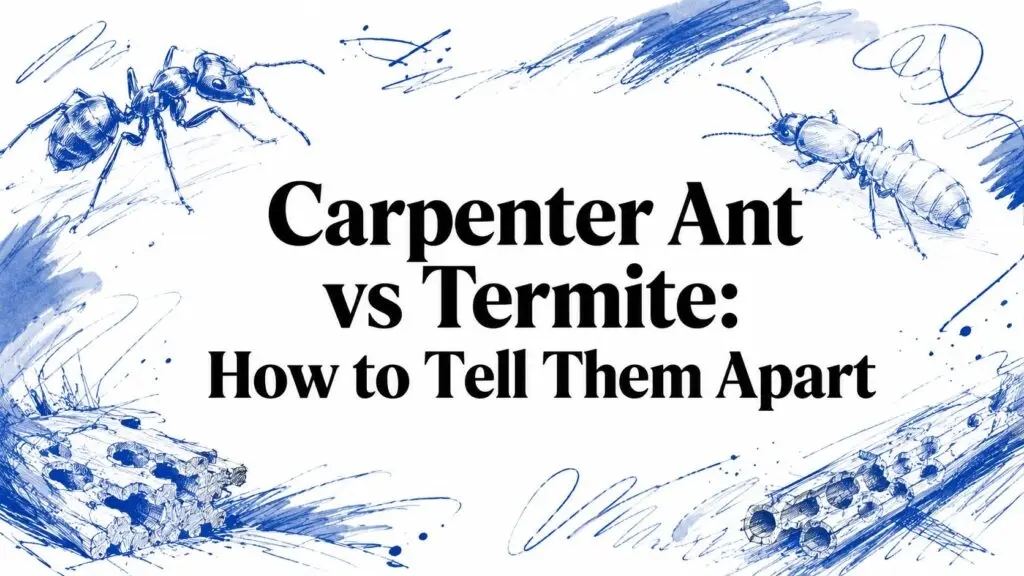
A small pile of gritty debris beside a Magnolia baseboard can trigger an expensive question: is a carpenter ant excavating a nest, or is a termite consuming the house? Pale winged insects near a window create the same worry, especially after a warm spring rain. The insect matters, but the more useful question is what kind of wood damage and moisture condition you're looking at. In Montgomery County homes, common discoveries include shed swarmers by a back door, fibrous frass below a bathroom baseboard, or a soft spot in a porch beam. A reliable diagnosis combines body shape, antennae, wing pattern, gallery construction, and debris, then connects those clues to the wood's location and moisture history. What a Homeowner in Magnolia Just Found A homeowner may notice the problem while sweeping the garage, checking a back porch, or opening a bathroom cabinet. The debris might look like coarse sawdust. The insects might be dark, pale, winged, or already dead on the windowsill. From a standing position, those clues can feel interchangeable, but they point to different service decisions. Carpenter ants and termites are often confused because both can appear around wood and both produce winged reproductive insects. Their biology, however, is different. Carpenter ants excavate wood to create nesting galleries, while termites consume cellulose in wood as food, a distinction documented by University of California Integrated Pest Management guidance on carpenter ants. A porch beam that feels soft may reflect moisture damage before any insect arrived. A bathroom baseboard with frass may indicate a nest in damp framing. Shed wings near a door may show a swarm event, but the wings alone won't tell you whether the colony is inside the structure, below the slab, or outside and attracted to light. Practical rule: Treat the insect as a clue, not the entire diagnosis. The wood condition often explains why the pest is present and what must change for control to last. Start with the three visible clues Body structure: Carpenter ants have a narrow, pinched waist. Termites have a thicker body without that constriction. Antennae: Carpenter ant antennae are elbowed. Termite antennae are straight. Wings and debris: Ant swarmers have unequal wing lengths, while termite swarmers have two pairs that are about equal. Fibrous frass favors carpenter ants, while mud tubes and packed galleries favor subterranean termites. A photograph can help narrow the possibilities, but it has limits. A crushed insect may hide the waist. A close-up may omit the wings, antennae, foundation, or moisture source that makes the difference. If the finding involves structural wood, preserve the evidence and arrange an inspection instead of relying on a quick visual guess. Two Wood Pests, Two Very Different Habits Carpenter ants are wood-nesting insects, not wood-eating insects. They excavate galleries in damp, softened, or decaying wood, often using a moisture-compromised joist, window header, soffit, porch component, tree, stump, or fence post as a nesting site. Their galleries are usually smooth and clean, and the colony pushes fibrous material out through small openings. Termites use wood differently. Subterranean termites maintain a soil-connected colony and travel through protected mud tubes to reach structural timber. They consume cellulose and commonly hollow wood along the grain, which can leave serious thinning behind surfaces that still look intact. The University of Massachusetts comparison of termite and carpenter ant control describes this difference in both feeding behavior and gallery pattern. Trait Carpenter Ant Subterranean Termite Relationship with wood Excavates wood for nesting Consumes cellulose as food Typical gallery appearance Smooth, clean galleries, often across the grain Grain-following damage, often packed or lined with mud Moisture relationship Strongly associated with damp or decayed wood Relies on moist soil and protected humidity Common evidence Coarse, fibrous frass near kick-out holes Mud tubes, hollowed wood, or packed galleries Body structure Pinched waist and elbowed antennae Thick body and straight antennae Winged forms Front wings longer than hind wings Two wing pairs about equal in length Why the nesting location matters A carpenter ant colony can occupy a moisture-damaged section of framing, while additional satellite nests may occur outdoors in trees, stumps, or fence posts. The visible ants may be foraging from a nest that isn't directly behind the baseboard. Subterranean termites usually depend on a route between soil and wood. Foundation edges, crawl spaces, plumbing penetrations, porch connections, and other concealed transitions deserve attention because the colony may remain underground while workers feed inside the structure. Drywood termites also occur in Texas coastal areas, but inland Southeast Texas homes more often require careful evaluation for subterranean activity and moisture-conducive conditions. The important distinction isn't colony size. It's whether the insect is using the wood as shelter or as a continuing food supply. That biology explains the practical severity gap. Carpenter ants can create extensive tunnel networks, but their excavation is closely tied to nesting behavior and pre-existing wood deterioration. Termites can continue consuming sound cellulose, which raises a more direct concern about ongoing structural loss. Maryland's pest guidance on termites and ants also emphasizes that carpenter ants may signal hidden moisture intrusion rather than represent an isolated insect problem. Reading the Body, Wings, and Antennae Most homeowners don't find termite workers or carpenter ant workers during a swarm event. They find winged reproductives, shed wings, or a few dead insects near a window. That makes three physical checks especially useful. Check the waist first A carpenter ant has a distinct, narrow waist between the thorax and abdomen. It looks segmented and pinched, similar to the body plan people associate with ants. A termite has a broad, more uniform body with no obvious constriction. Don't judge by color alone. Both groups can include dark or pale reproductive forms, and size can overlap. The waist is more dependable than a quick impression from across the room. Inspect the antennae Carpenter ant antennae are elbowed, with a visible bend near the head. Termite antennae are straight and bead-like. If the insect is intact, this feature can separate the two even when lighting
Argentine Ant Control: A Complete Guide for Southeast Texas

You clean the kitchen counter at night, wipe away every crumb, and spray the ants marching beside the sink. By morning, the trail is back. A few days later, there are even more ants along the baseboard, around the pet bowl, or crossing the laundry room floor. That pattern is common in Argentine ant control, especially around Magnolia and nearby Southeast Texas communities. The ants inside your home are often only a small part of a much larger colony network outside. A lasting solution depends on finding entry points, protecting bait trails, reducing moisture, and addressing reinvasion from surrounding properties instead of treating visible workers alone. Why Argentine Ants Are Different From Other Ant Species Argentine ants are easy to underestimate. Workers are small, dark brown, and fairly uniform in size, and they usually move in organized trails. They don't look as imposing as fire ants or as destructive as carpenter ants, but their colony structure makes them unusually persistent inside homes. Argentine ants can belong to large, interconnected colonies with multiple queens. Neighboring colonies may cooperate rather than fight, creating what pest professionals often call a supercolony. USDA-linked guidance describes these colonies as capable of spreading through broad connected areas, which is why identifying the different ant species found in Texas matters before choosing a treatment. Why a quick spray rarely solves the problem A contact spray can kill the ants you see. It usually doesn't reach queens, brood, or the connected nesting sites producing new workers. If the product repels ants or disrupts one trail, surviving workers may just use another route through the wall, under a slab, across landscaping, or through a utility opening. That creates a frustrating cycle. The visible activity drops, the homeowner assumes the problem is over, and then a new trail appears after the colony finds another food or water source. Partial treatment has long been associated with fairly rapid reinfestation because residual liquids, granules, or baits are often applied to only part of the colony, as described in the annual review of Argentine ant management. Practical rule: Kill fewer ants immediately if that allows more workers to carry bait back to the colony. Argentine ants also respond differently to food availability than many people expect. A trail may be driven by sugar residue one week and moisture or protein needs later. That behavior makes bait acceptance, placement, and timing more important than choosing the strongest-smelling product on the shelf. The right question isn't, “How do I kill these ants?” It's, “How do I move a properly selected treatment through the colony while preventing new workers from entering?” Understanding Colony Structure and Reinfestation Patterns A Magnolia property is rarely a sealed island. Argentine ants may nest in damp soil beside the foundation, under concrete, inside wall voids, beneath mulch or pavers, and around irrigation features. Workers can move between connected yards, fences, landscaping, and utility openings, so activity on one lot may be supplied from several nearby locations. That changes the treatment plan. Guidance from New Zealand warns of a high risk of reinvasion within a month after baiting when nearby colonies remain untreated. It recommends treating neighboring properties and street frontages together through coordinated boundary control guidance. A treatment can reduce activity on your lot and still fail across the surrounding block. What the trails tell you Track ant movement at different times of day. A trail beginning at a patio edge and disappearing beneath siding suggests outside pressure. Ants emerging from a wall outlet, cabinet seam, or plumbing opening point to an interior route or concealed void. Trails that return after cleaning usually mean the colony still has access to moisture or a protected travel path. Southeast Texas conditions keep those routes active. Humid weather supports foraging around damp soil, mulch, irrigation lines, and shaded foundation edges. Activity often becomes more noticeable during spring and fall. Winter may slow movement without ending it, while hot, dry periods can drive workers toward indoor water sources such as sinks, condensation, pet bowls, and laundry areas. Why the block may be the actual treatment unit Researchers and pest technicians measure success in different ways, but the field pattern is consistent. Broad, carefully targeted treatment performs better than a narrow application aimed only at visible trails. Residential testing summarized by the University of California found that a perimeter spray combined with broadcast granules produced a 93% reduction in ant activity after 8 weeks. A sweet-water bait containing 0.001% imidacloprid produced about an 80% reduction for one month. The results appear in the University of California management review. Fast reinvasion after a strong initial reduction calls for a boundary check. Inspect the property line, shared fence, street trees, neighboring mulch beds, and irrigation zones. One untreated yard can continue supplying workers to treated homes. Speak with neighbors before treatment. Compare trail locations, identify shared pressure points, and schedule work close together when several properties are connected by the same ant routes. For Magnolia and nearby communities, coordinated neighborhood action often determines whether a treatment lasts. Complete Inspection Checklist for Southeast Texas Homes Treatment should begin with a map, not a spray bottle. Walk the outside of the home first, then inspect the rooms where ants appear. Mark every trail, moisture source, structural gap, and exterior feature that could support movement. Magnolia homes vary in construction and landscaping, but Argentine ants repeatedly exploit the same practical routes. A brick veneer may offer access around weep holes. A slab foundation may have cracks or joints that connect to damp soil. Irrigation systems, mulch, shaded beds, and utility penetrations can all provide protected travel lanes. Exterior inspection checklist Use this list with a phone camera, flashlight, painter's tape, and a notepad: Foundation edges: Check cracks, expansion joints, slab gaps, and areas where soil touches the structure. Brick veneer: Inspect weep holes, mortar gaps, and transitions around doors and windows. Utility penetrations: Look around pipes, electrical conduits, cable entries, hose bibs, and air-conditioning lines. Mulch and plant beds: Pull
How to Get Rid of Fleas in House: Complete Elimination Guide
You hear scratching in the middle of the night, then you spot a flea on the dog, and the whole house suddenly feels like it's crawling. Most homeowners go straight after the pet and spray whatever's on the shelf, then wonder why the bites keep coming back a week later. The problem is usually bigger than the animal, and the fix has to be bigger too. If you're dealing with how to get rid of fleas in house, start by assuming the visible flea is only the small part you can see. The bulk of the work is in the carpets, bedding, couch seams, floor gaps, and the pet areas where fleas keep rebuilding. In Magnolia, Texas, and across nearby Southeast Texas, that matters even more because warm conditions can keep flea pressure going long after a homeowner thinks the problem should be over. Why Fleas Are Harder to Eliminate Than You Think A lot of people think the infestation lives on the dog or cat. That's the trap. In reality, the pet is often just the moving vehicle, while the home is where the population is growing, hiding, and maturing out of sight. The hidden part of the infestation The RSPCA says about 95% of flea eggs, larvae, and pupae live in the environment. Washington State University Extension breaks the home population down as about 50% eggs, 35% larvae, 10% pupae, and only 5% adults. That means the fleas you see are the smallest part of the problem, not the main one. The eggs drop into carpet fibers, the larvae move deeper into fabric and dust, and the pupae wait for the right conditions before emerging. Practical rule: if you only kill adult fleas on the pet, you've treated the symptom, not the source. That's why one spray rarely solves the issue. Even a good pet product can knock back the adults on the animal, but the hidden immature stages in the room can keep developing. One female flea can lay up to 50 eggs in a day and about 1,500 eggs in a lifetime, so a small surviving population can rebuild fast after cleaning if the rest of the house is ignored. What that means in a real home I've seen homeowners treat the dog, wipe down the floor once, and call it done. A week later, they're back where they started, because the remaining eggs and pupae kept the cycle alive. That's why flea removal has to be a whole-home, multi-stage process, not a one-time knockdown. The visible adults matter, but the environment matters more. Carpets, bedding, upholstery, pet rests, and even small cracks along baseboards are where the work really happens. Once you accept that, the plan gets clearer and a lot less frustrating. The goal is to interrupt every stage at once, not just chase the fleas that jump. Treating Your Pets to Stop the Source Treating the pet still matters, because fleas often ride in on dogs and cats. The problem is that pet treatment by itself does not finish the job. If the house stays untreated, carpets, bedding, and furniture keep feeding the next wave. What to use and how to use it Veterinarian-recommended topical spot-on products can work well in many homes, especially when they are applied exactly as directed. Oral medications are another option, and they help when you need fast adult knockdown on the animal. Flea collars can help in some cases, but they do not solve an established home infestation. Medicated shampoos can give a quick clean-up, especially if a pet is covered in live fleas, but the effect is temporary unless the rest of the environment is treated too. Treat all pets in the household at the same time. Missing one cat or dog lets the infestation keep moving from room to room. In a multi-pet home, one untreated animal can undo the work on the others. Product choice matters less than correct use and species safety. Dogs and cats do not always use the same flea products safely, and small mammals need extra caution. Keep pets separated if a topical product needs time to dry, and do not stack multiple flea products without veterinary guidance. Pets can keep scratching after treatment even when the live fleas are gone. Sometimes that comes from lingering flea allergy dermatitis, not from a failed treatment. If the skin stays irritated after the fleas are under control, the pet may need veterinary care. For a practical walk-through on product use and timing, use this guide on treating fleas on dogs. If your dog is already stressed from itching, diet changes, or medication, some owners also look into dog probiotics as a supportive resource, but that does not replace flea control. What homeowners often miss Many homeowners overlook that treating pets alone leads to reinfestation from environmental reservoirs. Once treatment starts on the animal, the house has to be cleaned hard and repeatedly. Otherwise, the pet gets reinfested from the room, the couch, or the bedding. Deep Cleaning and Indoor Treatment Protocol This is the stage that decides whether the infestation fades out or keeps cycling through the house. Adult fleas are the part you see, but most of the population is hidden in carpet, bedding, cracks, and upholstered furniture. EPA guidance says vacuuming is the best initial control method for an infestation, and that makes sense because it removes eggs, larvae, and debris before they can keep the cycle going. Start with the surfaces fleas use Vacuum floors, cracks, crevices, furniture, and pet-resting areas every day during the active cleanup period, then dispose of the vacuum contents immediately. Texas A&M AgriLife Extension specifically says to vacuum under furniture, cushions, chairs, beds, and along walls when controlling fleas. In real homes, that means carpet edges, baseboards, sofa seams, and bed frames matter more than the open center of the room. Steam cleaning adds another layer. EPA guidance says steam cleaning can kill fleas in all life stages on carpets and upholstery when
Flea Pest Control: A Complete Guide for SE Texas Homes

You can vacuum until your back aches and still find fleas hopping on the dog two days later. That's the part that frustrates Magnolia homeowners the most, especially in Southeast Texas where warm, humid weather keeps flea pressure active longer than people expect. The problem usually isn't that nothing worked, it's that the treatment didn't hit the pet, the indoor hiding spots, and the outdoor harborages at the same time. Flea pest control works best when you treat it like a synchronized job, not a one-and-done spray. The house, the animal, and the yard all have to be pushed through the same timeline, or the life cycle resets. That's why timing matters more than the brand name on the bottle. Why Fleas Keep Coming Back After Treatment A family in Magnolia can do everything “right” on a Saturday, spray the floors, clean the bedding, even treat the dog, then see fresh fleas again by Tuesday. That usually feels like failure, but it's often the pupal stage doing what it does best. The protective cocoon shields the insect until conditions are right, so the problem can look finished before it really is. The part most homeowners never see Fleas don't live only on the pet. Eggs fall into carpet, furniture seams, baseboards, and pet bedding, then larvae feed and develop out of sight. When a treatment hits carpets and upholstery, it may stop larvae, but it doesn't kill pupae, so fleas can keep emerging for up to 2 weeks after treatment according to UC IPM's flea guidance. That delay is why people think the treatment failed when it didn't. The job may have knocked down the active stages, but the hidden reserve keeps hatching. If the pet wasn't treated at the same time, those emerging adults have a host waiting. Practical rule: if fleas “come back,” assume the cycle was interrupted, not destroyed. What keeps the cycle alive A single indoor spray misses the point if the dog or cat is still carrying fleas. The same is true in reverse, a pet-only treatment leaves the carpets, couches, and shaded yard spots untouched. For a cleaner visual on the warning signs that show up before a full blowout, the FullScope flea infestation signs guide is worth keeping handy. The reason recurring cases feel so stubborn is simple. Flea pest control is about synchronized pressure on the pest at every stage, not a quick kill on the adults you can see. When that timing slips, the pupae get a second chance, and homeowners see exactly what they thought they'd already eliminated. Inspecting Your Home and Pets for Flea Activity Start with the animal. Use a flea comb over the neck, back, belly, and tail base, then check the comb over a white paper towel so dark specks stand out. If those specks smear reddish-brown when dampened, that's a strong sign of flea dirt rather than ordinary dust. Check the places fleas actually prefer Inside the home, look where the pet spends the most time, not just where you happen to walk. Carpets, couch cushions, pet beds, and soft crevices hold more risk than bare tile. The Montgomery County Vector Control District notes that homeowners may need to vacuum carpets, rugs, cushions, upholstered furnishings, and all crevices repeatedly for days or weeks until the infestation is gone. A quick white-sock walk across carpeted rooms can help expose adult fleas. They're small, but if they're active, you'll often notice movement near rest areas, baseboards, and the edges of furniture. Outdoor checks matter too, especially under decks, beside kennels, around doghouses, and in shaded turf where pets linger. Pet bedding: Pull it up first, because eggs and larvae collect fast here. Resting spots: Focus on couches, chair corners, and the exact patch of carpet the animal prefers. Outdoor harborages: Look at shaded areas near walls, kennel runs, and spots with minimal sun exposure. High-traffic crevices: Baseboards, floor gaps, and under furniture can hold fleas even when the center of the room looks clean. If you're washing bedding during inspection week, a guide to clean dog bedding can help you choose washable options that make routine maintenance easier. Match the inspection to the treatment plan A light infestation may show up in just one or two pet resting areas. A heavier one spreads into multiple rooms, upholstery, and outdoor pet zones. That's the practical dividing line, if fleas are concentrated, treatment can be targeted, but if you're seeing them in several rooms, the whole environment needs attention. For a tighter homeowner checklist, the FullScope treatment checklist is useful before any product goes down. The point of inspection is not just to confirm fleas are present. It's to find the exact locations that will keep feeding the infestation if you miss them. Executing a Same-Day Treatment Sequence The strongest flea control jobs don't drift across several days. They start the same day on the pet, move through the house, and finish with the outdoor zones where the pet spends time. That coordinated sequence is what keeps adults from bouncing back before the environment has been reset. Start with the pet, then move to the room The pet comes first because every untreated host can repopulate the room. Use veterinarian-recommended products suited to the species, since cats and dogs don't always respond safely to the same ingredients. Public-health guidance from the European Centre for Disease Prevention and Control says control should include periodic ectoparasiticide treatment on pets along with cleaning the pet environment. After that, vacuum all pet-visited areas thoroughly. University extension guidance says to treat pets, vacuum pet-visited areas, exclude other hosts where possible, and treat indoors and outdoors in one coordinated sequence, all on the same day according to UAEX flea management guidance. That same-day timing matters because fleas don't stay neatly in one stage or one location. Treat the animal, then the rooms, then the outdoor harborages. If that order gets scrambled, the cycle survives. Use the right product logic, not just the strongest spray