1500+ reviews

You hear light scratching behind the bedroom wall after dark. It stops when you turn on the light, then starts again near an outlet, a plumbing line, or the baseboard. The obvious question is, how do mice get into walls when the opening is almost impossible to see?
In Southeast Texas homes, the answer usually involves a small exterior gap connected to a much larger interior route. A mouse may enter around a utility penetration, move through insulation between studs, and reach kitchens, cabinets, attics, or crawl spaces without crossing an open room. Traps can remove the animal you notice, but lasting control depends on finding the building failure that allowed access.
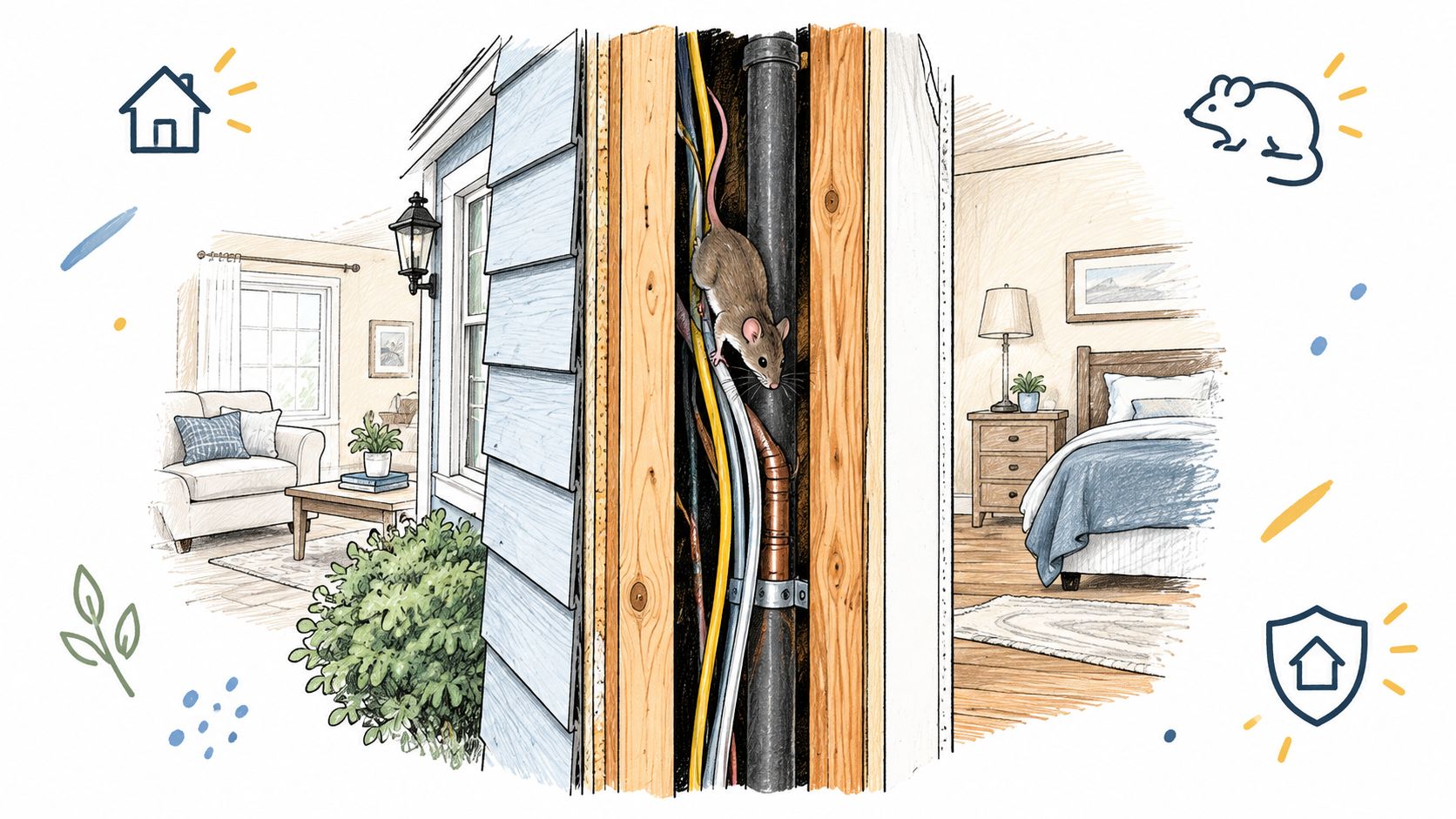
Why Wall Voids Are the Ultimate Mouse Highway
A wall cavity is not just a quiet place for a mouse to sleep. It can function as a protected travel corridor, with insulation, darkness, and framing that help rodents move through the house while staying out of sight. The same void may connect an exterior penetration with a kitchen wall, ceiling space, attic, or plumbing chase.
That explains the familiar pattern. You hear quick scratching near the bedroom at night, find droppings under the kitchen sink, and assume you have two unrelated problems. Often, those signs belong to one hidden route. The mouse entered near the outside wall, followed the edge of the cavity, and emerged wherever food, water, or shelter was available.
Why trapping alone often disappoints
A trap in the garage or attic can catch an individual mouse, but it doesn't close the route behind it. If the exterior gap remains open, another mouse can use the same passage. The wall then continues to serve as a sheltered highway, even after the noise temporarily stops.
Practical rule: Treat scratching in a wall as evidence of a route, not proof of a single animal.
Wall activity also changes how an inspection should be approached. A technician shouldn't focus only on the room where you hear noise. The search needs to follow the building envelope, including the roofline, service penetrations, exterior wall junctions, foundation, crawl space, and interior openings around pipes and wires.
The important shift is from “Where is the mouse hiding?” to “Which connected opening lets mice move through this structure?” Once that question guides the inspection, the repair plan becomes more durable and more specific.
The Quarter-Inch Rule and Common Entry Points
The house mouse can fit through a hole about the width of a pencil, roughly 1/4 inch or 6 millimeters in diameter, according to the U.S. CDC guidance summarized by University of Nebraska–Lincoln Extension. The Nebraska guidance gives the same practical threshold for mice and notes that rats need only slightly more than 1/2 inch, making a seemingly insignificant gap a realistic mouse entrance.
The reason is anatomical. A mouse's skull is the limiting structure, while the rest of its body can compress and flatten through a narrow opening. A gap doesn't need to look like a doorway to a homeowner. If it reaches a connected void, it can provide full access to the wall.
Prioritize the junctions, not just visible cracks
The highest-value inspection points are where one material meets another or where a service passes through the enclosure:
- Utility penetrations: Check around electrical cables, plumbing pipes, HVAC lines, gas lines, and air-conditioning connections. A deteriorated seal around one pipe can open directly into a wall cavity.
- Soffit-to-wall transitions: Look for separation, warped panels, and damaged screening where the soffit meets brick, siding, or another exterior surface.
- Foundation interfaces: Inspect the joint where siding, brick veneer, or framing meets the foundation. Settling and weathering can turn a narrow seam into an access route.
- Weep vents and ventilation grilles: Brick facades and crawl spaces may contain openings that need proper rodent-resistant screening rather than improvised filler.
- Doors, windows, and siding: Examine worn weatherstripping, corner joints, deteriorating siding, and gaps around frames.
- Roof and chimney penetrations: Roof vents, chimney pipes, and damaged soffits can give climbing mice access above the wall line, where they can descend into cavities.
Humid, storm-prone weather adds pressure to these weak points. Sealants age, siding transitions shift, and construction joints can open as materials move or weather. The practical standard is simple: if a pencil can enter, the opening deserves attention. For a more detailed explanation of repair methods and rodent-proofing priorities, review this guide to sealing common rodent entry points.
How to Inspect Your Home for Hidden Access Routes
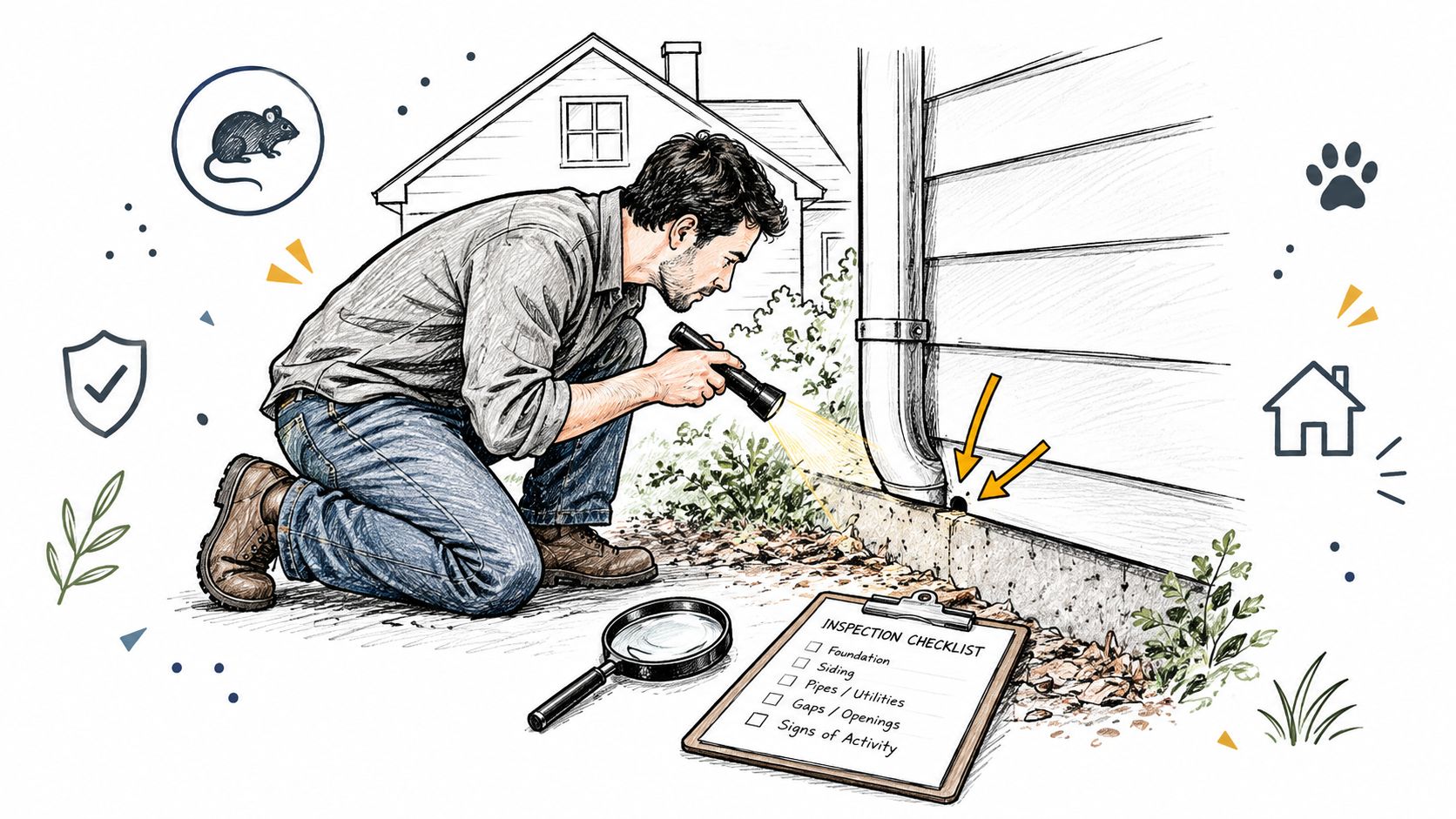
Start outside. An exterior inspection shows how a mouse reaches the wall before interior signs reveal where it travels. Walk the structure slowly from the roofline downward, using a flashlight and a small ruler or pencil as a practical size reference.
Follow a roof-to-foundation route
Check these areas in order:
- Roofline and soffits: Look for displaced screening, open seams, damaged vents, and gaps where soffits meet brick or siding. Mice can climb, so ground-level inspection alone misses important routes.
- Wall penetrations: Examine every pipe, wire, duct, outdoor spigot, dryer vent, and HVAC line. Pay attention to cracked sealant, loose collars, and openings hidden behind trim.
- Windows and doors: Inspect frames, thresholds, garage-door edges, and worn weatherstripping. Daylight or visible separation signals a repair need.
- Foundation and crawl space: Check foundation cracks, ventilation grills, crawl-space doors, weep vents, and the wall-to-slab junction inside a garage.
- Ground-level clutter: Move stored materials, dense vegetation, and debris away from the wall so the foundation line remains visible.
Look for chewed edges, grease marks, disturbed insulation, droppings, and nesting material. A gap with fresh rub marks matters more than a larger opening with no evidence, because repeated contact helps identify an active route.
Check the matching interior locations
Inside, inspect under kitchen sinks, behind appliances, around baseboards, inside cabinets, and wherever plumbing or wiring enters the wall. Don't limit the search to the room where you hear scratching. The entry point may be outside, while the visible evidence appears near food or water.
Detached structures need the same attention. If you're securing a shed or outbuilding, guidance on a professional shed foundation from Firm Foundations can help you evaluate the structure-to-ground interface, a location homeowners often overlook.
Recognizing the Early Signs of Wall Activity
The mouse is hidden, but its route usually isn't completely invisible. Scratching, droppings, grease marks, gnawing, and odor form a pattern that can show whether a wall cavity is being used regularly.
Mice typically produce light, rapid scratching and short bursts of movement, often followed by silence. Noise near electrical outlets, plumbing chases, baseboards, or ceiling edges deserves attention because those locations frequently align with the framing and service paths mice use to move through a structure.
Read the signs as a route map
Don't treat one dropping or one sound as a complete diagnosis. Look for clusters and connections:
- Droppings near baseboards or cabinets: These can indicate where mice leave the wall to forage.
- Grease marks along edges: Faint dark smears may appear where a mouse's body repeatedly rubs against drywall, framing, pipes, or trim.
- Gnawing: Damaged food packaging, wood, insulation, or wiring can show that the animal is feeding or modifying its route.
- Musky odor: Enclosed wall spaces can develop an ammonia-like smell when urine accumulates.
- Disturbed insulation: Pulled or shredded material may indicate nesting rather than simple passage.
Heavier movement can point to a larger animal, such as a rat or squirrel, while insects may create a different, more continuous sound. Noise alone isn't enough to identify the pest, so physical evidence matters.
The location of the sign often tells you more than the sign itself. A trail near a pipe or baseboard can connect an exterior opening to an interior feeding area.
When several indicators appear along one wall, think enclosure failure, not an isolated visitor. The droppings show where the mouse emerged, the grease marks show the travel edge, and the scratching reveals activity inside the void. This route-based interpretation helps a professional choose trap locations and determine which exterior junctions need sealing. Use this reference on signs of a mouse and rodent infestation when comparing what you find.
Why Professional Exclusion Outlasts DIY Repairs
DIY materials can close a visible hole and still leave the building vulnerable. Steel wool may work as part of a small repair, but it can be displaced. Expanding foam can fill a void without creating a durable rodent-resistant barrier, and ordinary caulk may crack, shrink, or separate as heat, humidity, and building movement affect the joint.
That doesn't make every homeowner repair useless. Cleaning the area, removing old debris, and temporarily blocking a clearly identified gap can reduce access while a full plan is arranged. The problem starts when a single patch is mistaken for exclusion.
The repair has to match the opening
A durable repair considers the size, location, movement, moisture exposure, and pressure a gap receives. Depending on the site, a professional may use:
- Copper mesh: Useful around smaller penetrations when installed tightly and finished with a compatible sealant.
- Heavy-gauge hardware cloth: Appropriate for vents and larger openings that need physical screening.
- Commercial-grade sealants: Better suited to exterior joints than interior filler alone.
- Metal flashing or fitted panels: Helpful where siding, foundation, roof, or utility interfaces have substantial separation.
- Door sweeps and weatherstripping: Necessary at movable openings where a rigid patch cannot function.
The trade-off is straightforward. DIY work costs less upfront, but it requires complete visibility of the route and periodic inspection. Professional exclusion takes more planning because the technician must trace activity, select suitable materials, and repair multiple junctions instead of plugging the first hole found.
Integrated pest management also combines exclusion with trapping, sanitation guidance, and monitoring. That approach addresses the animals already inside while reducing the chance that new mice will enter through a different weakness. For a clear comparison of treatment and structural prevention, see rodent extermination versus rodent exclusion. Similar structural thinking applies to pest exclusion for hunting cabins, especially in buildings that sit near vegetation or have exposed foundations.
Securing Your Property with Local Pest Experts
If you hear recurring wall activity or find signs in more than one location, start by documenting the pattern. Note the room, time, wall position, nearby outlets or pipes, and any droppings or gnawing. Avoid opening drywall before the route is understood, because the entry point is often outside the room where the noise is loudest.
A thorough inspection should cover:
- Exterior enclosure: Roofline, soffits, siding, brick joints, vents, foundation, doors, windows, crawl spaces, and utility penetrations.
- Interior evidence: Baseboards, cabinets, plumbing chases, attic edges, garage walls, and areas near food or water.
- Control plan: Targeted trapping or other appropriate measures for mice already inside.
- Exclusion work: Rodent-resistant repairs matched to each opening and its exposure.
- Follow-up monitoring: Rechecking repaired locations and adjusting control when fresh signs appear.
Magnolia is in southwest Montgomery County at the junction of FM 1774 and FM 1488, about 45 miles northwest of Houston and about 25 miles southwest of Conroe, as described in this Magnolia, Texas location overview. That makes Magnolia a practical reference point for north-Houston pest coverage, alongside Conroe, Kingwood, and nearby Montgomery County communities.
FullScope Pest Control is one local option for inspection, trapping, exclusion, and sanitation guidance, with service locations and coverage across communities including Magnolia-area destinations, Conroe, Kingwood, Porter, Montgomery, New Caney, Splendora, Spring, and Willis. Ask the provider to show you the suspected route, identify the materials used for each repair, and explain how follow-up will confirm that the wall cavity is no longer active.
If you're in Magnolia, Conroe, Kingwood, or a surrounding Southeast Texas community and hear scratching behind the drywall, schedule a structural rodent inspection rather than relying on a trap alone. Bring your notes and photos, ask for an exterior-to-interior entry-point assessment, and request a written plan covering trapping, exclusion, and monitoring so the repair addresses the mouse highway, not just the noise.