1500+ reviews


A preventive maintenance plan for pest control is recurring inspection, monitoring, targeted treatment, exclusion, and documentation designed to stop infestations before they take hold. In Magnolia, that discipline matters more as the city reports 147.4% population growth from 2020 to 2024, adding homes, yards, and commercial buildings where Gulf Coast heat, humidity, and rainfall can turn a small gap or standing-water spot into an active problem.
You're probably reading this after a familiar moment. Ants return to the kitchen a few weeks after a spray. You hear scratching in the attic at night. A tenant sends a photo of a roach and asks what you're going to do differently this time. A plan answers that question before the next sighting, not after it.
What a Preventive Maintenance Plan Actually Means for Pest Control
Preventive maintenance didn't start with pest control. It became a formal reliability discipline in the mid-20th century as organizations moved away from waiting for failure and toward scheduled inspection, servicing, and replacement, a shift traced in the reliability history covering the 1950 Department of Defense committee and its 1952 successor, AGREE. That same account notes the first national reliability symposium in 1954 and MIL-R-25717 in 1957, described as the first military specification for a reliability-assurance program.
The language sounds industrial, but the logic transfers directly to a house or small business. You identify where deterioration starts, you inspect on a set interval, and you intervene before a small defect becomes a costly failure.
What That Looks Like on a Magnolia Property
For pest work, deterioration isn't a worn bearing. It's a door sweep that no longer seals, mulch holding moisture against a slab, a torn vent screen, or irrigation overspray keeping a foundation damp. A preventive plan schedules people to look for those conditions, refresh barriers where needed, and record what changed.
- Inspection comes first: A technician maps entry points, harborage, food and water sources, and prior activity.
- Monitoring continues between treatments: Traps, termite stations, and visual checks show whether pressure is rising or falling.
- Intervention stays targeted: Treatment, exclusion, or sanitation work follows what the inspection found.
A subscription that only puts a truck in your driveway isn't prevention. Prevention is the documented loop that catches a conducive condition before pests use it.
Magnolia's growth makes that loop practical, not theoretical. New subdivisions add shared fence lines, fresh landscaping, construction debris, and builder-grade gaps around utility penetrations. Established properties add mature trees, stored items, and aging seals. Both create routes for termites, rodents, mosquitoes, and seasonal invaders, and both benefit from scheduled attention instead of waiting for visible damage.
Why Scheduled Service Beats Reactive Callouts
The clearest way to understand scheduled service is to compare the timing of the work. A reactive callout starts after you've seen the pest, the droppings, or the damage. A preventive visit starts earlier, while the problem is still a condition you can correct.
The stress of that late call is familiar to many homeowners, as shown below.

A 2022 peer-reviewed reliability study gives this idea a measurable example. Reliability at six time units rose from R(6) = 0.45963 before preventive maintenance to R(6) = 0.55756 after it was introduced, an improvement of approximately 21%, according to the Alba 26 machine reliability study. That research studied machinery, not pests, so don't treat the number as a pest-control promise. Treat it as evidence for the operating principle. Repeated inspection and timely correction reduce the chance that a developing fault becomes a disruptive failure.
Translating Reliability Into Pest Decisions
In a Magnolia kitchen, early monitoring can reveal German roach activity in a hinge or appliance void before reproduction spreads through cabinets. Along a slab edge, termite monitoring can flag activity while treatment remains focused. In an attic, fresh rodent sign found during a scheduled check leads to exclusion before insulation and wiring face extended exposure.
The short video below illustrates the broader scheduled-service mindset behind that timing advantage.
Scheduled work also changes what you can prove. You'll have dates, findings, products, locations treated, and follow-up notes. That record helps a homeowner budget predictably, helps a property manager answer a tenant complaint, and gives buyers and sellers clearer evidence during a transaction. Reactive service may solve today's sighting, but it rarely shows whether the underlying route, moisture source, or harborage still remains.
The IPM Foundation Behind Every Strong Plan
A strong pest preventive maintenance plan is built as an Integrated Pest Management, or IPM, control loop. It's not a promise to avoid products, and it's not a fixed calendar of sprays. The EPA specifically identifies monitoring, accurate identification, action thresholds, lower-risk control selection, and plan updates as core principles in its IPM principles guidance.
That sequence matters because the wrong identification leads to the wrong treatment. A few outdoor ants trailing to a tree don't carry the same meaning as German roaches breeding near a dishwasher. IPM forces the technician to name the pest, measure the pressure, and decide whether action is justified.
How the Five Principles Show Up During a Visit
Monitoring means checking traps, stations, droppings, mud tubes, webbing, standing water, and fresh damage. During a humid Magnolia summer, that includes shaded mosquito harborage and moisture-prone foundation areas. In cooler months, attention shifts more toward attic entry, stored-food pests, and rodents seeking shelter.
Accurate identification narrows the response. Roof rats use raised routes, while Norway rats more often pressure grade-level openings. Fire ants in turf need a different response from pharaoh ants indoors. You can see how those principles fit together in a practical overview of integrated pest management practices.
Action thresholds define when risk becomes unacceptable. A warehouse may tolerate a single outdoor sighting while staff correct a door gap. A daycare kitchen shouldn't apply the same tolerance to roach activity near food preparation. The threshold should reflect health risk, nuisance, damage potential, and the setting.
- Lower-risk control selection: Start with exclusion, sanitation, habitat change, traps, or targeted placement when they'll solve the pressure.
- Plan updates: Change frequency, treatment zones, or corrective work when monitoring shows conditions improving or worsening.
Field rule: If no one can explain what threshold triggered a treatment, you're probably buying application by habit, not IPM.
That final update step is where many plans either improve or stall. Records from one visit should shape the next one. If activity falls after sealing and sanitation, the plan can stay lean. If sightings continue, the technician should escalate inspection and correction instead of repeating the same perimeter routine.
Core Components Inside a Magnolia Pest Maintenance Plan
A complete plan turns IPM into tasks a technician can complete and a customer can verify. Six components do most of that work. If one is missing, you'll usually feel the gap. Treatment without exclusion invites reentry. Monitoring without documentation leaves no trend. Inspection without corrective action becomes a tour of problems nobody fixes.
Inspection Schedules and Monitoring
The baseline inspection should cover foundation vents, weep holes, door thresholds, garage corners, attic gaps, roof returns, AC line penetrations, plumbing entries, mulch lines, woodpiles, and food storage. Outside, the technician should note irrigation overspray, clogged gutters, dense vegetation against siding, and debris that shelters pests. Inside, kitchens, utility rooms, bathrooms, and storage areas deserve close attention because they combine water, warmth, and hiding places.
Monitoring then checks whether conditions are changing. Visual inspection still matters, but glue boards, rodent devices, and termite stations add evidence between visits. A homeowner can understand the value of that rhythm through the case for regular pest inspections for your home, especially when activity is hidden in wall voids or attic spaces.
Treatment, Sanitation, Exclusion, and Records
Targeted treatment should follow species and location. Barrier work may protect entry zones, baits may address specific indoor populations, and mosquito work may focus on shaded resting sites and breeding sources. The product choice matters less than placement, timing, and whether the technician corrects the condition supporting the pest.
Sanitation and habitat reduction remove the resources pests need. That can mean sealed food storage, corrected refuse, reduced standing water, trimmed vegetation, or better drainage. Physical exclusion closes the route with durable materials around pipes, vents, doors, and roof intersections.
Documentation ties the visit together. Your report should list findings, thresholds observed, products and locations treated, corrective actions, unresolved conditions, and follow-up results. Without those details, the next technician starts from memory instead of evidence.
Pest Maintenance Plan Components at a Glance
| Component | What It Covers | Magnolia Example | Plan Output |
|---|---|---|---|
| Inspection | Entry points, moisture, harborage, damage | AC penetration beside damp mulch | Baseline risk map |
| Monitoring | Traps, stations, fresh sign | Termite station near slab edge | Activity trend |
| Treatment | Targeted product or device placement | Kitchen baiting after identification | Treatment record |
| Sanitation | Food, water, refuse, habitat | Standing water in shaded yard items | Corrective checklist |
| Exclusion | Sealing doors, vents, pipes, roof gaps | Torn vent screen at attic access | Completed repair note |
| Documentation | Findings, actions, follow-up | Repeat sightings near utility room | Updated service plan |
Among local options, FullScope Pest Control offers recurring residential and commercial plans built around inspections, barrier treatments, and ongoing protection. Whichever provider you compare, ask to see a sample report and check whether it contains these six outputs in language you can act on.
Residential vs Commercial Cadence in Southeast Texas
A single-family home and a multi-tenant building don't carry the same pest risk, even when they're on the same Magnolia street. Homes usually center on kitchens, attics, yards, and slab edges. Commercial sites add shared walls, dumpsters, deliveries, employee food areas, tenant turnover, and documentation duties that may need to withstand outside review.
The comparison below shows how inspection frequency planning differs between those property types.
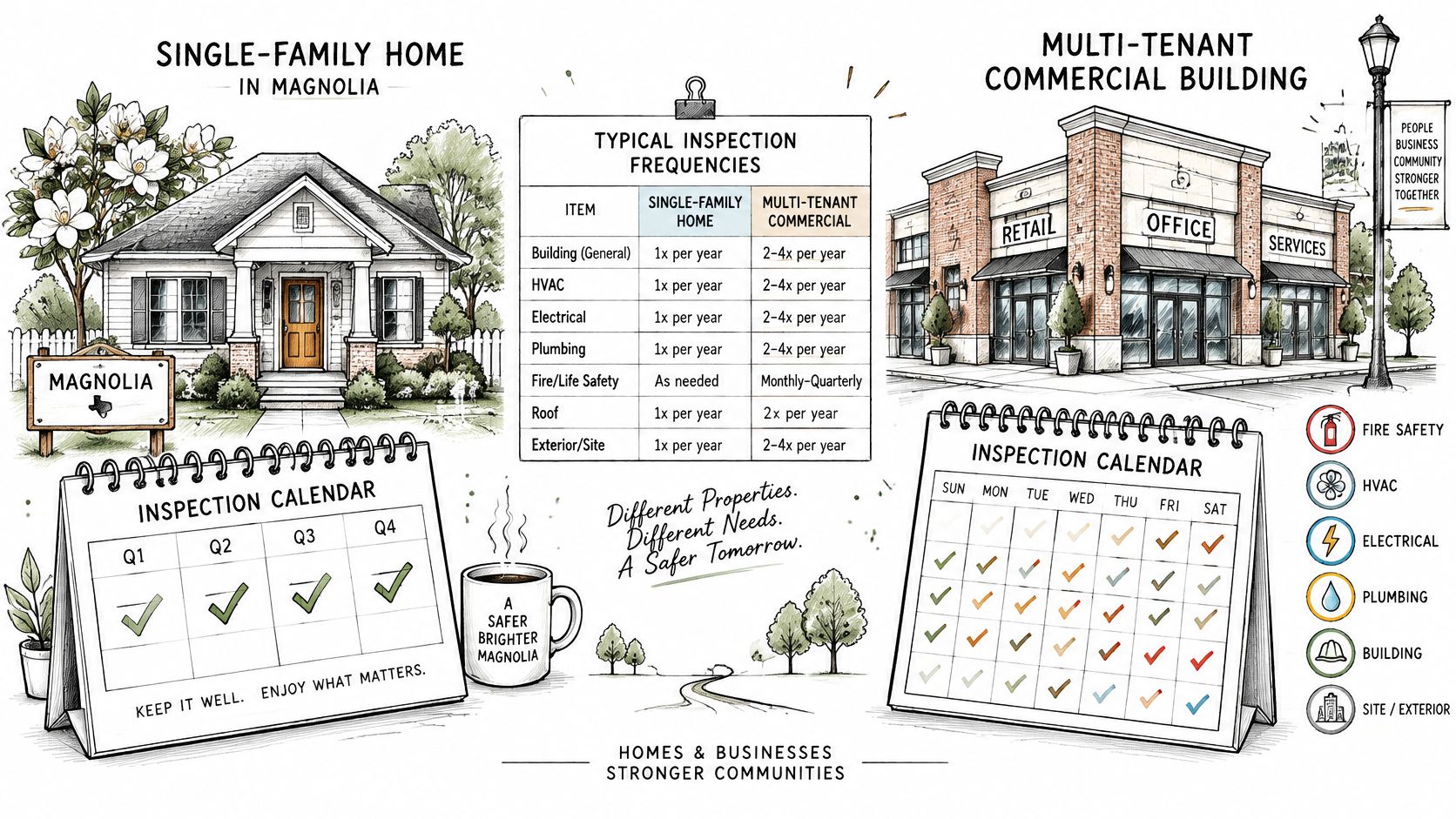
For many homes, a quarterly cadence with seasonal touchpoints gives technicians enough chances to refresh exterior protection, inspect the attic and foundation, and adjust for fire ants, mosquitoes, spiders, or occasional invaders. Biannual service may fit lower-pressure properties, but only if monitoring and homeowner reporting stay active between visits.
Commercial and multi-site programs often need higher-frequency checks because one unit, kitchen, or loading area can reseed the rest. That's why tailored pest control plans for commercial properties emphasize facility type, sanitation, and compliance rather than copying a residential route.
Rodent Numbers That Make Cadence Concrete
Rodent prevention shows why measurements belong in the plan. CDC guidance specifies openings smaller than 19 mm (3/4 inch) to exclude adult Norway rats, smaller than 13 mm (1/2 inch) for adult roof rats, and smaller than 6 mm (1/4 inch) for adult mice, according to the CDC integrated pest management manual. The same manual lists community benchmarks of no more than 2% of premises with active exterior rodent signs and no more than 15% with rodent entry or access routes near grade.
| Setting | Common Pressure | Typical Focus | Documentation Need |
|---|---|---|---|
| Single-family home | Fire ants, mosquitoes, roof rats, termites | Quarterly exterior and seasonal checks | Service report and homeowner actions |
| Small business | Roaches, flies, rodents, stored-food pests | Kitchens, storage, doors, refuse areas | Visit log and corrective actions |
| Multi-tenant property | Shared-wall roaches, rodents, recurring entry | Unit trends, common areas, exclusion | Auditable records by location |
Ask any provider for a simple template outline before you sign. It should name visit cadence, inspection zones, monitoring devices, threshold-based escalation, exclusion responsibilities, and who receives reports. If the outline only lists treatment dates, it doesn't yet describe a maintenance system.
Why More Visits Do Not Automatically Mean a Better Plan
More visits can help when pressure is high. They don't help when each visit repeats the same spray and ignores the last report. That execution gap appears in maintenance generally, not just pest control.
Survey data from 1,320 maintenance professionals found that 71% of organizations identify preventive maintenance as a strategy, yet fewer than 35% spend most of their maintenance time on it, and 58% still devote less than 40% of their time to planned work, according to the 2025 state of industrial maintenance survey. The setting is industrial, but the warning is familiar. Calling work preventive doesn't make the work planned, completed, or effective.
How to Tell a Visit From a Service
Here is the rewritten paragraph:
A visit produces a timestamp. A service produces evidence and decisions. Look for completed inspection zones, recurring sightings, entry points corrected, moisture or sanitation issues resolved, callback frequency, and time from alert to response. Those indicators show whether risk is falling.
- Preventive work: Seal a rodent opening, repair a door sweep, correct drainage, remove harborage, or change food storage.
- Corrective treatment: Apply a targeted product, trap active rodents, or treat an established roach population.
- Weak substitute: Spray the same perimeter again while the entry route and attractant remain unchanged.
Frequency creates opportunity. Execution creates prevention.
Magnolia's new construction makes this distinction easy to miss. A new subdivision can look tidy while irrigation overspray keeps siding wet, beds touch the foundation, and utility penetrations remain poorly sealed. A technician who only follows a route checklist may never flag those conditions. A technician working from a baseline and risk ranking knows exactly where to look, what changed, and when persistent activity should trigger a plan review.
When to Move From Calendar to Condition-Based Service
A calendar gives your plan a minimum rhythm. Conditions should decide when that rhythm changes. Heavy rain, construction next door, a new tenant, or a sudden run of sightings can alter pest pressure faster than a quarterly schedule can respond.
That shift is happening across maintenance fields. A 2025 report found that 44% of surveyed organizations had implemented or were piloting AI-powered maintenance, while another 21% were evaluating or planning such tools within the following year, according to the 2025 industrial maintenance report summary. For pest control, don't read that as a need to buy software first. Read it as movement away from fixed intervals and toward decisions triggered by observed risk.
A Simple Decision Matrix for Magnolia Properties
| Condition You Observe | Likely Risk Change | Plan Response |
|---|---|---|
| Heavy rainfall, humidity, or drainage failure | Moisture pests and mosquito breeding increase | Inspect drainage, remove standing water, shorten review interval |
| Recent construction or renovation | New gaps, debris, disturbed harborage | Reinspect penetrations and seal entry points |
| Vegetation touching the structure | Ants and roof rats gain bridge routes | Trim contact points and monitor elevated entries |
| Tenant turnover or sanitation change | Food, refuse, and stored items change | Reset baseline and inspect kitchens and storage |
| Prior termite evidence | Hidden activity may continue | Increase monitoring and inspect vulnerable zones |
| Sightings between visits | Threshold may be exceeded | Identify species, inspect source, escalate treatment |
Sensors, digital records, and automated alerts can help you prioritize. They can't seal a vent, correct a dumpster area, identify every species, or judge whether a threshold fits a daycare, warehouse, or home. Human inspection and interpretation still close the loop.
The practical model is hybrid. Keep a minimum preventive cadence so monitoring never goes dark. Then add condition-based inspections or treatments when evidence changes. That approach avoids two mistakes at once. You won't overservice a quiet property just because the calendar says so, and you won't wait months while a new condition turns into an established infestation.
Putting the Plan to Work in Magnolia and the Wider Trade Area
Specific geography matters when you're scheduling recurring service. Magnolia sits in southwestern Montgomery County at the junction of FM 1774 and FM 1488, approximately 45 miles northwest of Houston and 25 miles southwest of Conroe, with both Interstate 45 and U.S. 290 about 20 miles away, according to the Magnolia, Texas location overview. Those corridors give homeowners and facility managers a concrete way to judge whether an address fits a Magnolia route.
There's also an important distinction in the name. The Census Bureau recorded 2,359 residents in the April 1, 2020 census and a July 1, 2023 estimate of 5,320 for the incorporated city, as shown in Census QuickFacts for Magnolia city, Texas. The City of Magnolia separately describes a greater area extending approximately 12 miles in all directions with more than 138,000 residents in its Magnolia location and trade-area description. A provider should tell you which definition applies to your property, because it affects eligibility, routing, and how efficiently follow-up visits can be grouped.
The screenshot below shows the local provider presence behind this service-area discussion.

Your Proposal Checklist
- Baseline included: Does the plan start with species, entry points, moisture, harborage, and vulnerable zones?
- Thresholds defined: Can the provider explain what level of activity triggers escalation at your property type?
- Correction assigned: Who seals openings, fixes sanitation, trims vegetation, and verifies the result?
- Records usable: Will each report show findings, actions, unresolved conditions, and next steps?
- Cadence adjustable: Can weather, construction, turnover, or sightings change the interval?
Use that checklist for a home near FM 1488, a rental closer to Conroe, or a small business serving the wider trade area. You're not buying a date on a calendar. You're buying repeated chances to detect, correct, and document risk before pests gain a durable foothold.
Ready to replace reactive callouts with a documented preventive maintenance plan for your Magnolia home or business? Contact FullScope Pest Control to request a baseline inspection, review your property's entry points and moisture risks, and build a quarterly or condition-adjusted schedule you can verify after every visit.