1500+ reviews

You step outside after rain in Magnolia and spot a loose trail of reddish ants crossing the patio. A few are climbing the foundation, while another cluster seems to have appeared near the kitchen sink. Calling them “little red ants” feels reasonable, but color alone won't tell you whether you're dealing with a harmless nuisance, an indoor colony, or fire ants that can sting repeatedly.
In Southeast Texas, the first decision is identification. The right treatment depends on where the ants nest, how workers behave, whether they form soil mounds, and whether they vary in size. A spray aimed at the wrong species can waste time, contaminate surfaces, or scatter an indoor colony.
What Are Little Red Ants in Southeast Texas
A Magnolia homeowner may use “little red ants” for any small reddish insect found around the house. A technician sees a classification problem. The phrase can refer to unrelated ants, including red imported fire ants outdoors, pharaoh ants indoors, and other nuisance species that follow pavement edges or enter through foundation gaps.
That distinction matters because red imported fire ants, Solenopsis invicta, are common in eastern Texas, while pharaoh ants are much smaller, fairly uniform in size, and often establish colonies inside wall voids, electrical boxes, cardboard, or narrow spaces near plumbing. Texas A&M guidance warns that color isn't enough for identification, and very small ants may require microscopic examination to separate accurately. Texas A&M AgriLife's ant identification guidance is a useful reference before you choose a product.
Practical rule: Treat “little red ants” as a description, not a diagnosis.
Magnolia's setting creates several opportunities for ant activity. The community sits in southwest Montgomery County near FM 1774 and FM 1488, approximately 45 miles northwest of Houston and 25 miles southwest of Conroe. The broader Magnolia area extends approximately 12 miles in all directions, so a property near the city may experience different soil, drainage, landscaping, and development conditions from a home farther along those corridors. The City of Magnolia's location information provides those local geographic anchors.
A mound in sunny turf points toward a different problem from tiny ants emerging around an outlet. Workers that scatter aggressively after a mound is disturbed require a different response from a slow indoor trail. Start with the species and nesting location, then select control.
How to Identify Fire Ants Versus Nuisance Species
Red imported fire ants have several field clues that separate them from ordinary indoor nuisance ants. Their workers vary in size, roughly 1/16 to 3/16 inch, and their bodies include two waist nodes between the thorax and abdomen. A mound often has loose soil without a visible entrance hole because workers use underground tunnels. Disturbing it can produce a rapid, aggressive response, with workers climbing nearby surfaces and stinging repeatedly. These behaviors are most dependable when temperatures are approximately 55 to 95°F. Utah State University Extension's fire-ant identification guide explains these field indicators.
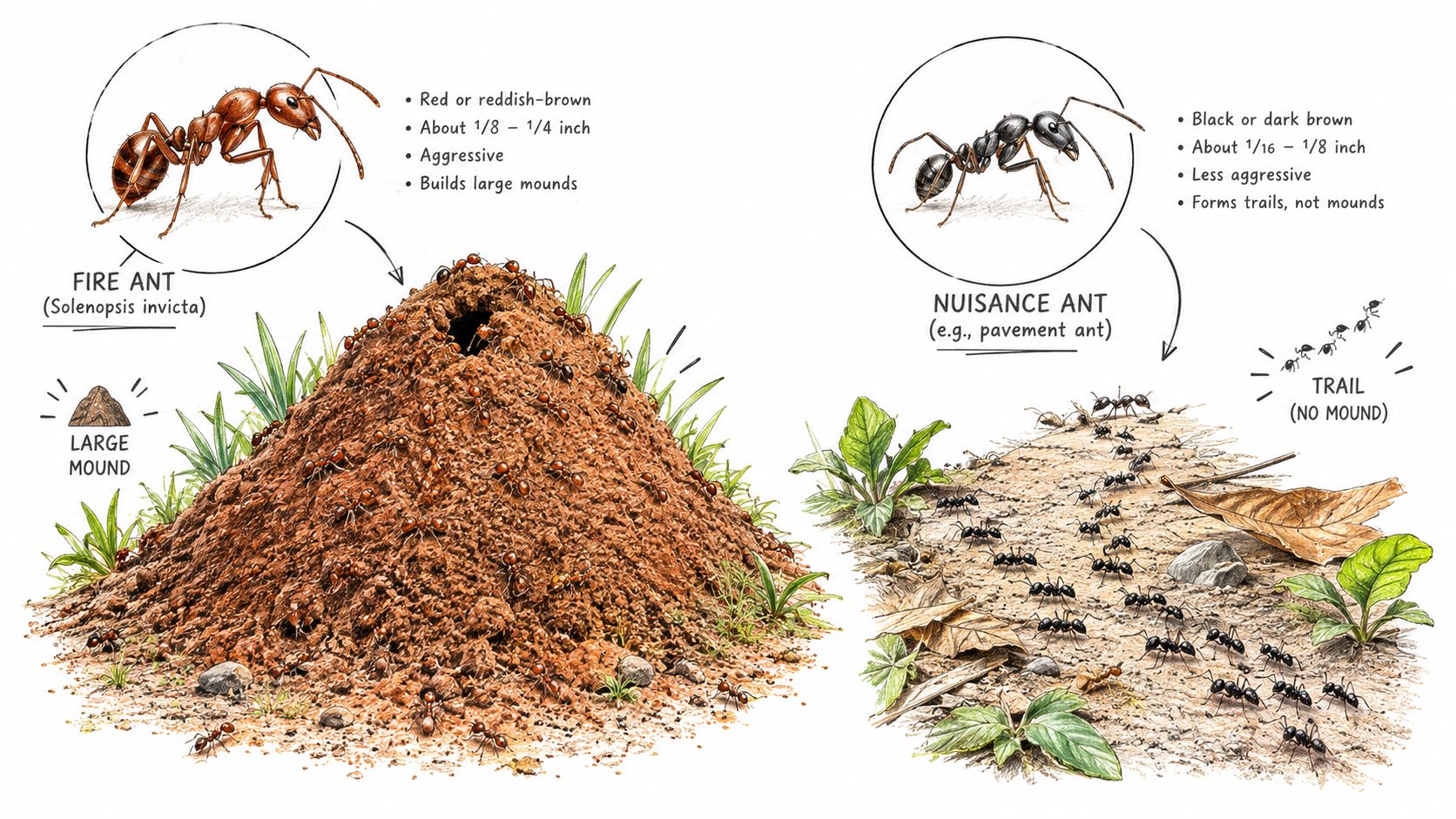
Read the body and the nest together
Pharaoh ants present a different pattern. Workers are very small, uniformly sized, yellowish-red, and commonly have a darker abdominal tip. They prefer protected indoor locations, including wall voids, electrical boxes, cardboard, and moisture-adjacent areas. A persistent trail around a sink or appliance, with no outdoor mound and no size variation among workers, deserves suspicion of an indoor nesting species.
Pavement and other nuisance ants may form long trails along concrete, foundation joints, or window edges. Their presence doesn't automatically indicate fire ants. Use a hand lens if you have one, but don't rely on a phone photograph alone when the ants are tiny.
| Field clue | More consistent with fire ants | More consistent with indoor nuisance ants |
|---|---|---|
| Worker appearance | Different worker sizes and two waist nodes | Often much smaller and more uniform |
| Nest evidence | Soil mound, usually without an open entrance | Wall voids, cabinets, outlets, plumbing areas, or trail edges |
| Disturbance response | Rapid climbing and repeated stinging | Trail disruption or retreat without a mound eruption |
| Main inspection area | Sunny lawn margins, pavement edges, tree bases, disturbed soil | Kitchens, bathrooms, utility penetrations, and wall voids |
For a broader comparison of fire ants, odorous house ants, carpenter ants, and pavement ants, review this field guide to common ant differences. If you're uncertain, collect a specimen without touching it directly and ask a county extension office or licensed inspector for identification.
Where to Find Ant Activity in Magnolia Properties
Inspection works best when you search for the colony, not just the ants crossing a countertop. Begin outdoors during a mild period when workers are active. Walk the sunny edges of the lawn, pavement margins, tree bases, patio stones, foundation perimeter, and areas where soil has been disturbed by irrigation, landscaping, or construction.
Fire-ant mounds may be subtle when the surface is dry or temperatures are unfavorable. Probe suspected soil cautiously with a long tool rather than your hand, then watch the response from a safe distance. A mound that produces rapidly climbing workers is more concerning than a quiet patch of loose soil.
Use rain as an inspection trigger
Heavy rain can force fire ants to raise or rebuild mounds, making activity easier to see. It can also push workers upward into vegetation or structures. A post-rain walk around the property often reveals fresh soil, relocated activity, and trails that were hidden during dry conditions.
Map what you find. Mark the approximate locations of mounds, trails, trees touched by branches, irrigation boxes, and foundation gaps. Then inspect indoors at the corresponding wall or entry points. This simple map helps distinguish a single outdoor colony from repeated entry along a perimeter.
Search moisture and shelter indoors
Pharaoh ants favor warm, dark crevices and moisture-adjacent spaces. Check beneath sinks, around plumbing penetrations, behind appliances, inside cabinet joints, near baseboards, around electrical boxes, and along cardboard storage. Don't flood these areas with repellent spray before you know what you're dealing with. A hidden indoor colony can continue producing workers even after the visible trail disappears.
Fire-ant activity also changes with temperature. Brood is strongly associated with mound temperatures of 25 to 30°C, or 77 to 86°F, and workers may move brood below ground once temperatures rise above 32°C. North Carolina State Extension's fire-ant guidance supports inspecting and baiting when workers are actively foraging, often during mild mornings or evenings in warm-season Texas.
Understanding the Risks and Dangers
The urgency depends on the ant, its location, and who uses the property. A few pavement ants following a foundation joint may be a nuisance. An active fire-ant mound beside a play area, walkway, or pet route presents a sting hazard, especially because disturbed workers can climb and sting repeatedly.
Fire-ant stings are painful. Anyone with a known severe allergy should follow their medical plan and seek urgent medical attention for concerning symptoms after a sting. Keep children and pets away from suspected mounds until identification and treatment are complete. Don't kick, flood, or probe a mound with an unprotected hand.
Indoor ants create a different risk profile. Pharaoh ants can establish hidden colonies in wall voids and moisture-adjacent spaces, so killing the workers you can see doesn't necessarily remove the source. Repeated trails around food-preparation areas can also create sanitation concerns, particularly when ants travel through wall cavities, utility penetrations, or contaminated spaces.
Compare the response, not just the appearance
| Situation | Main concern | Sensible priority |
|---|---|---|
| Isolated outdoor trail | Entry and food access | Locate the route and seal practical gaps |
| Active mound near people or pets | Repeated stings | Restrict access and arrange accurate treatment |
| Persistent trail from a wall or outlet | Hidden indoor colony | Avoid scattering the colony and investigate the void |
| Ants appearing after rain | Relocation or newly visible activity | Inspect the full perimeter and nearby vegetation |
The invasive little fire ant, Wasmannia auropunctata, is a separate species from the red imported fire ant. The IUCN Global Invasive Species Database associates it with reduced species diversity, lower abundance of flying and tree-dwelling insects, and impacts on wildlife in invaded areas. That distinction reinforces the central point: a common name shouldn't determine the treatment.
DIY Control Methods That Actually Work
The most common DIY mistake is spraying every visible worker. Contact sprays can produce an immediate visual result, but they often leave the colony, brood, and reproductive ants untouched. Repellent products may also disrupt trails and push indoor ants into new voids, making the source harder to find.
Baits work through a different pathway. Workers collect an attractive food source and carry it back to nestmates. A properly selected bait gives the colony time to distribute the active ingredient instead of killing only the ants exposed on the surface.
A practical DIY decision process
Identify before applying. Photograph the ants, note whether workers vary in size, and record the exact nesting location. If there's a mound, don't disturb it with your hand.
Choose the target. Outdoor fire-ant control generally calls for a labeled granular bait or mound treatment. Indoor trails require attention to food, water, entry points, and the possibility of hidden colonies. Follow the product label exactly.
Apply during active foraging. Fire-ant workers may be less visible during very hot afternoons or when soil temperatures fall below roughly 65 to 70°F or rise above 90°F. Bait discovery is more likely when workers are moving. North Carolina State Extension's timing guidance explains why weather affects treatment results.
Remove competing food. Wipe trails, store food in sealed containers, clean crumbs, repair leaks, and reduce standing moisture. Sanitation won't remove a colony by itself, but it makes bait and exclusion measures more useful.
Recheck instead of repeating sprays. If ants return, map the new trail and reassess the species. Don't keep applying different products without understanding why the first attempt failed.
For a product-by-product discussion of common ant killers, see this DIY ant-control guide. DIY treatment is reasonable for a clearly identified, limited outdoor problem when the label supports the application. Persistent indoor trails, multiple mounds, stinging incidents, or uncertain identification call for an inspection rather than escalating chemicals.
Why Professional Treatment Is Necessary for Tough Cases
Professional treatment earns its place when the colony is hidden, widespread, hazardous, or repeatedly returning. A licensed technician can inspect both sides of the problem, the visible workers and the conditions sustaining them. That includes nest locations, moisture, food sources, foundation gaps, vegetation contact, and activity that appears only after weather changes.
Established fire-ant activity often needs more than one visible mound sprayed in isolation. A technician may combine targeted mound treatment, broadcast baiting, perimeter work, and follow-up inspection according to the species and label requirements. The trade-off is cost and scheduling, but the alternative is repeated consumer applications that may kill surface workers without changing colony pressure.
Indoor pharaoh-ant problems require particular restraint. Repellent sprays can interfere with foraging and encourage movement into additional voids. A professional plan can emphasize non-repellent materials, bait placement, sanitation, moisture correction, and monitoring rather than treating every trail as a separate infestation.
FullScope Pest Control provides ant inspections that assess species, entry points, trails, and colony locations, followed by targeted baiting or non-repellent spraying where appropriate. Any provider you choose should explain the identification, treatment method, safety precautions, and follow-up plan in plain language.
Good treatment targets the colony and the conditions around it, not just the ants you can see.
Professional service also reduces guesswork around children, pets, gardens, and sensitive areas. Ask the technician what must be removed, how long treated areas should remain undisturbed, and which changes will prevent reinvasion.
When to Contact FullScope Pest Control
Use a tiered response. A single outdoor ant trail with no mound and no sting may justify observation, sanitation, and careful exclusion. A visible mound near a walkway deserves faster attention. Repeated indoor trails, ants emerging from outlets or wall joints, or activity that returns after baiting indicates a more complex problem.
Contact a licensed professional when:
- Mounds keep reappearing: Repeated outdoor activity suggests more than a one-time intrusion.
- People or pets are being stung: Restrict access first, especially around play areas and paths.
- Indoor trails survive DIY treatment: Hidden colonies or scattered activity may be involved.
- The species is unclear: Small reddish ants can't be identified reliably from color alone.
- Rain changes the pattern: Newly raised mounds or indoor activity after storms can reveal concealed colonies.
- Your property has multiple risk zones: Large lawns, irrigation, dense landscaping, wall voids, and food-service areas complicate treatment.
Magnolia service planning should account for the broader local market, not only the city boundary. The city is positioned near FM 1774 and FM 1488, while the surrounding area extends approximately 12 miles in all directions and includes nearby Montgomery County communities. Magnolia's official economic-development page supports using those corridors when describing service coverage. Montgomery County also lists its Magnolia branch at 19100 Unity Park Drive, Magnolia, Texas 77355, with weekday hours of Monday through Friday, 8:00 a.m. to 4:30 p.m. County office information is available here.
A technician should begin with identification, then inspect the property, document activity, and recommend the least disruptive effective treatment. That approach protects your home without assuming every “little red ant” is the same pest.

If you're in Magnolia, Conroe, Montgomery, or a nearby Southeast Texas community and the ants keep returning, contact FullScope Pest Control to arrange an inspection and receive a species-specific treatment plan.
Don't disturb an active mound or keep layering sprays over a persistent indoor trail. Photograph the ants if it can be done safely, note where and when activity appears, keep people and pets away from suspected fire ants, and request professional help when identification or control remains uncertain.
Call FullScope Pest Control today to schedule a Magnolia-area ant inspection. A technician can identify the species, locate outdoor or indoor colony sources, and recommend targeted control for your home, property, and surrounding service area.