1500+ reviews

Most homeowners hear “cockroach” and think useless, filthy pest. That advice is too broad. A cockroach in a forest and a cockroach crossing your kitchen counter may belong to the same ancient insect order, but they don't have the same role, habitat, or risk.
The purpose of cockroaches depends on where they live. Outdoors, wild roaches help process decaying organic matter. Indoors, urban roaches can carry environmental microbes into places where people prepare food and live. Respecting their ecological value doesn't mean tolerating an infestation inside your home.
Rethinking the Role of Cockroaches in Our World
Cockroaches aren't “bad.” They're highly adaptable insects that have survived major environmental changes by taking advantage of shelter, food, and moisture. That adaptability becomes useful in a forest, where a roach helps break down leaf litter, but unwelcome in a pantry, where the same feeding and traveling behavior creates a sanitation concern.
The most important distinction is wild roach versus indoor pest. Many cockroaches live under bark, in soil, inside decaying wood, or among fallen leaves. They rarely interact with people. Their work is part of the background machinery of a healthy terrestrial ecosystem, even though most homeowners never see it.
Urban pest species operate differently because human buildings offer concentrated resources. A home supplies warmth, water, food residue, hiding places, and protection from changing outdoor conditions. Once a population settles near kitchens, bathrooms, wall voids, or utility spaces, the question isn't whether cockroaches have ecological value. The question is whether they're contaminating the indoor environment.
Practical rule: Appreciate wild cockroaches where they belong, but treat indoor activity as a pest-management problem.
That distinction also prevents a common mistake. Some people assume that because cockroaches recycle organic material outdoors, they must serve the same useful purpose inside a house. They don't. A forest floor needs decomposers. A kitchen counter needs cleaning, food safety, and exclusion from pests.
The science supports both parts of the picture. Cockroaches are ancient decomposers with a legitimate place in nature, while urban populations can acquire microbes from the environments they move through. Homeowners don't need to choose between respecting nature and protecting their families. They need to identify the setting and respond accordingly.
The Evolutionary and Ecological Purpose of Cockroaches
Cockroaches belong to an ancient insect lineage with roots in the Carboniferous period. Multiple fossil records place cockroach-like insects at roughly 315 to 325 million years ago. Molecular research places the last common ancestor of modern cockroaches at about 235 million years ago, approximately 95 million years older than the earliest fossils clearly assigned to living cockroach families from the Early Cretaceous, around 140 million years ago. These figures are summarized in the peer-reviewed review of cockroach evolution and fossil history.
That timeline puts cockroaches more than 150 million years ahead of dinosaurs and more than 300 million years ahead of humans, according to the same source. Their survival isn't evidence that they're indestructible, but it does show that their body plan and feeding strategies have remained effective through dramatic planetary changes.
Ancient survivors with a recycling job
The Carboniferous is sometimes called the “Age of Cockroaches.” One account estimates roughly 800 kinds of cockroach-like insects from that period, while fossil roaches and roach-like species were abundant in Upper Carboniferous coal seams. A separate overview reports that cockroaches represented about 40% of the world's insect population during the Carboniferous. Those historical figures appear in the overview of cockroach anatomy and ecological history.
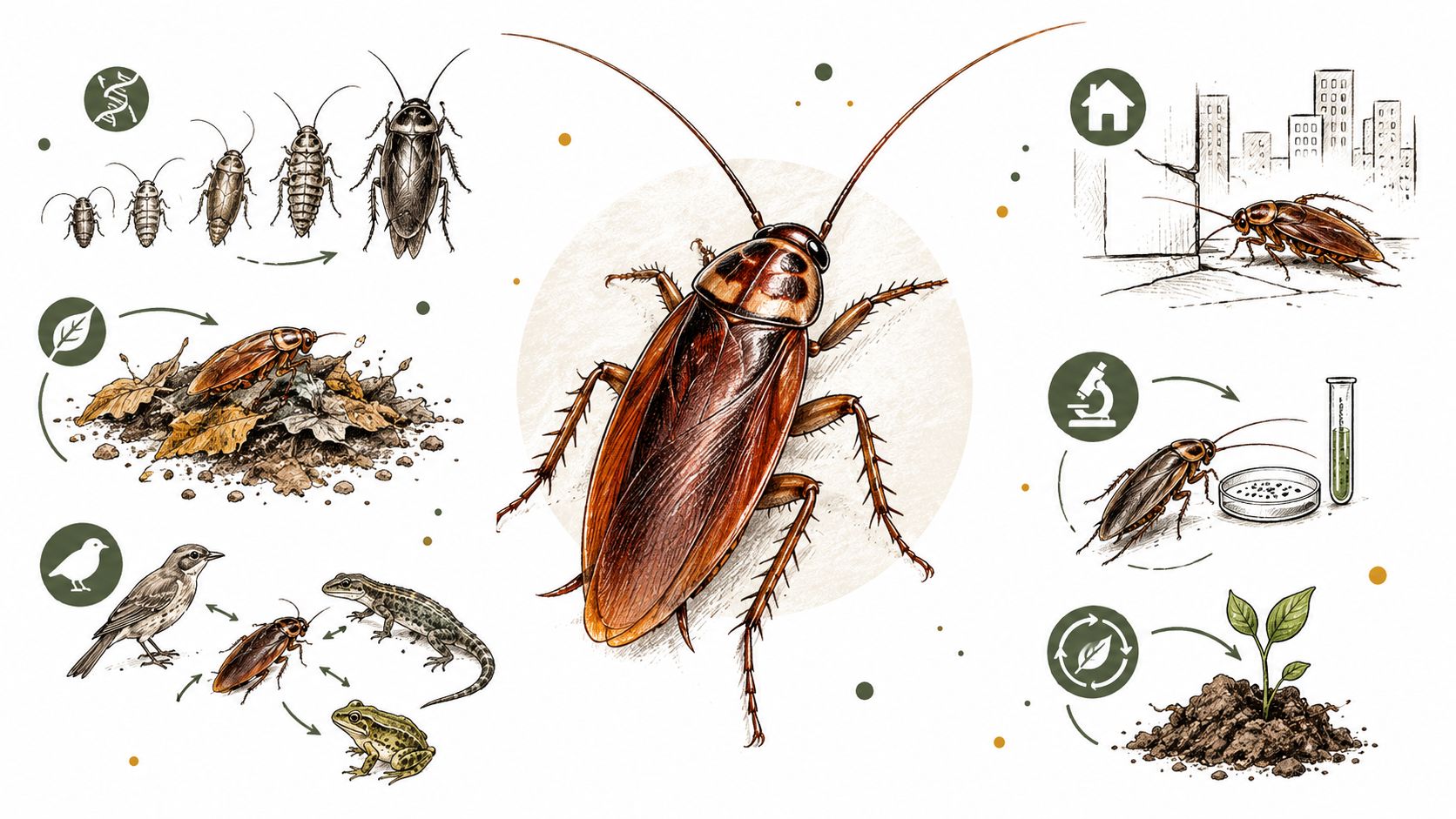
Their ecological role is easier to understand by following what happens to a fallen leaf. A wild cockroach consumes and fragments dead plant material, rotting wood, animal remains, and feces. That mechanical breakdown increases the surface area available to bacteria and fungi, allowing microbial decomposers to work more efficiently.
The result is faster movement of nutrients through the ecosystem. Nitrogen and other elements return to soil in forms that plants and other organisms can use. Cockroaches therefore participate in the same broad recycling process as many other detritivores, including some beetles, termites, worms, and other invertebrates.
Why decomposition matters
Wild cockroaches are primarily detritivores, meaning they feed on dead or waste organic matter. Their role isn't glamorous, but it helps prevent plant debris and animal waste from remaining intact for as long as it otherwise might. By processing that material, they support nutrient cycling and contribute to food webs that include predators such as birds, amphibians, reptiles, and small mammals.
Wood-feeding species show how specialized this work can become. The cockroach Cryptocercus is described in the research as the “most important wood-decomposing cockroach,” and fossil evidence from dinosaur coprolites indicates that rotting conifer wood made up 13% to 85% of the material in some deposits, as documented in the EBSCO source above.
For a broader look at animals that perform overlooked ecological work, readers can also explore hard-working animals that support natural systems. The key point is simple: outdoors, cockroaches are part of the cleanup crew. Their purpose is not to invade houses, but to help move organic matter back into the living system.
When Ecological Recyclers Become Indoor Health Risks
A forest roach belongs in leaf litter. An urban roach inside a home belongs on an inspection list. The insect's ecological role doesn't make indoor activity harmless because the surroundings determine what material it contacts and what microbes it may carry.
Cockroaches have gut and surface microbiota shaped by both long-term colonization and environmental acquisition. Research summarized in a review of cockroach microbiomes and their public-health relevance describes these insects as microbial hosts whose communities reflect their habitat and behavior. In practical terms, a roach moving through a drain area, waste material, or unsanitary void can later travel across food-preparation surfaces.
The indoor problem is movement
Cockroaches don't need to bite a person to create concern. Their bodies, legs, feces, shed skins, and secretions can move through the same spaces where people store food and prepare meals. The risk comes from mechanical transfer, not from any useful decomposer function.
That distinction matters in Southeast Texas homes, where an outdoor invader may enter through a gap and an established indoor breeder may remain hidden near plumbing or appliances. One occasional large roach is a different management problem from repeated sightings of small roaches, droppings, or nymphs in a kitchen.
Indoor cockroach debris can also affect sensitive occupants. Allergens may be present in feces, shed skins, and body fragments, so homeowners dealing with recurring activity should review practical guidance on whether cockroaches can trigger allergies.
Ecological value has a boundary
The line is not moral, it's environmental. A decomposer performing a useful job in a woodland can become a contamination concern when it enters a human food area. The same body and feeding behavior that help process decay outdoors can make indoor exclusion necessary.
You don't need to eradicate every wild cockroach from your property. You do need to prevent indoor access, remove food and moisture that sustain a population, and respond promptly when signs show that the insect is no longer an occasional visitor.
Common Cockroach Species in Southeast Texas
Species identification changes the response. A large roach found near a garage may have wandered in from vegetation or a drain, while smaller roaches repeatedly appearing around kitchen appliances may indicate an indoor population. Color alone isn't enough, so note the body shape, activity pattern, location, and whether you see adults, nymphs, or droppings.
Southeast Texas Cockroach Identification Guide
| Species | Typical Size | Primary Habitat | Key Behavior |
|---|---|---|---|
| German cockroach | Small | Kitchens, bathrooms, cabinets, appliances, and other protected indoor areas | Primarily an indoor breeder that stays close to food, warmth, and moisture |
| American cockroach | Large | Drains, utility areas, basements, crawl spaces, garages, and outdoor harborage | Often wanders indoors from outside and may move through plumbing or structural gaps |
| Smokybrown cockroach | Large | Tree canopies, mulch, leaf litter, attics, and shaded exterior areas | Strong flyer that can be drawn toward lights and may enter from above or nearby vegetation |
| Oriental cockroach | Medium to large | Damp ground-level areas, drains, crawl spaces, and moist exterior locations | Moisture-dependent ground dweller that tends to stay near cool, wet harborage |
German cockroaches deserve special attention because their ability to breed indoors makes them more than seasonal invaders. Repeated sightings in a kitchen, especially near refrigerators, dishwashers, sinks, and cabinet hinges, suggest that sanitation alone may not solve the problem. You'll need to locate harborages and interrupt the population.
American and Smokybrown cockroaches often create a different pattern. A homeowner may find one near a door, garage, attic access, or exterior wall after weather changes. That doesn't guarantee an established indoor colony, but it does point toward entry points, vegetation, moisture, and lighting as part of the inspection.
Oriental cockroaches provide another clue. Their association with damp ground-level spaces means a sighting near a floor drain, crawl-space access, or plumbing penetration should prompt a moisture investigation rather than a quick spray alone.
For visual clues and behavioral differences, use this comparison of American and German cockroaches. Correct identification helps determine whether the priority is indoor population reduction, exterior exclusion, moisture correction, or a combination of all three.
Why Magnolia and North Houston Homes Attract Roaches
Magnolia, Texas, sits in southwestern Montgomery County within the Houston metropolitan area. Published location information places the city at the junction of FM 1774 and FM 1488, about 45 miles northwest of Houston and 25 miles southwest of Conroe, as described in this Magnolia location reference.
That setting helps explain why homeowners see both outdoor and indoor roach pressure. Magnolia's wooded surroundings offer leaf litter, decaying wood, shaded harborage, and moisture. During hot weather, heavy rain, or changing outdoor conditions, roaches may explore the edges of buildings for more stable shelter.
The local service area extends beyond the city limits. The City of Magnolia describes the greater Magnolia area as spanning approximately 12 miles in all directions, with an estimated population of more than 138,000, according to its published maps and community location information. That broader footprint includes nearby North Houston communities and connected residential areas.
How an outdoor roach reaches a home
A Smokybrown cockroach may approach from tree canopies or roofline vegetation, especially where exterior lights attract flying insects. An American cockroach may move from a garage, drain, crawl space, or yard edge. Slab foundations, gaps around utility penetrations, uncovered vents, weep holes, and damaged weather stripping can all reduce the barrier between outdoor habitat and indoor shelter.
Homes in and around Conroe, Kingwood, Porter, Atascocita, Humble, New Caney, Splendora, Montgomery, and Willis can face similar pressure because residential development meets wooded and moisture-rich environments. The exact route varies by property, but the pattern is familiar: outdoor food and shelter support the source population, while the building supplies a protected place to hide.
A home doesn't need to be dirty to attract an occasional invader. Outdoor pressure, structural openings, standing moisture, and accessible food can be enough. The goal is to reduce those opportunities before a visitor becomes a resident.
Practical Prevention and Exclusion Strategies
Prevention works best when you treat the house as a system. Sealing one visible crack won't help much if a leaking faucet, clogged gutter, open pantry bag, or unprotected vent continues to support activity elsewhere.
Start outside the foundation
Walk the perimeter in daylight and look for places where the building connects with soil, plants, plumbing, and roof runoff.
Close structural gaps: Repair damaged weather stripping and seal openings around pipes, doors, windows, and utility lines. Where appropriate, use suitable screening or copper mesh for weep-hole protection, while preserving required drainage and ventilation.
Reduce harborage: Pull leaf litter, rotting wood, and heavy mulch buildup away from the foundation. Trim dense vegetation that touches walls or rooflines, particularly near doors, attic vents, and exterior lighting.
Control water: Check hose connections, outdoor faucets, downspouts, and low areas that remain damp. A wet perimeter gives moisture-dependent species a reason to stay close to the building.

Make the interior less useful
Inside, focus on the resources that allow cockroaches to remain hidden and active. Fix leaking faucets, dry wet cabinet areas, improve ventilation in crawl spaces, and address condensation around plumbing or appliances.
Store pantry goods in airtight containers rather than leaving open packages in cabinets. Clean crumbs and grease from under appliances, empty food waste regularly, and avoid leaving pet food out overnight. These actions won't seal an entry point, but they reduce the carrying capacity of the home.
Use sticky monitoring traps along walls, beneath sinks, behind appliances, and near garage entry doors. Traps can show where activity is concentrated, but they won't replace exclusion when roaches are entering through the structure or treatment when a population is established.
Homeowners who want to reduce reliance on broad chemical applications can review practical guidance on safer chemical-free pest solutions. Any product, even one marketed as natural, should be used according to its label and kept away from children, pets, food, and areas where accidental contact could occur.
When to Call Professional Pest Control for Lasting Results
DIY prevention is valuable, but it has limits. If you repeatedly see roaches, find nymphs, notice activity during the day, or discover droppings in several rooms, the problem may involve hidden harborages that surface cleaning won't reach.
German cockroaches are especially difficult for homeowners to manage with occasional over-the-counter sprays. Spraying visible insects may kill what you see while leaving eggs, hidden adults, and protected breeding areas untouched. Some products can also scatter roaches into nearby rooms or interfere with bait-based control.
What a professional inspection should include
A sound pest-management process starts with identification rather than an immediate blanket application. The technician should examine:
- Activity locations: Kitchens, bathrooms, utility rooms, garages, attics, crawl spaces, and areas around appliances.
- Moisture sources: Leaks, condensation, plumbing penetrations, drains, and damp exterior harborage.
- Entry points: Door gaps, vents, weep holes, foundation openings, and cracks around utilities.
- Population evidence: Droppings, cast skins, egg cases, nymphs, live insects, and trap results.
- Treatment constraints: Children, pets, food areas, occupant sensitivities, and the building's construction.
Integrated pest management combines inspection, sanitation, exclusion, monitoring, targeted chemistry, and follow-up. That approach is more precise than repeatedly spraying whatever insect appears in the open. Low-toxicity or eco-conscious options may be available, but the right selection depends on the species, location, population, and label requirements.
FullScope Pest Control provides cockroach inspections and treatment plans in communities including Atascocita, Cleveland, Conroe, and Magnolia, with licensed technicians using integrated pest management, targeted treatments, and options intended for homes with children and pets. Its service model can include one-time remediation or ongoing quarterly or biannual protection, with local coverage that also includes Kingwood and Porter.
A lasting result comes from removing the reasons roaches stay, not just killing the roach that happens to be visible.
The purpose of cockroaches belongs outdoors, where decomposers support natural nutrient cycling. Inside a Southeast Texas home, the appropriate purpose of pest control is to restore that boundary. If you're seeing recurring activity in Magnolia, Conroe, Kingwood, Porter, or a nearby North Houston community, schedule an inspection, document where and when you see roaches, and ask for a species-specific plan that addresses entry points, moisture, food access, and follow-up monitoring.
Contact FullScope Pest Control to arrange a cockroach inspection for your Magnolia-area home or business. Share the rooms affected, the appearance of the insects, and any moisture or entry-point concerns so a licensed technician can recommend the right exclusion and treatment strategy.