 1500+ reviews

Termite Inspection Report for Closing What Texas Buyers Need
You're a few days from closing. The lender has already cleared most of the file, the title company is sending updates, and then one more item lands in your inbox: the termite letter. A lot of buyers glance at it, look for a clean result, and move on. That's where confusion starts. A termite inspection report for closing isn't a casual pest note, and it isn't a promise that the home will stay termite-free. It's a transaction document tied to timing, signatures, and lender rules. If the report is incomplete, too old, or shows conditions that raise risk, closing can slow down fast. That matters even more around north Houston, where buyers in Magnolia and nearby communities are often juggling inspection windows, financing deadlines, and seller repairs at the same time. A report can look harmless on page one and still create work for the buyer, seller, agent, or lender before the deal can move forward. Introduction Why This Report Can Make or Break Your Closing A common closing-week scenario goes like this. The home inspection is done. Appraisal is in. Insurance is bound. Then your lender asks for the termite report, or asks for an updated one because the file sat longer than expected. Buyers get tripped up because they assume this is just another version of the home inspection. It isn't. A home inspector may point out visible damage, but in Texas a TREC-licensed home inspector may not say termite infestation exists. That call belongs to a licensed wood-destroying insect inspector under the Texas rules discussed later in this article. If you want a practical homeowner-level primer on why these inspections matter in Texas conditions, this overview on why termite inspections matter for Texas homeowners is a useful starting point. Why buyers misread the report A binary yes or no answer is expected. Clean or not clean. Approved or failed. That's not how lenders and title teams use it. They use it as a point-in-time risk screen. The report documents visible evidence, or the lack of visible evidence, on the inspection date. It helps the people handling the loan decide whether there's a current issue, a past issue, visible damage, or conditions that make future activity more likely. A clean-looking report can still create closing work if the date is too old, the form is wrong, or the findings suggest treatment or repair before funding. Why timing matters as much as findings Even a favorable report can become a problem if the calendar slips. Buyers often focus on what the inspector found and ignore when the report was issued. Lenders usually care about both. That's why this document can make or break closing. It sits at the intersection of pest evidence, lender underwriting, and plain old scheduling. In Magnolia, Texas and the north Houston area, where multiple parties are trying to coordinate inspections, signatures, and final loan conditions, that timing piece matters as much as what the inspector checked on site. What a Termite Inspection Report for Closing Actually Is The formal name in Texas is usually a wood-destroying insect report, often shortened to WDI report. That wording matters because the report isn't limited to termites alone. It covers visible evidence of termites and other wood-destroying insects, plus related conditions that increase risk in the structure. A medical screening. It doesn't promise what will happen next year. It records what a trained professional can see right now, in accessible areas, and flags signs that deserve attention. The four findings that drive real decisions The report is more useful when you stop reading it as pass or fail and start reading it in four parts. Independent guidance on WDI reporting highlights these categories and explains why they matter in lending decisions, especially the category called conducive conditions, such as wood-to-soil contact, excess moisture, and wood debris near the foundation. Those conditions can increase future termite risk even when no live insects are visible, which is why a lender may still ask for corrective action based on the report's structure and findings in those categories in this WDI inspection guidance. Here's the simple version: Active infestation means the inspector saw evidence that points to current insect activity. Previous infestation means the home shows signs of an older issue, even if no current activity is visible. Damage means wood or related structural components show visible harm that should be documented and may need further evaluation. Conducive conditions means the house has features or moisture patterns that make future activity more likely. Why conducive conditions confuse first-time buyers People get stuck. They read “no active termites” and assume the deal is done. But if the report also notes excess moisture, wood touching soil, or wood debris near the foundation, the transaction may still need a fix. Those conditions are like seeing standing water next to a foundation before mosquito season. You may not see the problem itself at that exact moment, but you can see why the risk is higher. If you want to compare how home inspections and specialized property checks are discussed more broadly, Restore Heroes has a library of home inspection content that helps readers see where general inspection ends and specialty reporting begins. Who can say what in Texas In Texas, scope matters. A general home inspector and a licensed WDI inspector do not have the same authority on this issue. That distinction protects buyers. It keeps a major transaction document in the hands of someone licensed to identify visible evidence of wood-destroying insect activity on the state-prescribed form, instead of leaving that determination to a broader home inspection report. Inside the Texas Official Form and What Each Section Means Texas treats this report as a regulated record, not a homemade checklist. State rules require inspection reports on visible termite presence, other wood-destroying insects, and conducive conditions to use a department-prescribed form, and each completed report must be prepared for both the person who ordered the inspection and the business files of the licensed issuer. The Texas
Integrated Pest Management Benefits That Save Money

You've sprayed the kitchen baseboards, sealed a few cracks, and still find ants near the sink after the next humid spell. A property manager may have a similar problem on a larger scale, with roaches appearing after each service visit or rodents returning because an access point remains open. Repeating the same treatment can feel like bailing water from a boat without repairing the leak. Integrated pest management benefits come from changing that pattern. IPM isn't one product or one visit. It's a risk-based decision framework that connects inspection, prevention, monitoring, thresholds, and targeted control. That makes it useful for homeowners in Magnolia, Kingwood, Conroe, and nearby Southeast Texas communities, as well as facility managers responsible for safe, dependable buildings. The approach also fits how people make property decisions today. Buyers increasingly use digital tools, including resources about how buyers find properties via AI, so clear inspection records and sensible maintenance decisions matter. For practical home prevention, this guide to pest-proofing your home is a useful place to start. Why Southeast Texas Homes Need a Smarter Approach to Pests North Houston and Southeast Texas give pests plenty of opportunities. Warm conditions, moisture, dense vegetation, standing water, food residue, and small openings around buildings can support mosquitoes, roaches, ants, termites, and rodents. A home in Magnolia may face mosquitoes around a shaded yard, while a Kingwood property might deal with ants entering through several exterior routes after rain. The common response is simple, spray whenever pests appear. That can suppress visible activity, but it may not answer the more important questions. Where are pests entering? What food or moisture source is sustaining them? Is the observed activity large enough to justify treatment, or would exclusion and sanitation solve the issue? Treat the cause, not only the symptom Think of calendar spraying as turning on a fan whenever a room feels warm. It may provide temporary relief, but it doesn't address the broken air conditioner. IPM looks for the equivalent of the faulty equipment, such as leaking plumbing, unsealed utility penetrations, clogged gutters, dense vegetation against the structure, or accessible trash. That doesn't mean chemicals are forbidden. A licensed professional may use targeted chemistry when monitoring shows that prevention and physical controls aren't enough. The difference is that treatment follows an assessment instead of an automatic schedule. For homeowners, this can mean fewer surprises and clearer priorities. For facility managers, it creates documentation around observations, corrective actions, follow-up, and remaining risk. Those records can support communication with tenants, employees, vendors, and property stakeholders. Practical rule: If the same pest returns after treatment, ask what condition is allowing it to return. IPM is especially useful when a property has recurring pest pressure, sensitive occupants, valuable landscaping, food-handling requirements, or structural concerns. It can also make one-time remediation more effective by pairing control with steps that reduce reinfestation. The local question isn't whether every property needs the same program. It's how much monitoring, exclusion, sanitation, and treatment the property's actual risk requires. That's the central idea behind a practical IPM plan for Magnolia and the surrounding communities. How Integrated Pest Management Works as a System The U.S. Environmental Protection Agency defines IPM as a sustainable approach that combines biological, cultural, physical, and chemical tools while minimizing economic, health, and environmental risks. The EPA's IPM guidance also identifies benefits such as reducing pest numbers, reducing pesticide applications, saving money, and protecting human health. A useful analogy is a medical checkup. A doctor doesn't prescribe medication before asking about symptoms, examining the patient, and considering possible causes. An IPM professional follows a similar sequence for a pest problem. Start with identification and monitoring First, identify the pest accurately. Ants, termites, and carpenter ants require different decisions, even when a homeowner only sees “small insects.” Rodent droppings, gnaw marks, nesting material, and tracks can reveal activity that a quick visual inspection misses. Monitoring then establishes whether activity is isolated, increasing, or widespread. Indoors, this may involve inspection points, traps, evidence checks, and review of moisture or food conditions. Outdoors, it may include observing harborage areas, vegetation, standing water, and routes into the structure. Next comes the action threshold. A threshold is the point at which pest activity or risk justifies intervention. It isn't a universal number for every home. A single ant near an exterior door may call for sealing and observation, while repeated sightings in a kitchen, evidence of termites, or rodent contamination demands a faster response. Match the control to the risk The four tool categories work together: Biological controls use natural relationships or biological methods where appropriate. Cultural controls change conditions that support pests, such as sanitation, moisture management, landscaping, and waste handling. Physical controls block, trap, remove, or exclude pests. Chemical controls use the least intensive effective treatment when other measures aren't sufficient. For a home, physical control may mean door sweeps and sealed penetrations. For a business, cultural control may involve waste storage, cleaning procedures, and correcting moisture sources. Chemical treatment remains one tool, not the entire plan. The FullScope approach to integrated pest management practices follows this same logic by combining inspection, prevention, monitoring, and targeted control. A written plan should also explain what happens after treatment. The professional needs to check whether activity declined, whether entry conditions changed, and whether the threshold for further action has been reached. The system works because each visit produces information. Instead of asking only, “What should we spray?” the technician asks, “What evidence do we have, what risk does it represent, and which intervention is proportionate?” Key Benefits of Integrated Pest Management for Health and Budget IPM's value goes beyond reducing visible pests. It helps property owners connect pest control with health, operating cost, building condition, environmental responsibility, and documentation. Health and exposure The EPA states that IPM reduces exposure to both pests and pesticides. That matters because pests themselves can affect indoor comfort and health. The EPA identifies rodents, cockroaches, and dust mites as common indoor pests that can cause or worsen
Black Ants vs Red Ants in Magnolia Texas
After a Gulf storm, a Magnolia homeowner may spot a loose mound in the St. Augustine, notice dark ants crossing the patio, or find a thin trail along the kitchen baseboard. The first question is usually, “Are these black ants or red ants?” In Southeast Texas, that question can send treatment in the wrong direction. I've seen the same color-based mistake play out around Magnolia and Conroe homes. A reddish mound may be an imported fire ant colony, while a line of dark ants near a fascia board may be carpenter ants following moisture. Odorous house ants can look like harmless outdoor ants until they reach a pantry, and pavement ants may be using a driveway crack. Species behavior matters more than color. Use this early comparison as a practical starting point, not a final identification. Ant you may see Typical location Main concern Fastest field clue Imported fire ant Open lawn, sunny soil, mound Stings and invasive colony activity Workers erupt aggressively when disturbed Carpenter ant Moisture-damaged wood, wall voids, fascia Wood damage and hidden nesting Large workers, nighttime activity, frass Odorous house ant Mulch, soil, kitchens, wall voids Persistent indoor trails Sweet-seeking trails and rotten-coconut odor when crushed Pavement ant Driveway cracks, slab edges, under stones Outdoor nuisance and indoor entry Slow movement from joints and cracks What Magnolia Homeowners Actually See in Their Yards A Magnolia resident walks the back fence line near FM 1488 after rain and notices a fluffy mound rising through the St. Augustine. Dark workers move around the mulch, and from ten feet away the colony looks ordinary. The homeowner wonders whether it's just black ants working through damp landscaping or a fire ant mound that needs immediate attention. That uncertainty is common here. Magnolia sits in southwestern Montgomery County within the Houston metropolitan area, with service-area relevance around ZIP codes 77353, 77354, and 77355 (Magnolia location and community details). The city is positioned at FM 1774 and FM 1488, about 45 miles northwest of Houston and 25 miles southwest of Conroe, while the greater Magnolia area extends about 12 miles in all directions and has an estimated population above 138,000 (City of Magnolia location information). That means a pest inspection may involve wooded lots, newer subdivisions, open acreage, irrigated lawns, and homes near heavy traffic corridors. A mound-shaped disturbance on a Magnolia lawn can be a hybrid imported fire ant colony. A dark trail along the patio can instead be carpenter ants moving toward a moisture-damaged fascia board. Those ants need different decisions, even if a homeowner describes both as “black ants.” Field rule: Don't identify an ant from a phone photo alone. Watch where it nests, how it reacts when disturbed, and what the surrounding moisture conditions look like. Color is only a clue. Body shape, nesting depth, trail behavior, and disturbance response provide more useful information. The yard itself is the identification field, not a cropped image that removes the mound, slab, tree line, or damaged wood. Why Black Ants and Red Ants Are Not Real Categories A reddish ant crossing a Magnolia patio may be a fire ant, while a dark ant trail may belong to a carpenter ant, odorous house ant, or pavement ant. Color helps with a first impression, but it does not identify the pest or determine the treatment. In pest management, “red ants” commonly refers to red imported fire ants, Solenopsis invicta, or related fire ant species. “Black ants” covers several unrelated species. One overview groups about 24 black-ant species under that broad label, including Lasius ants, carpenter ants, and odorous house ants (overview of red ants and black ants). Their nesting sites, food preferences, and response to disturbance can differ sharply. Southeast Texas homeowners should treat the red category with more caution. Red imported fire ants are a widespread nonnative species across the eastern two-thirds of Texas. Texas A&M guidance identifies five fire ant species in Texas and distinguishes the widespread nonnative red imported fire ant from other species (Texas A&M fire ant identification guide). Fire ant workers can also combine reddish-brown and darker coloring, so a colony may not look uniformly red. The dark-ant category creates a different set of mistakes. Carpenter ants may occupy damp or damaged wood. Odorous house ants can spread satellite colonies through mulch, wall voids, and other moisture zones. Pavement ants commonly use cracks beneath driveways or slabs. A fire-ant treatment may kill exposed workers while leaving the condition that supports the colony. For example, dust applied to carpenter ants in a wall void does not correct wet siding, a leaking gutter, a soft soffit, or a compromised window frame. Odorous house ants often need bait placed along active trails, combined with correction of food and moisture access. The practical question is which species is present, and what behavior is it showing? Fire ants build mounds and sting when disturbed. Carpenter ants associate with wood and may point to moisture trouble. Odorous house ants form persistent trails, often toward sweets indoors. Pavement ants stay closely tied to soil, cracks, and slabs. Comparing the Ants You Meet in SE Texas The four ants below cover many of the calls homeowners describe as black ants vs red ants in Magnolia, Conroe, and nearby Montgomery County communities. Treat the size descriptions as field estimates, because coloration and worker size can vary, especially in fire ant populations. Trait Imported Fire Ant Carpenter Ant Odorous House Ant Pavement Ant Approximate size Workers range from 1/8 to 1/4 inch Workers can reach 1/2 inch Around 1/8 inch Small, commonly dark workers Common nest Sun-exposed soil mound Wall voids, damp wood, rotting wood, fascia Shallow soil, mulch, wall voids, moisture zones Driveway cracks, slab edges, under stones Reaction to disturbance Aggressive swarming and stinging Usually retreats or stays concealed Scatters and may produce a rotten-coconut odor when crushed Slow response, often in tight groups Sting or bite risk Workers can swarm and sting together May bite, but rarely stings Nuisance-level activity Nuisance-level activity Property
Dead Animal Smell in House How to Find and Remove It

You notice it first in the hallway, then near the ceiling vent. It's a sickly, sweet odor with a sulfurous edge, and no amount of air freshener makes it disappear. By the afternoon, the smell seems stronger when the air conditioner runs. You check the trash, the refrigerator, and the drains, but the source still isn't obvious. A dead animal smell in house situations usually becomes a building-science problem as much as a wildlife problem. The carcass may be in an attic, wall cavity, crawlspace, or duct branch, while decomposition fluids have already reached insulation, wood, drywall, or duct liner. Removing the animal matters, but finding the contaminated materials and treating them matters just as much. The odor usually builds rather than appearing instantly. One wildlife-removal source describes it beginning within the first 1 to 3 days, becoming strongest around days 4 to 10, and then fading over weeks as the carcass dries out. A small animal such as a mouse may fully decompose in about 1 to 2 weeks, while rats and squirrels can take longer, with odor lasting from a few days to several weeks. See the wildlife-removal timeline for a dead animal in a wall or attic for the field context behind those ranges. This guide focuses on the decisions that prevent wasted effort: distinguishing decomposition from look-alike odors, tracing the source without randomly cutting drywall, removing contaminated material safely, and knowing when professional inspection makes more sense. The same approach applies to homes around Magnolia, Texas, where enclosed spaces, active HVAC systems, and humid conditions can make odor behave differently from one room to the next. Introduction to Dead Animal Odor at Home A homeowner often calls after trying the obvious fixes. They've opened windows, placed bowls of vinegar around the room, sprayed deodorizer into a vent, and waited for the smell to pass. Instead, the odor returns whenever the temperature rises or the HVAC system moves air through the house. That pattern is important. Air freshener changes perception, not the source, and even a strong disinfectant can fail if the carcass remains hidden or decomposition fluid has soaked into porous material. A smell that grows stronger in one room, travels through a vent, or changes with airflow deserves a source investigation before deodorizing begins. What the timeline can tell you A dead animal odor often follows a recognizable arc. It may start as a faint organic or sour smell, intensify during active decomposition, and then decline as the body dries. The exact experience depends on the animal's size, the temperature, moisture, and whether the carcass is exposed or enclosed. The source linked above describes odor beginning during the first 1 to 3 days and reaching its strongest point around days 4 to 10. It also notes that a mouse may decompose in about 1 to 2 weeks, while a rat or squirrel may take longer. Those figures aren't a promise that your house will be odor-free on a particular day. They're a reason to avoid assuming that a smell appearing yesterday came from an animal that died yesterday. An attic carcass may dry differently from one in a sealed wall bay. A carcass beside an air handler may spread odor through several rooms, while one inside insulation may create a powerful but highly localized smell. Practical rule: If the odor keeps returning after the HVAC cycles or after the room warms, assume something remains contaminated until you've inspected the source zone. Don't overlook similar odors Decomposition is a strong possibility, but smell alone doesn't prove it. A dry drain trap, moisture damage, mold, gas issue, or electrical problem can produce an unpleasant odor that homeowners may describe as rotten, sulfurous, or stale. A dead animal becomes more likely when you also find flies, insect activity, disturbed insulation, nesting material, staining, droppings, or a concentrated odor near a vent or wall opening. A gas or electrical concern requires a different response. If the smell resembles fuel or burning insulation, leave the area and contact the appropriate utility or emergency service rather than investigating an attic or wall cavity yourself. The safest starting point is controlled localization. Identify where the odor is strongest, determine whether airflow changes it, and inspect accessible spaces before opening finished surfaces. In Magnolia and nearby north Houston communities, that method usually saves more time than treating the entire house at once. What Causes the Smell and Why It Lingers Decomposition creates a mixture of volatile compounds rather than one single odor. Two important compounds are cadaverine and putrescine, biogenic amines formed as tissue breaks down. Sulfur-containing compounds also influence odor perception, which helps explain why a small hidden animal can produce an intense smell with a rotten or sulfurous character. The chemistry is only part of the answer. The building around the carcass controls where those compounds travel, how quickly moisture leaves, and how much odor becomes trapped. A carcass in an open attic, a closed wall cavity, and a duct chase may be the same animal, but the odor pattern won't be the same. Enclosure changes the odor path In an open attic, air can move around the carcass and carry odor toward penetrations, vents, and ceiling fixtures. Insulation can hold decomposition fluids, but the surrounding air may still dilute the odor across a broad area. A homeowner may notice a general attic smell rather than one precise point. A wall cavity behaves differently. The stud bay can hold moisture and volatile compounds, then release them through outlets, switch boxes, baseboard gaps, ceiling penetrations, or cracks around trim. The strongest smell may appear several feet away from the carcass because pressure and airflow determine the exit point. Ductwork adds another complication. A carcass in or beside a supply or return path can make the odor appear in multiple rooms, especially when the blower runs. The register isn't necessarily the location of the animal. It may be the place where contaminated air enters the living space. Why humidity and temperature matter
Property Management Pest Control in Magnolia, Texas

A Magnolia property manager can do everything right on paper and still get three pest complaints in one morning. A wet spring, a new construction edge, an overflowing dumpster, or one untreated apartment can move activity through connected buildings quickly. By the time residents start calling, the visible pest is often only the symptom. That's why property management pest control needs to run as an operating workflow, not as a recurring spray appointment. Magnolia sits in southwestern Montgomery County and forms part of the Houston metropolitan area. The city proper grew from 1,393 residents in 2010 to 2,359 in 2020, according to the U.S. Census Bureau's Magnolia QuickFacts profile. The City of Magnolia's demographics page reports a 2024 population of 5,836, a materially higher figure that points to a service market changing quickly. The population figures come from different reporting sources and should not be treated as a single comparable series, but together they show why older maintenance routines can struggle to keep up. Why Magnolia Property Managers Need a Smarter Pest Playbook A manager working around the 77354 and 77355 corridors may notice the pattern after a wet spring. Residents in one building report ants near patio doors. A tenant in another building sees roaches beneath the kitchen sink. The maintenance team finds wasps around a pool enclosure, while a leasing employee mentions mosquitoes near a retention pond. The first reaction is often to add a spray visit. That can knock down exposed insects, but it doesn't explain where the pressure began or why it keeps returning. New development west of Conroe and north of Tomball creates changing boundaries between managed properties, disturbed soil, drainage areas, and undeveloped lots. Older apartments, newer multifamily communities, retail sites, and light commercial buildings all present different entry points and sanitation risks. Magnolia's location makes response geography part of the operating plan. The city is roughly 10.9 miles from Tomball, 17.3 miles from Conroe, and 36.2 miles from Houston, while Dobbin is roughly 12 miles away, according to Census Reporter's Magnolia location profile. A vendor's ability to reach a site consistently matters when an issue involves several units or requires a follow-up inspection. Why calendar spraying falls short Calendar spraying treats time as the trigger. IPM treats evidence as the trigger. Integrated pest management emerged from the development of integrated control after World War II. In 1952, Michelbacher and Bacon introduced the term “integrated control” for combining biological and chemical methods, and the broader IPM framework was standardized later in the 1960s and 1970s, as documented in this history of integrated pest management. The modern approach uses monitoring, sanitation, habitat modification, thresholds, exclusion, and selective chemical treatment. Federal policy moved toward that model when President Nixon directed agencies to advance IPM in 1972, followed by a federal IPM coordinating committee in 1979, according to historical IPM teaching materials from the University of Minnesota. For an owner, the financial argument is straightforward. Repeated spraying without correcting access routes creates recurring labor, resident disruption, and vendor visits without solving the source. A documented inspection-first program gives ownership a clearer record of what was found, what was corrected, and why a treatment was or wasn't authorized. Managers who also review building consumption and maintenance patterns may find utility submetering from Axis Meter Solutions useful for broader property operating oversight. The operational framework is consistent with the importance of pest control in property management, but the local execution matters more than the label. Magnolia properties need a playbook that connects inspection findings to work orders, resident communication, vendor accountability, and follow-through. The Inspection-First IPM Workflow That Actually Works Start outside, then move inward. A manager who begins with a complaint-driven interior spray may miss the overflowing dumpster, irrigation leak, vegetation touching the wall, or gap beneath a service door that keeps feeding the problem. Run the property in a defined sequence Use the same route every time so technicians and on-site staff can compare findings. A practical workflow looks like this: Inspect the exterior perimeter. Check foundation transitions, pipe penetrations, door sweeps, utility entries, wall cracks, roofline access, mulch, irrigation, drainage, and vegetation contact. Photograph conditions that maintenance can correct. Sample apartments by risk. Don't wander randomly through units. Select apartments based on complaint history, adjacent activity, move-in or move-out status, visible moisture, sanitation concerns, and proximity to known source areas. Record the unit number, room, pest evidence, and likely contributing condition. Check common areas. Inspect trash rooms, laundry rooms, stairwells, mail areas, mechanical spaces, storage rooms, kitchens, leasing offices, and amenity buildings. German cockroaches and rodents don't respect the boundary between a resident unit and a shared service space. Walk dumpsters and outdoor zones. Look for spilled food, standing water, damaged lids, dense groundcover, irrigation overspray, and harborage beside fences or retaining walls. Magnolia's humidity can keep these areas productive for pests when housekeeping and drainage lag behind. Set an action threshold. A single ant trail may call for sanitation and exclusion. Repeated cockroach evidence across connected units may justify baiting, monitoring devices, and a coordinated inspection. A threshold should reflect pest type, location, vulnerability, complaint frequency, and the risk of spread. Turn findings into work, not just reports The vendor's service ticket should identify the building, unit or zone, observed evidence, corrective action, product used if any, and required follow-up. “Treated apartment” isn't enough. A useful ticket says that food debris was removed, a pipe gap was sealed, monitors were placed beneath a sink, and the manager must verify the repair. The lightest effective tool may be a bait station, gel bait, exclusion repair, sanitation correction, moisture repair, or targeted crack-and-crevice application. Broadcast spraying should not become the default because it's familiar. Research on multifamily housing found that a single-visit IPM intervention reduced cockroach counts more effectively at three and six months, lowered kitchen allergen levels, and used less pesticide than routine controls, as reported in this multifamily IPM study. Use a shared spreadsheet, property-management platform, or vendor portal. The format matters less than
Big Black Ants in House Identification and Control Guide
You notice them first on the kitchen counter, then on the bathroom floor near the baseboard. They're much larger and darker than the tiny ants that usually gather around a sweet spill, so the question becomes immediate: are these just visitors from outside, or are big black ants in the house nesting inside the walls? In North America, the leading suspect is usually a carpenter ant, particularly the black carpenter ant, Camponotus pennsylvanicus. But color and size alone don't settle the question. The more useful diagnosis asks where the ants are traveling, whether they appear when outdoor activity is unlikely, and whether moisture has softened nearby wood. A few ants around a window may be scouts or outdoor foragers. Repeated activity in a bedroom, bathroom, attic, or several rooms can point to an indoor nest. This guide walks through the distinction step by step, from a quick physical identification to a room-by-room moisture inspection, then to treatment decisions for homes in Magnolia and surrounding Southeast Texas communities. Introduction to Big Black Ants Inside Your Home A large dark ant on a countertop can mean several things. It may have followed a gap around a window, crossed a plumbing penetration, or wandered indoors while searching for food. One sighting doesn't automatically mean your framing is damaged. The concern changes when the pattern repeats. Suppose you see one ant near the kitchen sink on Monday, several along the bathroom baseboard on Wednesday, and another on a bedroom windowsill after rain. The locations matter because carpenter ants often use damp wood and enclosed voids as nesting space, then send workers into nearby rooms to forage. Practical rule: Treat the ant as a clue. Treat the moisture condition and travel pattern as the diagnosis. Carpenter ants are the classic big black ants in house pest in North America. University extension guidance identifies the black carpenter ant as the species most commonly nesting in homes, although roughly 12 carpenter ant pest species occur across North America according to North Carolina State Extension's carpenter ant guidance. Workers commonly measure about 1/4 to 1/2 inch, while some state guidance describes the black carpenter ant as reaching up to 3/4 inch through the National Pest Management Association's ant identification information. That size makes them noticeable, but it isn't the main reason to worry. Carpenter ants excavate galleries in wood softened by moisture. They don't eat wood like termites do, yet their tunnels can hollow out wood over time and weaken already compromised framing as explained by North Carolina State Extension. The practical questions are straightforward: What does the ant look like from the side? Is there frass, or coarse sawdust-like material, near wood? Are the ants appearing in rooms without exposed food? Can you find a leak, damp void, or damaged window frame? Are they entering from an exterior nest or emerging indoors? Answer those questions before reaching for a surface spray. Killing visible workers may reduce what you see, but it won't necessarily reach the colony or correct the condition that made your home attractive. How to Identify Big Black Ants Correctly Start with the easy clues, then move to the traits that separate carpenter ants from lookalikes. Step one is size and overall color Indoor carpenter ant workers are typically about 6 to 13 millimeters long, and Texas A&M describes common Texas carpenter ant workers as approximately 1/4 to 3/8 inch long in its household ant guide. The largest species found in Texas, the black carpenter ant, commonly measures 1/4 to 1/2 inch according to Texas A&M AgriLife Extension. Many are dull black, but some Texas carpenter ants have a black abdomen with a reddish-brown head and thorax. Winged adults may appear entirely black, so color can shift within the same general group. That's why “large and black” is a useful starting description, not a final identification. Check the waist and antennae Look for a single node, or small raised segment, between the thorax and abdomen. Carpenter ants also have elbowed antennae. Termite swarmers, one of the most important lookalikes, have straight antennae and a thicker, less pinched waist as described in Texas A&M's identification guide. The waist is easy to remember with a simple image. A carpenter ant looks as if its body has been fitted with a narrow belt. A termite looks more like a straight-sided tube between its front and rear sections. For additional background on common ant types and their habits, see this overview of ant species and control considerations. Use the thorax as your deciding feature Color and length overlap among dark ants. The thorax, viewed from the side, gives you a better clue. Carpenter ants have a smoothly rounded thorax profile, while many dark field ants have a different outline. Think of the thorax as a small hill. A carpenter ant's profile rises and curves evenly, without a sharp dip or step. Photographing that curve is more useful than taking a blurry top-down image. Place a ruler or familiar object nearby only for scale, and avoid handling the insect. A clear side-view photograph showing the head, antennae, waist, and thorax can help a pest professional confirm whether the visitor is likely a carpenter ant. Why Moisture and Wood Condition Matter More Than Size The important question isn't why the ant is large. It's why the wood near your home has become suitable for excavation. Carpenter ants create galleries for nesting. They remove wood particles rather than consuming the wood as food, leaving coarse debris or frass near openings. Chronic dampness softens framing and makes excavation easier, which is why roof leaks, wet window frames, plumbing leaks, and water-damaged structural wood deserve more attention than the ant's body length. Follow the moisture trail room by room In the bathroom, inspect the cabinet beneath the sink, the wall behind plumbing fixtures, window trim, and areas around the tub. A small leak can keep an enclosed void damp even when the visible surface looks normal. In the kitchen, check beneath the sink,
What Do Termite Tunnels Look Like? Texas Guide
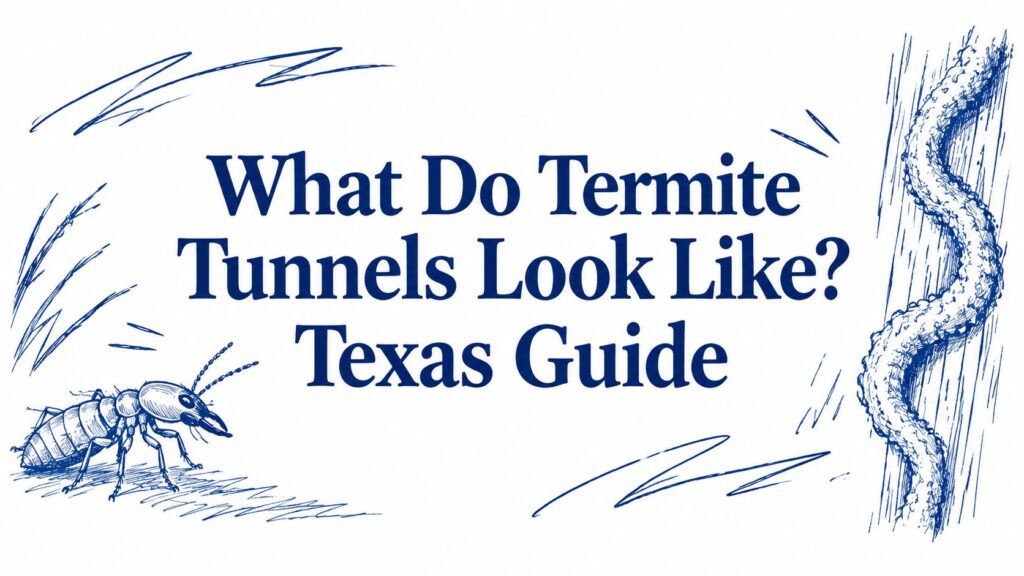
You're walking around your Magnolia home when a thin, dirt-colored line catches your eye on the concrete foundation. It looks too deliberate to be ordinary soil, but too small to seem like a serious problem. That narrow mark may be a subterranean termite shelter tube, and the visible section may represent only one access route from a hidden colony. The practical answer to what do termite tunnels look like is more nuanced than “a pencil-sized line of mud.” Tubes can be narrow, dry, branching, patchy, or blended so closely with masonry that homeowners miss them during a quick inspection. Knowing where to look, how the material behaves, and whether the structure is active gives you a much better starting point than scraping it away and hoping the termites disappear. Identifying Termite Shelter Tubes on Your Property A subterranean termite shelter tube is an earthen passage built across an exposed surface. It usually appears as a narrow, crusted line of dried dirt on a foundation, wall, crawl-space pier, or masonry surface. The purpose is protection. Termites use the covered route to travel between soil and a food source while reducing exposure to dry air and predators. During a preliminary check, start at the places where the ground, structure, and moisture meet. Walk the entire exterior perimeter with a flashlight, even if the suspicious mark is only on one side of the house. Where to direct your flashlight Check these areas closely: Foundation walls: Look for vertical lines rising from soil, landscaping, expansion joints, or slab edges. Masonry and concrete: Inspect cracks, corners, utility penetrations, steps, and areas where tubes can follow an irregular surface. Crawl-space piers: Examine both sides of wooden or masonry supports, especially where the pier meets the ground. Wooden supports: Check sill plates, joists, porch framing, and other wood located close to soil. Fence lines and outdoor wood: Stumps, timbers, and fence posts can provide nearby access points even when the house itself shows little visible evidence. The tubes are commonly about pencil-width, roughly one-quarter inch, according to Texas A&M AgriLife's reference on subterranean termites. That description helps, but don't treat it as a strict measurement. A tube may look like a raised dirt seam, a flattened strip, or a thin crust that disappears around a corner. Practical rule: Photograph the tube before disturbing it. Include a close view and a wider image showing its location on the property. You can also compare your observation with this guide to what to do after spotting a termite mud tube. The key point is simple: a visible tube deserves inspection, but its presence alone doesn't tell you how far the colony has traveled or whether the route remains active. The Variable Size and Texture of Mud Tubes The building material is a mixture of soil or wood particles bound with termite saliva and fecal matter. That blend produces an earth-toned surface that can resemble dried dirt, tan soil, brown sediment, or a gray crust. On concrete, the tube may be only slightly darker than the wall. In a crawl space, it can blend into dusty masonry or exposed soil, so a quick visual check may miss it. The material composition is described by Texas A&M AgriLife. Why width isn't a reliable diagnosis Field observations show that tubes may range from one-quarter inch to one inch or larger, particularly where a colony is active and established. A narrow route may serve as a protected passage, while a wider section can reflect repeated travel, repairs, or a need to move more workers and material. Width should guide inspection, not decide the diagnosis. Scientific work also describes narrower egress structures measuring 3 to 5 millimeters. Other termite species build fewer, wider, less-branched tunnels. The research in this study of termite tunnel architecture helps explain why a suspicious line should not be dismissed because it is thin or lacks a rounded profile. Texture offers additional clues: Dry and crusted: Exposure to air or changing moisture may harden the outer surface. Patchy or incomplete: Termites may cover only the section needed to cross an exposed area. Rough and granular: Sand, soil, wood particles, and organic debris can leave an uneven finish. Flattened against masonry: Limited space and pressure from the wall can make the tube look like a dirt smear. Slightly damp or compact: Moisture can keep the material cohesive and make it appear darker. Texas soil conditions affect what an inspector sees. Sandy material may leave a loose, grainy surface, while clay-rich soil can form a smoother, denser crust. Moisture near slab edges, shaded crawl spaces, or poorly drained areas can also keep tubes darker and less brittle. Species, humidity, available particles, and the tube's function all influence its final shape. A narrow, dry, or broken-looking tube doesn't rule out activity, while a thick tube does not prove termites still use it. Appearance identifies where to investigate. Activity requires a closer check of the route, surrounding soil, and nearby wood. Understanding the Hidden Branching Network A straight line on a foundation can give the wrong impression. It suggests a single route with a clear beginning and end, but subterranean termites often work through a branching system that changes as workers locate food and encounter crowded areas. Research described by the International Research Group on Wood Protection found that tunnel systems can radiate from discovered food sites, intercept nearby sites, and branch again. Related species also differed in how much they branched. At congested tunnel faces, workers may extend the existing route or create a side branch, depending on the conditions they encounter. One visible tube can have many hidden connections The section you see on the foundation may be only the exposed part of a larger foraging system. Other routes may remain underground, pass through cracks, follow the slab edge, or enter structural wood without creating a conspicuous surface line. That distinction matters during an inspection. If a homeowner scrapes off one tube, the colony hasn't necessarily lost access. Workers may repair the
Ants on Kitchen Counter: A Practical Removal Guide
You've just wiped the kitchen counter, put the fruit away, and turned to grab a clean towel. Then one ant appears beside the sink. Within minutes, a narrow line is moving across the surface, following the backsplash toward a crumb you can barely see. The scene feels like a cleaning failure, but ants on a kitchen counter usually point to a trail, moisture source, or hidden entry route, not a neglected home. The practical response is a sequence: clean the contact surface, remove competing food and water, place bait where foragers already travel, inspect moisture and access points, then seal and repair what keeps the route active. Stronger spray isn't automatically a better answer. The goal is to reach the colony without scattering its workers into new parts of the house. Why Ants Keep Showing Up on a Spotless Counter A homeowner can watch this happen in real time. One scout crosses a freshly cleaned counter, pauses near the sink, and disappears behind the coffee maker. A second ant follows the same path. Soon, the line looks deliberate because it is. The first ant has found something useful and marked a route that other foragers can follow. That route doesn't require visible grime. Kitchens provide water, warmth, and tiny food residues in places a normal wipe misses, including sink rims, drawer seams, appliance bases, cabinet joints, and damp areas beneath plumbing. A counter may look spotless while a small bead of water under the dish rack or grease beside the stove continues rewarding the colony. The hidden issue is often the connection between the counter and the nest. Ants may enter through a backsplash seam, a plumbing penetration, a window gap, or a concealed path behind cabinets. Once the colony treats that route as dependable, wiping away individual workers doesn't remove the reason new workers keep arriving. Practical rule: A clean counter can still be an active feeding station if ants have access to moisture or a reliable trail. Why cleanliness alone stalls Spraying the visible line can create a temporary visual improvement, but it doesn't necessarily affect the nest. Repellent products may drive workers away from one route and into another, making the infestation look as if it has spread. The better approach is to clean the surface without destroying your ability to identify the active trail, then use that trail to guide colony control. This distinction matters for food safety. In a 2018 peer-reviewed kitchen study, microbiological analysis of 50 domestic-kitchen ants detected yeasts and molds in 100% of samples, coliforms in 52%, Escherichia coli in 18%, Bacillus species in 26%, Salmonella in 8%, and Listeria monocytogenes in 6% of samples. The same study found that ants transferred E. coli to food-contact surfaces in 70% of tests. See the peer-reviewed ant contamination study for the full findings. That doesn't mean every ant carries every organism. It does mean you should treat ants crossing preparation areas as a contamination concern, not just an annoyance. The clean, bait, and seal workflow breaks both the visible route and the colony's access to your kitchen. Immediate Cleaning and Safe Removal on the Counter Start by making the counter unprofitable. Remove fruit, bread, open packages, pet bowls, and anything else that can provide food or water. Put those items into sealed containers or move them away from the activity zone while you clean. Next, wipe the counter with a mild vinegar-and-water solution, following the care instructions for the countertop material. The purpose is to remove food residue and disrupt the chemical route, not to sterilize every surface with a harsh product. If the counter is stone, check the manufacturer's guidance before using vinegar, since acidic cleaners can damage some finishes. Clean the overlooked contact zones Use a damp cloth to pick up visible ants, or use a small bottle of soapy water for ants on a washable surface. Avoid broad aerosol applications across food-preparation areas. A repellent spray may kill exposed workers, but it can also interrupt the trail and push activity toward cabinets, wall voids, or another room. Give nearby areas the same attention: Sink rim: Remove film and standing droplets, then dry the area. Appliance edges: Wash around the coffee maker, microwave, refrigerator, and dishwasher. Drawer pulls: Clean sticky residue where hands and food packaging leave deposits. Toaster and microwave bases: Sweep crumbs from the seams and floor beneath them. Trash and recycling areas: Empty containers and clean residue around lids and handles. Keep raw ingredients separate from any surface ants have crossed until you've washed and disinfected it according to the product label. The contamination findings above explain why this step deserves urgency. For pet-safe approaches that avoid unnecessary chemical exposure, review this guide to getting rid of ants without chemicals that could hurt your pets. Don't scrub every trail away before you've observed where it starts and ends. If ants are still active, watch for a short period after removing food. Note whether they head toward the sink, backsplash, window, cabinet toe-kick, or a plumbing opening. That observation gives you a more useful starting point for bait placement than guessing at the center of the counter. Baiting and Targeted Treatments That Reach the Colony Aerosol spray is designed for immediate contact. Bait is designed to be carried away. That difference makes slow-acting gel or liquid bait more suitable when the objective is colony control rather than a quick reduction in visible workers. Foragers feed at the station and return to the nest before the active ingredient takes effect. Depending on the product, the chemistry may include a slow-acting ingredient such as boric acid, borate, hydramethylnon, or another labeled ant toxicant. Workers can share food within the colony, allowing the bait to reach ants you never see. Use only products labeled for indoor kitchen use, and follow the label around children, pets, food, and food-contact surfaces. Placement beats brand switching Put bait beside the active trail, near the counter edge, close to the entry point, or along a baseboard
Blowflies vs House Flies: Identification and Control Guide

A metallic green fly lands on your kitchen window, then another appears near the ceiling light. A day later, more show up, even though the counters are clean. Or perhaps dull gray flies are gathering around the back door after a cookout, with a trash bin sitting outside and a torn screen giving them an easy route indoors. Those two problems look similar from a homeowner's point of view, but they often point to different sources. Blowflies vs house flies isn't a trivia contest. The identification tells you where to look, what to remove, and whether a spray will solve anything at all. In Magnolia, Conroe, Kingwood, and nearby Southeast Texas communities, fly pressure follows waste, moisture, warm weather, wooded lots, septic systems, and the way buildings are sealed. A gray fly around a garbage can usually calls for sanitation and exclusion. A metallic green fly inside may justify a much more urgent search for a dead animal, sewer exposure, or another protein-rich source. Why Telling Blowflies and House Flies Apart Changes Everything A metallic green fly at a Magnolia kitchen window is a diagnostic clue, not just an indoor nuisance. If several appear over a short period, inspect the crawl space, wall voids, roofline, chimney, and nearby waste. A hidden carcass, sewer exposure, or protein-rich residue may be supporting them. Gray flies gathering at a torn screen above a cookout trash can point toward a different job: remove food residue, secure the container, inspect outdoor breeding material, and repair the entry point. The visible symptom is the same, flies indoors. The source and treatment are not. Adult knockdown has limited value when larvae are still developing somewhere on the property. Spraying the window may remove the insects a homeowner can see while leaving a dead rodent or contaminated material untouched. Cleaning a trash can will not resolve a carcass-linked blowfly emergence. The fly can identify the property problem House flies commonly develop around people, animals, fecal material, garbage, and decaying organic matter. A global systematic review and meta-analysis found parasites on 43% of the house flies examined, based on 7,234 positives among 15,282 sampled house flies (the published analysis in Parasites & Vectors). That finding does not mean every house fly carries a dangerous organism. It does explain why repeated house fly activity deserves sanitation and exclusion work, not just an aerosol treatment. Blowflies indicate a narrower source search. Missouri Extension describes them laying eggs on dead animals, decaying meat, or garbage containing meat scraps (Missouri Extension's fly management publication). A sudden indoor appearance can lead to a carcass in an attic, chimney, wall, ceiling void, crawl space, or beneath the structure. A damaged sewer line or sewage-contaminated area can create similar conditions. Field rule: Treat the fly as evidence about the breeding source, not as the whole pest problem. The inspection should answer one practical question: what material allowed this species to develop? That answer determines whether the call requires source removal, sanitation, exclusion, plumbing repair, or a combination of controls. In Magnolia, Conroe, and Kingwood, the warm season can expose these sources quickly, especially around crawl spaces, trash areas, septic systems, and wooded lots. Quick Field Identification in Under a Minute On a Magnolia service call, the fly's color can change the inspection within seconds. Start with appearance, then use posture, flight, and the room or structure where it was found to decide what source to check. Check the color. A shiny metallic blue, green, or blue-black body points toward a blowfly. A dull gray body with dark thorax striping points toward a house fly. Purdue Extension's fly identification guide describes blowflies as medium-sized metallic filth flies and house flies as duller gray flies. Check the build. Blowflies usually look thicker and heavier. House flies have a narrower gray body, with dark stripes visible across the thorax. Watch how it rests. House flies often hold their wings slightly spread over the body. Blowflies commonly keep the wings flatter, giving them a compact profile. Watch the flight. Blowflies often circle or move in a slower, side-to-side pattern near an odor source. House flies usually dart, turn sharply, and react quickly when disturbed. Use the location to test the identification. A metallic fly near a roofline, chimney, attic, crawl space, garbage area, or dead animal calls for a carcass or sewer-exposure search. In Magnolia, Conroe, and Kingwood, that pattern commonly appears around sheltered voids, wooded lots, and warm-weather breeding sites. A gray fly around a kitchen, patio, pet-waste area, compost bin, or trash container points toward sanitation problems and entry points. House fly identification guidance provides another way to compare the gray body and thorax markings. If the identification remains uncertain, place one fly in a clear jar and shine a flashlight from the side. The angled light can reveal metallic blue-green reflections without specialized equipment. That first decision is diagnostic, not cosmetic. A blowfly usually justifies searching for hidden organic material, while a house fly pattern calls for sanitation, exclusion, and inspection of moist waste sources. Side by Side Comparison of Appearance, Breeding, and Behavior Use the comparison as a field decision tool. Color narrows the identification, while the breeding material and flight behavior determine where to inspect first. Feature Blowflies House flies Typical appearance Medium-sized, often about 1/4 inch long, with a metallic blue, green, or blue-black sheen Dull gray body with dark thorax striping Common breeding material Carrion, decaying meat, meat-containing garbage, and sometimes sewage-linked organic matter Garbage, pet waste, fecal material, fermenting food, compost, and other moist organic buildup Warm-weather behavior Follows odor plumes toward carcasses, meat waste, garbage, and contaminated areas Concentrates around kitchens, patios, trash, pet waste, food scraps, and compost Cool-weather behavior May seek sheltered indoor spaces when outdoor conditions become less favorable Outdoor activity tapers, but indoor sources can sustain activity Diagnostic meaning Often points to a concentrated protein-decay source More often indicates distributed sanitation or exclusion problems The table matters because the same control response will not fit both
Identifying the Signs of Black Widow Infestation
You're clearing out the garage in Magnolia, Texas, when a dark spider slips behind a storage bin. A tangled web hangs beneath a shelf, close to the concrete, and a pale sac is tucked into the corner. It's understandable to wonder whether you've found one stray spider or the first visible evidence of a larger problem. The signs of black widow infestation usually appear as a pattern, not a single frightening discovery. Web location, web structure, egg sacs, hidden retreats, and live spiders provide much better evidence than an isolated web or an unexplained skin mark. The Southern black widow, Latrodectus mactans, is one of the widow spiders found in Texas and is the species most commonly encountered across much of the state, according to Texas Parks and Wildlife's arachnid safety guidance. Is It a Black Widow Lurking in Your Home A homeowner cleaning a shed may notice a web stretched between a wall and a stack of containers. Someone working beneath a porch may see a shiny black spider retreat into a protected gap. In Kingwood, Conroe, Magnolia, and nearby Southeast Texas communities, these discoveries deserve a careful look, but they don't automatically mean the entire home is infested. The first question is whether the evidence is active. A dusty web that breaks apart when touched may be leftover activity. A web containing an egg sac, a live spider, or newly emerged spiderlings tells you much more. Black widows prefer quiet, sheltered locations, so the surrounding environment matters as much as the spider itself. Look for a pattern, not a panic trigger Focus your inspection on places that rarely get disturbed: Garages and sheds: Check behind stored items, beneath shelves, and around low wall edges. Crawl spaces: Humid, protected areas can provide shelter, especially where clutter remains undisturbed. Porches and foundations: Look under furniture, around foundation openings, and in structural voids. Outdoor storage: Woodpiles, boxes, yard debris, and water meter boxes can conceal webs and retreats. A single adult spider may have wandered into a space, while repeated sightings in connected sheltered areas suggest established activity. The most useful evidence is a combination of a low, irregular web and a hidden retreat containing a live spider or egg sac. Practical rule: Treat the web as a clue. Treat the web plus an egg sac or live spider as confirmation that the area needs prompt attention. Homeowners who want to reduce inviting conditions can also review this practical guide to preventing black widow risks at home before disturbing storage areas or exterior harborage. Keep children away from suspected activity, and don't reach into dark gaps with bare hands. Decoding the Telltale Webs and Egg Sacs A dusty web under a porch or behind a garage box may be leftover activity. A low, tangled web connected to an egg sac or live spider points to activity that deserves prompt attention. Black widows build messy, irregular webs close to the ground, often in protected spaces such as humid crawl spaces, cluttered garages, sheds, woodpiles, and foundation voids. PestWorld's black widow identification guidance identifies this disorganized, low construction as a useful field clue. The setting matters in Southeast Texas homes. Check beneath porch edges, inside foundation openings, behind stored boxes, and under lawn furniture. The web may appear three-dimensional and disorderly, with strands joining nearby surfaces instead of forming the clean circular pattern associated with orb-weavers. Separate old webbing from active evidence Webbing alone cannot confirm that a black widow remains nearby. Dust, debris, and weather can leave loose strands behind after the spider has moved on. Stronger evidence includes a live spider, a hidden retreat, an egg sac, or newly emerged spiderlings attached to the web, consistent with Orkin Canada's guidance on black widow webs and activity. Inspect from outside the web's reach. Use a flashlight and keep children away from the area. Look for: A live spider hanging beneath the web, particularly in a dark, undisturbed corner. A papery egg sac suspended in or beside the web. Small spiderlings or shed remains near the retreat. Fresh webbing leading into a protected space, rather than isolated strands exposed to rain or movement. A black widow egg sac is usually papery and pale brown to white, about 8 to 12 millimeters in width or length, according to Alabama Cooperative Extension's black widow fact sheet. One sac may contain an average of 200 to 255 eggs, with reported ranges from 25 to more than 900 eggs. Females may produce 4 to 9 sacs in one summer, so crushing or handling one can create unnecessary contact with spiders or spiderlings. Do not reach into a dark gap or sweep a suspected sac with bare hands. For practical handling guidance, review safe ways to remove spider eggs. An old web may only need removal after inspection. A web with an egg sac or live spider calls for prompt control planning. Confirming Your Suspicions How to Identify a Black Widow The adult female Southern black widow is usually the spider people recognize most easily. She has a glossy black body, a rounded abdomen, and a red hourglass marking on the underside. Because the spider often hangs upside down in its web, the marking may become visible when viewed from below, but don't approach closely just to confirm the color. Males and immature spiders can look different from the familiar adult female. That makes the web, egg sac, location, and behavior important parts of identification. A technician may need to inspect the surrounding harborage rather than rely on a quick view of one spider. The comparison below can help separate a suspected black widow from common spiders found around Southeast Texas homes. Black Widow vs. Common Texas House Spiders Feature Black Widow Common Orb-Weaver Cellar Spider (Daddy Long-legs) Body appearance Glossy, dark body with a distinctive red hourglass marking on the underside Often patterned or brightly marked, with a larger abdomen that may be rounded or angular Small body with very long, thin legs Web type Irregular,