1500+ reviews

Preventative treatments on an established home typically run $500 to $1,500 upfront, and ongoing monitoring usually adds $200 to $900 per year depending on the method chosen. In Magnolia, that's a key number to weigh against a repair bill that can jump fast once termites get a foothold.
A lot of homeowners first hear about termites when the renewal letter shows up, a neighbor mentions a treatment, or an inspector knocks on the door after a nearby hit. At that point, the question isn't whether termites are a nuisance. It's whether you're budgeting for a controlled protection plan or gambling on a future repair problem.
Why Magnolia Homeowners Are Asking About Termite Prevention Cost
A Magnolia homeowner looking at a $900 quote usually isn't comparing it to a luxury upgrade. They're comparing it to doing nothing, hoping the house stays quiet, and trusting that the first sign of damage won't come through a soft floor or a swollen trim board. That's a bad bet in Southeast Texas.
Orkin says U.S. residents spend an estimated $5 billion annually to control termites and repair termite damage, and it also notes that termites damage approximately 600,000 homes each year. The same source says the average homeowner who discovers termite damage spends about $3,000 on repairs, which is why prevention makes sense as a risk-management line item, not a discretionary purchase. Orkin's termite statistics
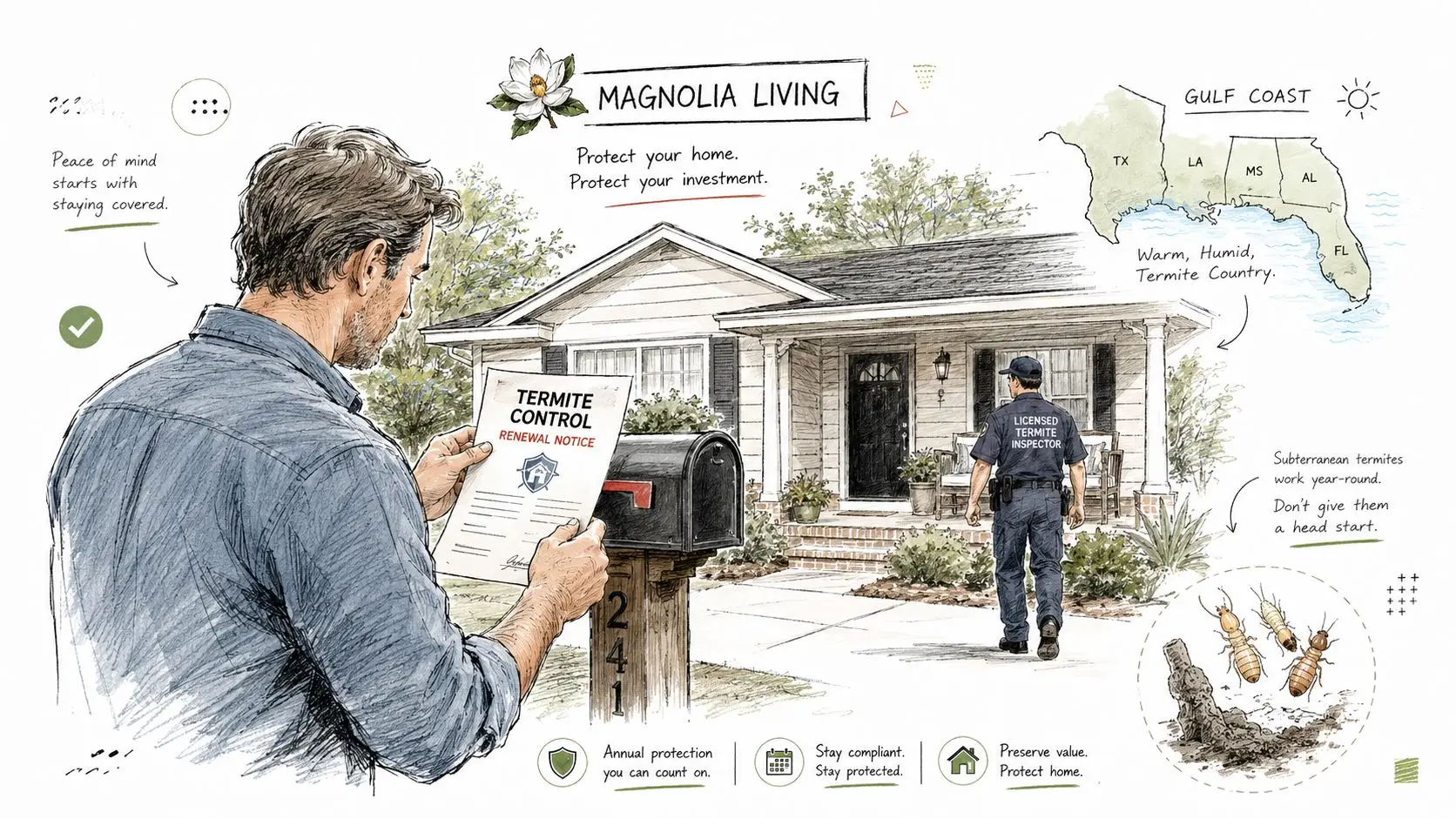
Magnolia sits in the kind of humid, high-pressure termite environment where slab-on-grade homes and recurring soil contact keep pest pros busy year after year. That's why two neighbors can get very different quotes for what sounds like the same service. One house may need a simple monitor-and-check plan, while the other needs perimeter work, station hardware, or a warranty that means something.
If you want a hard reminder of how expensive hidden wood damage can become, a practical reference like termite damage repair tips for Long Island is useful because it shows the downstream cost of waiting too long. The lesson is universal, even if the geography isn't.
Practical rule: if the quote feels high, compare it to the repair exposure, not to a lawn service bill or a one-time spray.
The Four Main Prevention Methods and What Each Costs
Start with inspection, because it sets the baseline
A professional inspection is the cheapest doorway into termite prevention, but it's also the step that keeps people from overbuying. The inspector checks for activity, past damage, moisture conditions, access points, and the shape of the perimeter before recommending anything. That matters because termites aren't priced like a generic pest visit, they're priced around the structure.
The background pricing guide in the research says inspection-only entries commonly sit around $75 to $325, and that's the number to expect when a provider is evaluating risk and writing a report. For a Magnolia homeowner, that fee is often the smartest money spent in the whole process, because it tells you whether you're dealing with a low-risk maintenance situation or a home that needs a real barrier plan. FullScope's termite control options
Liquid soil barrier and bait systems are the core protection choices
Liquid soil barriers work by creating a treated perimeter in the soil around the home. The installed price commonly lands in the low thousands for many houses, and the annual renewal keeps the barrier active. Bait systems use stations around the property, then require ongoing checks and service to keep the system functioning.
Industry pricing in the supplied data puts chemical soil treatments around $3 to $20 per linear foot, bait systems at about $7 to $12 per linear foot or roughly $1,000 to $2,500 for a whole home, and annual monitoring often at $200 to $400 per year. That's a real difference in how the job is built, not just how it's sold.
Monitoring-only plans are the lightest commitment
Monitoring-only plans are the lowest-friction option for a home that's low risk or already under another pest maintenance contract. They don't promise the same level of perimeter intervention as a barrier, but they do give you recurring checks and early detection.
For Magnolia homeowners, that can make sense on newer builds, on homes with good drainage, or on properties where the owner wants a cautious entry point before committing to a heavier treatment. The tradeoff is simple, you're paying less upfront, but you're also accepting less aggressive protection.
A cheap plan that doesn't match the home's risk profile isn't a bargain. It's just underbuilt.
Liquid Barrier vs Bait System vs Monitoring Plan
The choice usually comes down to how much risk you want to push away from the house and how much you're willing to spend every year to keep it there. A liquid barrier is the most direct perimeter defense. A bait system is more modular and station-based. A monitoring plan is the least expensive on day one, but it's also the slowest to respond if activity appears.
Here's the buying view I'd use in Magnolia.
| Prevention Method Comparison at a Glance | Typical Upfront Cost | Annual Renewal | Service Life | Best Fit |
|---|---|---|---|---|
| Liquid barrier | $1,000 to $2,500 for many homes | $150 to $350 | Ongoing with renewals | Slab homes, visible perimeter access, owners who want direct soil protection |
| Bait system | $1,200 to $2,500 | $200 to $400 | Ongoing with station service | Properties that need station-based monitoring and recurring oversight |
| Monitoring plan | Lower entry cost than full treatment | $200 to $400 or more depending on plan | Service-based, not a fixed barrier | Low-risk homes, budget-conscious owners, early detection focus |
The key difference is not just price, it's behavior. A liquid barrier is built to hold the line at the soil interface. A bait system depends on stations, inspections, and follow-up. Monitoring plans are there to catch trouble early, which is useful, but they're not the same thing as a treated perimeter.
For a Magnolia homeowner, I'd rank them like this. If the house has a slab, decent access, and you want stronger defense, liquid barrier usually earns its keep. If the property needs a more passive station setup, or you want a system that's easier to watch over time, baiting is the more flexible route. If the home is low risk and you mainly want eyes on the property, monitoring-only is fine, but don't pretend it's a full shield.
For more detail on how station economics work, the internal breakdown at termite baiting economics is worth reading before you sign anything.
What Drives Your Termite Prevention Quote
Two Magnolia homes can bring back quotes that look unrelated because termite pricing is built on geometry, access, and risk. The biggest driver is usually not square footage alone, it's linear perimeter, because that's what a technician has to treat, inspect, or station. A bigger footprint with clean access may still be easier than a smaller house wrapped in additions, decks, and landscaping.
Perimeter and foundation type do the heavy lifting
A slab home with long exterior runs and limited access often costs more than a simple open perimeter. That's why the same method can land at a different price on the next street. The work changes with the structure, not just the address.
The supplied cost guide for subterranean termite prevention says liquid soil barriers commonly run $4 to $16 per linear foot, and bait systems often run $8 to $12 per linear foot because they include station hardware and recurring monitoring labor. On a typical 1,500 to 3,000 sq ft home, the initial price is often about $1,000 to $2,500 for a liquid barrier and $1,200 to $2,500 for an in-ground baiting system. Termite bond pricing calculator
Severity and warranty terms change the bottom line
If a technician sees signs of active damage, the quote can move from prevention into treatment mode quickly. Spot work is cheaper than full-perimeter work, but it's only appropriate when the issue is limited. Once the home needs broader coverage, the labor, product, and follow-up all rise.
Warranty level matters just as much. A basic treatment without meaningful renewal support may look cheaper, but you're taking on more future risk yourself. That's where many Magnolia homeowners overspend on the front end or under-protect on the back end.
My rule for Magnolia quotes: pay attention to the perimeter length, ask whether the estimate includes renewal, and don't assume a cheaper line item is cheaper over time.
Access problems are the last cost lever. Dense shrubs, added decks, hardscape, and tight crawl access all add labor. If the technician has to work around obstacles, the price reflects that reality.
Real Magnolia Cost Scenarios Over Five Years
A first-year quote can mislead you fast. In Magnolia, the better question is what the house costs to protect over five years, because Gulf Coast pressure changes the math. A cheap start can turn into a pricey habit if the plan leaves the perimeter exposed or forces you to pay for repeated fixes later.
Scenario A, a 1,800 sq ft slab home with no prior activity
A clean slab home in Magnolia with no termite history usually fits a liquid barrier plan. The upfront treatment sits around $1,000 to $2,500, and annual renewal runs about $150 to $350. Over five years, that puts the total roughly in the $1,600 to $4,000 range, depending on the provider, the layout, and how the renewal is structured.
That price makes sense for a homeowner who wants direct soil protection around the slab and a straightforward service record. It is not the lowest checkout number, but it gives you a real barrier instead of a token visit. If the lot is open and the crawl or slab edges are easy to reach, this is usually the cleaner buy.
A monitoring-only plan changes the cash flow but not the risk. The initial spend is lighter, which looks appealing on paper, yet the service still stays on the clock every year. For a Magnolia homeowner, that works only if the property is low pressure and the goal is observation rather than active soil defense. For a practical breakdown of why the cheapest setup often leaves gaps, see why DIY termite solutions fall short.
Scenario B, a 2,400 sq ft home with prior activity on a wooded lot
A house with prior activity and more pressure from trees, mulch lines, or moisture edges needs a stronger plan. A bait system can fit that situation because the stations give the provider a place to check, refresh, and intervene over time. The supplied pricing puts bait systems at about $1,200 to $2,500 upfront, with $200 to $400 annual renewal.
That is the kind of quote Magnolia owners see when the home needs more than a simple perimeter pass. The stations cost more to keep going, but they give you ongoing visibility around the structure. On a wooded lot, that matters because termites do not care that the first-year number looked friendly.
A more intensive barrier-plus-monitoring setup can also fit this house if access is decent and the owner wants direct perimeter protection. The five-year total climbs because you pay for the initial treatment and the renewals, but you are also buying more complete coverage around a home that already has a history. That is the right place to spend money if the goal is to protect the structure instead of chasing the lowest quote.
For a rough cost-per-square-foot view, the research gives a five-year prevention example on a 2,000-square-foot home at $750 upfront plus $113 annually, which works out to $0.13 per square foot per year over five years. It also gives a more intensive option at $2,000 upfront plus $450 per year, equal to $0.43 per square foot per year, and another at $2,750 upfront plus $563 annually, equal to $0.56 per square foot per year. A termite treatment cost analysis shows how wide that spread can be once the home size, service model, and follow-up level change.
That spread is the whole story in Magnolia. The home, the pressure around it, and the service model decide what affordable really means. A homeowner on a clean slab can spend less and still sleep well. A wooded-lot house with prior activity needs a plan that costs more up front but protects the property more effectively over time.
DIY Prevention vs Hiring a Local Pro
Retail stations and consumer termite products look cheaper because they are cheaper at checkout. They also leave out the parts that matter most, which are perimeter coverage, product concentration, and someone standing behind the work if termites show up again.
A homeowner can do light monitoring on a low-risk property. That's especially true when the house is easy to access and there's no known activity. But DIY falls apart fast when you need a true soil treatment or a station layout that matches the structure.
The difference isn't subtle. A retail station kit may cost a homeowner far less than a professionally installed and monitored system, but that doesn't make it a substitute for a full defense program. You're buying a small tool, not a treatment strategy.
That's why I don't treat DIY as a universal answer. It's a budget choice for a narrow set of conditions, not a replacement for professional coverage on slab homes with pressure around the perimeter. If you want the local logic behind that, the internal guide at why DIY termite solutions fall short lays out the gaps plainly.
For unrelated household maintenance, a resource like local leaf removal cost breakdown shows the same pattern in another category. Cheap homeowner work can be fine for simple upkeep, but once risk or hidden access issues rise, pro labor starts to make more sense.
Here's where a local pro earns the fee in Magnolia. A technician can match the treatment to the foundation, adjust for access, provide a written warranty, and tell you whether the home needs monitoring, liquid protection, or both. FullScope Pest Control's QualityPro credentials and Southeast Texas presence matter here because termite work is local, not generic, and the same plan won't fit every house.
Smart Ways to Lower Termite Prevention Cost Without Cutting Corners
The easiest savings come from making the technician's job simpler. Clear out wood-to-soil contact, fix moisture problems, and trim dense mulch away from the slab before the inspection. Those moves don't just reduce risk, they also keep the quote from creeping up because the work is easier to scope.
Ask providers whether they offer multi-year renewal pricing, and ask if an inspection can be bundled with other pest work. If you already know the home's history, say so. Hidden prior activity usually creates more change-orders than honest disclosure ever will.
A homeowner should also ask about follow-up timing, warranty terms, and whether the treatment includes WDI reporting for a future sale. If the answer is vague, the quote probably is too.
Save money by buying the right scope the first time. The cheapest non-renewable spot treatment looks good until you need a second visit and a larger repair check.
Don't chase the lowest number if it strips out warranty coverage or leaves half the perimeter untreated. That's the kind of false economy that costs more in a few years, especially in humid Southeast Texas conditions.
Questions to Ask Any Termite Provider in Magnolia
Ask what the warranty covers. If it only includes retreatment, you still own the repair risk when termites get into framing, trim, or subflooring. A stronger warranty carries retreatment plus damage repair, and that changes the cost of the job.
Ask whether the warranty transfers to the next owner. In Magnolia, that matters if you may sell the house, because buyers and title companies both look more closely when termite protection follows the property. A transferable warranty can make the paperwork cleaner and the home easier to explain at closing.
Get the renewal fee in writing. If a provider gives you a vague answer on recurring cost, assume the number will move later. You want a clear annual figure, the terms attached to it, and a straight answer on what happens if you miss a renewal window.
Ask about the follow-up and reinspection schedule. A good provider explains when they come back, how they check activity, and what triggers another visit. If they only talk about the first treatment, you are paying for a one-time event instead of ongoing protection.
If you want lower-toxicity or eco-friendly options, ask how those choices affect both performance and price. That question matters in homes with kids, pets, or sensitivity concerns, but the answer should still be practical. A softer treatment that leaves the vulnerable parts of the house exposed is a bad trade.
Ask for a written WDI report if the house may be sold later. That document needs to be done correctly, not treated like a side note. In a Magnolia sale, proper paperwork helps show the work was done and documented the right way.
A provider should also tell you, plainly, what you are paying to avoid. In the Orkin data, the average repair bill for discovered termite damage is about $3,000, while prevention is usually a planned expense that stays well below major remediation. That is why the cheapest quote is not always the smartest one. A low first invoice can leave you exposed to a bigger repair check later.
For a Magnolia home, compare the five-year total, not just the first visit. Ask for the warranty in writing, ask what happens if termites show up again, and make the provider explain exactly how much protection the house gets for the money.