1500+ reviews

You've sprayed the kitchen baseboards, sealed a few cracks, and still find ants near the sink after the next humid spell. A property manager may have a similar problem on a larger scale, with roaches appearing after each service visit or rodents returning because an access point remains open. Repeating the same treatment can feel like bailing water from a boat without repairing the leak.
Integrated pest management benefits come from changing that pattern. IPM isn't one product or one visit. It's a risk-based decision framework that connects inspection, prevention, monitoring, thresholds, and targeted control. That makes it useful for homeowners in Magnolia, Kingwood, Conroe, and nearby Southeast Texas communities, as well as facility managers responsible for safe, dependable buildings.
The approach also fits how people make property decisions today. Buyers increasingly use digital tools, including resources about how buyers find properties via AI, so clear inspection records and sensible maintenance decisions matter. For practical home prevention, this guide to pest-proofing your home is a useful place to start.
Why Southeast Texas Homes Need a Smarter Approach to Pests
North Houston and Southeast Texas give pests plenty of opportunities. Warm conditions, moisture, dense vegetation, standing water, food residue, and small openings around buildings can support mosquitoes, roaches, ants, termites, and rodents. A home in Magnolia may face mosquitoes around a shaded yard, while a Kingwood property might deal with ants entering through several exterior routes after rain.
The common response is simple, spray whenever pests appear. That can suppress visible activity, but it may not answer the more important questions. Where are pests entering? What food or moisture source is sustaining them? Is the observed activity large enough to justify treatment, or would exclusion and sanitation solve the issue?
Treat the cause, not only the symptom
Think of calendar spraying as turning on a fan whenever a room feels warm. It may provide temporary relief, but it doesn't address the broken air conditioner. IPM looks for the equivalent of the faulty equipment, such as leaking plumbing, unsealed utility penetrations, clogged gutters, dense vegetation against the structure, or accessible trash.
That doesn't mean chemicals are forbidden. A licensed professional may use targeted chemistry when monitoring shows that prevention and physical controls aren't enough. The difference is that treatment follows an assessment instead of an automatic schedule.
For homeowners, this can mean fewer surprises and clearer priorities. For facility managers, it creates documentation around observations, corrective actions, follow-up, and remaining risk. Those records can support communication with tenants, employees, vendors, and property stakeholders.
Practical rule: If the same pest returns after treatment, ask what condition is allowing it to return.
IPM is especially useful when a property has recurring pest pressure, sensitive occupants, valuable landscaping, food-handling requirements, or structural concerns. It can also make one-time remediation more effective by pairing control with steps that reduce reinfestation.
The local question isn't whether every property needs the same program. It's how much monitoring, exclusion, sanitation, and treatment the property's actual risk requires. That's the central idea behind a practical IPM plan for Magnolia and the surrounding communities.
How Integrated Pest Management Works as a System
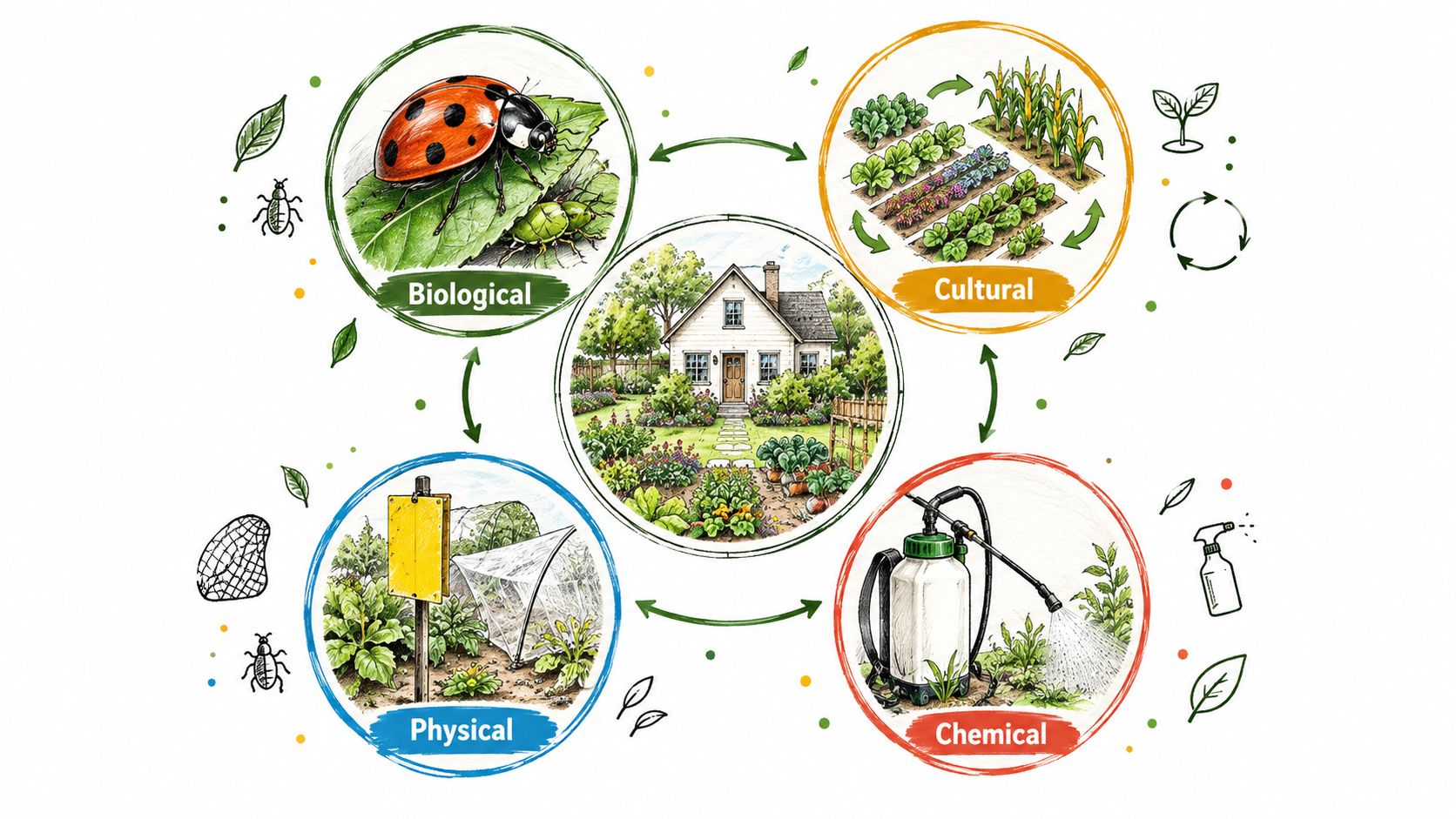
The U.S. Environmental Protection Agency defines IPM as a sustainable approach that combines biological, cultural, physical, and chemical tools while minimizing economic, health, and environmental risks. The EPA's IPM guidance also identifies benefits such as reducing pest numbers, reducing pesticide applications, saving money, and protecting human health.
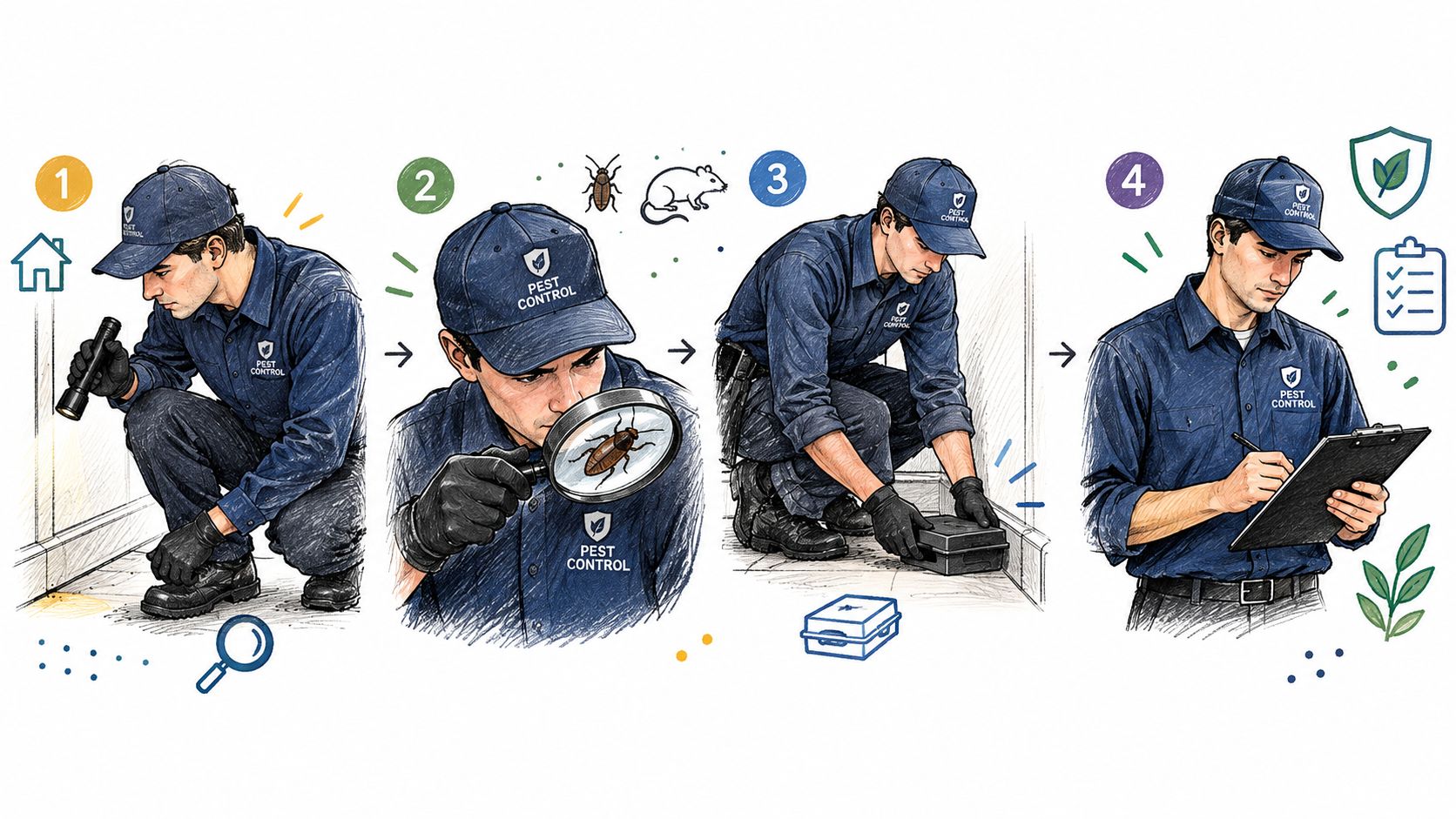
A useful analogy is a medical checkup. A doctor doesn't prescribe medication before asking about symptoms, examining the patient, and considering possible causes. An IPM professional follows a similar sequence for a pest problem.
Start with identification and monitoring
First, identify the pest accurately. Ants, termites, and carpenter ants require different decisions, even when a homeowner only sees “small insects.” Rodent droppings, gnaw marks, nesting material, and tracks can reveal activity that a quick visual inspection misses.
Monitoring then establishes whether activity is isolated, increasing, or widespread. Indoors, this may involve inspection points, traps, evidence checks, and review of moisture or food conditions. Outdoors, it may include observing harborage areas, vegetation, standing water, and routes into the structure.
Next comes the action threshold. A threshold is the point at which pest activity or risk justifies intervention. It isn't a universal number for every home. A single ant near an exterior door may call for sealing and observation, while repeated sightings in a kitchen, evidence of termites, or rodent contamination demands a faster response.
Match the control to the risk
The four tool categories work together:
- Biological controls use natural relationships or biological methods where appropriate.
- Cultural controls change conditions that support pests, such as sanitation, moisture management, landscaping, and waste handling.
- Physical controls block, trap, remove, or exclude pests.
- Chemical controls use the least intensive effective treatment when other measures aren't sufficient.
For a home, physical control may mean door sweeps and sealed penetrations. For a business, cultural control may involve waste storage, cleaning procedures, and correcting moisture sources. Chemical treatment remains one tool, not the entire plan.
The FullScope approach to integrated pest management practices follows this same logic by combining inspection, prevention, monitoring, and targeted control.
A written plan should also explain what happens after treatment. The professional needs to check whether activity declined, whether entry conditions changed, and whether the threshold for further action has been reached.
The system works because each visit produces information. Instead of asking only, “What should we spray?” the technician asks, “What evidence do we have, what risk does it represent, and which intervention is proportionate?”
Key Benefits of Integrated Pest Management for Health and Budget
IPM's value goes beyond reducing visible pests. It helps property owners connect pest control with health, operating cost, building condition, environmental responsibility, and documentation.

Health and exposure
The EPA states that IPM reduces exposure to both pests and pesticides. That matters because pests themselves can affect indoor comfort and health. The EPA identifies rodents, cockroaches, and dust mites as common indoor pests that can cause or worsen allergies and asthma, as described in its IPM guidance for buildings.
Reducing exposure doesn't mean promising a chemical-free property. It means using monitoring, exclusion, sanitation, and targeted applications so treatment responds to documented risk. Families with children or pets can ask providers which areas require access restrictions, what preparation is needed, and which lower-toxicity options may fit the property.
Lower long-term operating costs
The EPA explains that IPM may require more upfront labor and resources, but costs are generally lower over time because the underlying cause of the pest problem is addressed. A technician who finds and corrects an entry point, moisture condition, or sanitation gap may reduce the need for repeated emergency treatments.
The savings aren't limited to pesticide purchases. EPA notes that building weatherization can exclude pests while also saving energy and reducing moisture problems. Sealing gaps, improving door seals, and correcting damp conditions can serve several building goals at once.
For businesses, the financial benefit also comes from predictability. A documented program can help maintenance teams assign corrective actions, schedule follow-up, and avoid treating every complaint as an isolated event. Software and estimating tools can support that planning, including resources covering the benefits of AI quoting, although the inspection still determines what work a property needs.
Less chemical dependence
A 2015 meta-analysis of IPM projects across Asia and Africa found a mean yield increase of 40.9%, while pesticide use fell to 30.7% of baseline levels. The review linked lower synthetic pesticide use with cost savings for farmers, improved public health, and stronger natural capital on farms. Those agricultural findings don't translate automatically to a Magnolia home, but they demonstrate how a decision-based system can support production while reducing chemical dependence. Read the meta-analysis.
Commercial facilities gain another benefit, compliance readiness. Inspection notes, monitoring records, corrective actions, and treatment details help demonstrate that pest management is controlled rather than improvised. The exact documentation depends on the facility and its obligations, but a structured record is more useful than a stack of disconnected service invoices.
When IPM Outperforms Conventional Spraying and When It Does Not
IPM isn't automatically superior in every setting. Its performance depends on pest pressure, the property's ability to monitor conditions, the cost of prevention, and how quickly a risk must be controlled.
Calendar spraying applies treatment according to time. Threshold-based IPM applies treatment according to evidence. The first approach can be convenient, but it may treat low-risk conditions unnecessarily. The second requires observation and decision-making, yet it can concentrate effort where it produces the most value.
| Outcome | Conventional Calendar Spraying | Integrated Pest Management |
|---|---|---|
| Trigger for action | A recurring date or routine schedule | Observed activity, risk, and an action threshold |
| Main focus | Repeated suppression | Identification, prevention, monitoring, and targeted control |
| Use of prevention | Often secondary | Built into the plan through exclusion, sanitation, and habitat changes |
| Flexibility | Less responsive to changing conditions | Adjusted as pest evidence changes |
| Best fit | Situations requiring a simple routine | Properties with recurring pressure, sensitive areas, or identifiable causes |
| Limitation | Can miss the cause of reinfestation | Requires inspections, communication, and follow-up |
The broader evidence base is context-dependent. A Reading University meta-analysis of 55 studies across 20 countries found that IPM benefits in apple systems vary by pest type and production metric, as reported in the research data record. That finding supports a practical conclusion for Texas properties: don't judge IPM by a universal promise. Judge it by whether the plan matches the site's actual risk.
Where the framework adds the most value
IPM tends to add value in high pest-pressure settings, resistance-prone systems, and operations capable of monitoring thresholds. In those conditions, repeated broad treatment may create cost, exposure, or resistance concerns without correcting the source.
The same 2026 review described in the evidence record reported typical pesticide-use reductions of 40% to 70% and yield gains of 10% to 35%, while also noting that AI-driven precision spraying can achieve pesticide cuts of 25% to 40% with comparable yield stability in some cases. Those agricultural comparisons don't establish a guaranteed result for residential pest control, but they show why IPM should be treated as a framework rather than a slogan.
A 2021 corn and watermelon field study offers a specific historical example. IPM reduced insecticide applications by about 95%, insecticide costs from $100.98 per hectare to $3.35 per hectare, and increased watermelon yields by 26%, worth about $4,513 per hectare in added revenue, while conserving wild bee pollinators. Review the field study.
For a Southeast Texas home, the equivalent decision is straightforward. Treat aggressively when evidence shows immediate risk, use prevention when conditions support recurrence, and avoid automatic treatment when monitoring shows no meaningful threat.
How FullScope Applies IPM From Inspection to Ongoing Protection
A practical program begins with a property-specific inspection. The technician looks for active pests, evidence of previous activity, entry points, moisture, food access, harborage, structural vulnerabilities, and conditions that could support recurrence.
Inspection and identification
The first visit should produce more than a treatment recommendation. It should identify the pest, locate likely sources, and separate urgent concerns from maintenance items. Termites, rodents, mosquitoes, roaches, ants, and lawn pests each require different inspection priorities.
Monitoring continues after the initial assessment. Follow-up checks can review traps, bait stations, activity indicators, exterior conditions, and customer observations. Good documentation helps the technician adjust the plan instead of repeating the same application automatically.
Treatment and prevention
FullScope Pest Control is one local option that applies IPM through inspection, customized treatment plans, exclusion, sanitation guidance, monitoring, and follow-up. Its services include residential and commercial pest control, termite protection, mosquito management, rodent work, lawn-related treatments, and wood-destroying insect inspections.
Treatment can include targeted chemistry and lower-toxicity, eco-friendly options where appropriate. The choice depends on the pest, location, occupants, property use, and level of risk. A rodent plan may emphasize sealing openings, sanitation, and trapping, while a mosquito plan may combine barrier applications with habitat reduction or a MistAway automated misting system.
Follow-up matched to the property
Ongoing protection may use quarterly or biannual schedules, with emergency response when conditions require faster attention. A home with seasonal pest activity may need a different rhythm than a commercial facility with sanitation procedures, inspections, and operational compliance requirements.
FullScope operates with licensed professionals and QualityPro certification, with local service locations in Cleveland, Kingwood, Conroe, and Porter. Its broader coverage includes Magnolia and nearby communities. Pest-control companies also rely on scheduling and documentation systems, and readers interested in the operational side can review information about Recepta.ai management software.
For homeowners, the process is easier to evaluate when the provider explains what was found, what the customer needs to correct, what treatment was selected, and when activity will be reassessed. A useful overview of why inspections matter is available in this resource on regular pest inspections for your home.
Local IPM Examples Across Magnolia and Greater North Houston
Magnolia properties often combine wooded edges, expansive yards, ornamental landscaping, shaded areas, and moisture pockets. A sensible mosquito plan may begin by checking standing water and dense vegetation, then use a targeted barrier spray. Where outdoor use and mosquito pressure justify it, a MistAway automated misting system can become part of the broader plan rather than a substitute for inspection and habitat management.
Kingwood homes with recurring ants or roaches may need more than another interior application. A technician can look for exterior entry routes, gaps around doors and utility penetrations, food residue, plumbing moisture, and harborage near landscaping. The decision may combine exterior barriers, sealing guidance, sanitation changes, and interior treatment only where evidence supports it.
Different properties require different decisions
In Conroe, rodent work often centers on finding how animals enter and what keeps them returning. Exclusion, sanitation guidance, and trapping address separate parts of the problem. Treating only the visible activity leaves the structure vulnerable to another intrusion.
Commercial facilities in Conroe, Magnolia, Kingwood, and surrounding communities need a more documented process. Sanitation routines, waste handling, monitoring points, exclusion work, and targeted treatments can be coordinated with facility operations. The plan should reflect the building's use, access requirements, sensitive areas, and inspection expectations.
Real estate transactions present another distinct need. The Texas Department of Agriculture requires its prescribed Wood Destroying Insect report form to document the visible presence or absence of wood-destroying insects and conditions conducive to infestation. That makes a WDI inspection a formal, standardized step rather than an informal visual check. See the prescribed Texas WDI report form.
Service needs can vary across Atascocita, Cleveland, Coldspring, Conroe, Huffman, Humble, Kingwood, Livingston, Montgomery, New Caney, Porter, Splendora, Spring, and Willis. The common thread is not a single treatment. It's matching inspection, prevention, monitoring, and control to the property's actual exposure.
Choosing an IPM Program That Fits Your Home or Business
Choose one-time remediation when the issue is isolated and the cause can be corrected. Choose ongoing maintenance when pest pressure is recurring, the property has sensitive occupants, the building supports commercial operations, or monitoring shows continuing risk.
Before hiring a provider, ask:
- Inspection detail: Will the technician identify entry points, moisture, food sources, and harborage?
- Treatment logic: What triggers a chemical application?
- Prevention work: What exclusion, sanitation, or landscaping changes are included?
- Follow-up: How will the provider confirm whether activity has declined?
- Documentation: Will you receive useful service notes and, when needed, formal reports?
FullScope Pest Control offers inspection-led residential and commercial programs in Magnolia, Kingwood, Conroe, and nearby communities, with one-time, recurring, specialty, and emergency options. Schedule an inspection to identify the source of your pest problem, set a practical action threshold, and build a protection plan that fits your property and budget.
Start with a property assessment before authorizing another routine spray. Contact FullScope Pest Control to schedule service in Magnolia, Kingwood, Conroe, Cleveland, Porter, or a nearby Southeast Texas community.