1500+ reviews

Adult fleas can begin dying within hours after a quality spot-on or oral pet treatment, but a fully clear home in Magnolia usually takes 3 to 8 weeks because pupae protected in cocoons keep emerging after the initial application. A controlled NexGard study recorded fleas beginning to die after 4 hours, with effectiveness exceeding 99% at 8 hours, but those results apply to that approved product under defined study conditions, not every flea treatment (DailyMed product information).
You treat the dog, vacuum the living room, wash the bedding, and still see a flea jump near the sofa a week later. That scene is common in Magnolia homes, especially where dogs and cats move between shaded yards, porches, and air-conditioned rooms. The first adult fleas can disappear quickly, while the protected stages already scattered through carpet, upholstery, cracks, and outdoor resting areas continue developing.
The practical question isn't only “is the product working?” It's which stage of the flea life cycle is active today, and whether the pet, home, and yard are being managed together.
Why Fleas in Magnolia Homes Outlast the First Spray
A Magnolia homeowner recently treated the family dog, applied a household product to the carpet, and vacuumed the rooms where the dog sleeps. Six days later, one flea appeared beside the sofa. The homeowner assumed the treatment had failed, but the flea had likely emerged from a protected cocoon rather than survived direct exposure as an adult.
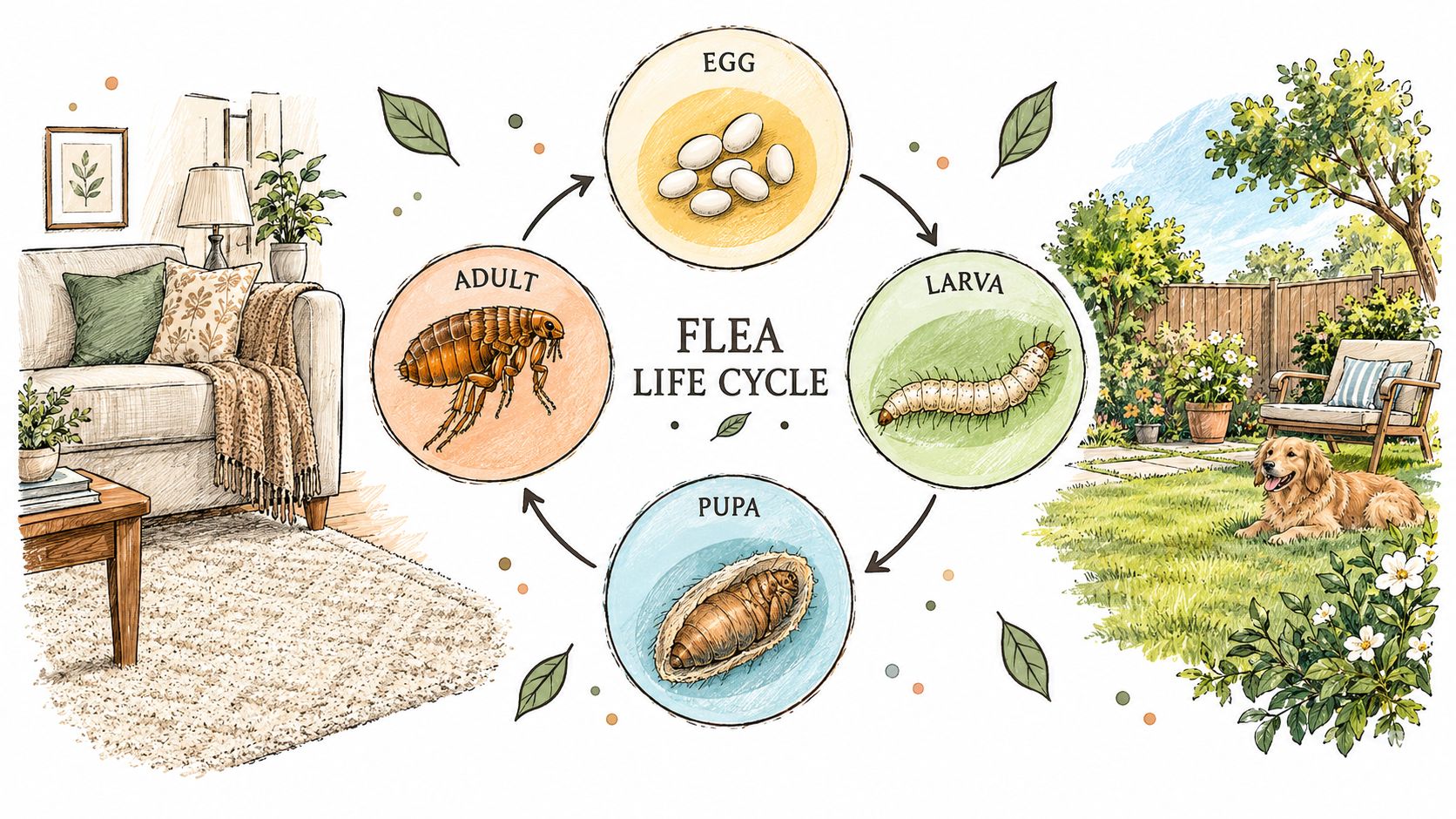
Fleas complete four stages, egg, larva, pupa, and adult, and a female can lay approximately 40 eggs per day, according to Cornell Veterinary Medicine's flea management guidance. Eggs fall from the animal into carpet fibers, pet bedding, floor cracks, and shaded resting places. A treatment that kills exposed adults can't automatically remove every immature stage already hidden around the property.
Practical rule: A flea sighting during the first few weeks is evidence that the cycle is still unwinding, not automatic proof that the treatment failed.
Two clocks run at once
The first clock measures adult-flea suppression on the pet. A suitable oral or topical product can begin reducing feeding adults the same day. The second clock measures household control, which depends on eggs, larvae, and pupae developing and emerging in sequence.
Magnolia's Gulf Coast conditions can keep that second clock active. Warm, humid conditions and shaded soil around porches, decks, crawlspace edges, and pet resting areas create more favorable shelter than a dry, exposed environment. The result is often a fast drop in adult activity followed by scattered sightings as new adults emerge.
That distinction matters when you're evaluating flea activity inside your home. Seeing fewer fleas on the pet but an occasional jumper indoors can mean the treatment is reducing the feeding population while the premises still contain earlier life stages.
A one-time spray may improve the visible problem, but it doesn't rewrite the biology of fleas. In Magnolia, a coordinated response has to account for suburban pets with yard access, multiple indoor resting sites, and the possibility that protected pupae will emerge after the first application.
The Flea Life Cycle and Why It Sets the Timeline
A flea problem moves between the animal and the environment. The pet supplies blood meals and transportation, while the home and yard hold most of the developing stages. Understanding that division explains why a single application rarely produces an instantly empty house.
From egg to larva
Eggs are laid on the animal but readily drop into the Magnolia living-room carpet, bedding, upholstery, and gaps along the floor. Larvae stay out of direct light and feed on organic debris, including flea dirt, in protected fibers and crevices. Vacuuming can physically remove some eggs and larvae, while cleaning disrupts the places where they develop.
The timing varies with conditions. University of Missouri Extension reports that a cat-flea life cycle can finish in as little as 20 to 35 days under normal conditions. It lists egg hatching at 2 to 14 days, larval development at 8 to 24 days, and a pupal stage of 5 to 7 days, though the pupal period can extend to about 1 year when conditions are unfavorable (University of Missouri Extension).
The protected pupa
The pupa is the stage that most often surprises homeowners. A larva spins a cocoon in carpet, beneath furniture, near baseboards, or in shaded outdoor soil. That cocoon shields the developing flea from many environmental stresses and makes this stage harder for surface insecticides to reach.
Vibration, body heat, and carbon dioxide from people or pets can stimulate an adult to emerge. A professional interior application may kill exposed adults and use an insect growth regulator to interfere with eggs and larvae, but protected pupae can still produce new adults later. Yard treatment has the same limitation if cocoons sit in sheltered, undisturbed areas.
Adult emergence
Once an adult emerges, it looks for a host, feeds, and can continue the cycle. A pet treatment targets this feeding stage, while vacuuming and premises work reduce the environmental reservoir. No single tool reaches every stage equally well, which is why the clock starts with treatment but ends only after repeated exposure and follow-up interrupt the cycle.
Realistic Timelines for Each Type of Treatment
A Magnolia homeowner may see fewer fleas on a treated dog the same day, then find adults jumping near a sofa or patio several days later. Gulf Coast humidity, shaded yards, and pets moving between the house and grass keep the infestation active after the first visible improvement. Treatment type affects the first result, but the property determines how long control takes.
As noted in the introduction, a controlled NexGard study found rapid adult-flea kill under approved study conditions. That result applies to the treated animal, not the carpet, crawl spaces, or shaded yard. In Magnolia homes where pets re-enter humid outdoor areas daily, an on-animal kill window does not shorten the environmental tail. Plan for premise follow-up rather than judging success by the pet alone.
Flea treatment timelines at a glance
| Treatment Type | First Visible Effect | Major Reduction Window | Full Household Control |
|---|---|---|---|
| Spot-on pet treatment | Adult activity on the pet may fall within hours, depending on the product | Noticeable reduction often develops during the first day | Requires environmental control and continued, label-compliant treatment for every pet |
| Oral flea medication | Some approved products start killing adult fleas within hours | Host control often becomes clearer during the first 24 hours | Fleas can continue emerging from the property for several weeks |
| Premise spray | Exposed adults may drop soon after application | Activity improves as treated surfaces affect newly emerged adults | Follow-up and coordinated pet treatment are often needed |
| Flea bomb | It may affect exposed areas reached by the product | Results depend on placement, coverage, and concealed harborages | Rarely resolves a full infestation because cocoons and untreated sites remain |
| Professional interior and yard service | Coordinated treatment can reduce exposed activity promptly | The first several weeks are used to intercept emerging adults and reach harborages | A Magnolia infestation commonly needs 3 to 8 weeks of coordinated control |
Oral tablets can suit a dog or cat that needs fast adult-flea control. Spot-ons may also act quickly, but bathing, application mistakes, an unsuitable product, or untreated pets can weaken the practical result. Use only products approved for that animal, and follow veterinary and label directions.
A pet may keep scratching after live fleas decline. Skin inflammation can last beyond the active infestation, and a veterinarian can help separate flea-related irritation from another condition. This dog itch relief guide provides general support while you assess the problem, but it does not replace premise treatment or veterinary advice.
Quarterly or biannual service plans fit Magnolia properties differently. A heavy infestation may need a targeted follow-up before routine visits resume, while recurring yard exposure makes scheduled inspections useful even after the home looks clear.
The practical sequence is consistent: the pet usually improves first, the interior follows, and the yard and protected pupae create the longest tail.
Indoor, Bedding, and Yard Treatments Compared
Indoor treatment, bedding care, and yard work solve different parts of the same problem. Treating one area while ignoring the others often creates the impression that a product didn't work, when the actual issue is untreated habitat.
Inside the home
Interior service focuses on rooms where pets rest and people spend time. Carpet edges, upholstery, beneath furniture, floor cracks, and pet pathways deserve attention because eggs and larvae fall away from the host and collect there. Vacuuming before and after treatment helps remove debris and immature stages, while repeated cleaning keeps disturbing the habitat.
A second interior application is commonly scheduled 10 to 14 days after the first when label directions and inspection findings support it. That timing is designed to address newly developing activity before it contributes to another wave of adults, although the exact schedule depends on the product and the site.
Bedding and laundry
Pet bedding can act as a concentrated harboring site. Wash removable covers and household linens according to their care labels, dry them thoroughly, and clean the area beneath the bed. Replacing or isolating heavily infested soft materials may be more practical than repeatedly treating items that cannot be cleaned effectively.
Bedding work doesn't replace pet or premise treatment. It removes one reservoir and helps prevent the animal from returning to the same contaminated resting place.
The yard
Outdoor pets can bring new adults inside from shaded soil, grass margins, porch edges, and protected areas beneath decks. Yard service therefore targets the harborages the pet uses most, not every square foot indiscriminately. The objective is to reduce re-entry pressure while the indoor plan deals with existing stages.
Magnolia homeowners should treat the yard as part of the home's flea boundary. Guidance on flea treatment for the yard can help you identify the outdoor areas that deserve attention instead of relying on an indoor spray alone.
Skipping the yard may not make an indoor treatment useless, but it can keep feeding the problem.
Factors That Slow Down Flea Control in Magnolia
Some infestations clear near the short end of the expected range. Others continue toward the long end because the environment keeps supplying new adults. Magnolia's local conditions make that difference visible.
Humidity and shade matter first. Shaded soil, covered patios, porch furniture, and protected spaces beneath decks can shelter immature stages longer than exposed, dry locations. A pet that spends time outdoors can also move between these areas and the living room repeatedly.
Every pet must be accounted for. If one dog receives treatment while another dog or cat remains untreated, adult fleas can continue feeding and reproducing. Multi-pet homes often need a coordinated veterinary-approved plan, not a product applied to whichever animal is easiest to catch.
Reused rugs and stored bedding can preserve flea habitat. Second-hand rugs, blankets stored in closets, and rarely moved pet beds may hold eggs, larvae, or pupae. Clean those materials appropriately before returning them to the pet's resting area. A separate pet-safe cleaning product guide can help you compare household cleaning options without confusing cleaning chemistry with flea medication.
Earlier over-the-counter use can complicate the picture. Incorrect dosing, incomplete coverage, repeated use of unsuitable products, or products that don't address immature stages can leave the homeowner with a partial result. Don't stack products or combine treatments without veterinary or label guidance.
Oklahoma State University Extension reports an egg-to-adult range of 12 to 190 days, with an average of 12 to 28 days, and notes that unstimulated cocoons can remain dormant for approximately six months (Oklahoma State University Extension). That wide range is why a quiet week doesn't always mean the premises are clear, and a single late sighting doesn't always mean the plan failed.
What to Expect Day by Day After Professional Treatment
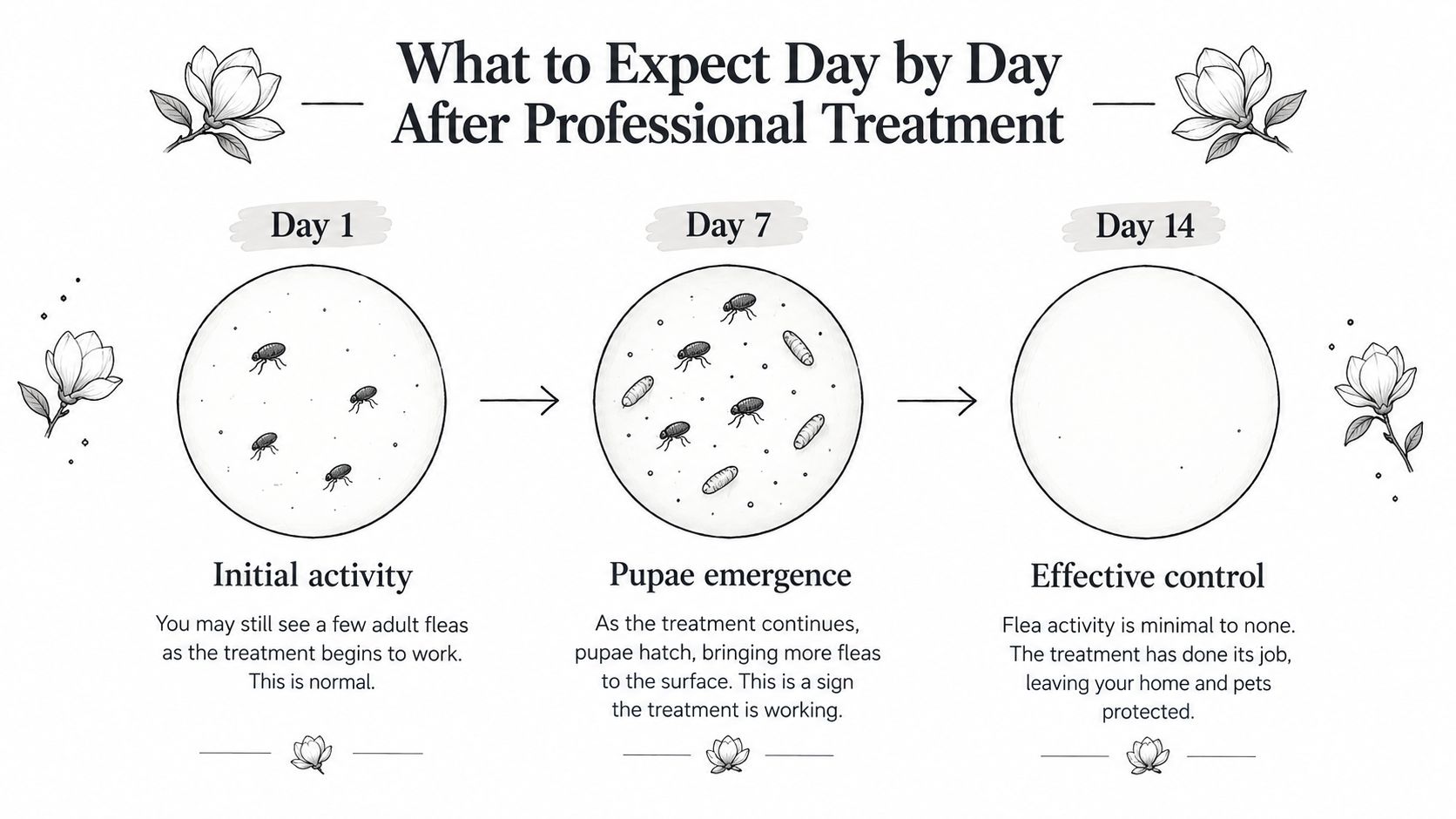
A normal Magnolia treatment timeline isn't perfectly linear. You should expect a sharp improvement in exposed adult activity, followed by occasional emergence from protected areas. The pattern matters more than one isolated flea.
The first checkpoints
Day 1: You may see very few adult fleas on the pet or indoors compared with the pre-treatment level. Some fleas may become more noticeable as they move through treated areas or seek a host, so don't judge the entire program by the first evening.
Day 7: A temporary uptick can occur as pupae respond to household movement, warmth, and pet activity. The correct response is continued cleaning and observation, not an immediate assumption that the application was ineffective.
Day 14: If a second interior visit is part of the plan, this is a common point for follow-up based on label directions and inspection findings. Flea activity should be trending downward, though a few newly emerged adults may still appear.
For practical preparation and aftercare, use this homeowner checklist for a successful flea treatment. It helps keep cleaning, pet coordination, access, and follow-up aligned with the treatment.
A short video can also help you visualize why control continues after the first application:
The longer checkpoints
Day 30: Under a coordinated pet, indoor, and yard plan, the infestation should be substantially quieter. A small number of fleas can still reflect residual emergence, especially where cocoons were protected.
Day 60: Activity should be close to resolved in a responsive, consistently managed infestation. Continued regular sightings at this point call for an inspection of untreated pets, outdoor harborages, missed interior areas, or product and application issues.
The key signal is direction. Fewer fleas, less flea dirt, reduced scratching, and longer gaps between sightings suggest progress. A stable or rising pattern suggests the plan needs adjustment.
How Magnolia Service Plans Shorten the Timeline
A structured service plan works because it joins the three places that keep the cycle alive, the pet, the home, and the yard. The homeowner or veterinarian manages approved pet medication, while the pest professional evaluates interior harborages and outdoor areas where adults and immature stages may persist.
FullScope Pest Control describes flea service for the north-Houston area as a process involving inspection, interior treatment, insect growth regulator use, repeated applications where needed, and follow-up rather than a single isolated spray. Its Magnolia service context fits the city's location in southwestern Montgomery County, at the junction of FM 1774 and FM 1488, about 45 miles northwest of Houston and 25 miles southwest of Conroe, according to the City of Magnolia location information.

What a coordinated plan changes
A one-shot interior application can reduce exposed fleas but leave the homeowner waiting through the emergence cycle. A coordinated plan creates several opportunities to intercept adults and reduce the places where eggs and larvae develop.
Ask a Magnolia-area provider how the plan handles:
- Pet coordination: Whether every dog and cat needs veterinary-approved treatment at the same time.
- Interior coverage: Which rooms, floor edges, upholstery, bedding areas, and inaccessible harborages require attention.
- Outdoor pressure: Whether shaded pet resting areas, porch edges, and yard harborages are included.
- Follow-up timing: What triggers a return visit and how observed activity changes the schedule.
- Long-term protection: Whether quarterly or biannual visits address broader pest pressure after the flea infestation is controlled.
Quarterly service can make sense for homes with recurring outdoor exposure or broader seasonal pest concerns. Biannual scheduling may suit lower-pressure properties, but neither schedule replaces the initial flea-control sequence when an active infestation is already present. The first objective is to finish the cycle. Ongoing service helps reduce the chance that a new outdoor introduction becomes another indoor problem.
When to Call a Magnolia Pest Professional Sooner
A few fleas during the early emergence period can be normal. You shouldn't wait indefinitely when the pattern points to an uncontrolled source.
Call for an inspection sooner if adult activity continues regularly past week 6, especially when sightings aren't becoming less frequent. That can indicate untreated pupae, missed harborages, continuing yard introduction, or a pet treatment problem that needs review.
Escalate promptly when multiple pets aren't receiving consistent treatment. One untreated animal can keep adults moving through the home even when the carpet has been treated. A pest professional can identify environmental sources, while a veterinarian should direct the medication plan for each animal.
Pay attention to flea dirt returning on freshly cleaned bedding. Dark specks that reappear after a clean period can indicate renewed feeding activity, particularly when accompanied by live fleas or persistent pet scratching. Bites around family members' ankles or lower legs also justify a closer look, since people may notice activity before they find the flea source.
Magnolia has grown rapidly. The city recorded 2,359 residents in the 2020 U.S. Census, while the Census Bureau estimated 5,320 residents on July 1, 2023, a 119.9% increase from the 2020 census base (U.S. Census Bureau QuickFacts). More homes and expanding residential areas mean service conditions vary widely between established neighborhoods, newer developments, and properties with larger shaded yards.
A Magnolia-area professional should inspect rather than just reapply the same product. The response may involve retreatment, better pet coordination, revised interior coverage, yard-focused work, or a longer maintenance plan.
If fleas are still appearing after your first treatment, contact a licensed pest professional serving Magnolia, Montgomery County, Conroe, and the north-Houston area. Ask for an inspection of the pets' resting areas, interior harborages, bedding, and yard, then request a written follow-up schedule so you know what should happen by the first week, the second visit, and the later control window.