1500+ reviews


Carpenter ant treatment costs about $250 to $500 for an accessible nest, while severe or hidden-nest cases can reach about $1,500. Structural repairs add more and aren't necessarily included in the extermination quote.
The bigger financial risk is confusing a treatment price with the price of solving the entire problem. A technician may eliminate the ants while a separate contractor repairs a leak, replaces damaged framing, or restores an opened wall. To compare estimates fairly, you need to know what the technician found, what the quoted work will reach, and how control will be verified.
What Carpenter Ant Treatment Costs by Scope
A carpenter ant treatment quote covers only part of the potential expense. The work may also involve inspection, access to concealed nests, follow-up, and repairs to damaged or damp wood. Planning ranges help compare scopes, but they are not fixed prices for Magnolia homes.
Carpenter ant treatment cost by scope of work
| Scope of work | Typical cost | When it applies |
|---|---|---|
| Inspection and diagnosis | Provider-set fee; ask whether the visit is free | Locating the nest and checking for conditions that support activity |
| Localized nest or trail treatment | $250 to $500, the standard treatment estimate published by The Pest Control Brief | An accessible nest outside or near the foundation |
| Interior void dusting or drilling | Within the publication's $250 to $1,500 severe-case planning range | A concealed nest inside wall voids |
| Severe or multi-nest treatment | Up to about $1,500 under the same severe-case estimate | Several nests or extensive treatment work |
| Recurring monitoring | $40 to $70 per month, as estimated by The Pest Rangers, or an annual contract priced separately | Ongoing monitoring after initial treatment |
| Structural and moisture repairs | Assessed after inspection; depends on the extent of framing damage and needed moisture correction | Damaged framing or wet wood |
The table separates pest-control work from repairs. A treatment quote may cover locating and treating ant activity, while a separate assessment is needed to determine whether wood repairs or moisture corrections are required. FullScope Pest Control offers free estimates and inspections, which can clarify the proposed treatment scope.
For a straightforward case, the quoted work may focus on an accessible nest or trail. Concealed activity can require added access work, while multiple nests may broaden the treatment area. Each added task should correspond to inspection findings.
Separate treatment from the surrounding work
Recurring monitoring is a different service from eliminating an active colony. Ask whether a maintenance agreement includes carpenter-ant treatment or only ongoing inspections and applications.
Repair costs also depend on what an inspection finds. The amount of damaged framing and the work needed to correct moisture conditions determine the repair scope.
For more context on comparing ant service estimates, see this guide to ant pest-control costs. Match the quote to the findings, then ask what supports any additional work.
Cost Factors That Move the Final Bill
Diagnostic work and access often matter more than the insecticide itself. A technician who can trace a trail to an exposed nest has a different assignment from someone investigating intermittent activity behind finished walls.
Iowa State University Extension's historical guidance reports professional prices of approximately $25 to $1,000, with extensive wall-void drilling, dusting, and monthly service at the high end. Because that guidance dates from 1993, its range isn't a current local quote; its useful finding is the relationship between scope, labor, and price.
Inspection should establish which wood-destroying insect is present before the technician prices treatment.

Cost factors and how they change the bill
| Cost factor | Lower-cost case | Higher-cost case |
|---|---|---|
| Nest accessibility | Visible nest reachable from outside | Nest inside wall voids, roof, or crawl space |
| Infestation extent | One colony with a single satellite nest | Multiple satellite nests or workers across floors |
| Structural access | Open garage or accessible crawl space | Finished walls that need drilling and patching |
| Moisture condition | Dry, sound wood | Decayed or water-damaged framing |
| Termite overlap | Carpenter ants only | Termite activity requiring a separate program |
| Visits required | One treatment and one check | Several visits over several weeks |
Nest accessibility determines how much investigation precedes application. For example, an exterior nest may be directly reachable, while a roof-space nest requires access arrangements and additional inspection.
Infestation extent changes the search area. Workers upstairs and downstairs don't automatically prove separate nests, but they do justify tracing activity rather than pricing only the first visible trail.
Translate each finding into a line item
Structural access is distinct from nest location. A colony may be located precisely yet remain expensive to reach because a finished wall needs drilling, protection of nearby surfaces, and later patching.
Moisture condition adds building work rather than more pesticide. Termite overlap adds a separate diagnosis and control proposal, not an unspecified surcharge to the ant treatment.
Finally, visits represent technician time for evaluation, replenishment, or retreatment. Ask the estimator to distinguish included verification from separately billed additional work.
Estimate test: Every higher-cost recommendation should connect an observed condition to a named task.
Iowa State's guidance cautions that extensive wall-void work can be proposed even where activity hasn't been confirmed. Ask which factors apply to your house, what evidence supports them, and which line item each adds to the bill.
Localized Treatment Versus Whole-Structure Treatment
Localized treatment targets a confirmed nesting area or activity route. A whole-structure program investigates and treats a broader network of interior voids, entry points, and moisture-prone locations.
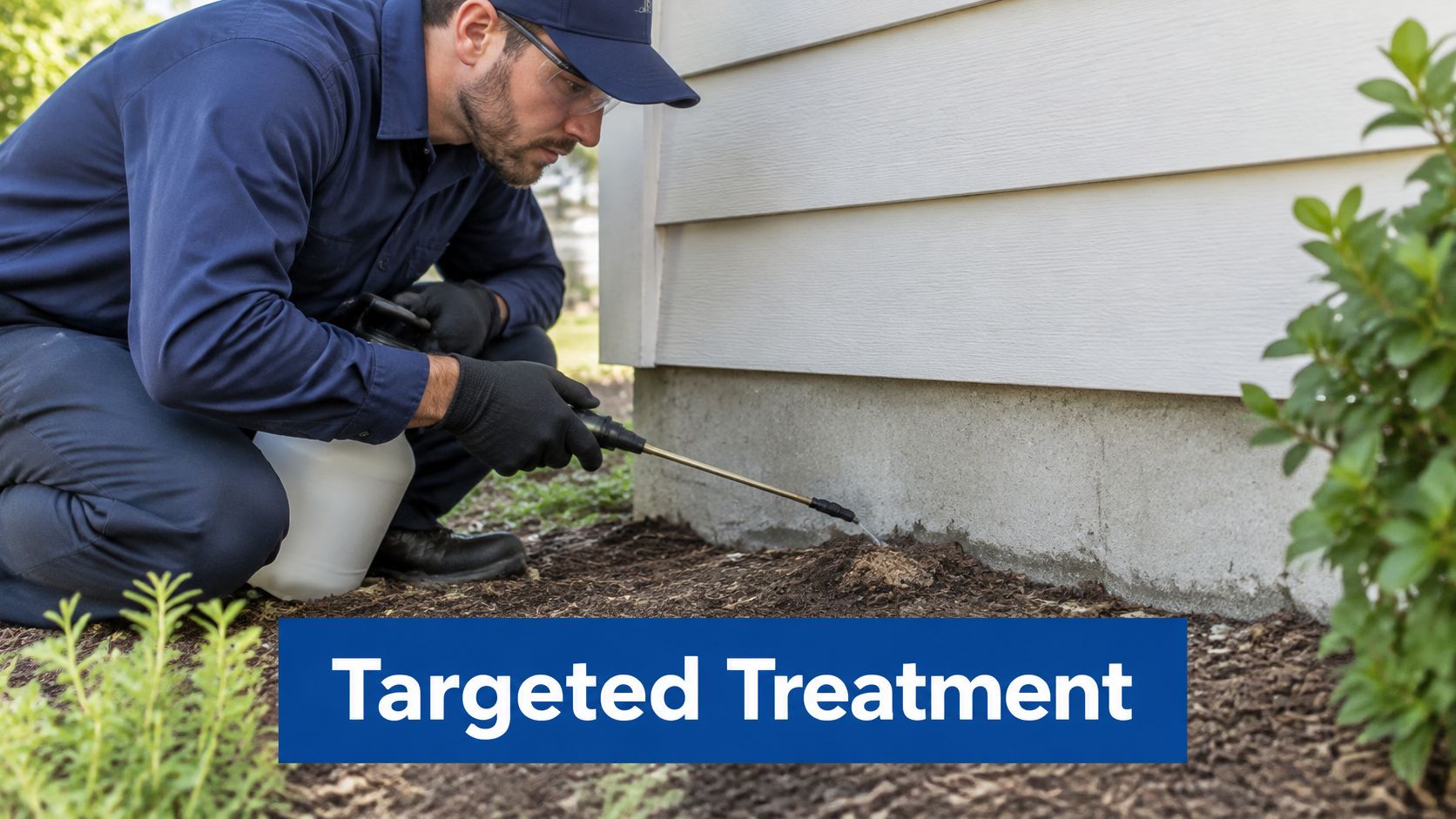
Targeted foundation work illustrates why an application can involve several methods without becoming a whole-house project.
Texas A&M AgriLife Extension states that carpenter ants in Texas rarely cause significant structural damage and advises weighing control costs against the expected benefit. A few workers or an occasional swarm therefore shouldn't, by themselves, become the justification for an extensive treatment program.
A foundation-level job versus concealed interior activity
Consider a hypothetical trail running from a garden bed to an accessible nest beside the foundation. A technician might place perimeter bait stations, apply an appropriate foundation treatment, treat the nest directly, and seal the garage-threshold opening used by the ants. No wall needs opening, so access labor stays limited.
A documented Kingwood ant treatment provides a real operational comparison. Our team applied granular bait along the perimeter, sprayed a liquid barrier around the foundation, treated two active mounds, and sealed garage-door-threshold entry points with foam. That was an ant job, not evidence of a confirmed carpenter-ant colony, but it shows why method count alone doesn't define an expensive scope.
The accompanying video provides additional treatment context.
Choose scope from evidence
A reachable nest connected to a visible exterior trail, without evidence of interior nesting, supports a localized proposal. Swarmers emerging from wall openings, frass in separate rooms, or activity associated with distinct structural locations justify a broader investigation.
Those signs aren't a license to treat every wall indiscriminately. The technician still needs to distinguish a confirmed nest from a suspected location.
A large house with a reachable nest can require less work than a small house with a concealed colony.
Read the proposed treatment zones, access locations, and exclusions. Those details tell you more about the assignment than labels such as “complete treatment” or “whole-home protection.”
Baiting, Dusting and Follow-Up Visit Costs
A treatment quote covers more than product application. Baiting, direct nest treatment, access work, and follow-up checks can all affect the total cost, and the right mix depends on where the colony is active.
Carpenter ant treatment methods and their follow-up needs
| Method | Where it is used | Cost pattern | Follow-up |
|---|---|---|---|
| Perimeter bait stations | Foraging routes outside the foundation | Lower access labor, often incorporated into the initial visit | Recheck before declaring control |
| Liquid trail or nest treatment | Visible trails and reachable nests | Standard-treatment scope when access is straightforward | Recheck named in the written scope |
| Void dusting | Wall voids and hidden galleries | Higher diagnostic and access labor | Monitor for returning activity |
| Drilling and void injection | Concealed nests inside framing | More invasive access work within an extensive-treatment scope | Follow-up plus moisture correction |
| Scheduled monitoring | Sites needing continued observation | Separately priced contract service | Periodic checks specified by contract |
Colony elimination can take more than one visit over a period of weeks. The disappearance of visible workers alone does not confirm control, so a proposal should specify how activity will be reassessed.
Perimeter stations can be serviced without opening construction materials. Their placement still needs to match active foraging routes, and the technician should explain what feeding or activity they expect to reassess.
Liquid treatment can address reachable nesting areas, but treating a visible trail may not reach the colony. The application method alone does not show whether the treatment covers the full infestation.
Access changes the labor requirement
Void dusting requires identifying where ants are nesting or traveling. Drilling adds access work, with suitable points chosen to avoid wiring, plumbing, and finishes.
The same suspected nesting location can generate different proposals depending on whether the technician can reach it through an existing opening or needs access through construction materials. Ask why the method is proposed and what evidence supports the treatment area.
FullScope Pest Control uses Integrated Pest Management, applying the lowest level of insecticide and baiting needed to address a pest problem. In a recent Kingwood ant treatment, a follow-up was recommended in 30 days to confirm full elimination. That recommendation applies to the documented job, not every infestation.
The carpenter ant treatment FAQs address practical treatment questions. Before accepting a proposal, establish:
- Included visits: Which evaluation and application visits are covered?
- Unresolved activity: What triggers an additional charge rather than covered retreatment?
- Verification date: When will the technician reassess activity, and what findings will establish control?
Put the recheck date and any retreatment terms in writing. Without them, the quoted application price leaves the cost of verifying control unclear.
Moisture Repairs and Termite Overlap Costs
The cheapest treatment can become the most expensive job if it leaves the moisture source in place. Eliminating ants and correcting the building conditions that supported them are connected tasks, but they aren't necessarily performed or billed by the same contractor.
Pennsylvania State University Extension notes that carpenter ants usually don't infest sound wood with moisture content below 15%. It also emphasizes correcting moisture defects and explains that moisture-related decay may cause more structural damage than the ants themselves.
Budget for the source of the wet wood
A technician finding damp framing should identify the affected location and recommend appropriate building assessment. A moisture meter helps characterize the condition, but the contractor still needs to identify where the water comes from.
The correction plan may include:
- Roof and gutters: Repair flashing or leaks and restore drainage away from vulnerable wood.
- Plumbing: Repair leaking supply fittings, waste connections, or other identified defects.
- Crawl spaces: Assess ventilation, drainage, and persistent dampness.
- Exterior openings: Seal utility penetrations and correct water-entry details.
- Decayed material: Assess affected wood before deciding what can remain and what requires replacement.
For a practical explanation of drying before restoration, Eagle Restoration's resource on drying wood to safe moisture levels helps frame the questions to put to a repair contractor. Drying and cosmetic refinishing aren't substitutes for assessing compromised framing.
In humid Southeast Texas, ask for the moisture correction to be assigned to a responsible contractor rather than left as a vague recommendation. Otherwise, you may authorize pest work without resolving the building condition.
Keep termite work financially separate
Correct identification matters because termite protection isn't carpenter-ant treatment. Our comparison of termites and carpenter ants helps homeowners understand why the treatment proposals differ.
Termite baiting works gradually rather than instantly, so it's often most useful when activity is found before damage escalates. Our Ultra Shield Platinum plan has an initial Pest & Sentricon installation fee of $900 plus tax. That combined plan price isn't a stand-alone carpenter-ant treatment quote.
Keep ant control, termite protection, and building repairs on separate lines, even when one inspection identifies all three needs.
A home-purchase wood-destroying insect inspection is also a separate reporting service. We provide fast response and digital reporting for home buyers, but don't assume a transaction report is included in an ordinary treatment estimate; confirm its scope and any separate cost.
Magnolia, Texas Service Area
Magnolia, Texas is a specific location, not a substitute name for the entire North Houston market. The Magnolia economic-development community profile places the city in southwestern Montgomery County, within the Houston metropolitan area and the county's growth corridor.
The City of Magnolia's location page identifies its position at FM 1774 and FM 1488, approximately 45 miles northwest of Houston and 25 miles southwest of Conroe. These roads and nearby communities provide a more useful dispatch reference than saying a property is near Houston.
City limits aren't the whole Magnolia area
The U.S. Census Bureau's Magnolia profile records 2,359 residents and 2.87 square miles of land in the incorporated city in 2020. A Magnolia mailing address may therefore refer to a different service geography than the municipal boundary.
When discussing wider coverage, Magnolia and surrounding Montgomery County communities is the clearer description. Provide the property's actual address when arranging service, especially for rural roads, gated properties, or locations beyond the city.
What location can change in an estimate
A wooded lot may call for investigation beyond the foundation if ant trails lead toward outdoor nesting areas. An older property may need closer assessment of past leaks and repaired framing. Newer construction still warrants inspection of penetrations and construction gaps.
These are possible inspection needs, not evidence that every Magnolia home requires extensive work. Any travel charge, access arrangement, or expanded search area should be disclosed rather than folded into an unexplained local premium.
FullScope Pest Control's established service locations include Cleveland, Kingwood, Conroe, and Porter, with coverage across nearby North Houston and Southeast Texas communities. Magnolia dispatch coverage isn't confirmed here, so confirm availability for your address before booking.
When contacting the team, ask whether it can dispatch to your exact address and whether travel charges apply. FullScope Pest Control offers free inspections and estimates; confirm that the requested visit falls within that service. Ask for a written proposal identifying treatment zones, access work, and exclusions.
Confirm the Scope Before You Approve a Quote
A low one-time price may cover visible trail treatment without addressing suspected satellite nests, wall-void investigation, exclusion, or verification. The meaningful comparison is the complete assignment, not the smallest advertised starting price.
For an additional published benchmark, PestPin's ant-control cost guide estimates carpenter-ant and other wood-nesting pest work at $250 to $600, with annual monitoring at $150 to $400. Those categories help distinguish an initial treatment from a monitoring agreement; they don't establish what either contract includes.
Use a line-item approval checklist
Require the proposal to separate:
- Inspection and diagnosis: Confirmed evidence, suspected nest locations, and areas not inspected.
- Initial application: Whether we're treating a trail, a suspected nest, or a broader infestation.
- Access work: Proposed drilling or openings, plus responsibility for patching.
- Follow-up terms: Recheck timing, verification criteria, and any exclusions.
- Moisture correction: Identified defects and the contractor responsible for them.
- Exclusion: Entry points to be sealed and materials included.
- Carpentry: Wood assessment and replacement, priced separately where required.
- Monitoring: Covered pests, service schedule, cancellation terms, and annual cost.
If pests return between treatments, we retreat at no additional cost. Have the applicable service terms recorded in your agreement so the policy and purchased scope are clear.
Don't assume insurance will pay
The Retcho Agency's infestation-coverage overview explains that standard homeowners insurance generally excludes infestation removal and gradual carpenter-ant damage. A separate sudden covered event, such as a pipe leak, may be treated differently from the insect damage itself.
Ask your insurer about the specific loss before allocating insurance proceeds to pest control or repairs. Document the evidence and address urgent safety or water problems without assuming cosmetic restoration should begin before the underlying conditions are resolved.
Request a written scope from FullScope Pest Control and a comparable proposal from another provider before booking an inspection. We offer a free residential pest-control quote; provide your address, photos of activity, and any known leak history, then compare the proposals line by line rather than choosing on the initial treatment price alone.