1500+ reviews

You find a small pile of sawdust beneath a window frame, then notice a few winged insects near the glass. Outside, a narrow line of mud runs along the foundation. Are you dealing with termites or carpenter ants? The answer matters, but identification is only the first decision. You also need to know whether the insects are creating a nuisance, exploiting damp wood, or feeding inside structural members where damage can remain hidden.
Termites and carpenter ants need different responses. Carpenter ants excavate wood for nesting, while termites consume cellulose. A visible ant trail can look alarming, yet concealed termite activity may represent the greater structural threat. This guide focuses on the practical question homeowners in Magnolia, Texas, and nearby Southeast Texas communities need answered: how urgent is the damage, and when should a professional inspect it?
Why Homeowners Confuse Termites and Carpenter Ants
A Magnolia homeowner notices movement around a damp fascia board after a humid spell. The insects are dark, winged, and gathered near wood. A quick search produces pictures of termites and carpenter ants that look similar at a glance, so the homeowner sprays the visible insects and waits.
That's the wrong stopping point. Both pests are associated with wood, both can produce winged reproductive insects, and both may appear around homes with moisture problems. The visible insects may be only a small part of the colony, and the most important evidence may be inside a wall, under flooring, or near a foundation rather than on the surface.
The confusion becomes costly when homeowners treat the wrong problem. A carpenter-ant treatment may reduce activity without addressing termite feeding. A termite product may be unnecessary for an isolated carpenter-ant nest in a decaying stump, while leaving the moisture source untouched allows the ants to return.
Practical rule: Identify the insect, then identify the damage pattern. The second answer determines urgency.
Visibility can distort the risk
Carpenter ants often draw attention because homeowners can see workers, frass, or movement emerging from a trim board. Their galleries may be close to the surface, and their debris can collect where it's easy to notice. Termites can work behind surfaces and within wood, leaving fewer obvious clues until damage becomes advanced.
That doesn't mean every carpenter-ant sighting is harmless. A nest inside a beam, joist, fascia board, or wall void deserves inspection, especially if the wood has softened from leaks or persistent humidity. It does mean that a homeowner shouldn't rank risk by insect visibility alone.
The distinction between winged termites and winged ants can help with the first visual question, but a photograph rarely establishes how far an infestation has spread. Treat the image as a clue, not a structural diagnosis.
The question to ask before choosing a treatment
Ask three practical questions:
- What evidence is present? Mud tubes and rough, concealed damage point in a different direction than sawdust-like frass and smooth galleries.
- Where is the activity? A dead outdoor stump is not the same risk as a sill plate, floor joist, attic beam, or fascia board.
- Is moisture involved? Damp wood can attract carpenter ants and also create conditions that support termite access and concealed activity.
If you find mud tubes, hollow or weakened structural wood, repeated winged activity indoors, or damage that you can't inspect fully, skip guesswork. Arrange a professional wood-destroying insect inspection.
Physical Identification and Behavioral Differences
Start with the body, not the color. Color varies among species and life stages, but body structure and damage evidence provide more dependable clues.
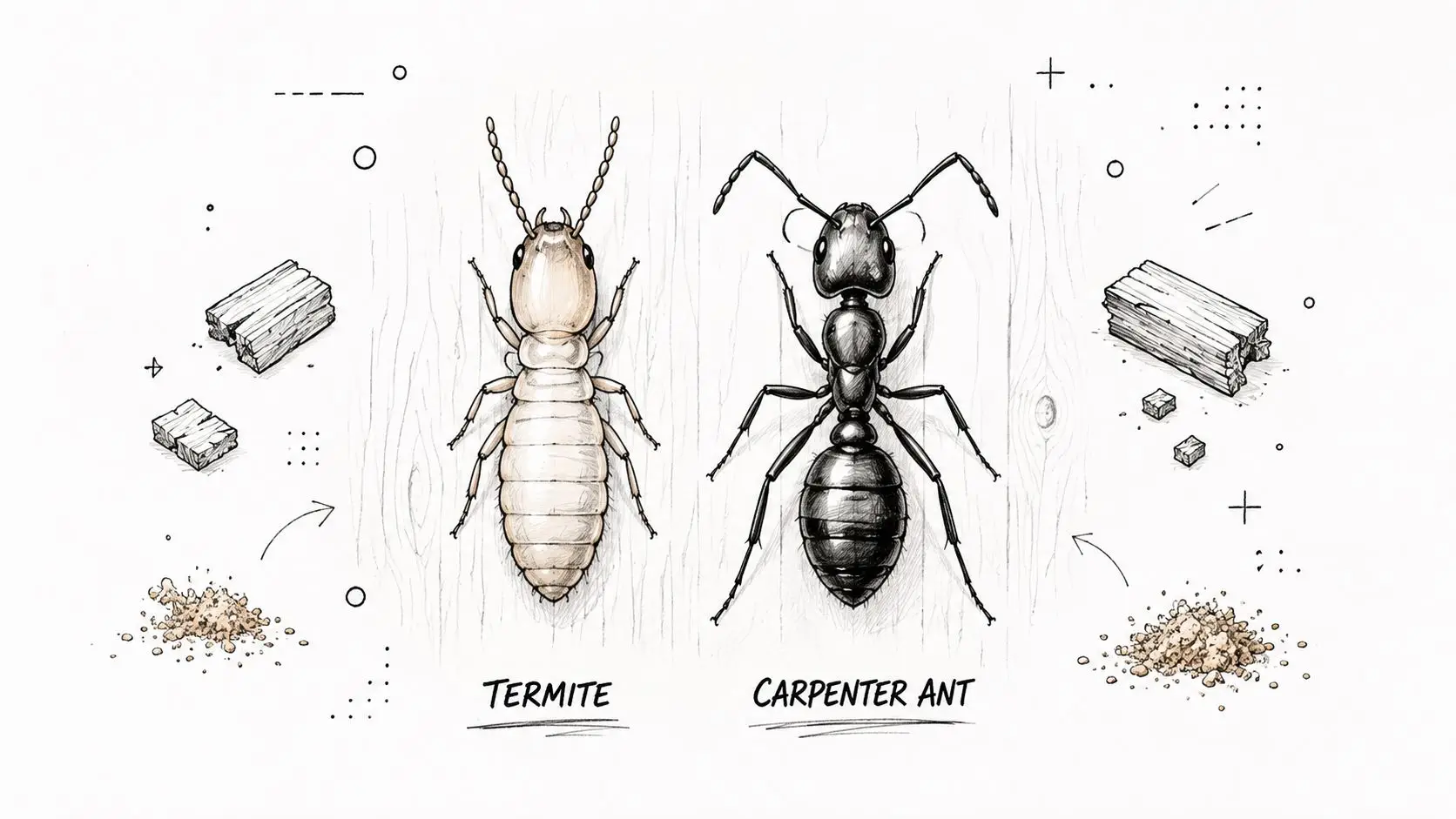
Carpenter ants have a pinched waist, elbowed antennae, and a distinctly segmented body. Their winged forms have two pairs of wings, with the front pair longer than the hind pair. Workers are typically dark, though some species show reddish coloring. Carpenter ants carry debris out of galleries, so sawdust-like frass beneath an opening is an important sign.
Termites have a broad, straight-sided waist and straight antennae. Their winged forms have pairs of wings that are similar in length, and shed wings may collect near windows, doors, or other light sources. Worker termites are pale, and termite damage can leave wood hollowed into a honeycombed internal structure.
Termites vs Carpenter Ants Key Identification Features
| Feature | Termites | Carpenter Ants |
|---|---|---|
| Waist | Broad and straight, without a narrow pinch | Narrow, visibly constricted between body segments |
| Antennae | Straight | Elbowed |
| Winged form | Wing pairs are generally equal in length; shed wings may remain nearby | Front wings are longer than hind wings |
| Food source | Feeds on cellulose in wood and other plant material | Doesn't eat wood, excavates it for nesting |
| Gallery appearance | Often concealed, rough, or packed with soil and debris | Usually smooth and clean, with sanded-looking surfaces |
| Common field evidence | Mud tubes, concealed damage, hollowed wood | Sawdust-like frass, active workers, clean galleries |
| Moisture relationship | Subterranean activity often connects soil and wood through protected routes | Frequently nests in moisture-damaged or decayed wood |
The common types of ants and their identifying features can provide useful background, but homeowners should avoid relying on one feature alone. A dark insect isn't automatically a carpenter ant, and a winged insect near a window isn't automatically a termite.
Read the evidence around the insect
Mud tubes are one of the most actionable termite indicators. Termites use protected, soil-lined routes to travel between their colony and a food source. A tube along a foundation wall, pier, crawl-space surface, or concealed interior route warrants attention, particularly if it connects soil to structural wood.
Carpenter-ant frass looks more like coarse sawdust or wood shavings. It may appear beneath a crack, trim joint, beam, window frame, or other gallery opening. Smooth gallery walls suggest excavation rather than consumption, but that distinction doesn't tell you whether the colony is outdoors or inside the house.
Don't crush the evidence before an inspection. Photograph the insects, retain shed wings or debris in a container, and mark the exact location where you found the activity. The location often tells a technician more than the insect's color.
Understanding the Biology and Damage Patterns
The central biological difference is simple: termites eat cellulose, while carpenter ants excavate wood for shelter. That difference explains why the same piece of damaged lumber can represent very different risks.
Termites can feed through sound wood and gradually convert its interior into a honeycombed structure. The exterior may look intact while the inside loses strength. Carpenter ants generally prefer wood softened by moisture, decay, or other deterioration, then create smooth galleries for nesting rather than consuming the wood as food. Guidance from the U.S. Forest Products Laboratory on wood-destroying insects identifies these contrasting damage signatures as important inspection clues.
Why hidden termite activity deserves priority
A carpenter-ant colony can signal a moisture problem that needs correction. A termite colony can signal active consumption of structural cellulose. The two findings may occur in the same house, but they don't carry the same interpretation.
Termites often move through protected routes and work inside wood, which makes casual inspection unreliable. Carpenter ants more often leave visible workers, frass, and clean galleries, giving homeowners a better chance of locating the immediate nesting area. That visibility can make carpenter ants feel more dangerous even when termite activity presents the larger structural concern.
Colony biology also changes the treatment decision. Eliminating visible workers doesn't necessarily remove a hidden nest. With carpenter ants, the technician needs to locate the nest and correct the moisture or decay that made the wood suitable. With termites, the plan must address the colony's access and feeding routes, not merely the insects seen indoors.
This is why termite damage can threaten a home's structure, even when no large swarm is visible. The absence of obvious insects doesn't prove the absence of active feeding.
What the larger economic picture means for a homeowner
Termites are among the most economically important wood-destroying insects worldwide. A World Bank report on termite damage estimated annual structural damage costs in urban areas at about $15 billion to $20 billion globally, with agricultural and forestry losses raising total societal costs above $30 billion per year. Other literature summarized in that material places the global cost above $40 billion annually, reinforcing that termite damage is an infrastructure and property-management issue, not a minor maintenance annoyance.
Inspection Strategies for Southeast Texas Homes
Inspect the transition points first. In Southeast Texas, a home's foundation, crawl space, attic, exterior trim, fences, stumps, and firewood can all reveal where insects are entering or nesting.
Begin outside and follow the wood
Walk the foundation perimeter and look for narrow mud tubes, especially where soil, mulch, slabs, or vegetation meet the structure. Check piers, crawl-space walls, sill areas, porch supports, and wood-to-ground contact points. Don't remove a suspicious tube immediately. An intact tube gives an inspector useful evidence about the route and whether activity may be current.
Next, examine damp or deteriorated wood. Focus on leaking gutters, poorly drained areas, hose connections, roof edges, fascia, window trim, deck attachments, and siding near wet soil. Carpenter ants commonly use dead wood outdoors, including old stumps, dead tree sections, fences, and firewood. Indoors, Texas A&M guidance identifies shingles, siding, beams, joists, and fascia boards as possible nesting locations, and reports fourteen carpenter-ant species in Texas in its School IPM guidance.
Use the right clue for the right pest
A flashlight, screwdriver, camera, and moisture meter can improve a homeowner's preliminary inspection. Use the screwdriver only to test already exposed, visibly deteriorated wood. Don't probe aggressively through finished surfaces or rely on a hollow sound alone to diagnose termites.
Look for:
- Mud tubes or rough-packed concealed damage. These findings raise the termite priority because they suggest protected movement or internal feeding.
- Sawdust-like frass beneath openings. This points toward carpenter-ant excavation, especially when paired with smooth gallery surfaces.
- Wing evidence near windows and doors. Save shed wings and photograph the insects before cleaning.
- Moisture-linked activity. A leak or decayed stump may explain carpenter ants, but it doesn't rule out termites.
Decide whether the activity is a nuisance or a structural concern
An isolated carpenter-ant trail leading to a decaying stump may be an exterior nuisance, provided the house has no connected damage or indoor activity. Ants emerging from a beam, fascia board, joist, sill, or wall opening deserve a professional assessment because the nest may be inside structural wood.
Treat mud tubes as an inspection trigger, not a cosmetic defect. If a tube reaches structural wood, reappears after removal, or appears in a crawl space, professional inspection should come before treatment. The same applies when you find repeated frass, weakened wood, multiple emergence points, or winged insects indoors.
Magnolia is an incorporated city in Montgomery County, within the Houston metropolitan area. The city's geographic profile lists a 2024 population of 5,836 and an area of about 5.7 square miles, so a service provider should distinguish Magnolia municipal service from the broader postal area and surrounding unincorporated development.
Treatment Options and Prevention Strategies
Treatment should follow the pest and the pathway, not the homeowner's first guess. Carpenter-ant control focuses on finding the nest, treating active galleries or entry routes, and correcting moisture. Termite control focuses on stopping access and protecting the structure through a professionally selected treatment or monitoring plan.
Carpenter-ant treatment targets the nest and the moisture
Spraying workers as they cross a countertop may provide temporary relief, but it rarely answers where the colony is located. A technician may trace activity to damp wall voids, roof edges, fascia, beams, joists, siding, or outdoor wood connected to the building.
The durable fix includes two parts:
- Eliminate the nesting site: Target the colony with an appropriate insecticide, bait, or localized treatment selected for the location.
- Remove the invitation: Repair leaks, improve drainage, replace decayed wood, manage firewood, and reduce contact between vulnerable wood and persistent moisture.
Sealing entry points helps after the nest and moisture source receive attention. Otherwise, ants may use another opening into the same damp area.
Termite treatment requires a broader protection plan
Termite activity can extend beyond the spot where you see damage. Depending on construction, access, and evidence, a professional may recommend a liquid termiticide treatment, a baiting and monitoring system such as Sentricon, or another targeted approach. The treatment must account for soil contact, foundation design, crawl-space conditions, slab penetrations, and vulnerable structural components.
DIY products can kill exposed insects without reaching the colony or protecting hidden entry routes. Misidentification creates the bigger problem. If termites are feeding behind a wall, treating only the visible edge delays the decision that matters, namely how to interrupt access and assess structural impact.
Prevention starts with moisture and separation
Southeast Texas homes benefit from disciplined moisture management. Keep gutters and downspouts directing water away from the structure, correct plumbing and roof leaks promptly, maintain ventilation where appropriate, and avoid storing firewood against siding. Keep exterior wood from sitting directly against soil when construction allows.
Schedule inspections based on the property's risk, previous activity, construction, and planned sale. A single visual check can miss concealed damage, while an ongoing monitoring plan can provide earlier warning where termite pressure or building conditions justify it.
The scale of termite damage explains why professional treatment can cost more upfront than a store-bought spray. The World Bank's termite assessment places global structural damage from urban termites at about $15 billion to $20 billion annually, and total societal costs above $30 billion when agricultural and forestry losses are included. For a homeowner, the practical lesson is direct: pay for accurate attribution before paying for the wrong treatment.
When to Call a Professional Pest Control Service
Call a professional when the evidence points inside the structure, below the structure, or beyond your ability to inspect safely. That includes mud tubes, repeated winged activity indoors, frass emerging from beams or trim, weakened wood, unexplained hollow areas, or damage near a foundation and crawl space.
Use clear action thresholds
You don't need to identify the species perfectly before requesting an inspection. You do need to preserve the evidence and report where it appeared.
Arrange prompt professional inspection if you find:
- Mud tubes: Especially on foundation walls, piers, crawl-space surfaces, or structural wood.
- Internal damage: Wood that sounds hollow, feels soft, or shows concealed rough-packed galleries.
- Repeated frass: Fresh sawdust-like debris below the same opening suggests an active carpenter-ant route.
- Indoor swarmers or shed wings: Repeated winged activity may indicate a nearby colony rather than an accidental visitor.
- Structural locations: Activity in joists, beams, sill areas, fascia, roof edges, or wall voids deserves more than surface treatment.
- A real estate transaction: A wood-destroying insect inspection and report can document findings for buyers, sellers, and agents.
Do not use visibility as your risk meter. The insects you see may be workers leaving a nest, not the colony itself.
Why DIY treatment often stalls
DIY treatment makes sense only for limited, clearly exterior nuisance activity with no sign of structural involvement. Even then, remove the moisture source and monitor the location rather than assuming the problem is solved.
An established colony inside a wall or structural member is different. Surface sprays may kill exposed insects while leaving the nest, feeding route, and damaged wood untouched. Termite treatment is especially unsuitable for trial-and-error application because the technician must evaluate the building and select a protection strategy that reaches the relevant access routes.
Professional monitoring also matters as climate and development patterns shift. Research on ants and termites at Purdue University includes work on termite range expansion under climate change and changing pest biology. Warming conditions, urbanization, and altered habitats can change where homeowners encounter these insects, so a property should be assessed according to local construction and environmental conditions rather than an outdated assumption about seasonal risk.
Working with FullScope Pest Control in Magnolia and Southeast Texas
For a Magnolia property, choose a provider that can identify the insect, document the damage, and explain the treatment decision in writing. Ask whether the inspection covers foundation areas, crawl spaces, attics, exterior wood, moisture conditions, and likely nesting sites. If you're buying or selling, request the appropriate wood-destroying insect inspection and report for the transaction.
FullScope Pest Control is one local option serving Magnolia and nearby communities, with locations and service coverage that include Cleveland, Kingwood, Conroe, Porter, Atascocita, Coldspring, Huffman, Humble, Livingston, Montgomery, New Caney, Splendora, Spring, and Willis. Its stated process includes inspection, a treatment plan, and ongoing protection, with termite services, carpenter-ant control, monitoring, targeted treatments, and wood-destroying insect reports.
Ask the technician to separate three findings clearly:
- The insect identified
- The evidence of active or previous damage
- The recommended treatment and prevention work
FullScope also states that it offers integrated pest management, QualityPro certification, low-toxicity options for homes with children and pets, one-time remediation, continuing maintenance plans, and follow-up service policies within stated windows. Compare those details with the scope of the problem, the property's construction, and your budget before authorizing work.
If you're in Magnolia, Conroe, Kingwood, or a surrounding Southeast Texas community, contact FullScope Pest Control to schedule a wood-destroying insect inspection. Preserve any insects, wings, frass, and mud tubes, and ask for a written explanation of whether the evidence indicates a nuisance nest or hidden structural activity.
Don't wait for the insects to identify themselves through expensive repairs. Schedule an inspection now if you've found mud tubes, indoor swarmers, fresh frass, or damaged structural wood, and have the provider document exactly what requires treatment and what moisture or access conditions need correction.