1500+ reviews


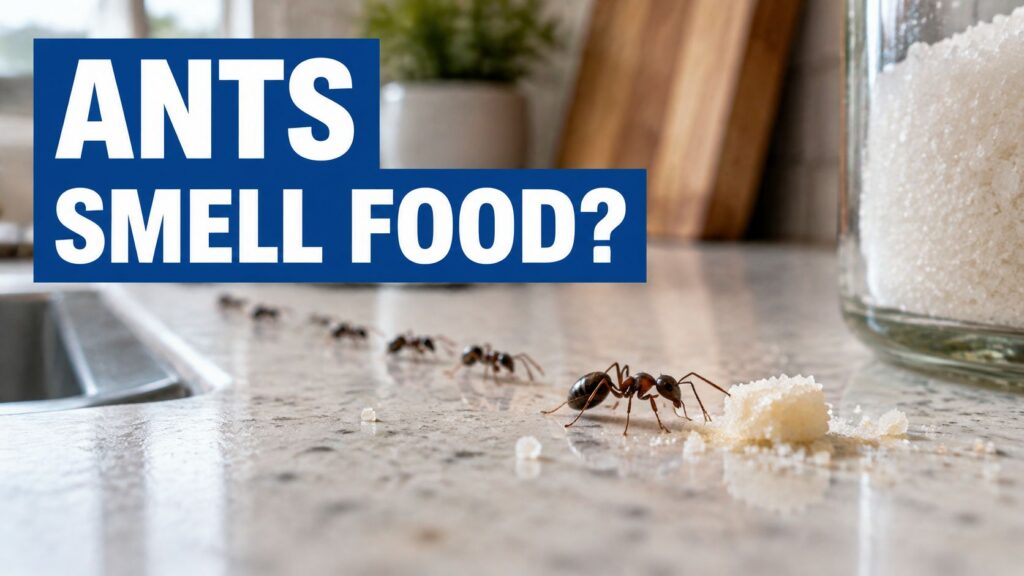
Yes, ants smell food mainly through chemical receptors on their antennae, using a two-stage process of airborne detection followed by contact sampling. Finding the food and recruiting nestmates are separate steps, which is why removing a crumb doesn't always stop an established trail.
You wiped the counter after dinner, put the leftovers away, and still woke up to ants beside the coffee maker. The missing piece may be a sticky residue you can't see, a nearby water source, or the chemical route workers have already marked.
Yes, Ants Smell Food Through Their Antennae
Say a drop of soda lands beside your toaster at bedtime. By morning, ants are walking between that spot and the backsplash.
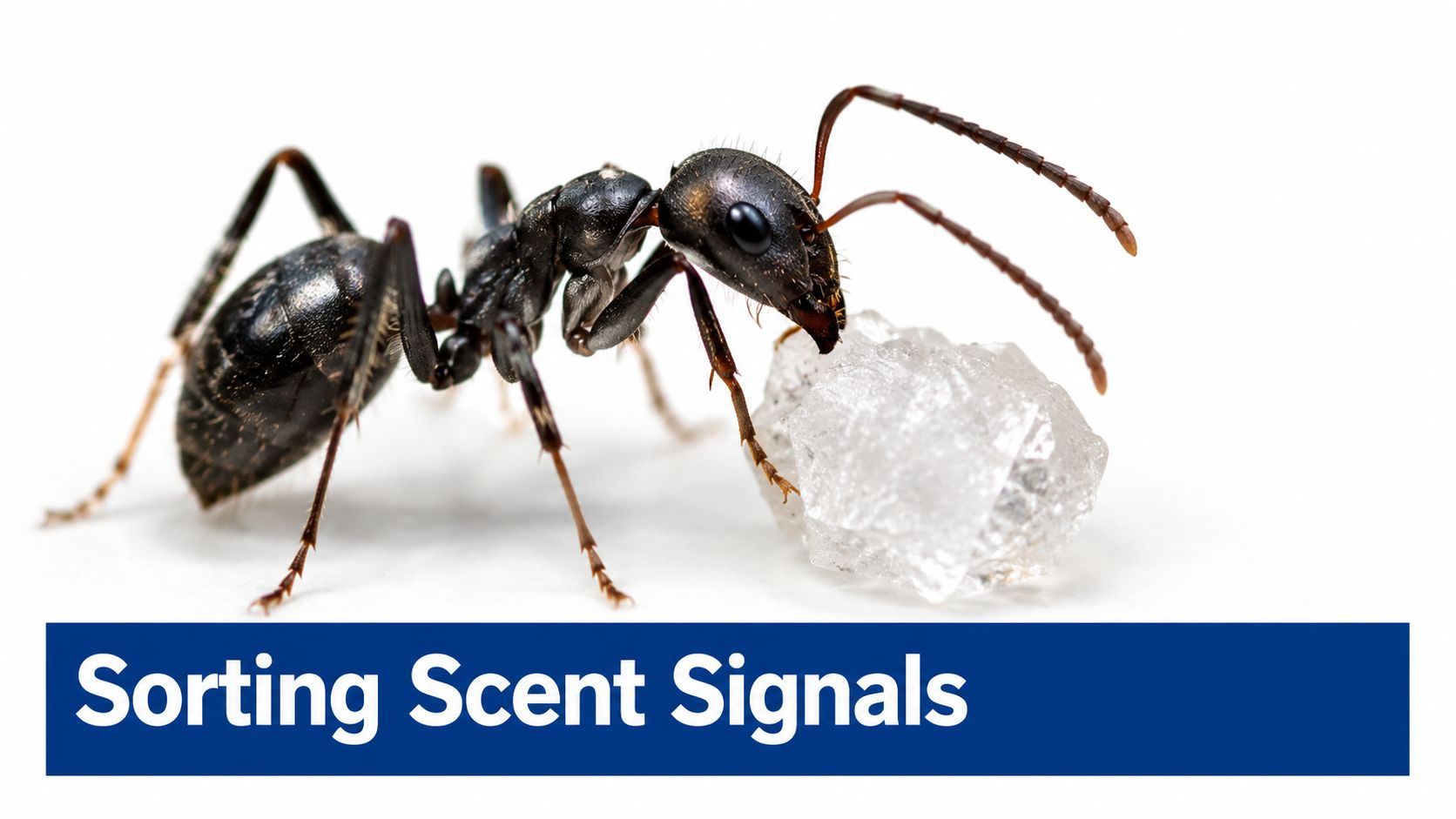
Yes, ants can smell food without having a nose. Their antennae carry sensilla, tiny sensory hairs that detect airborne odor molecules and chemicals encountered through touch. Food-associated airborne compounds are commonly detected through basiconic sensilla, while other sensory structures help ants recognize different chemical signals.
A small spill can become the destination of an organized trail.
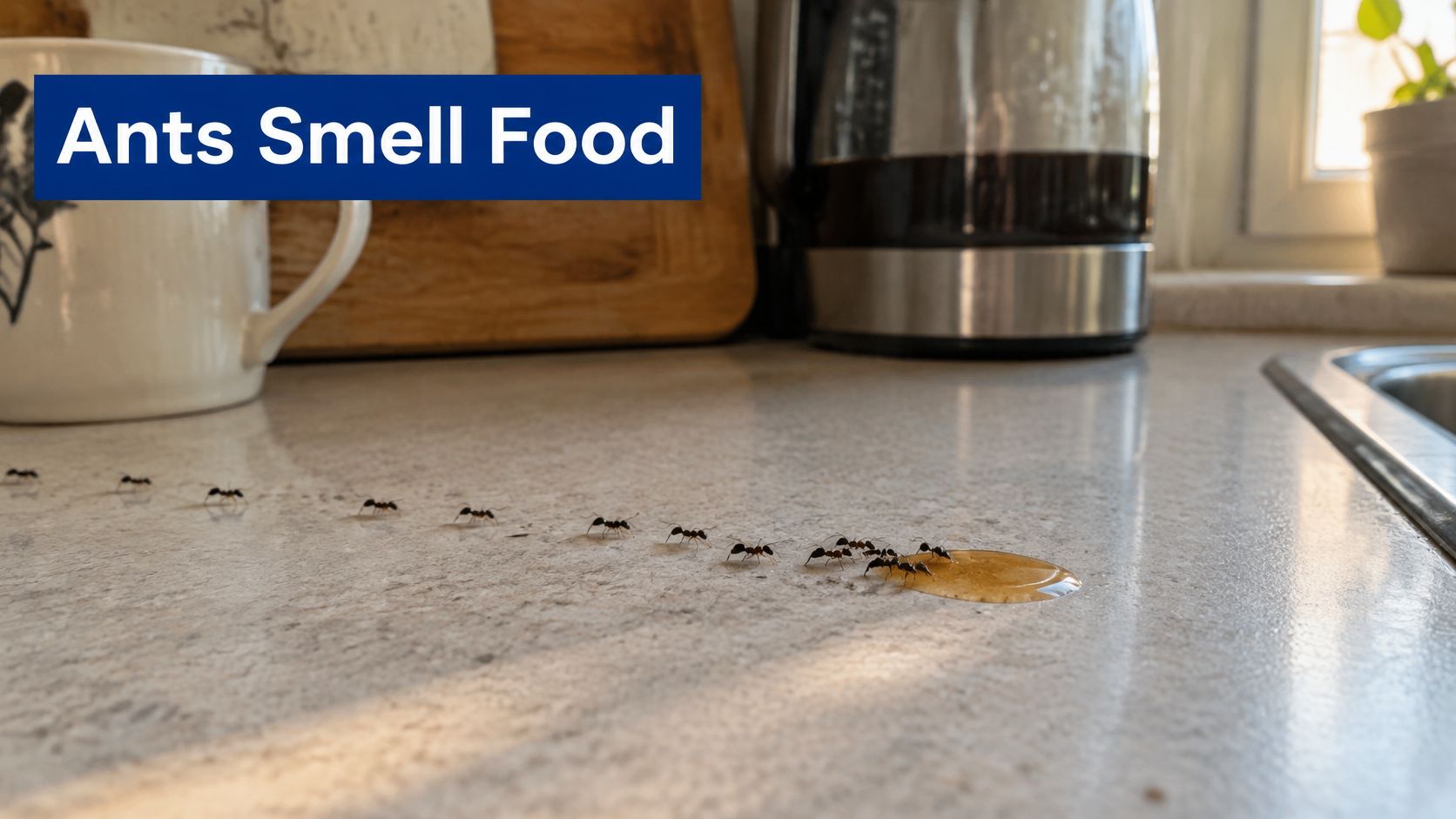
Noticing a possible meal versus checking it
Airborne detection helps a worker notice a potential resource. Once it reaches the spot, antennal contact helps it assess the chemicals more closely. Those are related tasks, but they aren't interchangeable: detecting an odor doesn't establish that food is accessible or worth collecting.
A 2026 red imported fire ant study published on PubMed Central tested antennal responses to 62 odor cues, including compounds associated with nectar, plants, and insect prey, and found that workers and winged females responded to most of them. That range matters because a kitchen offers more than sweet smells: plant material, food residues, and prey-related odors can also provide detectable cues.
Ants find food through smell, then nestmates can follow a chemical route to the source.
There isn't a universal detection distance you can apply to every kitchen. The food, airflow, obstacles, and ant species all affect whether a passing worker encounters a useful cue.
How Ant Antennae Sort Food Smells From Other Odors
Think of an antenna as a sorting room with many receiving bins, rather than a single food detector. Different receptor types respond to different molecules, and the ant's nervous system interprets the resulting pattern.
Close inspection lets a worker gather information it couldn't obtain from an airborne cue alone.
The 2018 Florida carpenter ant genome study available through PubMed Central identified 503 putatively functional odorant-receptor gene models, noted that many ant species possess roughly 300–400 odorant-receptor genes, and discussed a 2017 finding that ants lacking the Orco co-receptor couldn't forage effectively or bring food back to the nest.
“Putatively functional” means the researchers identified gene models expected to function, not that they established a separate household smell for every gene. Orco helps the odorant-receptor system operate; it isn't merely a receptor for sugar.
Ant chemical cues, home sources and colony responses
The following distinctions help separate a food attractant from the signals ants exchange with each other. Water belongs in the comparison as a resource cue, not as a food odor.
| Chemical cue | Common home source | How the antenna detects it | What the colony does with it |
|---|---|---|---|
| Sweet liquids and residues | Spilled soda, syrup, honey, sticky jam film | Associated airborne volatiles detected by basiconic sensilla, then antennal contact | Scouts assess quality and may recruit nestmates |
| Protein and fat scraps | Pet food, grease, meat or cheese crumbs | Odor detection plus contact sampling | Scouts sample the find and may recruit |
| Water and moisture | Sink drips, leaks, pet water bowls | Close-range assessment involving antennae and mouthparts | Reliable water can draw repeat foraging, especially in dry conditions |
| Trail pheromone | Chemical marks deposited by workers along a route | Antennal receptors detect pheromone near the traveled surface | Workers follow and reinforce a recruitment route |
| Alarm and colony odors | Disturbed nest material, crushed workers, other ants | Distinct receptor responses to chemical signals | Workers recognize danger or colony identity rather than food |
Watch how actively ants use their antennae while exploring.
A useful correction follows: ants aren't necessarily smelling a pure sugar crystal from across the room. Odors associated with food can guide exploration, while direct sampling helps evaluate substances that don't readily become airborne.
The antenna that helps flag a spilled drink also helps an ant distinguish recruitment from danger. Food-associated chemicals and trail pheromones carry different information, even when a worker encounters them in the same place.
Why One Crumb Turns Into a Daily Trail
Why did ants appear after dinner when the food was covered? A lid may protect the dish while leaving sauce on its rim, grease on the counter, or a drip beneath the serving spoon.
Smelling food is not the same as locating an infestation. A worker can investigate a food odor without revealing where the colony lives, and a busy countertop route doesn't prove the nest is inside the kitchen.
The ant-foraging study available through PubMed Central describes how food odors, visual information, and pheromone recruitment contribute to foraging. The visible line usually develops after workers confirm a usable resource, rather than because every worker independently smells your dinner.
From exploration to repeated traffic
- An exploring worker encounters a food-associated odor, reaches the potential resource, and samples it.
- If the resource is worthwhile, the worker returns toward the nest and deposits recruitment pheromone along the route.
- Nestmates follow the chemical marks, reach the resource, and may add deposits of their own.
- Continued traffic strengthens the route, turning an inconspicuous spill into a busy destination.
It's like a footpath across a lawn. An initial crossing barely marks the grass; repeated crossings make the path easier to recognize and follow.
A covered dish may prompt investigation without supporting a lasting trail if workers can't reach anything edible. Conversely, residue outside the container may provide enough accessible food to sustain traffic.
The important clue is where workers actually stop and feed.
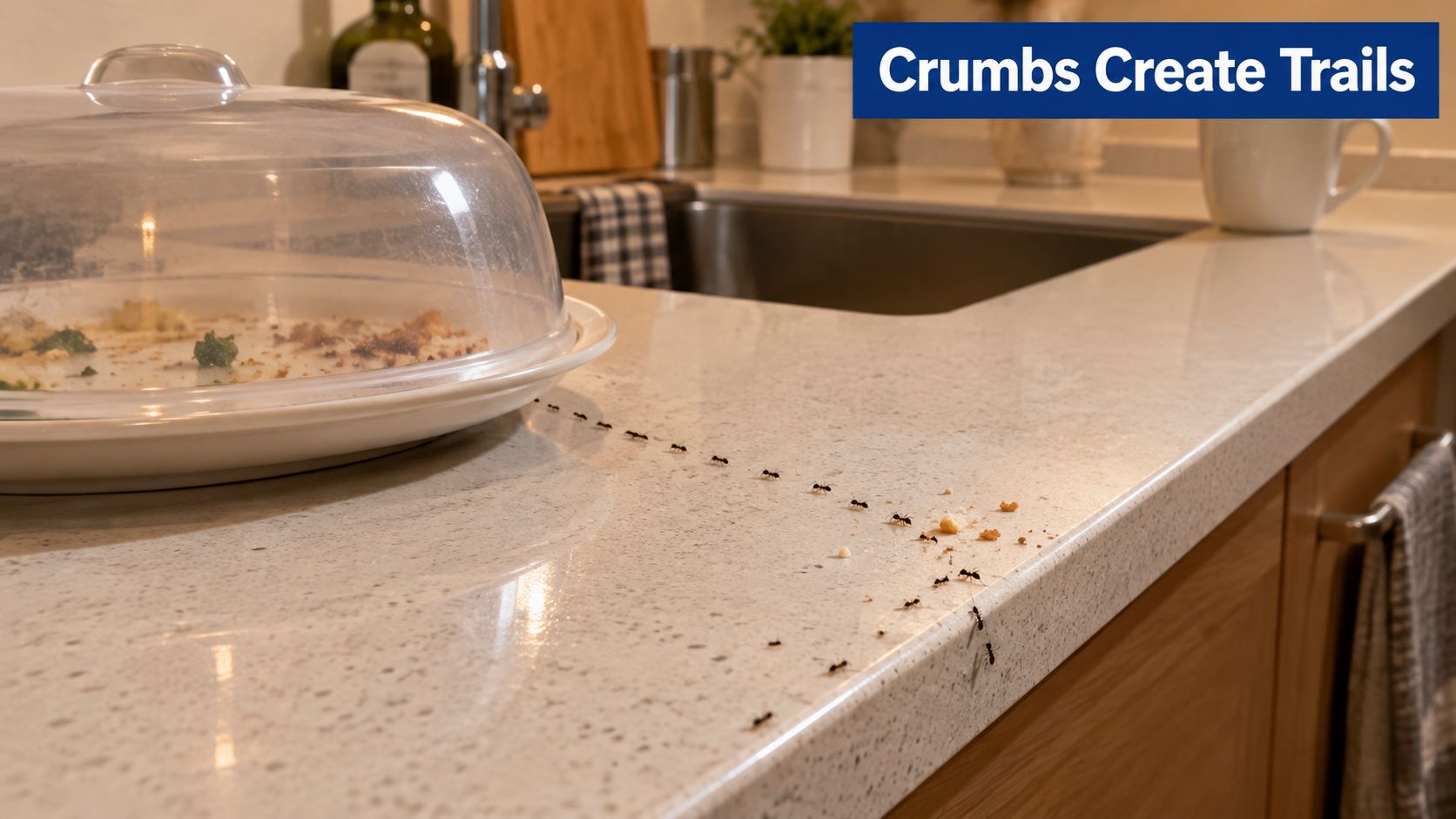
Wiping a route can interrupt traffic without removing the reason ants established it.
Before cleaning, follow the ants far enough to identify their destination and entry point. The practical guidance on ants on the kitchen counter can help you organize that inspection without treating every wandering worker as evidence of an indoor nest.
Check whether the route leads to food, moisture, or a nest entry. Those destinations call for different corrective work, even when the ants look identical from above.
How Long Ants Remember a Food Odor
Say a jam jar sits on a pantry shelf through several breakfasts. You move it, but ants keep investigating the same corner.
That doesn't mean ants can smell food that no longer exists. A thin film beneath the jar may remain detectable, and workers may have learned an association between that odor and a meal.
What the memory experiment established
In a desert-ant study published in PNAS, a single exposure to a previously neutral food odor produced a memory: more than 80% of trained ants followed the odor one day later, over 45% still responded after 26 days, and ants retained at least 14 consecutively learned food odors.
These were desert ants studied under controlled conditions. The results demonstrate durable, odor-specific learning, not a timetable for how long household ants will visit your pantry.
The distinction is useful. An ant can learn that a particular odor predicts food rather than responding only to a broad category such as sweetness or decay. Removing the container doesn't necessarily remove the odor that workers associated with it.
Where a familiar odor can remain
- Cabinet-base cracks: Sticky liquids can enter seams beyond the reach of a quick countertop wipe.
- Trash areas: Residue beneath liners, around lid hinges, and on adjacent flooring can remain after you empty the bin.
- Behind appliances: Grease and food particles collect where routine cleaning rarely reaches.
A worker returning to an old spot isn't proof that memory alone caused the visit. A surviving trail, fresh scouting, or remaining residue may also explain it.
Visible cleaning often misses the relevant material. Find and remove the residue, then correct moisture problems and access routes so the location no longer offers a useful resource.
Attractant Fixes That Cut Repeat Visits
A clean-looking counter can still direct ants toward an old food site. Smelling food and recruiting the colony are separate steps: antennae identify the odor, while trail pheromone gives other workers a route to follow. Removing the visible crumb removes the reward, but leaving the chemical route behind can keep replacement ants coming back.
Start with the sequence that addresses both parts. Find the food or moisture source, remove it, clean the surfaces workers have traveled across, seal practical entry gaps, and use targeted bait where appropriate.
In a trail-pheromone study published by Springer, black garden ants deposited up to 22 times more trail pheromone within 10 centimeters of a food source than near the nest.
The crumb supplies the reason to visit; the pheromone marks the route. That distinction explains why a concealed spill can support concentrated traffic long after the food appears to be gone. It also explains why bait works differently from a spray: workers need to reach the bait, feed on it, and carry it back toward the colony.
Household attractants, hiding spots and fixes
| Attractant | Where it hides | Fix |
|---|---|---|
| Sweet drink spills and syrup | Counters, under sinks, pantry shelves, cabinet bases | Wipe with soapy water, rinse, then inspect cracks behind appliances |
| Pet food and pet water | Floors near bowls, laundry rooms, garages | Pick up food bowls after meals, seal stored food, and wipe water spills while maintaining pets' access to drinking water |
| Leaks and humid zones | Under sinks, around the water heater, AC condensate line, outdoor spigots | Repair drips, keep the condensate drain clear, and run exhaust fans in wet rooms |
| Trash and recycling | Bin bottoms, open lids, unrinsed containers | Rinse containers, use lidded bins, and clean bin bottoms |
| Grease and crumbs | Stovetop, toaster, behind the range, under appliances | Degrease after cooking, empty crumb trays, and vacuum beneath accessible appliances |
| Entry gaps | Door sweeps, window screens, slab cracks, utility penetrations | Caulk appropriate gaps, replace worn door sweeps, and repair screens |
| Firewood and mulch against the house | Foundation edges, patios, wall-adjacent beds | Move wood and mulch away from walls and trim branches off the roof |
| Aphid honeydew and fallen fruit | Shrubs, fruit trees, flower beds | Hose aphids off suitable plants, collect fallen fruit, and inspect plants regularly |
Clean thoroughly without disrupting treatment
Canes Cleaners' kitchen cleaning guide for Miami homeowners provides a room-by-room sequence for overlooked kitchen surfaces. The tasks also apply to Southeast Texas kitchens when paired with an inspection for the ants' food source and entry route.
Pair cleaning with food storage practices that deter common household pests. Use tight-fitting containers, clean jar threads, and inspect packaging for residue before returning it to the shelf.
- Wipe traveled surfaces: Use soapy water to remove residues and disrupt trails, but leave active bait placements undisturbed.
- Protect bait access: Keep repellent sprays away from bait stations so workers can reach and feed on the bait.
- Watch the route: Look for ants entering through a crack, following a cabinet edge, or collecting beneath an appliance.
Treatment caution: Killing visible workers can leave the hidden colony, its food supply and the route between them untouched.
Use enclosed bait placements inaccessible to children and pets, and choose products labeled for the site and pest. If ants appear to emerge from a wall void, have the species and nesting situation assessed before sealing that opening or spraying into it.
Checking Ant Coverage in Magnolia and Booking an Inspection
Magnolia sits in southwestern Montgomery County within the Houston metro area, and the City of Magnolia's location guide places it at FM 1774 and FM 1488, approximately 45 miles northwest of Houston, 25 miles southwest of Conroe, and about 20 miles from both Interstate 45 and U.S. Highway 290.
That geography matters when arranging an inspection. A provider serving north Houston or Conroe does not automatically cover every Magnolia address, including properties outside the incorporated city limits.
City boundaries aren't service boundaries
The U.S. Census Bureau's Magnolia city profile records 2,359 residents in 2020, compared with 1,393 in 2010, an increase of 966 residents, or about 69.3%, and lists a 2023 estimate of 5,320 residents. These are municipal population figures, not a count of households throughout the larger surrounding service territory.
FullScope Pest Control lists residential pest control for ants, with inspections and targeted treatments. Its named service area includes Atascocita, Cleveland, Coldspring, Conroe, Huffman, Humble, Kingwood, Livingston, Montgomery, New Caney, Porter, Splendora, Spring, and Willis. Sanitation guidance and exclusion are described under rodent work, so do not assume they are bundled into an ant visit.
Magnolia isn't named on that list. No listed town proves coverage from a map alone, so the office should confirm the exact address before scheduling.
Review the residential ant-control service information and confirm the current service list on the company website before booking. Service areas can change, and an address-level answer from the office is the only firm confirmation of coverage in Magnolia.
Prepare for an inspection that answers the right question
- Mark where the trail enters and where it ends. Note whether workers stop at food, water, or a structural opening.
- Photograph the route and any possible nest signs without disturbing them.
- Remove the two most relevant attractants from the household checklist.
- Seal visible exterior access gaps you can safely repair, while flagging suspected indoor nest openings for assessment.
- Call FullScope to confirm address coverage and request an inspection. Ask about targeted baiting, low-toxicity options for homes with children and pets, and the follow-up service policy.
Ask what precautions each proposed treatment requires, rather than treating “low-toxicity” as a guarantee of no risk. For a rental or commercial property, identify who will handle leaks, cleaning, and fixes to entry points so unresolved conditions do not undermine the treatment.
The inspection should answer a practical question: What resource are these ants using, how are they reaching it, and what needs to change to stop the colony from maintaining that route?