1500+ reviews

You've just wiped the kitchen counter, put the fruit away, and turned to grab a clean towel. Then one ant appears beside the sink. Within minutes, a narrow line is moving across the surface, following the backsplash toward a crumb you can barely see. The scene feels like a cleaning failure, but ants on a kitchen counter usually point to a trail, moisture source, or hidden entry route, not a neglected home.
The practical response is a sequence: clean the contact surface, remove competing food and water, place bait where foragers already travel, inspect moisture and access points, then seal and repair what keeps the route active. Stronger spray isn't automatically a better answer. The goal is to reach the colony without scattering its workers into new parts of the house.
Why Ants Keep Showing Up on a Spotless Counter
A homeowner can watch this happen in real time. One scout crosses a freshly cleaned counter, pauses near the sink, and disappears behind the coffee maker. A second ant follows the same path. Soon, the line looks deliberate because it is. The first ant has found something useful and marked a route that other foragers can follow.
That route doesn't require visible grime. Kitchens provide water, warmth, and tiny food residues in places a normal wipe misses, including sink rims, drawer seams, appliance bases, cabinet joints, and damp areas beneath plumbing. A counter may look spotless while a small bead of water under the dish rack or grease beside the stove continues rewarding the colony.
The hidden issue is often the connection between the counter and the nest. Ants may enter through a backsplash seam, a plumbing penetration, a window gap, or a concealed path behind cabinets. Once the colony treats that route as dependable, wiping away individual workers doesn't remove the reason new workers keep arriving.
Practical rule: A clean counter can still be an active feeding station if ants have access to moisture or a reliable trail.
Why cleanliness alone stalls
Spraying the visible line can create a temporary visual improvement, but it doesn't necessarily affect the nest. Repellent products may drive workers away from one route and into another, making the infestation look as if it has spread. The better approach is to clean the surface without destroying your ability to identify the active trail, then use that trail to guide colony control.
This distinction matters for food safety. In a 2018 peer-reviewed kitchen study, microbiological analysis of 50 domestic-kitchen ants detected yeasts and molds in 100% of samples, coliforms in 52%, Escherichia coli in 18%, Bacillus species in 26%, Salmonella in 8%, and Listeria monocytogenes in 6% of samples. The same study found that ants transferred E. coli to food-contact surfaces in 70% of tests. See the peer-reviewed ant contamination study for the full findings.
That doesn't mean every ant carries every organism. It does mean you should treat ants crossing preparation areas as a contamination concern, not just an annoyance. The clean, bait, and seal workflow breaks both the visible route and the colony's access to your kitchen.
Immediate Cleaning and Safe Removal on the Counter
Start by making the counter unprofitable. Remove fruit, bread, open packages, pet bowls, and anything else that can provide food or water. Put those items into sealed containers or move them away from the activity zone while you clean.
Next, wipe the counter with a mild vinegar-and-water solution, following the care instructions for the countertop material. The purpose is to remove food residue and disrupt the chemical route, not to sterilize every surface with a harsh product. If the counter is stone, check the manufacturer's guidance before using vinegar, since acidic cleaners can damage some finishes.
Clean the overlooked contact zones
Use a damp cloth to pick up visible ants, or use a small bottle of soapy water for ants on a washable surface. Avoid broad aerosol applications across food-preparation areas. A repellent spray may kill exposed workers, but it can also interrupt the trail and push activity toward cabinets, wall voids, or another room.
Give nearby areas the same attention:
- Sink rim: Remove film and standing droplets, then dry the area.
- Appliance edges: Wash around the coffee maker, microwave, refrigerator, and dishwasher.
- Drawer pulls: Clean sticky residue where hands and food packaging leave deposits.
- Toaster and microwave bases: Sweep crumbs from the seams and floor beneath them.
- Trash and recycling areas: Empty containers and clean residue around lids and handles.
Keep raw ingredients separate from any surface ants have crossed until you've washed and disinfected it according to the product label. The contamination findings above explain why this step deserves urgency. For pet-safe approaches that avoid unnecessary chemical exposure, review this guide to getting rid of ants without chemicals that could hurt your pets.
Don't scrub every trail away before you've observed where it starts and ends. If ants are still active, watch for a short period after removing food. Note whether they head toward the sink, backsplash, window, cabinet toe-kick, or a plumbing opening. That observation gives you a more useful starting point for bait placement than guessing at the center of the counter.
Baiting and Targeted Treatments That Reach the Colony
Aerosol spray is designed for immediate contact. Bait is designed to be carried away. That difference makes slow-acting gel or liquid bait more suitable when the objective is colony control rather than a quick reduction in visible workers.
Foragers feed at the station and return to the nest before the active ingredient takes effect. Depending on the product, the chemistry may include a slow-acting ingredient such as boric acid, borate, hydramethylnon, or another labeled ant toxicant. Workers can share food within the colony, allowing the bait to reach ants you never see. Use only products labeled for indoor kitchen use, and follow the label around children, pets, food, and food-contact surfaces.
Placement beats brand switching
Put bait beside the active trail, near the counter edge, close to the entry point, or along a baseboard where ants are already traveling. Don't place it directly on a food-preparation surface unless the label specifically permits that use. Remove competing crumbs, grease, and water so the bait has a fair chance to remain attractive.
| Placement Location | Expected Forager Response | Timeline to Colony Impact |
|---|---|---|
| Beside an active trail | Workers investigate and may recruit additional foragers | Activity can fluctuate while feeding continues |
| Near a suspected entry point | Foragers encounter bait before reaching the counter | The route may weaken as the colony receives bait |
| Along a baseboard or cabinet toe-kick | Workers use the station on a concealed travel path | Hidden-nest activity may decline gradually |
| Away from the trail | Ants may ignore the station | Little useful colony impact if no feeding occurs |
Field evidence supports patience. In one urban residential study, containerized baits containing 1.0% hydramethylnon or 0.01% fipronil reduced total ant counts by more than 80% within one week, while about 60% of the bait was consumed by week 4. A separate residential trial reported an 87% reduction in ant activity by week 4 after a one-time 1% boric-acid hydrogel treatment. These findings are reported in the field bait-control study.
That means you should monitor baiting over one to four weeks, rather than expecting same-day elimination. Don't combine bait with repellent perimeter sprays along the same route, because you may prevent workers from reaching the station. For a practical breakdown of DIY ant products and their limitations, see what DIY ant killer will and won't do.
Moisture and Entry Point Audit Around the Kitchen
A flashlight and a notepad often reveal more than another round of wiping. Begin under the sink, where a slow P-trap drip, damp cabinet floor, or wet cleaning cloth can maintain activity. Check the dishwasher gasket for condensation, lift the garbage disposal splash guard, and inspect the window sill for moisture that collects near the glass.
Run the flashlight along the backsplash and countertop seam. Look for hairline cracks, loose caulk, or a trail that disappears behind the wall. Then follow the baseboard toward electrical outlets, cabinet toe-kicks, and plumbing penetrations. You don't need to dismantle the kitchen. You need to record where ants travel and what environmental condition sits beside that route.
Match each attractant to a specific repair
| Attractant Source | Targeted Fix |
|---|---|
| Sugar granules near the toaster | Unplug the toaster, clean its crumb tray, and sweep beneath it |
| Grease film beside the stove | Degrease the side panel, backsplash, and adjacent cabinet edge |
| Standing water under the dish rack | Empty the tray, dry the cabinet or counter, and check for a leak |
| Pet food residue along the floor edge | Remove leftover food and wipe the floor-to-baseboard seam |
| Sink drips or damp cabinet surfaces | Tighten the connection, dry the cabinet, and monitor for renewed moisture |
| Condensation near the dishwasher | Dry the area and inspect the gasket for wear or poor sealing |
Water can be the reason ants return even after you remove every visible crumb. A homeowner-focused explanation from Food52's kitchen ant guidance highlights overlooked moisture sources such as sink drips, damp cabinets, pet bowls, and condensation.
Draw a simple kitchen sketch. Mark the first sighting, the direction of travel, every suspected gap, and each bait position. This record turns a vague nuisance into a repair list. It also gives a technician useful information if the activity continues after cleaning and baiting.
Sealing Entry Points and Building Long-Term Prevention
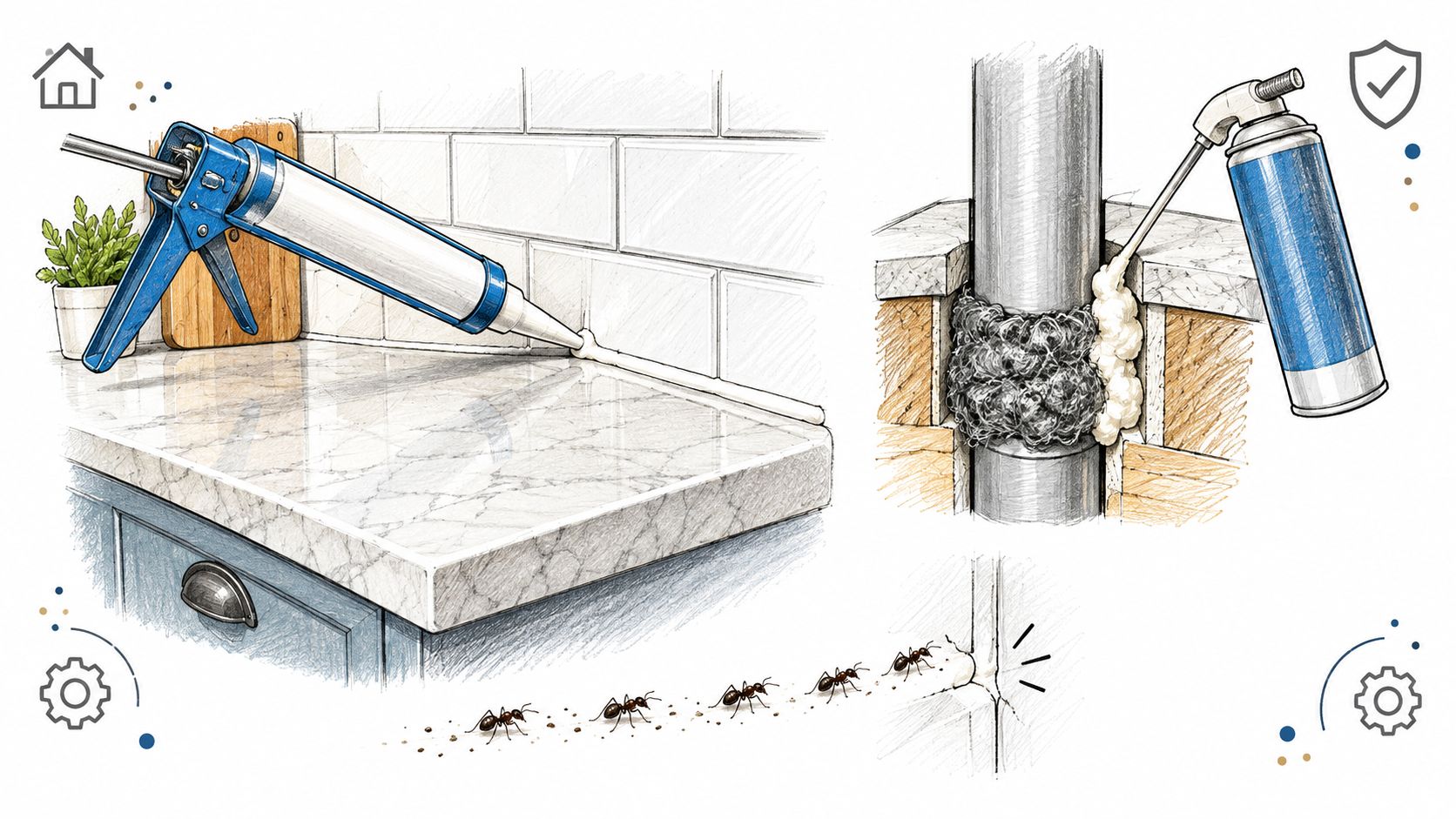
Once you know where the trail enters, seal that route instead of caulking randomly. For a backsplash seam, use mildew-resistant silicone suited to the countertop and wall materials. Around pipe penetrations, pack the void carefully with steel wool before applying an appropriate sealant or foam, while keeping the material away from electrical components and areas where children or pets can reach it.
Weatherstrip a loose window, add door sweeps where exterior drafts meet the kitchen, and close gaps around cabinet toe-kicks. Repairs work best after you've confirmed the route and given bait time to work. Sealing too early can redirect ants into an adjacent wall or cabinet if the colony is still actively using the structure.
Put prevention on a household rhythm
Moisture repairs matter as much as caulk. Tighten a leaking P-trap, replace a worn dishwasher door gasket, and use a small dehumidifier or moisture absorber under the sink when that area stays damp. Keep the dish rack from holding water overnight, and dry the sink basin before bed.
A workable routine can follow tasks you already remember:
- After food preparation: Wipe the counter and backsplash with a material-safe cleaner.
- By evening: Empty the dish rack and dry the sink rim.
- On garbage night: Clean the trash lid and the floor edge beside it.
- On recycling day: Rinse sticky containers before placing them in the bin.
- During monthly deep cleaning: Pull out the toaster-oven drip tray and clean beneath the appliance.
- Every 14 days: Check and refresh bait stations according to the product label.
Running a garbage disposal with ice and citrus can help remove residue, but it isn't a substitute for repairing a leak or cleaning the splash guard. For more household measures, use these simple ant prevention tips. The durable result comes from combining sanitation, dryness, bait access, and exclusion rather than relying on one scent or spray.
When DIY Plateaus and Magnolia Residents Should Call a Pro
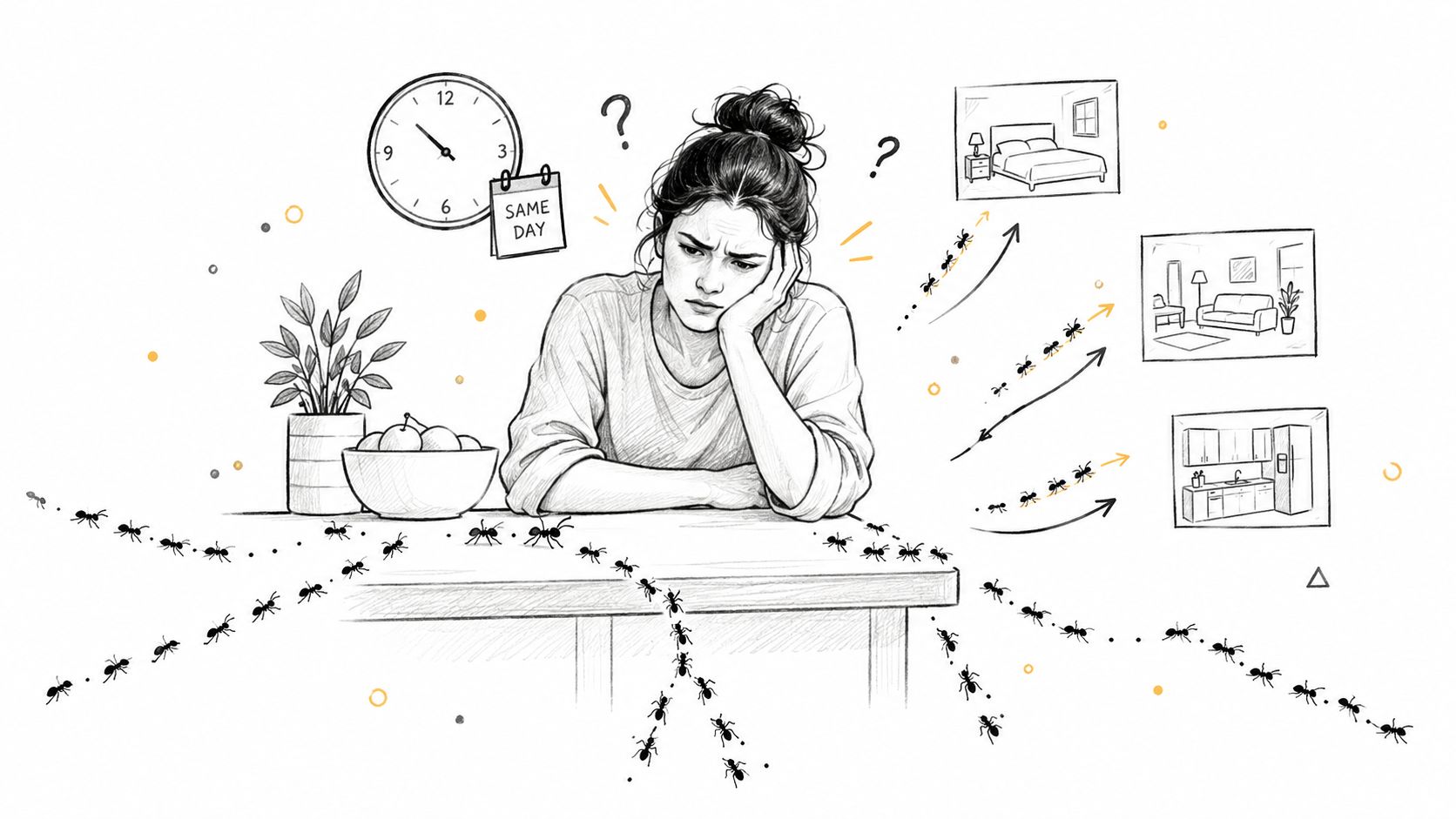
DIY has probably stalled when the same trail returns the same day after cleaning, activity appears in different rooms, or ants emerge from several unrelated gaps. Sawdust-like material near a baseboard, repeated foundation access points, or a sudden increase after heavy Montgomery County rain also deserves a structural inspection. These signs suggest that visible workers are only one part of a larger network.
At that stage, repeated surface spraying can make the pattern harder to read. Consumer bait may reduce activity at one station while another nest continues feeding elsewhere. A licensed technician approaches the building as a connected system, inspecting exterior conditions, plumbing penetrations, wall void indicators, attic or crawlspace areas where relevant, and the routes that lead back to the kitchen.
What a Magnolia service conversation should cover
Magnolia is a distinct service node within the North Houston area, not merely a vague extension of Montgomery County. The City of Magnolia's official area and service materials place the city in southwest Montgomery County and provide map resources that support precise location targeting. For homeowners, that means the technician should ask for the exact address, entry pattern, property layout, and whether the activity is limited to the kitchen or appears elsewhere.
The local market is residential in character. The U.S. Census Bureau QuickFacts profile lists Magnolia city, Texas, at 2,359 residents in the April 1, 2020 census and reports a median household income of $78,605. Those facts help explain why a Magnolia-area plan should focus on home inspection, exclusion, targeted treatment, and follow-up rather than assume a large industrial property profile.
Bring the technician your audit sketch, bait locations, photos of recurring trails, and the times activity returns. A local plan may include exterior perimeter work, targeted treatment at identified entry points, and inspection of attic, crawlspace, or structural voids when evidence supports it. FullScope Pest Control is one available Magnolia-area option for residential ant control, inspections, preventative plans, and related pest services.
This short video provides a visual look at the kind of ant activity homeowners may notice before a professional inspection:
The first visit should end with clear answers. Ask where ants are entering, which moisture or structural conditions need attention, what treatment is being used, what must remain undisturbed, and when follow-up is appropriate. A useful service plan doesn't just remove the line on the counter. It explains why the line formed and how the property will be monitored afterward.
Putting It All Together and Common Questions
Counter ants are easier to manage when every action serves the colony problem. Clean the food-contact area immediately, preserve enough trail information to find the route, place slow-acting bait where workers already travel, correct moisture, seal confirmed gaps, and call for an inspection when activity keeps returning. Consistency matters more than buying a stronger product after each failed attempt.
Use a weekly reset for counters, sink edges, pet feeding areas, trash residue, and appliance bases. Use a monthly check for caulk seams, plumbing penetrations, dishwasher moisture, window gaps, and the toaster-oven drip tray. Keep a simple log of sightings and bait activity so you can distinguish a declining trail from a relocated one.
Common questions from homeowners
Does vinegar repel ants?
Vinegar can help clean residue and disrupt a chemical trail temporarily, but it doesn't remove a nest or repair the entry point. Use it as part of surface cleaning, not as a stand-alone colony treatment.
How long does bait take to collapse a trail?
Expect the process to develop gradually. The field results discussed earlier show measurable reductions within a week and continued bait consumption through week 4, so don't remove a station just because ants remain visible at first.
Why do trails return after rain?
Rain can change outdoor nesting conditions and drive ants toward dry shelter, food, or water inside a structure. If the same interior gap becomes active afterward, inspect that route and the surrounding moisture conditions instead of only cleaning the counter.
Do cinnamon or essential oils solve the problem?
They may make a small area less appealing for a short time, but they don't reliably deliver a slow-acting toxicant to the colony or close an access point. Treat them as temporary deterrents, not a replacement for bait and exclusion.
What should I expect from a first professional visit in Magnolia?
Expect questions about the address, trail timing, rooms affected, moisture, repairs, and products already used. The technician should inspect the kitchen and relevant exterior or structural routes, explain the treatment plan, and tell you what to monitor after service.
If ants keep returning to your counter, save your audit notes and schedule a Magnolia-area inspection with FullScope Pest Control or another licensed provider who can evaluate the colony route, moisture sources, and entry points together.
Contact a licensed pest professional today if your Magnolia kitchen still has recurring trails after careful cleaning, targeted baiting, and entry-point repairs. Share your trail log and kitchen sketch during the appointment so the technician can start with evidence, identify the active route, and build a practical plan to protect your counter and the rest of your home.