1500+ reviews


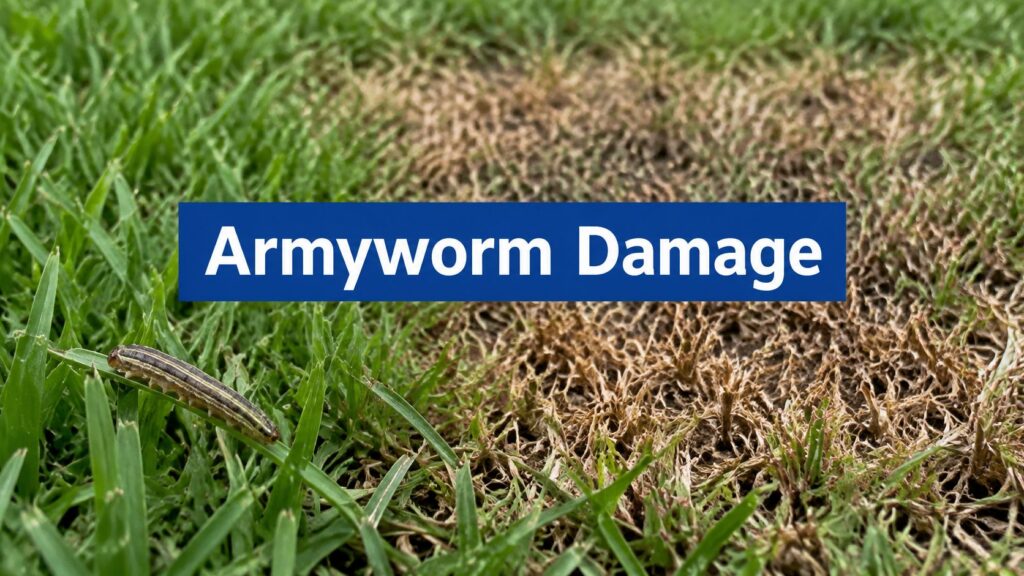
Your lawn looked fine on Friday. By Monday, ragged brown patches have spread across the sunniest part of the yard, and watering hasn't changed a thing. That's the pattern that should make you think about armyworm damage on a lawn before you reach for fertilizer or a fungicide.
Don't spray based on color alone. First, work out whether caterpillars are still feeding, how many you've got, and whether the grass underneath is still alive. Those three answers split the job into two separate decisions: stop active feeding, then restore the turf. Treating them as one problem is how homeowners waste money on a lawn that would've recovered, or miss a feeding front that strips the rest overnight.
Tell Armyworm Damage From Drought, Grubs and Disease
A Southeast Texas lawn can go from green to straw colored in a weekend when fall armyworms hit their final growth stages. The Texas A&M AgriLife Extension guide on fall armyworm identification and control reports that armyworms can consume an area as large as a football field in as few as 2 to 3 days, and that fifth and sixth stage caterpillars consume more than 90% of the total foliage they eat during their entire larval life.
That timing explains why you didn't see it coming. Small larvae barely mark the blades. Large ones strip leaf tissue fast, mostly at night, and hide in thatch by day. The species commonly attacks bermudagrass, ryegrass, fescue, and bluegrass, so it fits most residential lawns and sports fields in this region.
Match the Symptom Before You Treat
Armyworm damage compared with look-alike lawn problems
| Symptom | Likely cause | Quick check |
|---|---|---|
| Ragged leaf edges, stripped blades, brown patches that spread in days | Armyworm larvae feeding, mostly at night | Soap flush or look in thatch at dusk |
| Turf lifts like a loose carpet when pulled | Grubs cutting roots | Tug test on the edge of the brown area |
| Brown patches with intact blades and dry, hard soil | Drought or heat stress | Check soil moisture a few inches down and irrigation coverage |
| Ring-shaped lesions on blades, worst in humid weather | Fungal disease such as brown patch | Look for lesions on leaf sheaths and examine in early morning dew |
| Irregular patches along a building, post or sign edge with moths present | Egg masses or adult moth migration | Check vegetation at dusk and look for egg masses beside structures |
The tug test matters. If turf peels back easily, you're probably dealing with roots, not leaf feeding, and the best time to treat lawn grubs and prevent damage becomes the more relevant question. If blades are intact but wilted and soil is dry several inches down, check irrigation coverage first. For broader yellowing patterns that don't fit any row above, troubleshooting commercial lawn discoloration is a useful reference for separating nutrient and watering problems from pest injury.
Do this at dusk: Pull back a turf edge at the border between green and brown grass and part the thatch with your fingers. If you find green brown caterpillars curled there, you've got your answer before any product comes out.
Don't rule armyworms out from a midday walk. Larvae shelter low in the canopy during heat, so a clean look at noon proves very little.
How to Scout for Larvae With a Soap Flush
One brown corner does not mean the whole lawn is loaded. Armyworms bunch up. A clean stretch of St. Augustine ten feet away can be empty while the damaged edge is full of larvae, and a blanket spray based on that one patch treats a lot of turf that never needed it. The Utah State University guidance on armyworms and cutworms in turfgrass pairs a look at the injury with a soap flush run the same way each time, instead of calling the lawn infested from discoloration alone.
A flush answers a narrower question than most homeowners expect. It tells you whether larvae are still in the thatch and still able to feed. Brown blades with a zero count are a recovery problem, not a reason to spray tonight.
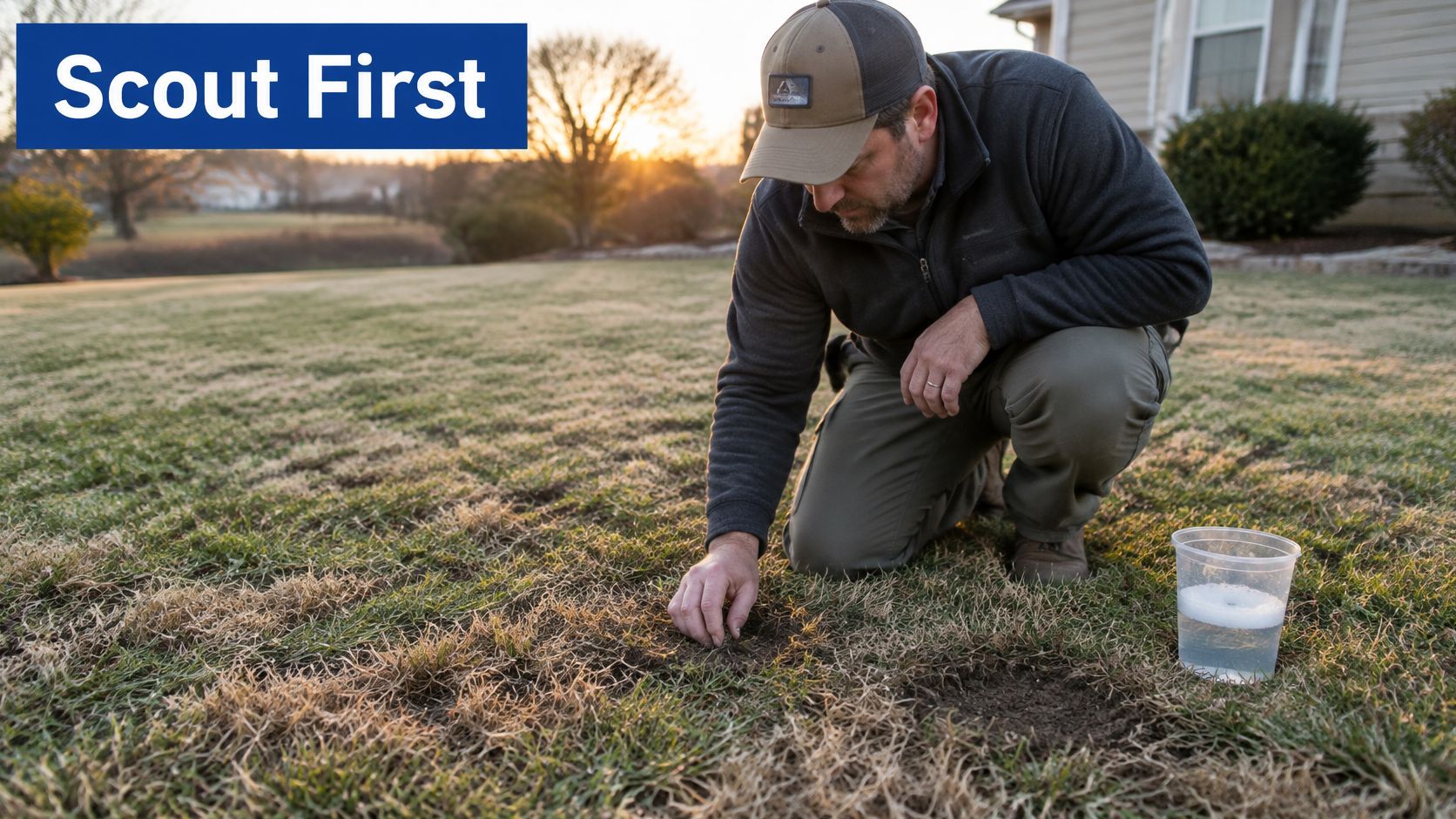
Run the Flush the Same Way Every Time
- Pick your spots: Choose three damaged areas and two apparently healthy areas, ideally near dusk. Larvae cluster unevenly, so a single test can miss them entirely.
- Mix the solution: Stir about 2 tablespoons of lemon-scented liquid dish detergent in 2 gallons of water. Don't substitute antibacterial soap or bleach-based detergents, which can burn turf.
- Pour evenly: Flood a 1 square foot section so the solution soaks through the thatch rather than running off the blades.
- Wait and count: Watch for 5 to 8 minutes and count every larva that surfaces. Note their size. Small larvae are the ones still doing most of the feeding, and they respond to a later treatment far better than nearly mature ones.
- Record each spot separately: Write down the count, larval size, turf species, damage severity, and location. Don't average a hot spot into clean areas and lose the signal.
- Repeat before deciding: Run the test in each area, then compare counts against the thresholds below.
The common slip is sampling only green turf because it looks like the place worth saving. Larvae sit in thatch during daylight and feed outward from damaged edges, so the transition between green and brown gives you the most honest count. If that band is empty and the brown area is already straw, you are past active feeding and into repair.
Compare Your Count to the Right Threshold
Larvae thresholds by guidance source
| Guidance source | Threshold | Per square foot equivalent | Context |
|---|---|---|---|
| Utah State University turf guidance | 10 to 15 larvae per square yard with obvious feeding injury | About 1.1 to 1.7 per square foot | Treatment threshold for turf |
| Texas A&M AgriLife | 3 to 5 larvae per square foot | 3 to 5 per square foot | Visible thinning of turf |
| Texas A&M AgriLife | 6 or more larvae per square foot | 6 or more per square foot | Severe damage possible within 2 to 3 days |
These two sources are not interchangeable. Utah State University counts on a square-yard basis and wants obvious feeding injury before treatment. Texas A&M AgriLife counts per square foot and separates visible thinning from damage that can worsen within a couple of days. Pick one source and write every flush in that same unit. I would not treat on moths alone. Armyworm pressure comes in waves, and a routine preventive spray is a poor substitute for a count you can repeat.
Treat when counts reach the threshold for your context and visible feeding injury is present. Counts without fresh damage, or damage without larvae, both call for another check rather than a spray.
Recheck after treatment or heavy rain. Survivors and a newly hatched group can restart feeding even when the first flush looked clean. A second zero, with no new notched blades, is the point where you stop chasing larvae and start judging how much turf remains.
Pick a Control Method and Time It for Night
You walk the lawn at dusk in August and the blades are still ragged. A foliar insecticide put down at noon in that heat mostly misses the population, because the larvae are not up in the canopy eating it. The University of Idaho extension IPM advisory on armyworm control notes that foliar sprays are most effective at night, when larvae are feeding above the thatch.

Aim at small, actively feeding caterpillars before they mature and move on. Large larvae have already eaten most of what they will eat, and they are harder to kill, so a late spray often saves very little leaf tissue. This pass is only about stopping active feeding. Filling in thinned turf is a separate job that starts after the larvae are gone.
Match the Option to Your Count
Control options for armyworm larvae in lawns
| Option | When it fits | Timing and application | Limits |
|---|---|---|---|
| Labeled foliar insecticide | Counts above threshold with visible feeding injury | Night spray at the label water volume, aimed to reach thatch | Follow label re-entry, irrigation and mowing rules; efficacy varies with larval age and thatch |
| Entomopathogenic nematodes (Steinernema carpocapsae) | Nonchemical programs and lower-pressure lawns | Apply at the rate printed on the product label in cool morning or evening conditions, irrigated before and after | Often several applications needed for adequate control |
| Scouting only, no spray | Counts below threshold or damage not progressing | Recheck after heavy rain or every few days during feeding | Count again before any spray decision |
Use only a product labeled for your turfgrass, site, pest, and application method. The label sets water volume, re-entry intervals, irrigation, and mowing restrictions, and it overrides any general advice, including mine. On the nematode route, keep them cool and out of direct sun during mixing. Ultraviolet light and heat kill them before they reach a host.
- Hot daylight spraying: Larvae stay down in thatch, product dries on blade tips, and contact drops sharply.
- Thin water volume: A light mist never reaches dense canopy or thatch where larvae rest.
- Mowing against the label: Cutting right before or after treatment can remove treated leaf tissue the larvae need to ingest.
- Ignoring the fence line: Unmanaged grass next door or along a ditch reinvades treated turf within days.
I would not promise a success percentage for any of these options, and you should not trust anyone who does. Results shift with larval age, canopy density, thatch depth, weather, and how evenly the application went down. Stage, timing, and coverage are the parts you can control, and those three decide most outcomes.
Recover Thinned Turf or Replace It
Here's the answer most homeowners want: a brown lawn after armyworms usually isn't dead. Texas A&M Extension guidance on fall armyworm outbreaks explains that fall armyworms consume grass leaves rather than roots or stolons, so bermudagrass and St. Augustinegrass can often recover within one to two weeks after rain or irrigation once feeding stops.
That distinction separates cosmetic defoliation from permanent turf loss. Severity still matters, since the same guidance reports that six or more armyworms per square foot can produce severe damage in two to three days, while three to five per square foot can visibly thin turf. Newly planted sod and sprigs sit at the vulnerable end, because they don't have the root reserves established turf draws on.
Triage the Patch Before You Buy Sod
- Confirm feeding has stopped: Run a fresh soap flush at the patch edge. Recovery work is wasted while larvae are still eating new growth.
- Check the roots: Pull a few plants from the brown area. Firm, pale roots mean the plant is alive below the damage. Black, mushy roots point to a different problem.
- Scratch a stolon: Scrape the surface of a runner with your thumbnail. Green tissue underneath means that stolon can still push leaves.
- Watch the nodes: Look for small green shoots emerging at stolon joints over the following week. That's the lawn telling you it intends to recover.
- Mark the holdouts: Flag any area still fully brown with no green at the nodes after two weeks. Those become your repair zones, and only those.
Repair in the Right Order
- Mow normally, not short: Keep the species' regular mowing height and never remove more than a third of the blade at once. Scalping stressed turf removes the leaf area it needs to rebuild.
- Water thoroughly and early: Aim for about an inch per week in the morning so blades dry during the day. Shallow daily watering keeps roots near the surface and invites disease, and if your irrigation habits may be part of the problem, learning to fix watering mistakes on stressed lawns is worth doing before you reseed anything.
- Rake out dead thatch: Clear matted dead material from bare patches so new shoots reach light and seed reaches soil.
- Aerate compacted spots: Core aeration pulls small soil plugs so air, water, and nutrients move to the roots. Overseed bare areas where your grass type allows it, since bermudagrass spreads by runners but thin fescue or ryegrass areas need seed to fill.
- Fertilize last, and lightly: Wait until new growth is visible. Feeding leafless turf pushes nutrients into soil with no plant ready to use them.
- Replace sod only where crowns are dead: Bermudagrass and zoysia frequently fill in on their own once feeding stops, so sod money should go only to patches that failed the two week check.
Keep foot traffic, pets, and mower turns off repaired areas for several weeks while roots establish. Recovery speed depends on how hard the turf was hit, whether drought stress is also in play, your mowing height, and how much warm growing season is left.
Once a clean soap flush confirms the larvae are gone, the lawn needs water and time. Another insecticide application at that point treats a pest that isn't there.
Monitor Late Summer and Fall to Catch the Next Outbreak
A lawn that greens up in early September can be stripped again by October. Clearing the larvae that are feeding now stops the chewing. It does not grow the canopy back, and it does not block the next flight. Moths migrate north each year from the Gulf Coast, Texas, or Mexico, so Southeast Texas lawns sit close to the source.
The Oklahoma State University Extension overview of fall armyworms notes that each female can lay about 1,000 eggs, often in masses of 50 to several hundred, and that warm weather generations can finish in about four weeks. One quiet August does not close the season.
Fall armyworm lifecycle and Southeast Texas risk window
| Stage | Typical timing | What to check |
|---|---|---|
| Eggs in masses | One female lays about 1,000; masses hold 50 to several hundred | Egg masses beside buildings, posts and signs |
| Feeding larvae | About 2 to 3 weeks of feeding; late instars do most of the damage | Soap flush counts and ragged blades |
| Pupation and adults | Pupate in soil; adults emerge about 10 to 14 days later | Moths around lawn edges at dusk |
| Full generation | About four weeks in warm weather | Weekly scouting interval |
| Peak risk window | Late summer through November, especially after early-fall rains | Intensify scouting and recheck after heavy rain |
Walk the same route every week: sun-exposed edges, turf beside buildings, posts, and signs where egg masses land, and any strip that looks noticeably greener or browner than the grass around it. Flush anything suspicious rather than guessing from color. Other caterpillars work the same turf in summer, so knowing how sod webworm damage differs from armyworm feeding keeps the treatment on the pest that is present.
Scout again after a heavy early-fall rain.
I split the response by what the flush shows. A fresh count of small larvae is still a feeding problem, and that is the window to treat. Large larvae have already done most of the damage. A clean flush means the pest is gone, so the next work is recovery, not another insecticide pass. Brown blades alone are not a reason to spray.
Hold mowing height steady through November. Water thoroughly instead of often, and skip heavy nitrogen that pushes the lush, tender growth egg-laying moths prefer. Stressed turf shows light feeding that a thicker stand would hide. Hardscape is a separate decision from this calendar, including a look at yard materials that withstand Prescott weather when borders are being replaced.
Keep a simple log in your phone:
- Date and rainfall: Outbreaks often follow early fall rain.
- Count per square foot and location: Repeated hot spots get scouted first.
- Larval size: Small larvae mean you still have a treatment window.
Decide Whether to Treat Your Magnolia Lawn Yourself
Magnolia gets named on its own here because it's its own market, not a shorthand for north Houston. The U.S. Census Bureau QuickFacts page for Magnolia city, Texas puts the 2020 Census population at 2,359 residents across 2.87 square miles, at 821.4 people per square mile. Lawns inside those city limits and the larger rural and suburban area around them face the same Gulf Coast migration pressure, but service coverage is set by address, so confirm yours directly rather than assuming.
The decision rule is scope. A small patch with counts below threshold is a home job: flush it, log the count, water properly, and recheck in a few days. A widespread, actively feeding infestation, repeated reinfestation from unmanaged neighboring grass, or thin new sod that isn't pushing green at the nodes calls for a licensed provider with equipment that gets product through thatch evenly at night.
Ask any provider four questions before booking:
- Do you scout first? You want counts per square foot, not a spray triggered by brown color.
- What's the labeled product and timing? Night application should be the default answer.
- What are the label rules? Water volume, re-entry, irrigation, and mowing restrictions should be stated plainly.
- What's the recovery plan? Stopping feeding and restoring turf are separate steps, and the second one shouldn't be an upsell you hear about later.
Our lawn treatment services cover fertilization, aeration, grub control, lawn disease control, overseeding, and grassy weed control, which matters when armyworm injury turns out to be layered over compaction or disease. We also provide a Lawn Care Estimator on our website, so you can price the recovery side once you've got real counts from your own yard.
If your Magnolia lawn is browning fast and you're not sure whether you're looking at armyworms, grubs, or drought, run the soap flush tonight and count what surfaces. Then contact FullScope Pest Control with that count and your address. We'll confirm whether your home falls in our service area, tell you honestly whether the numbers justify treatment, and build the recovery plan around what's still alive in your turf.