1500+ reviews


Most visible roach activity drops within 1–2 weeks, but complete elimination typically takes 4–8 weeks for light to moderate infestations and up to 12 weeks for severe or hidden infestations. If a product kills roaches quickly, why can a Magnolia homeowner still find them after treatment?
The gap is between killing exposed roaches and eliminating an established population. A treatment has to reach the right places, remain effective against the roaches present, and work alongside repairs and cleanup. In Magnolia, Texas, a useful estimate starts with an inspection, not a promise printed on a pesticide container.
The Realistic Timeline for Roach Control
A small, accessible infestation can show a major reduction within 1–2 weeks, while difficult infestations can take up to 12 weeks to eliminate. Many baits need at least 5 days to kill substantial numbers, and some kill approximately 70% to 90% in a week or longer, according to Utah State University Extension's cockroach management guidance.
For a light or moderate German cockroach infestation, 4–8 weeks is a practical planning range for reliable control when treatment, sanitation, and monitoring work together, consistent with the integrated approach described in University of Maine Extension's cockroach guidance. These are conditional ranges, not deadlines that apply to every property.
Separate relief from verified elimination
Initial knockdown means fewer active roaches. Verified elimination means inspections and monitoring no longer indicate an active population, including immature stages.
Those milestones aren't interchangeable. Seeing fewer adults is encouraging, but it doesn't establish that every occupied cabinet, appliance gap, or wall void has been addressed.
A useful treatment plan sets expectations around observable changes:
- Early progress: Activity starts declining in the areas where the infestation was concentrated.
- Continued suppression: Monitoring shows fewer roaches without activity appearing elsewhere.
- Verification: Repeated checks stop finding evidence of an active population.
Don't judge bait by the first sighting
Bait-fed roaches may continue moving through walls, cabinets, and other hiding places before dying. Some applications also leave protected egg cases unaffected, which helps explain why early sightings don't automatically indicate failure.
Practical rule: Judge a treatment by the direction of the evidence, not by whether you saw a roach after the technician left.
That doesn't mean every continuing sighting is acceptable indefinitely. A technician should explain what improvement should look like, what would trigger reassessment, and which household conditions could delay progress.
If someone answers “How long does it take to get rid of roaches?” with an unconditional guarantee, ask how they will verify the result. A credible answer distinguishes expected improvement from confirmed control and includes a plan for checking both.
Why Roach Species Change the Timeline
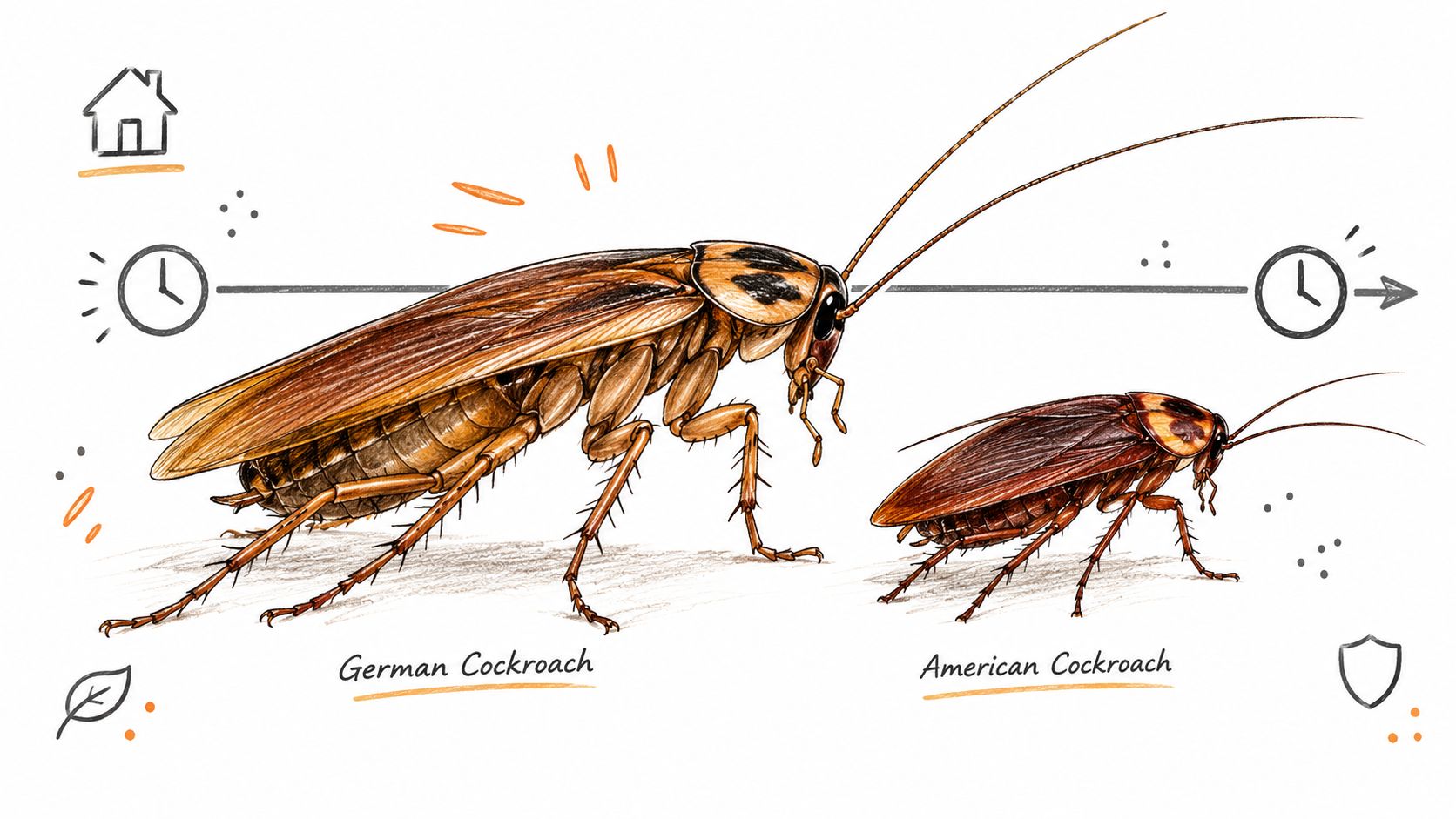
Species identification changes what a technician looks for and how follow-up is planned. Treating every cockroach sighting as the same problem can mean targeting the wrong locations or misreading the significance of later activity.
The physical comparison below is a useful starting point for discussing identification with your technician.
Development takes longer than visible knockdown
The CDC describes the German cockroach life cycle from egg through nymph to adult as approximately 2–8 months, compared with about 10 months for the American cockroach, in its cockroach life-cycle description. These biological timelines aren't treatment deadlines. They explain why a population contains more than the adults a homeowner notices.
An infestation can include adults, developing nymphs, and egg cases at the same time. Removing visible adults doesn't establish what remains in inaccessible spaces.
Development also varies with conditions. That's why a technician shouldn't use a species' average life-cycle length as a rigid countdown or imply that every property must remain under active treatment for that entire period.
Identification should guide the inspection
Before cleaning up a specimen, take a clear photograph or retain it for identification if you can do so safely. A description such as “small brown bug” or “large water bug” isn't a dependable basis for selecting treatment.
Use a guide to the difference between American and German roaches to support that conversation, rather than guessing from size alone.
- Ask for a species identification: The technician should connect that identification to the proposed inspection and treatment.
- Report immature roaches: Their presence helps the technician assess whether development is occurring near the monitored area.
- Keep location details: Finding roaches repeatedly around the same appliance provides different information from scattered sightings near entry points.
The practical question isn't which species takes longer to kill. It's where that species is living, which life stages are present, and whether the treatment reaches them.
A slower-developing species doesn't automatically mean a longer service program. Likewise, fast reproduction doesn't make control impossible. Identification gives the professional a better basis for deciding where to inspect and how to interpret subsequent findings.
Key Factors That Speed Up or Slow Down Control
A few roaches concentrated in an accessible cabinet present a different job from activity spread through appliances, wall voids, and connected units. The extent of the infestation and access to occupied spaces can matter as much as the product selected.
An inspection should establish the distribution of activity before the technician gives a firm estimate. Otherwise, the estimate reflects an assumption about the infestation rather than evidence from your home.
Conditions homeowners can change
Sanitation isn't a judgment about housekeeping. It's a practical effort to reduce the resources that allow surviving roaches to remain active and reproduce.
A clean countertop doesn't resolve grease beneath an appliance or persistent moisture inside a cabinet. Focus on the conditions closest to recorded activity.
- Food access: Remove crumbs, grease, open packages, and accessible food residue. Ask which areas need cleaning before treatment and which treated locations should remain undisturbed.
- Water access: Repair leaks and address recurring dampness. Tell the technician about condensation or plumbing problems even when no puddle is visible.
- Shelter and access: Reduce unnecessary stored material around affected areas so inspection and targeted placement are possible.
- Preparation: Follow the service instructions rather than emptying or washing every cabinet indiscriminately.
These actions support treatment, but they don't replace it. Aggressive cleaning in the wrong place can also remove a placement the professional intended to leave intact.
Conditions that need a broader assessment
In attached housing, activity may involve neighboring units or connected building spaces. Treating only the room where someone first noticed a roach may leave part of the problem unaddressed.
The technician should also distinguish continued survival inside the home from new entry into the home. Those situations can look similar to a homeowner but call for different corrections.
A homeowner can remove food and repair a leak. A property manager may need to arrange access to connected units before the larger problem can be resolved.
Home type matters here. A detached house may allow a different inspection strategy from an apartment, shared commercial kitchen, or property with restricted utility access.
For more background on these obstacles, review why cockroaches are difficult to control. During service, ask the technician to identify the specific obstacles present at your property rather than offering a generic checklist.
The shortest workable timeline comes from removing the actual obstacles, not applying more pesticide to the same accessible surfaces.
Comparing Treatment Methods and Their Timelines
The fastest visible kill isn't necessarily the fastest route to elimination. A contact treatment, bait program, and integrated pest management plan perform different jobs, so comparing them only by immediate results can be misleading.
Product selection should follow inspection findings. For a homeowner, the useful questions are where the material will be placed, what it targets, and how the technician will determine whether it worked.
Roach Treatment Methods Compared
| Method | Typical Timeline | Best For | Limitations |
|---|---|---|---|
| Targeted baits | Gradual reduction over several weeks | Delivering treatment where roaches feed and travel | Depends on consumption, placement, and product suitability |
| Contact or residual sprays | Potentially faster visible knockdown, with lasting control dependent on conditions | Selected exposed roaches or professionally identified treatment sites | Visible kill doesn't verify elimination of hidden activity |
| Integrated pest management | A staged program with inspection and follow-up | Combining population reduction with correction of supporting conditions | Requires access, homeowner participation, and reassessment |
A laboratory study of noviflumuron gel bait reported a mean population reduction of 99.3% at 7 weeks, a controlled-test result discussed in cockroach management guidance from University of Missouri Extension. That's evidence of what a bait can achieve under test conditions, not a guarantee for an occupied Magnolia kitchen.
Choose a program, not just a container
Baits require thoughtful placement and evaluation. Sprays can have a role when the product label and inspection findings support their use, but treating every visible surface isn't a substitute for locating activity.
Integrated pest management, or IPM, combines inspection, monitoring, sanitation, exclusion, and targeted applications. It gives the technician several ways to correct a stalled result instead of repeating the same application without reassessment.
For context on product categories, review what exterminators use to kill roaches. Then ask the provider why the proposed tools fit your property.
Commercial customers should also separate different pest-control purchases. A café operator looking to compare bug zappers for cafés can use Simply Hospitality's equipment resource for that separate decision, without treating it as a substitute for a roach-control plan.
Among local professional options, FullScope Pest Control provides residential and commercial pest management using inspection, targeted treatment, and follow-up. Whichever provider you choose, request a written explanation of preparation, application areas, and reassessment criteria.
The trade-off is straightforward: a structured program demands more coordination than spraying what you see, but it also gives you a way to measure progress and correct problems.
Why Lab Results Differ From Real Homes
Consider a hypothetical Magnolia kitchen, not a customer case study. The homeowner buys a bait with strong laboratory results, places it in a convenient cabinet, and continues finding roaches near the dishwasher.
The product may be capable of killing the target insect. The unresolved question is whether the roaches are encountering and consuming an effective treatment under that home's conditions.
A test result isn't a household forecast
Laboratory results don't automatically account for competing food, inaccessible hiding places, bait aversion, uneven placement, or movement from connected spaces. In a home, those variables can affect exposure before the insecticide's killing ability becomes relevant.
Resistance adds another complication. A 2025 study found that nearly all German cockroach populations exposed to random insecticide use or rotation were resistant to deltamethrin, while indoxacarb produced more than 90% mortality in about 80% of tested populations; performance varied for fipronil and imidacloprid. Another 2025 evaluation reported at least 80% adult-male mortality within 28 days for tested baits in laboratory trials, while home results ranged from reduced trap catches within one month to no decline, as described in the research on variable cockroach insecticide performance.
Those findings don't identify a universally effective active ingredient. They show why a professional shouldn't assume that the previous property's product will perform identically at the next address.
Reassess before adding another product
In the hypothetical kitchen, a useful follow-up would investigate the discrepancy between placement and recorded activity.
- Check exposure: Is the bait close to the active hiding or travel area?
- Check alternatives: Is accessible food reducing the likelihood of bait consumption?
- Check the treatment history: Which sprays and baits have already been used?
- Check the building: Could activity involve an untreated adjoining space?
A dead roach proves that a roach died. A consistent decline across monitored locations provides better evidence that the program is controlling the population.
Randomly changing products makes diagnosis harder. It can also contribute to resistance selection instead of resolving why the original treatment underperformed.
A trained professional should guide product changes and rotation decisions using inspection findings and monitoring records. The homeowner's most useful contribution is an accurate account of what was applied, where activity continues, and what changed between visits.
What Roach Control Looks Like in Magnolia Texas
Magnolia is in southwestern Montgomery County within the Houston metropolitan area. The city identifies its location at FM 1774 and FM 1488, approximately 45 miles northwest of Houston and 25 miles southwest of Conroe; it also describes the greater Magnolia area as extending about 12 miles in every direction, with an estimated population exceeding 138,000, in its official Magnolia location overview.
For a homeowner, the important distinction is between an address inside Magnolia city and a property in the broader surrounding area.
The illustration provides a residential setting for thinking about inspection access and property conditions.

Confirm the address, not just the city name
Magnolia's incorporated city had 2,359 residents and a land area of 2.87 square miles at the 2020 census, according to U.S. Census Bureau QuickFacts for Magnolia city. That municipal footprint isn't the same as the wider area residents and businesses may call Magnolia.
When requesting service, give your complete address and identify whether you're near the FM 1774 corridor, FM 1488 corridor, or in a surrounding unincorporated Montgomery County neighborhood. For properties farther toward Conroe or northwestern Houston, confirm coverage directly rather than assuming the provider's Magnolia service description includes your address.
Match the inspection to the property
A location name alone doesn't determine a roach-control timeline. A professional still needs to inspect the building and establish whether the problem involves indoor breeding, entry from outside, or connected spaces.
Useful booking details include:
- Property type: Detached home, attached residence, rental unit, or commercial building.
- Activity locations: Kitchen, bathroom, utility area, storage room, or exterior-adjacent space.
- Site conditions: Persistent moisture, nearby wooded or agricultural surroundings, and accessible outbuildings worth discussing.
- Access restrictions: Locked rooms, tenant coordination, stored belongings, or appliances that require special handling.
These details help a provider prepare; they aren't substitutes for an inspection. Regional familiarity is most useful when it leads to better questions and a more specific site assessment, not a blanket promise that every Magnolia home needs the same treatment.
The video below provides additional viewing alongside your service discussion.
Ask for a property-specific estimate that identifies what could shorten the work and what would require a revised plan.
How to Monitor Progress and Know When You Are Done
Use repeatable observations, not memory. A homeowner who records where activity occurs gives the technician better information than someone who can only say the problem feels unchanged.
Ask the technician where to place sticky traps and how to label them. Keep locations consistent unless the professional recommends moving them, so later checks remain comparable.
Build a weekly monitoring routine
- Check traps weekly: Record the location, date, and whether catches are increasing, decreasing, or unchanged.
- Document sightings: Note the room and exact area. Photograph specimens when practical.
- Flag small roaches: Tell the technician about apparent nymphs rather than assuming they mean the whole program failed.
- Verify corrections: Check that repaired leaks remain dry and previously identified food sources stay inaccessible.
Continue monitoring for several weeks after apparent control. An empty trap is useful evidence, but a single empty check doesn't establish that every occupied space is clear.
Use follow-up to answer specific questions
At the early follow-up inspection, the technician should compare findings with the initial assessment and determine whether additional control is necessary. Bring your records and disclose any products you've applied since service.
Persistent or increasing catches, activity in new areas, or an unresolved building-access issue justify contacting the provider. Repeated sightings can reflect newly emerged nymphs, an untreated hiding place, or migration, so the next step should be investigation rather than automatic respraying.
You're looking for sustained absence of activity, supported by inspection and monitoring, with the conditions that supported the infestation corrected. Ask the provider to explain its completion criteria and what to do if activity returns.
Schedule a roach inspection for your Magnolia-area property and provide your address, recent sighting locations, photographs, and treatment history. Ask for species identification, a written treatment plan, and a defined follow-up process so you'll know what progress should look like and when the technician needs to reassess.