1500+ reviews

A formal wood destroying insect report usually costs $100 to $300, and the broader U.S. range is commonly $75 to $225, with a national average around $150. That paid report is not the same thing as the free termite check many homeowners see advertised, and that difference is what trips up a lot of buyers in the Houston area right before closing.
If you're under contract on a house in Kingwood, Conroe, Porter, Humble, or The Woodlands, this usually comes up fast. A lender, agent, or title company asks for a WDI report, and the first question is simple: why am I paying for something I thought pest companies did for free?
The short answer is that you're not paying only for someone to look for termites. You're paying for a licensed operator to inspect accessible areas, document findings on a real estate form, and put professional liability behind that paperwork for your transaction. In Southeast Texas, where termite pressure is part of normal homeownership, that paperwork matters.
Understanding Your WDI Inspection Quote
You are under contract, the option period is running, and an agent asks for a WDI report. Then the quote shows up. If you were expecting the kind of free termite check pest companies advertise to homeowners, that number can feel out of place.
A WDI inspection quote is usually a transaction quote, not a basic service-call quote. The price covers the inspector's time on site, the written report used in the sale, and the responsibility that comes with putting a licensed company's findings on record for that specific date.
That is why two services that both involve "looking for termites" can be priced very differently.
What the quote usually includes
For a home sale, the fee usually reflects a few practical parts of the job:
- Inspection of accessible areas: The inspector checks visible and reachable parts of the structure where wood-destroying insects, damage, or conditions conducive to infestation may show up.
- Real estate paperwork: The company prepares the form or report the buyer, seller, lender, or title side may request for closing.
- Professional liability tied to the report date: Once a company issues a WDI report, it is standing behind what was visible and accessible at the time of inspection.
- Scheduling pressure: Real estate files often need quick turnaround, especially in busy Houston-area markets where buyers are lining up multiple inspections in a short window.
Some quotes also change based on the house itself. A pier-and-beam home, limited crawlspace access, a detached garage, a large attic, heavy storage against walls, or poor exterior clearance can all add time. More time usually means a higher fee.
Practical rule: If the inspection is being ordered for a sale and someone needs written documentation for closing, expect a paid WDI quote.
In Houston, that is the question to ask first. Not whether the company advertises free termite inspections. Ask what the quote includes, what form you are getting, and whether it meets the requirements of your transaction. That is how buyers avoid paying twice, once for a free check that does not satisfy the file, and again for the report they needed.
The Difference Between a Free Inspection and a Paid WDI Report
The biggest misunderstanding in this whole category is simple. Homeowners hear "free termite inspection" and assume every termite-related visit should cost nothing.
That isn't how real estate transactions work.
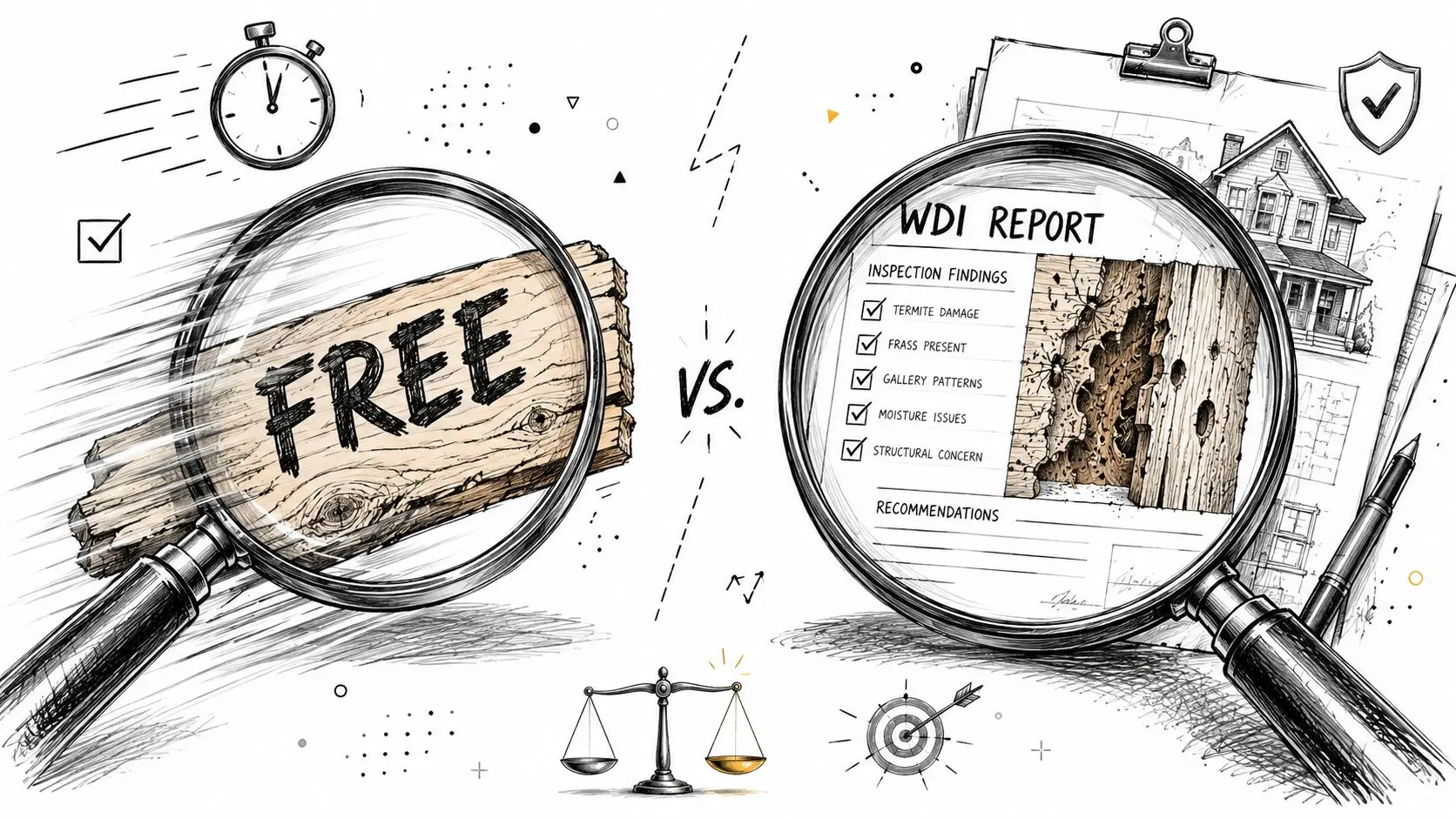
A free inspection is usually a marketing service. A pest company comes out, checks for visible signs of activity, and talks with the homeowner about treatment or prevention. That's useful, but it doesn't carry the same weight as a real estate document.
A paid WDI report is different because it has legal and transactional value. The fee is often around $125 to $300, and the charge is for the escrow-compliant documentation, not just the act of looking around the property, as noted by Defender Pest's explanation of free inspections versus paid WDI reports.
Why the paid report costs money
The report creates responsibility for the pest company in a way a casual inspection doesn't. When a licensed operator signs off on a WDI report for a sale, that form becomes part of a transaction involving a buyer, seller, lender, and often a government-backed loan program.
Here's the practical difference:
- Free homeowner check: Meant to identify concerns and start a conversation about service.
- Paid WDI report: Meant to document the condition of the property for escrow and lending.
- Free check: Often flexible in format.
- Paid report: Uses standardized documentation and has to be accurate, complete, and defensible.
- Free check: Usually for the current owner's information.
- Paid report: Usually for multiple parties who are making financial decisions.
You're paying for the document people can act on, not just the flashlight time.
What doesn't work for buyers
What doesn't work is assuming the cheapest option solves the problem. If a company offers a no-charge visit but doesn't issue the form your lender or closing team needs, you haven't saved money. You've only delayed the deal.
What does work is asking three direct questions before booking:
- Is this an official WDI report for a real estate transaction?
- Will a licensed operator complete it?
- Will the documentation satisfy my lender or agent's requirements?
In Houston-area closings, that clarity matters more than shaving a small amount off the fee.
How Much a Wood Destroying Insect Inspection Costs in Houston
A Houston buyer sees a company advertising a free termite inspection, books it, and then learns two days later that the title company needs a paid WDI report. That is one of the most common cost surprises I see in real estate deals.
In Houston, the number that matters for a closing is the fee for the official WDI report, not the price of a general termite check. As noted earlier, national pricing often falls into a broad range, but local quotes depend more on the house itself than on any advertised starting price.
For most Houston-area transactions, a straightforward WDI inspection on a standard home usually lands somewhere around the low to mid hundreds. The price goes up when access is difficult, the property is older, or the inspector has to document more than the main structure. A buyer who is budgeting for closing should expect the formal report to cost more than a promotional homeowner inspection, because the report has to hold up in a real estate file.
What changes the quote in Southeast Texas
Age and access drive a lot of the price.
Older homes in Houston often have prior termite treatment holes, patched trim, moisture staining, or repaired wood that takes extra time to sort out. An inspector cannot rush through those conditions if the report is going to be useful to a buyer, seller, agent, and lender.
Property layout matters too. Detached garages, sheds, additions, wood fences tied into the structure, and heavy landscaping all add inspection time. If a shed is part of the concern, a basic shed foundation inspection checklist can help you spot access or structural issues before the pest inspector arrives.
Foundation type affects labor as well. Many Houston homes are on slab foundations, which are usually easier to inspect than homes with crawlspaces. Tight crawlspaces, blocked attic entries, low roof lines, and packed storage all slow the job down and can push the fee higher.
If you want to compare this cost against other common pest-service charges, this North Houston exterminator cost guide gives useful context.
WDI inspection cost factors in Southeast Texas
| Property Feature | Typical Cost Range (Standard Home) | Potential Additional Cost |
|---|---|---|
| Standard residential WDI report | $100 to $300 | None if access is easy |
| VA loan transaction | $50 to $150 | May rise with size or complexity |
| Conventional loan transaction | $160 to $170 | May increase with added structures |
| Older or complex property | Varies | Higher fee for added inspection and reporting time |
| Detached structures included | Varies | Added charge is common |
| Difficult-access property | Varies | Higher fee is common |
How to read a Houston quote
A fair quote should match the amount of work on the property.
A smaller house with clear access, no outbuildings, and no obvious problem areas will usually price lower. A larger house with more trim, more attic area, more garage framing, or more exterior wood usually lands in the middle. A house with crawlspace entry issues, detached structures, heavy vegetation, or signs of previous repairs will usually price higher because the inspector has more areas to evaluate and more findings to document.
The cheapest quote is not always the best value in a transaction. If the fee does not include the actual WDI report, excludes structures you need inspected, or leaves major areas listed as inaccessible, you may still end up paying again before closing.
What Inspectors Check During a WDI Inspection
You are under contract on a Houston house, and the report needs to answer one question clearly. Is there evidence of wood-destroying insects, damage from past activity, or conditions that raise the risk enough to matter before closing?
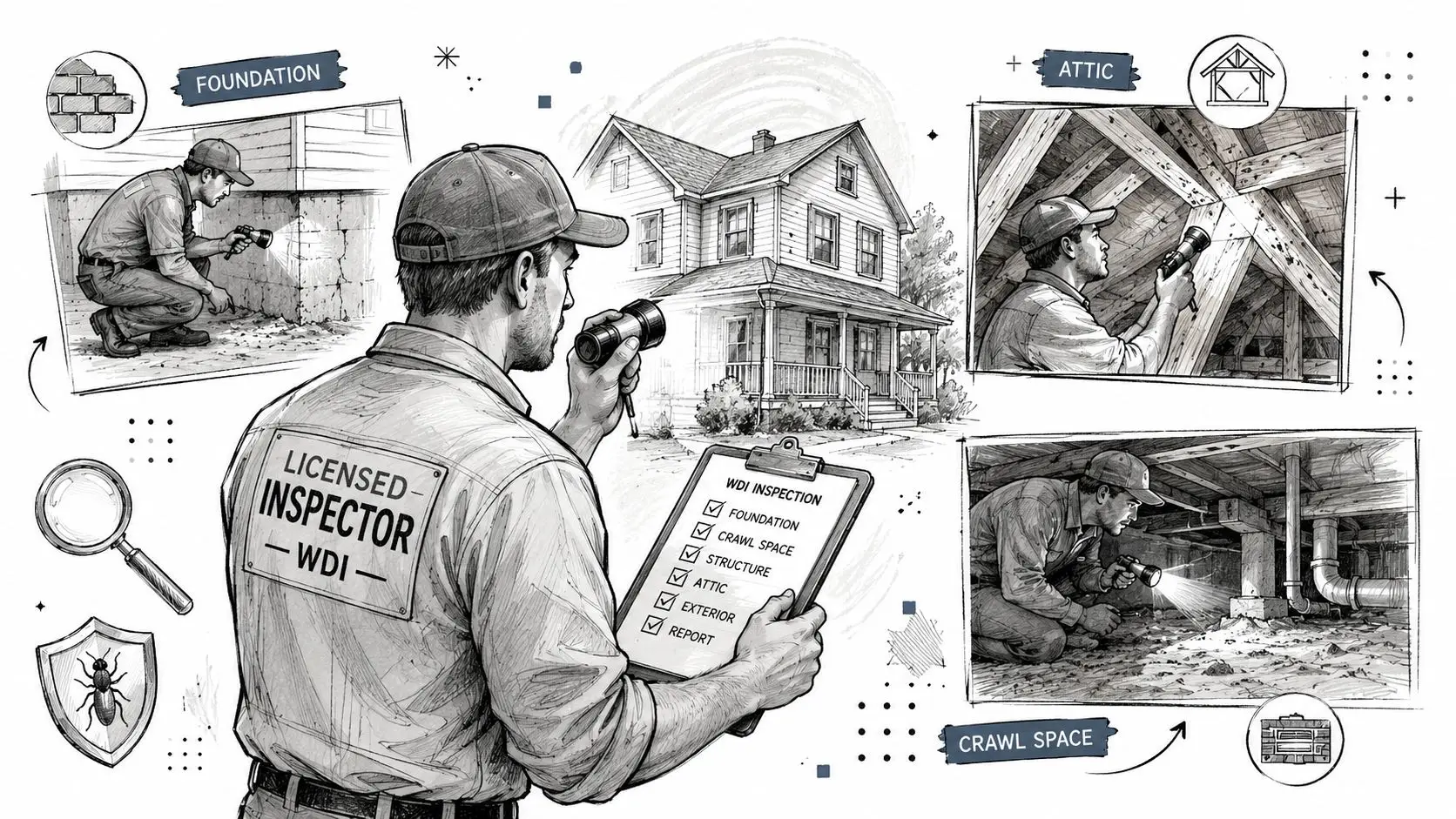
That is different from the quick, free termite check some companies offer homeowners. A transaction WDI inspection has to be documented, tied to the structure being sold, and limited to what the inspector can access and observe on the inspection date. Buyers miss that distinction all the time, and it matters because the report language can affect repairs, negotiations, and closing timelines.
How the inspection usually moves through the house
Most licensed inspectors start outside. In Houston, the exterior usually tells you where trouble starts. We look at slab edges, siding clearance, porch posts, door frames, attached fencing, mulch depth, tree stumps, and any spot where wood touches soil or stays damp after rain.
From there, the inspection moves into the garage, interior trim areas, plumbing penetrations, window lines, and other accessible rooms. Attics and crawlspaces get close attention when they can be entered safely because those areas often show old leaks, damaged framing, shelter tubes, or insect activity that a walk-through buyer will never notice.
The report is generally built around four types of findings:
- Current evidence: visible termites or other wood-destroying insects, shelter tubes, fresh frass, exit holes, or wood damage that still looks active
- Previous activity or damage: older signs that may have been treated before, but still need to be disclosed and evaluated in the report
- Conducive conditions: moisture problems, earth-filled porches, poor drainage, heavy vegetation, cellulose debris, or wood-to-soil contact
- Inaccessible areas: locked rooms, blocked attic hatches, packed garage walls, low crawlspaces, or finished surfaces that prevent a proper visual inspection
Detached structures can matter too, especially if they are included in the sale. A workshop, detached garage, or shed may have the same moisture and clearance issues as the main house. For owners trying to size up those risk points ahead of time, this shed foundation inspection checklist covers several exterior conditions that also show up in WDI inspections.
What inspectors are actually looking for
The focus is broader than termites alone. In Texas, the inspector may also note other insects that damage wood, depending on what is visible and required for the report. This guide to wood-destroying insects in Texas gives a solid overview of the pests commonly involved.
Access drives report quality. If storage blocks the garage perimeter, insulation buries the attic edges, or the crawlspace hatch is sealed shut, the report will reflect those limits. That can leave a buyer with unanswered questions at the worst time, right before closing.
This walkthrough gives a good visual sense of what a termite-focused inspection looks like in the field:
Field note: The cleanest WDI reports usually come from houses where the attic hatch opens, the garage walls are visible, and nothing is stacked tight against the foundation.
After the Inspection Report Costs and Next Steps
A lot of buyers get surprised here. The WDI fee pays for the report your lender, agent, or title company may require. It does not pay for termite treatment, wood repair, or a return trip if someone asks for updated paperwork before closing.

In Houston-area transactions, the next step depends on what the report says. A clean report usually means the inspection fee is the main pest-related cost. If the inspector documents active termites, old evidence that needs clarification, or conditions that support infestation, the budget can change fast. Treatment is a separate service, and repairs are a different line item again.
What can add cost after the report
The report itself is only one part of the total expense. Buyers and sellers often end up dealing with one or more of these items:
- Termite treatment: Needed if active infestation is found and the parties agree to treat before or after closing.
- Re-inspection or updated paperwork: Sometimes requested after treatment or when a closing timeline shifts.
- Wood repair: Damaged trim, fascia, flooring, sill plates, or framing usually falls to a contractor, not the pest company.
- Correction of conducive conditions: Moisture problems, wood-to-soil contact, or heavy debris against the house may need attention even if active insects are not found.
That separation matters in real estate. I have seen buyers focus on the WDI fee, then get blindsided by the fact that treatment and repair are quoted by different companies.
How to prepare the house before the inspector arrives
Good access helps produce a cleaner, more useful report.
- Open access points: Open gates, attic hatches, garages, and utility rooms.
- Clear the edges: Move storage away from interior garage walls and slab lines.
- Pull back vegetation: Shrubs and vines tight against the house can block visible evidence.
- Share prior paperwork: Old treatment records or repair invoices help the inspector note history accurately.
- Confirm detached structures: If a detached garage, workshop, or shed needs to be included for the transaction, confirm that before the appointment.
If the report shows findings
A report with findings does not automatically blow up the deal. It usually starts a cost discussion.
Here is the practical breakdown buyers should expect:
| Report result | What it usually means | Budget impact |
|---|---|---|
| Clear report | No visible reportable issue in accessible areas | Often limited to the inspection fee |
| Conducive conditions only | The house has risk factors that should be corrected | Usually maintenance or cleanup costs |
| Active infestation | Pest treatment is likely needed | Separate pest control charge |
| Visible damage | Further repair review may be needed | Contractor pricing may enter the deal |
The main mistake is treating all findings like they carry the same price tag. They do not. A moisture issue at a siding edge is a different conversation from active termites in a wall, and both are different from structural wood damage that needs a carpenter.
Treatment versus repairs
Pest control stops the insect problem. It does not automatically fix damaged wood.
If treatment is recommended, ask for the treatment scope in writing. If damage is visible, ask whether a contractor should evaluate it separately. That keeps everyone from mixing a pest bid with a repair bid and arguing over numbers that cover different work.
After closing, routine prevention is cheaper than dealing with a fresh infestation. These tips for preventing wood-destroying insects around the home are a good place to start.
A clean report makes closing easier. A report with issues can still be handled well if the buyer, seller, agent, and pest company deal with it early instead of waiting until the final week.
Frequently Asked Questions About WDI Inspections
Who usually pays for the WDI inspection
That depends on the contract. In many transactions, the buyer orders and pays for it. In others, the seller covers it as part of negotiations. What matters most is deciding this early so the report doesn't become a closing delay.
How long is a WDI report valid
For VA-related timing in termite-heavy areas like Southeast Texas, the inspection must be completed within the required closing window discussed earlier. If your closing gets pushed back, ask whether a new inspection or updated documentation will be needed.
What if termites are found
Finding activity doesn't automatically kill the deal. It usually means the parties need to decide who pays for treatment, whether a re-inspection is needed, and whether any damaged wood needs separate repair review.
Can the inspector quote treatment on the spot
Sometimes yes, sometimes not. If the inspector also works for a pest company that performs termite control, they may be able to outline treatment options quickly. Repair pricing is often a separate conversation because a WDI inspector isn't automatically quoting carpentry work.
Is a free termite inspection good enough for closing
No, not if your lender, agent, or title company requires a formal WDI report. A free inspection may be useful for routine homeowner concerns, but closings usually require official documentation.
What should buyers in Houston ask before booking
Ask whether the company handles real estate WDI reports, whether detached structures are included, what access is required on inspection day, and how quickly the final paperwork will be delivered.
If you need a formal WDI report for a home sale in north Houston, FullScope Pest Control handles wood-destroying insect inspections for buyers, sellers, and agents in communities like Kingwood, Conroe, Cleveland, Porter, and nearby Southeast Texas areas.