1500+ reviews

The typical quarterly pest control cost in the U.S. runs $100 to $300 per visit, or about $400 to $700 per year, and Magnolia, TX homes often land between $120 and $260 per quarter depending on size, scope, and pest pressure. If you just got three quotes for the same house and the numbers don't match, that's normal, but only one of those quotes is likely to be fair for the protection you need.
A Magnolia homeowner can get one bid that looks cheap on paper, another that's padded with extras, and a third that's priced correctly for Southeast Texas conditions. That spread usually comes down to what's included, how much pressure the property is under, and whether the provider is selling prevention or just a quick spray.
What Quarterly Pest Control Costs in 2026
A Magnolia homeowner with an 1,800-square-foot house might get three very different quarterly quotes for the same basic service, and that's exactly why people get confused. One provider prices the job like a light perimeter spray, another prices it like a full preventive program, and a third pads the estimate because they expect callbacks or heavier pest pressure. The number on the invoice matters, but the service scope matters more.
A quarterly plan means four scheduled visits per year, usually spaced about every 90 days. That schedule is built for ongoing barrier treatment, not one-time rescue work. In the national market, the common quarterly band is $100 to $300 per visit with annual totals often landing between $400 and $700 as summarized in this cost guide. Another pricing breakdown puts quarterly contracts at $95 to $145 per treatment and $380 to $580 per year, with an effective monthly cost of $31 to $48 in this annual cost breakdown.
Practical rule: if a quote is far below the common quarterly band, ask what got left out. Cheap is only cheap when the treatment actually covers the pests you have.
For Magnolia and the rest of Southeast Texas, the working range usually sits in the $120 to $260 per quarter zone for standard residential coverage. That's not a special local discount, it's the natural result of warmer conditions, heavier pest pressure, and the need for more complete perimeter work. The most common mistake homeowners make is comparing only the annual number and ignoring whether the plan is built for prevention or just minimal service.
A good way to sanity-check the quote is to ask whether the provider is selling a quarterly maintenance plan or repeating a one-off treatment on a schedule. Those are not the same product, even when the pricing sounds similar.
See whether quarterly service is worth it before you sign
What's Actually Included in Each Quarterly Visit
A real quarterly visit should do more than make the outside look treated. At minimum, the technician should inspect common entry points, treat kitchens and bathrooms where activity shows up first, apply exterior perimeter protection, place bait or other targeted material where appropriate, and leave a service report that tells you what was done. If a company won't put the scope in writing, they're leaving room to underdeliver.
The published pricing tiers line up with how much of the home gets covered. Interior-only service generally runs about $90 to $140 per quarter per this pricing guide. A standard interior plus exterior perimeter plan usually lands at $120 to $180 per quarter, while a broader perimeter-plus-interior-touch-up model sits around $150 to $210 per quarter from the same guide. For a straight residential benchmark, the quarterly visit band of $100 to $300 also shows up in national cost references here.
| Scope tier | Typical per-visit cost | What's included | Best fit |
|---|---|---|---|
| Interior-only | $90 to $140 per quarter | Targeted indoor treatment, limited exterior work | Small homes with low outdoor pressure |
| Interior plus standard exterior perimeter | $120 to $180 per quarter | Interior touch points, perimeter barrier, routine follow-up | Most single-family homes |
| Perimeter plus interior touch-up | $150 to $210 per quarter | Broader exterior service with indoor refresh | Wooded lots, heavier pressure, larger homes |
The excluded pests matter as much as the included ones. Termites, rodents, mosquitoes, and wildlife usually sit outside a general quarterly insect plan and need separate work. If the provider bundles everything into one vague “quarterly service” label, read that as a warning sign, not convenience.
If you need a separate specialty call, a practical reference point is a hornets nest removal guide from Bulls Eye Repair, which is useful because wasps and hornets are a different job from routine quarterly prevention. You want the right response for the actual pest, not a catch-all spray that sounds broader than it is.
Review plan structure before you compare contracts
The Five Factors That Change Your Quarterly Price
Quarterly pricing is not random. It moves for five reasons, and if you know those drivers, you can spot a fair quote fast.
Property size comes first
Larger homes cost more because technicians treat more perimeter, more entry points, and more interior square footage. A useful rule of thumb from cost breakdowns is that some providers add roughly $25 per 1,000 square feet over 1,500 square feet in this pricing guide. That's why a compact home in a low-risk neighborhood can be priced lower than a bigger house with the same pest list.
Pest type changes the job
General ant control is usually cheap enough to fit a routine quarterly plan, and recurring ant service is often priced around $30 to $50 monthly in recurring-plan terms as noted in the pricing summary. Once the job shifts to termites, bed bugs, heavier rodent work, or repeated fire ant pressure, the estimate stops looking like routine maintenance. Specialty pests need different materials, more labor, and sometimes separate inspection or exclusion work.
Straight answer: if your provider says every pest is covered by the same quarterly rate, they're either oversimplifying or planning to bill the real work later.
Severity matters next. A light prevention account is cheaper than a home that needs an initial cleanout before the maintenance plan even makes sense. That's why some bids look high at first, then settle down once the infestation is under control. The reverse is also true, a low monthly number can turn expensive if the provider charges for repeated cleanups.
Region and climate are real pricing drivers. Southeast Texas homes deal with longer pest seasons, so providers build more protection into the schedule than a drier or colder market would require. Frequency matters too, because a monthly plan costs more than quarterly service by design.
Residential Versus Commercial Quarterly Pricing
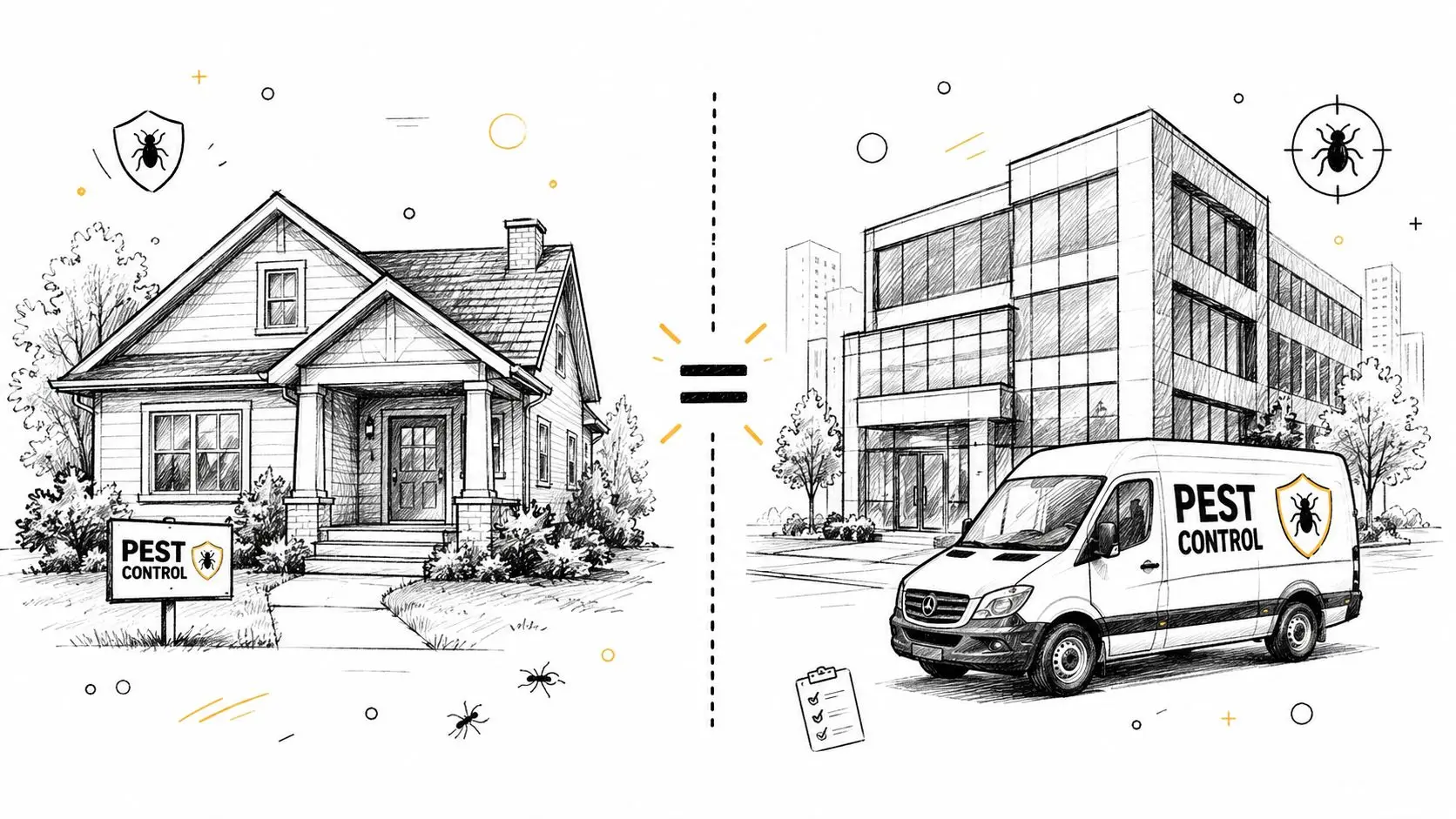
Residential quarterly pricing is mostly about protection, convenience, and keeping bugs from getting established. Commercial pricing adds compliance, documentation, and disruption control on top of that. That's why a business quote can look higher even when the technician is doing work that seems similar on the surface.
For homes, the bill usually reflects treatment scope and property size. For commercial sites, the quote often includes facility-specific Integrated Pest Management planning, logbook maintenance, audit support, and after-hours service windows. Those line items exist because food handling, healthcare, retail, and multi-tenant sites need proof, not just treatment. A fair commercial bid should spell out what the company documents, how often they inspect, and how they handle re-entry risk.
A short video can help property managers see why the service model changes once a building has compliance pressure.
The mistake I see most often is a business owner comparing a residential quote to a commercial one and calling the commercial number inflated. It usually isn't inflated, it's just priced for a different job. If your facility has sanitation requirements, tenant traffic, or inspection exposure, quarterly service needs more reporting and tighter scheduling than a suburban home.
A fair commercial quote should answer four questions clearly:
- What facility type is this built for? Restaurant, office, clinic, or retail each carries different pressure.
- What gets documented? Logbooks, inspection notes, and audit support should be named.
- What's the callback policy? If pests show up between visits, you need a clear response window.
- What's outside the base plan? Rodents, termites, and specialty exclusion work should be separate if they aren't included.
If a provider dodges those questions, the quote is padded or incomplete. Either way, it's not ready to sign.
Why Magnolia and Southeast Texas Sit at the Upper End
Magnolia sits in the Houston-The Woodlands-Sugar Land metropolitan area and in Montgomery County, so it lives inside the broader North Houston pest environment, not some milder outlier market as defined in this local geography reference. That matters because local pest pressure is shaped by long warm seasons, humidity, wooded lots, and the kind of standing water that keeps mosquitoes active. The same home that would be easy to maintain elsewhere can demand more aggressive prevention here.
A Magnolia provider who knows Southeast Texas will quote differently than someone applying a generic national template. Longer warm periods mean pests stay active longer, and termite or mosquito pressure doesn't disappear on a neat seasonal schedule. On top of that, wooded properties and neighborhood drainage patterns can push a home toward the upper half of the normal quarterly band.
Check how local climate can shift pest season in North Houston
Some services belong inside a quarterly plan, and some don't. Barrier sprays and standard insect prevention fit the recurring model. MistAway systems, termite baiting, WDI inspections, and rodent exclusion usually belong on separate lines because they solve different problems.
If a quote claims to cover everything on one quarterly price, ask what happens when mosquitoes, termites, or rodents show up. In Southeast Texas, those are common enough to deserve separate pricing.
That's the Magnolia story. The pricing isn't just about square footage, it's about climate, lot conditions, and how much ongoing pressure the property faces. Providers who understand that will usually quote in the upper half of the national range, and that's often the honest number.
Sample Quarterly Estimates for Magnolia-Area Homes
A 1,500-square-foot single-story home on a low-risk lot usually fits near the lower end of the Magnolia range. A fair estimate is $120 to $150 per quarter for standard interior-plus-perimeter coverage, assuming the home doesn't need cleanout work or specialty add-ons. That's the kind of house where a technician can stay efficient and keep the account on a basic maintenance schedule.
A 2,000-square-foot home with moderate risk usually lands closer to $150 to $190 per quarter. At that size, there's more perimeter to treat and more likelihood of repeated entry pressure around patios, utility areas, or shaded exterior walls. If the property already has frequent ant activity or signs of rodent entry, the quote can move up before the first treatment even starts.
A 2,500-square-foot home on a wooded or high-risk lot can run $180 to $260 per quarter. That range fits homes that need more intensive perimeter work, more re-inspection, or extra time on access-heavy areas. It's also where homeowners start seeing separate charges for things that don't belong in the base plan.
The add-ons that inflate the bill are usually the same ones:
- Initial cleanout fees for homes with active infestations
- Termite work and related inspection reporting
- Rodent exclusion, especially when entry points need sealing
- Mosquito barrier add-ons or seasonal sprays
- Misting system install and refill for higher-pressure yards
- WDI inspection reports tied to a real estate closing
FullScope Pest Control's residential and commercial programs, including mosquito management, termite protection, rodent services, and WDI inspections, fit that kind of layered pricing structure when a home needs more than basic quarterly coverage. That doesn't make the service expensive by default, it makes the estimate honest.
The best budgeting move is simple. Ask for the quarterly rate, ask for the add-ons separately, and refuse to let a specialty job hide inside a maintenance price.
Questions to Ask Before Signing a Quarterly Contract
Start with scope, because that's where most homeowners get burned. Ask, What pests are included, and which ones are excluded? A fair answer should name the pests and the service areas, not hide behind a broad promise. If termites, rodents, or mosquitoes are missing, you need to know that before you sign.
Then ask about contract terms and cancellation. How long is the agreement, and what happens if you move or need to stop service? A written answer beats a friendly verbal promise every time. If the company won't put the term in writing, they're asking you to trust too much.
Treatment safety and method matter too. What products do you use, where do you apply them, and how do you handle homes with children or pets? You don't need a chemistry lecture, but you do need enough detail to know whether the service is perimeter-focused, interior-focused, or both. If the provider can't explain that clearly, they probably don't run a consistent program.
Ask about the gap between visits, because that's where value shows up. If pests return between scheduled treatments, what's the callback policy? Reasonable companies stand behind their work and tell you exactly what happens when the barrier fails early or a new problem appears. You're buying ongoing protection, not a quarterly appearance.
My rule: the best quote is the one with the clearest written scope, not the lowest number on the first page.
A short checklist keeps the call tight:
- Scope: What's included, what's excluded, and is it written down?
- Timing: Are visits quarterly, or are they flexible when your account needs it?
- Safety: What gets applied inside versus outside?
- Callbacks: What happens if the problem returns before the next visit?
If a provider answers all four cleanly, you're probably dealing with a real maintenance plan. If not, keep shopping.
How to Lower Quarterly Pest Control Cost Without Losing Protection
The fastest way to waste money is chasing the cheapest per-visit price and accepting a thin plan. That often leaves homeowners paying again for follow-up service, exclusions, or cleanout work that should've been covered from the start. Savings come from buying the right scope once.
Bundling related services with one provider can help when the same company handles general pests, termites, mosquito work, and rodent services. Paying annually instead of quarterly can also make sense if the provider offers a real discount. On the home side, sealing obvious entry points and clearing leaf piles, stacked wood, and other outdoor harborage lowers the pressure between visits, which helps any quarterly plan work better.
The false savings are easy to spot. Skipping callbacks to avoid another service fee just lets the problem build. Stretching visits past the home's actual risk level is another bad move, especially in Southeast Texas where pest pressure doesn't politely wait for your budget cycle.
If you want a leaner bill, ask for a plan that matches the property, not the marketing brochure. A well-scoped quarterly program at the right tier beats a bargain plan that misses the pests you have. In Magnolia and the surrounding Southeast Texas market, that's the difference between paying for prevention and paying twice for cleanup.
Call a local provider and ask for a written quarterly quote that separates base service from add-ons, then compare the scope line by line. If your Magnolia home is near woods, water, or recurring ant pressure, ask for the price at the next tier up before you sign, because that's usually the honest number.