1500+ reviews


Spraying the patio first is often the wrong move. A fresh treatment can knock down adult mosquitoes while a water-filled planter saucer keeps producing their replacements. Effective mosquito control for patio seating starts with finding breeding water, then deciding whether the remaining adults need targeted treatment.
For Magnolia, Texas, there's another distinction worth making: private patio service, city fogging, and county mosquito surveillance aren't interchangeable.
Patio Mosquito Schedule at a Glance
Start with the containers, not the spray bottle. The CDC's mosquito prevention guidance recommends inspecting water-holding items at least weekly because Aedes mosquitoes can develop from egg to flying adult in approximately 7–10 days after water covers the eggs.
That makes a forgotten bucket more urgent than mosquitoes hovering around a porch light. Use this homeowner maintenance schedule as a baseline, with extra checks when rain or irrigation refills containers.
Patio mosquito tasks by frequency
| Task | How often | Why it matters |
|---|---|---|
| Empty, scrub, turn over or cover water-holding containers | Weekly | Eggs hatch in water, and development can finish in about 7–10 days |
| Check gutters, drains, tarps and grill covers for standing water | Weekly and after heavy rain | Hidden water in these spots is easy to miss |
| Refresh birdbath and pet water bowls | Every 3–4 days as a mosquito-maintenance checkpoint; provide pets fresh drinking water more often | Frequent refreshing interrupts development before larvae mature |
| Clear leaf litter and thin dense shrubs beside the patio | Monthly during the season | Shaded, humid areas give adults a place to rest |
| Check screens, door sweeps and window seals | Monthly | Keeps adults from moving indoors |
| Review the plan before peak season and after a wet spell | Seasonal | Adjusts treatment timing to current conditions |
Adjust the routine to the yard
These are maintenance appointments, not permission to leave obvious water until the next scheduled check. Tip out a saucer when you notice it, straighten a sagging cover after rain, and investigate a drain that keeps backing up.
In Southeast Texas humidity, inspect shaded containers even when exposed paving looks dry. A covered patio may shed rainfall directly into pots along its edge, while irrigation can refill trays without leaving the slab wet.
Before the warm months, test screen doors, inspect stored outdoor equipment, and check where downspouts discharge. During wet weather, spend more attention on drainage; during a dry stretch, check irrigation overspray and water stored under cover.
Practical rule: A tidy patio isn't necessarily a dry patio. Check underneath and behind things, not just the walking surface.
Judge progress by what you find and how the space feels. You want no unintended standing water at inspection, fewer adults during the opening minutes outside, and seating that remains usable between treatments.
How to Clear Breeding Sites Step by Step
Bring a flashlight, a stiff nylon brush, gloves, a rake, and something to collect discarded containers. Wear protective clothing and use a labeled personal repellent while inspecting; dusk is useful for finding shaded hiding places, but mosquitoes can bite at other times too.
Inspect the concealed edges of the patio rather than concentrating only on the furniture tops.
Work from containers to drainage
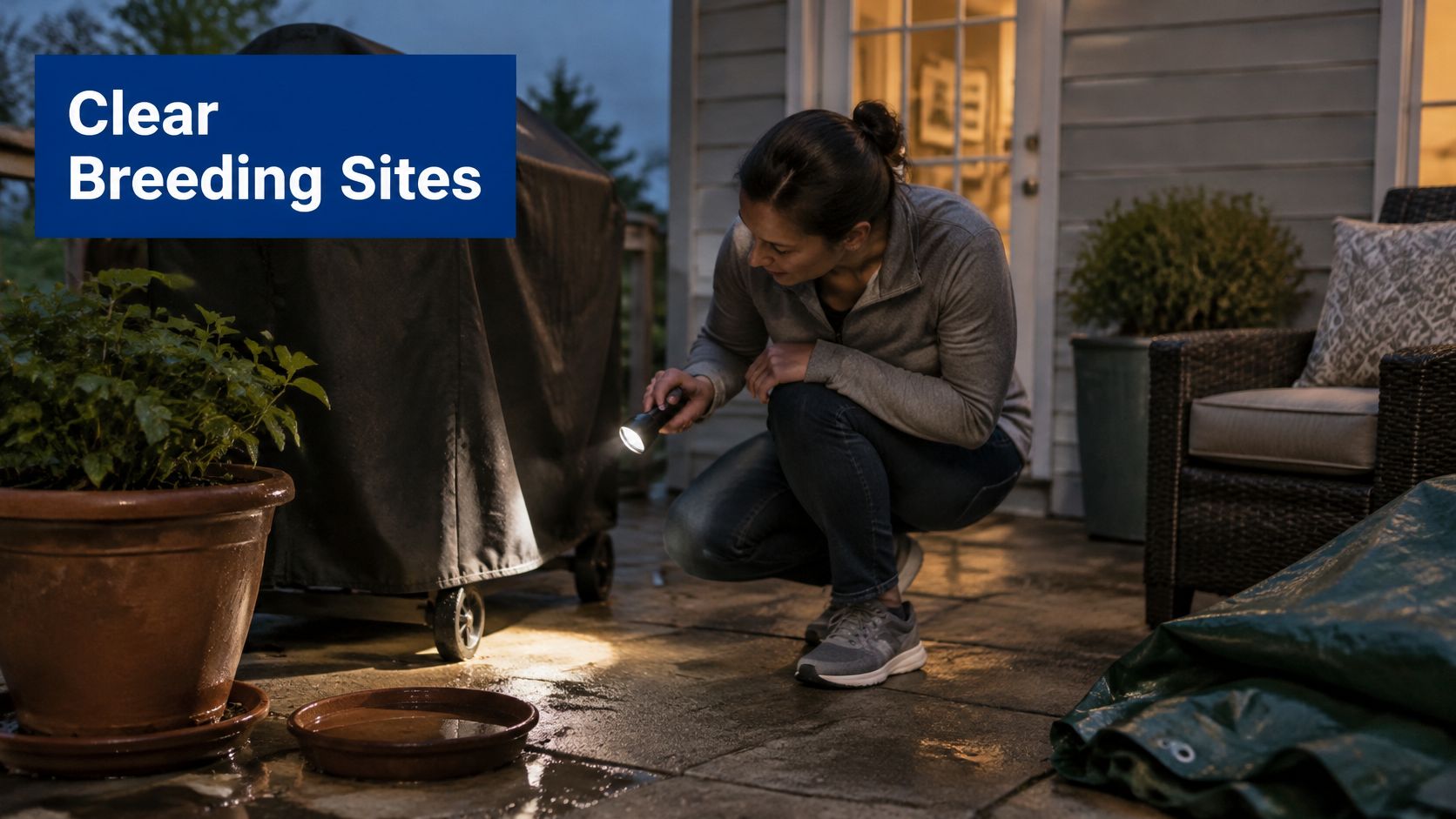
Walk the perimeter at dusk with a flashlight. Look beneath chairs, behind the grill, under planter rims, and inside folded tarps for damp pockets and resting adults. Don't mistake a cluster of adults for proof that they bred there; resting shelter and breeding water can be in different places.
Empty every removable water holder. Include plant saucers, toys, buckets, watering cans, and pet bowls, then give pets clean drinking water immediately. A common slip is draining the obvious bucket while overlooking the decorative outer pot around a nursery container.
Scrub the inside walls and rim. Mosquito eggs can cling above the waterline, so use the brush rather than relying on a quick rinse. Emptying a planter without scrubbing it can leave eggs ready for the next refill.
Turn over, tightly cover, or discard containers. Store unused pots upside down and support covers so they shed water rather than forming pockets. A saucer that's rinsed and then refilled by a hose remains a potential nursery.
Restore drainage instead of repeatedly dumping the same puddle. Clear accessible gutter outlets, remove debris from drain grates, and correct minor depressions without directing runoff toward a foundation or neighboring property. For the connection between blocked roof drainage and building problems, Cultivate House Detailing's explanation of gutter debris and moisture damage is useful; leave unsafe roof access and buried-drain repairs to qualified tradespeople.
Open up humid resting pockets. Rake leaf litter from beneath furniture and selectively thin dense shrubs to improve airflow. Don't strip the landscaping bare or prune plants indiscriminately; the target is trapped moisture and inaccessible growth against the seating area.
Treat necessary retained water appropriately. For a pond or rain barrel that can't be emptied, select a larvicide specifically labeled for that site, such as a suitable Bti product, and follow its application directions. Don't put an ornamental-water product in drinking water or assume every formulation is suitable around fish.
Check what refills
Run irrigation and watch where the water goes. A blocked pot drainage hole or a sprinkler aimed into stacked containers can undo an otherwise thorough cleanup.
Our guide to reducing mosquito breeding around your property can help extend that inspection beyond the patio. Include side yards, stored equipment, and the area behind sheds rather than stopping at the seating boundary.
At the next inspection, unintended containers should be dry, drains should discharge without holding puddles, and retained water should have an appropriate management plan. Repeat the routine rather than treating cleanup as a finished project.
Choosing Treatments and Using Them Safely
Patio mosquito options compared
| Option | What it targets | Best use | Main limit |
|---|---|---|---|
| Source reduction | Larvae in standing water | Every yard, as the first step | Only works if the weekly routine continues |
| Residual barrier spray | Adults resting on vegetation and shaded surfaces | Shaded beds, fence lines and areas under furniture where labeled | Must be re-treated as the label directs; does not kill larvae |
| Timer misting with positioned nozzles | Adults in the treated zone | Covered patios used often in summer, where installation and labeling permit | Comfort tool; not proven to prevent disease |
| Fogging | Adults exposed to airborne droplets over a wider area | Short-term relief during peak activity | Brief effect; does not address breeding sites |
| Fans and air movement | Adults flying near seating | Seating areas during gatherings | Does not reduce breeding; must run during use |
| Screens and door seals | Adults trying to enter the home | Doors, screened porches and windows | Does nothing for an open slab or yard |
Choose a treatment by its target, not by how impressive the equipment looks. A residual spray needs mosquitoes to contact treated resting surfaces; fogging needs exposed adults to encounter droplets. Neither method corrects a water-filled gutter.
Product selection starts with the label, not the bottle's marketing language.
Match the treatment to the target
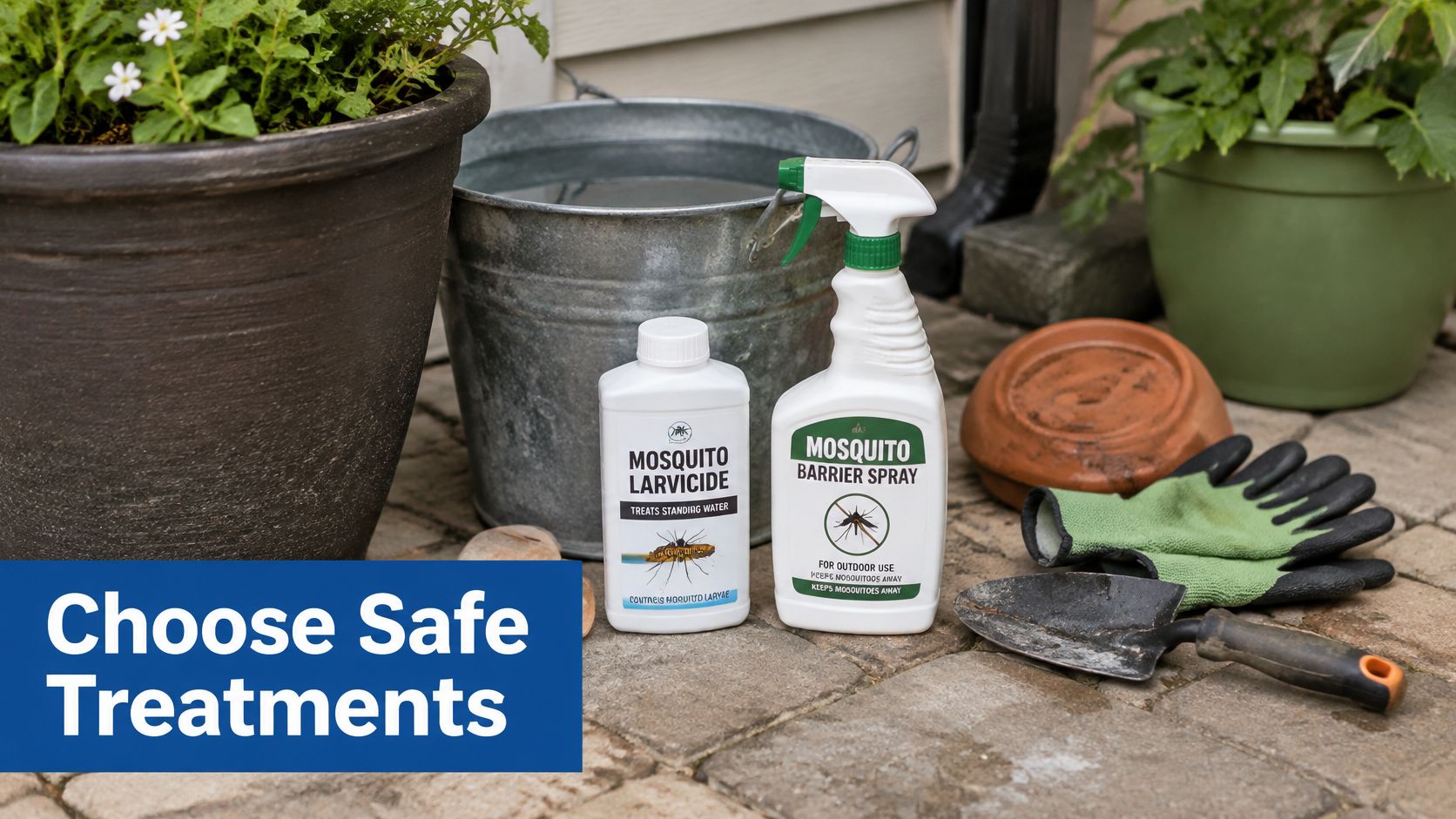
For a barrier application, inspect shaded bed interiors, sheltered fence vegetation, and permitted surfaces beneath furniture. Don't blanket-spray sunny paving, cushions, dining tables, toys, or food-contact surfaces just because mosquitoes are nearby.
Misting introduces a different trade-off: convenience comes with installed equipment, nozzle positioning, maintenance, and repeated pesticide applications. The EPA's residential mosquito misting guidance says these systems haven't been studied sufficiently to document their effectiveness and haven't been scientifically proven to prevent transmission of West Nile virus or other diseases.
That doesn't mean comfort is unimportant. It means fewer visible mosquitoes shouldn't be treated as evidence that disease risk has disappeared. Screens, protective clothing, and labeled personal repellents still have a role.
Use pesticides without creating unnecessary exposure
Read the active ingredient, approved application sites, dilution directions, environmental precautions, and re-entry instructions before opening a product. Our explanation of mosquito control chemicals helps distinguish product types, but the actual container label controls how that formulation is used.
Remove pet bowls, toys, and exposed food before treatment. Keep people and pets out during application and off treated surfaces until dry, and longer whenever the label requires it. Drying isn't permission to ignore a more restrictive re-entry direction.
The EPA and CDC joint statement on mosquito control supports integrated pest management, combining habitat management with appropriately selected control measures rather than relying on pesticides alone. Repeated blanket applications of the same chemistry can select for resistant mosquitoes while adding avoidable exposure.
More spraying isn't the right response to every rebound. First determine whether mosquitoes survived treatment, emerged from water, or flew in from elsewhere.
Rain and heavy irrigation can shorten residual performance, especially before a deposit has dried or set as directed. Don't automatically reapply after a storm; inspect activity, check the label's application limits, and resolve drainage or irrigation problems.
Before choosing equipment, consider how treatment and prevention fit together.
Use the patio layout to narrow the choice
- Screened porch: Repair mesh, door closure, and gaps first, then aim an outdoor-rated fan across occupied seating.
- Open slab: Remove breeding opportunities before considering targeted adult treatment around adjacent shelter.
- Shaded planting beds: Clear debris and improve access before a labeled barrier application. Avoid blooming plants and follow pollinator precautions.
- Children's or pets' play area: Start with physical controls and habitat changes. Ask us which lowest-impact option fits the site and what must be moved before treatment.
Adults returning shortly after treatment, larvae appearing in saucers, or repeated inflow from neighboring standing water call for another inspection, not stronger spray. Discuss neighboring sources respectfully; don't enter another property or apply pesticides there without authorization.
Magnolia Service Area and City Programs
Is the property inside Magnolia city limits, or does it only have a Magnolia mailing address? That's the first local service question. A postal address doesn't establish eligibility for municipal fogging, and it doesn't confirm a private company's current treatment route.
These reference points help distinguish the incorporated city from the surrounding Magnolia market.
Magnolia service-area reference points
| Reference | Detail |
|---|---|
| City location | Junction of FM 1774 and FM 1488, southwestern Montgomery County, as described by the City of Magnolia's location guide |
| Distance to Houston | About 45 miles northwest |
| Distance to Conroe | About 25 miles southwest |
| Interstate 45 and U.S. 290 | Each about 20 miles away |
| 2020 Census | 2,359 residents on 2.87 square miles, according to U.S. Census Bureau QuickFacts |
| 2025 estimate | 8,095 residents |
| City mosquito office | 18111 Buddy Riley Blvd., Magnolia, Texas 77354; 281-356-2266 |
| City fogging program | The City of Magnolia's mosquito program notice describes weekly evening rounds within city limits, using a truck-mounted fog sprayer, from July 17 through October |
| County mosquito control | 281-364-4203 for area-wide mosquito-control questions, including trapping and testing |
Confirm the boundary before assuming coverage
The city's location guide also describes the broader Magnolia area as extending roughly twelve miles in each direction, with an estimated population exceeding 138,000. That broader area isn't the same geographic unit as the incorporated city's census population.
A property along the Magnolia road corridors may therefore sit outside the municipal treatment boundary. Give us the street address, subdivision, and nearby cross street so we can confirm private service availability rather than relying on the town name alone.
Subdivision entrances identify communities, but they don't establish city-limit boundaries.

Separate municipal routes from property service
Treat the city notice as a published program description, not a guarantee that its dates or route remain unchanged. Contact the city office to confirm the current schedule and whether your street is included.
Private patio service addresses an individual property's conditions and is arranged separately. Our local mosquito service information is a starting point, but booking still requires address confirmation.
Pool maintenance needs the same geographic check. Pool & Landscaping of Vistancia LLC's find local pool maintenance page illustrates why checking a contractor's stated territory matters; it isn't confirmation of Magnolia, Texas, coverage.
For a managed property, keep the city contact, private treatment contact, and pool or drainage contractor separate. That prevents a missed municipal route from being confused with a missed private appointment.
Choose Your Patio Plan and Confirm Service
Choose the level of control that matches the inspection, not the most elaborate equipment available.
- Manageable container sources and low adult activity: Keep the DIY maintenance routine and use physical protection around seating.
- Persistent adults in shaded beds or beneath furniture: Consider a targeted barrier treatment after correcting the conditions supporting them.
- A patio used most evenings: Consider automated misting if you accept installation, maintenance, and its role as a comfort measure rather than disease protection.
Make the service conversation specific
At FullScope Pest Control, we use Integrated Pest Management and offer the lowest level of insecticide and baiting needed to resolve a pest problem. Our mosquito options include barrier sprays and MistAway automated misting systems, which apply treatments on a timer through positioned nozzles.
Barrier sprays and misting systems reduce mosquito populations during peak seasons and are popular around creeks, wooded lots, and lake properties. Those surroundings don't guarantee a suitable application site, though. Ask us whether barrier treatment fits the vegetation and nearby water, where nozzles would point, what service interval is appropriate, and what preparation and re-entry precautions apply.
If you're rearranging seating or landscaping, OutdoorBrite's AI patio design can help visualize a layout. Keep drainage paths, fan placement, and maintenance access in the design rather than hiding them behind planters.
For public-health and area-wide questions, Montgomery County Mosquito Control can be reached at 281-364-4203; its public program includes trapping and testing and is separate from private patio service.
Confirm the actual property, not just the community name.
Complete the first weekly check this week, and book an inspection if the same problem returns after two inspection cycles. Confirm any Magnolia, Kingwood, or Conroe address with us before booking: a Kingwood or Conroe property may be served separately from the Magnolia route.