1500+ reviews


If the spray was mixed correctly and the weather cooperated, why are mosquitoes back on the patio three days later? Most homeowners treat that rebound as a weak product. More often the chemical hit the wrong life stage, missed the water where the next generation is hatching, or met a local population that no longer dies at the labeled dose. Mosquito control chemicals only work when the active ingredient, the habitat, and the label all point at the same problem.
Mosquito Control Chemicals at a Glance
Adulticides act on flying mosquitoes that are already biting and resting. Larvicides act on developing larvae in breeding water before those insects ever emerge.
Read each row left to right. The stage tells you whether the product addresses the mosquitoes you can see. The strength is what the chemistry does well. The limit is the reason it can disappoint.
| Chemical class | Common active ingredients | Target stage | Main strength | Main limit |
|---|---|---|---|---|
| Pyrethroids | Deltamethrin, lambda-cyhalothrin, permethrin | Adult mosquitoes | Fast knockdown and surface residual | Resistance is widespread and they are toxic to fish and bees |
| Pyrethrins | Natural pyrethrins from chrysanthemum flowers | Adult mosquitoes | Low persistence and natural origin | Breaks down quickly in sunlight and needs frequent reapplication |
| Organophosphates | Malathion | Adult mosquitoes | Long track record against adults | Resistance is common and use is restricted in many programs |
| Insect growth regulators | Methoprene, pyriproxyfen | Larvae and pupae | Stops larvae from emerging as adults | Does not kill adults already flying |
| Microbial larvicides | Bti (Bacillus thuringiensis israelensis) | Mosquito and black fly larvae | Selective to target insects in water | Short duration in water and needs reapplication as larvae hatch |
| Spinosyns | Spinosad | Larvae in water | Effective larval control | Can affect some non-target aquatic insects |
No row is a universal answer. The stage and the habitat decide the choice.
Why one persistent chemical stopped being the plan
DDT shows what happens when a program leans on a single long-lasting compound. The EPA history of DDT records that U.S. use peaked at approximately 80 million pounds in 1959, that restrictions began in 1969, and that most uses were banned in 1972 after ecological harm, persistence, and widespread contamination. The Stockholm Convention still allows a narrow public-health exemption for indoor mosquito control where alternatives are unavailable. That split matters. DDT is not a general yard product. Modern programs rotate shorter-lived tools and pair them with habitat work.
Dumping standing water still does more than swapping brands. A practical way to eliminate mosquito breeding grounds around your home is to empty the containers that refill after every storm, then reserve chemistry for water you cannot remove.
Matching the Chemical to the Life Stage
An adulticide knocks down mosquitoes that are already flying. A larvicide interrupts development in water so the next flight never starts. The WHO guidance on mosquito control options lists adult tools such as deltamethrin, lambda-cyhalothrin, pyrethroid mixes with piperonyl butoxide, and malathion, plus larval tools such as microbials, insect growth regulators, spinosyns, and benzoylphenyl ureas. Use only products registered for the site. A barrier on shrubs is a different exposure than a product placed in water near children, pets, or a drinking source.
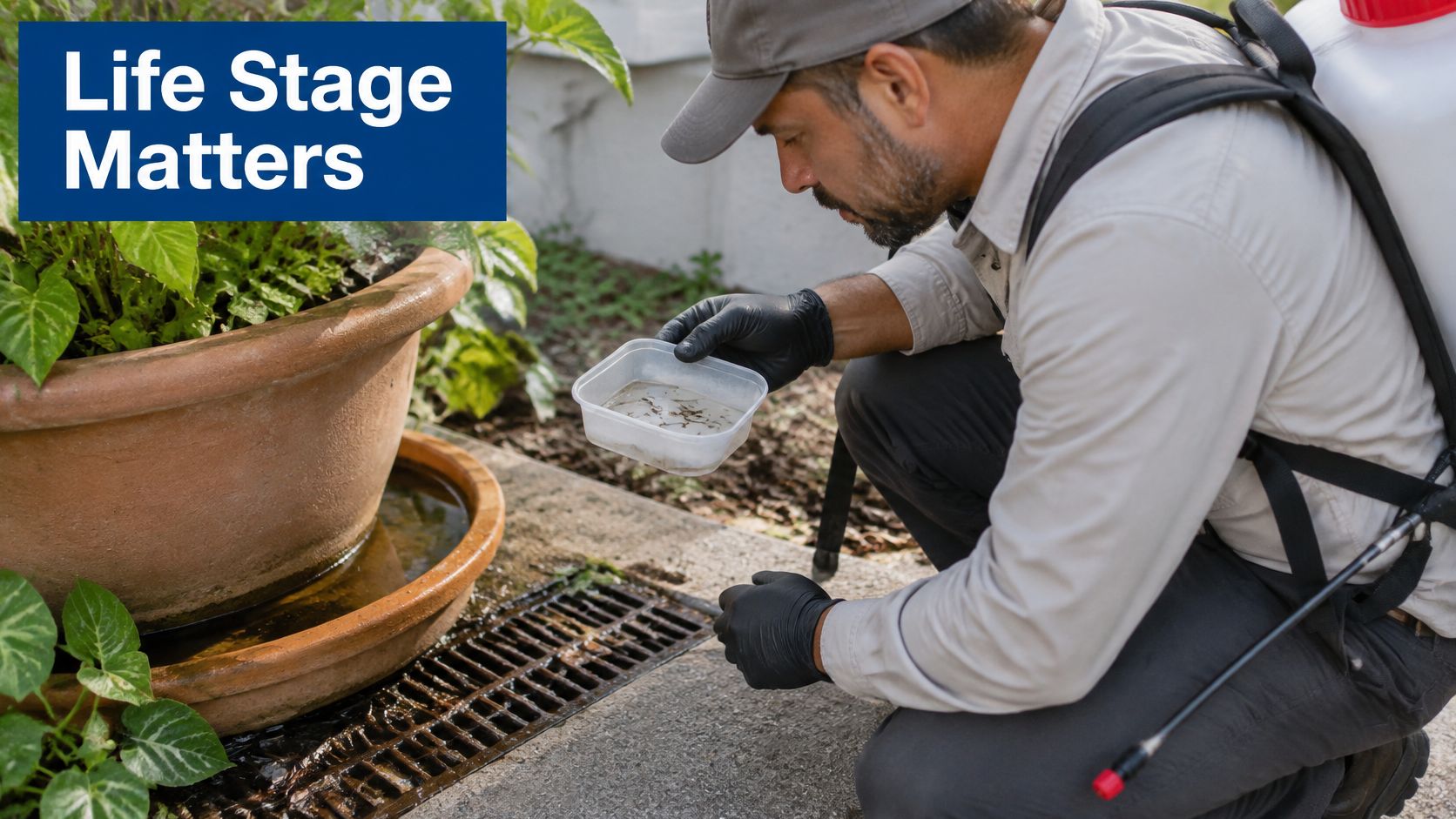
Three yards, three different jobs
Temporary containers. Tires, birdbaths, plant saucers, clogged gutters, and trash-can lids hold water for a few days, which is enough for eggs to hatch. Empty or drill them first. A chemical belongs there only when you cannot dump the water.
Persistent water. Ponds, drainage ditches, creek margins, and lake edges stay wet and often hold fish, tadpoles, and other non-target life. That is a larval job, with a product labeled for that water, not a broadcast adult spray.
Shaded resting sites. Adults sit in shrubs, tall grass, and wooded edges during the day. A residual barrier spray leaves a deposit on those surfaces. An automated misting system releases product on a timer through nozzles aimed at the same resting zone. Fogging is a contact treatment for adults in the air at the moment of application, not a substitute for finding the water.
The sequence and the record
Map every site. Separate water you can dump from water that stays. Put a larvicide only where removal fails, and an adulticide on resting vegetation, not on open water. The mosquito life cycle makes the timing obvious. Eggs, larvae, and pupae are in water. Adults are on foliage.
Write it down: For each product, record the target stage, the habitat, the label rate, and the re-entry or water-use restriction. A class name alone is not a plan.
Why Mosquitoes Stop Responding to a Chemical
A local mosquito population works like a crowd with uneven tolerance. The first treatments kill the most sensitive insects. Survivors breed. Each repeat of the same active ingredient shifts the crowd toward insects that live through the dose, and a longer-lasting residue raises that pressure because more generations meet the same chemistry.
How wide the problem already is
A World Health Organization review of insecticide resistance covering 2010 to 2016 compiled 17,824 resistance records from 79 of 91 malaria-endemic countries, and it sets confirmed resistance at mortality below 90 percent in a standardized bioassay. Resistance at that level showed up in all major malaria-vector species and in all four common classes: pyrethroids, organophosphates, carbamates, and organochlorines such as DDT. Among those 91 countries, 62 reported resistance to at least one class and 50 reported resistance to two or more. A Kingwood or Conroe yard sits far from any malaria program. The selection mechanism is the same, and a product that works on one block can fail two streets away.
That is why a test beats a guess. For adult mosquitoes, labs run a bottle bioassay: they expose a sample of mosquitoes to a diagnostic dose, read mortality at a set time, and compare the result against a published threshold for that insecticide. High mortality means the population still responds as the label expects. Mortality sliding toward the 90 percent line signals a population worth watching. Results below it point to resistance that calls for a different mode of action.
Resistance develops by degrees. A population heading toward the threshold often shortens your quiet period instead of missing entirely. Raising the rate above the label does not fix that. It selects harder and violates the directions on the container.
Four moves that actually change the outcome
- Rotate unrelated modes of action. Two brands in the same pyrethroid family still count as one chemistry.
- Log the active ingredient and the date. You cannot rotate what you cannot remember.
- Pair an adulticide with a larvicide. Killing flyers while larvae keep emerging looks like product failure.
- Ask for a resistance test when knockdown fades or rebound arrives sooner each visit.
A chemical that performs well against one mosquito population can perform poorly against another. Local results beat a national brand story.
Why a Treatment Can Look Like It Failed
A correct application can still look useless. Rain, a neighbor's ditch, a missed hedge, and a hatching brood all imitate a bad spray. Resistance is one cause on that list, not the automatic verdict. The CDC page on mosquito insecticide resistance notes that repeated use of the same insecticide selects for resistance, and that routine efficacy testing should guide the next product. A lab assay also does not fully predict the yard. Formulated product and the actual sprayer have to deliver a lethal dose in wind, foliage, and heat, which is why field checks belong beside the bottle test.
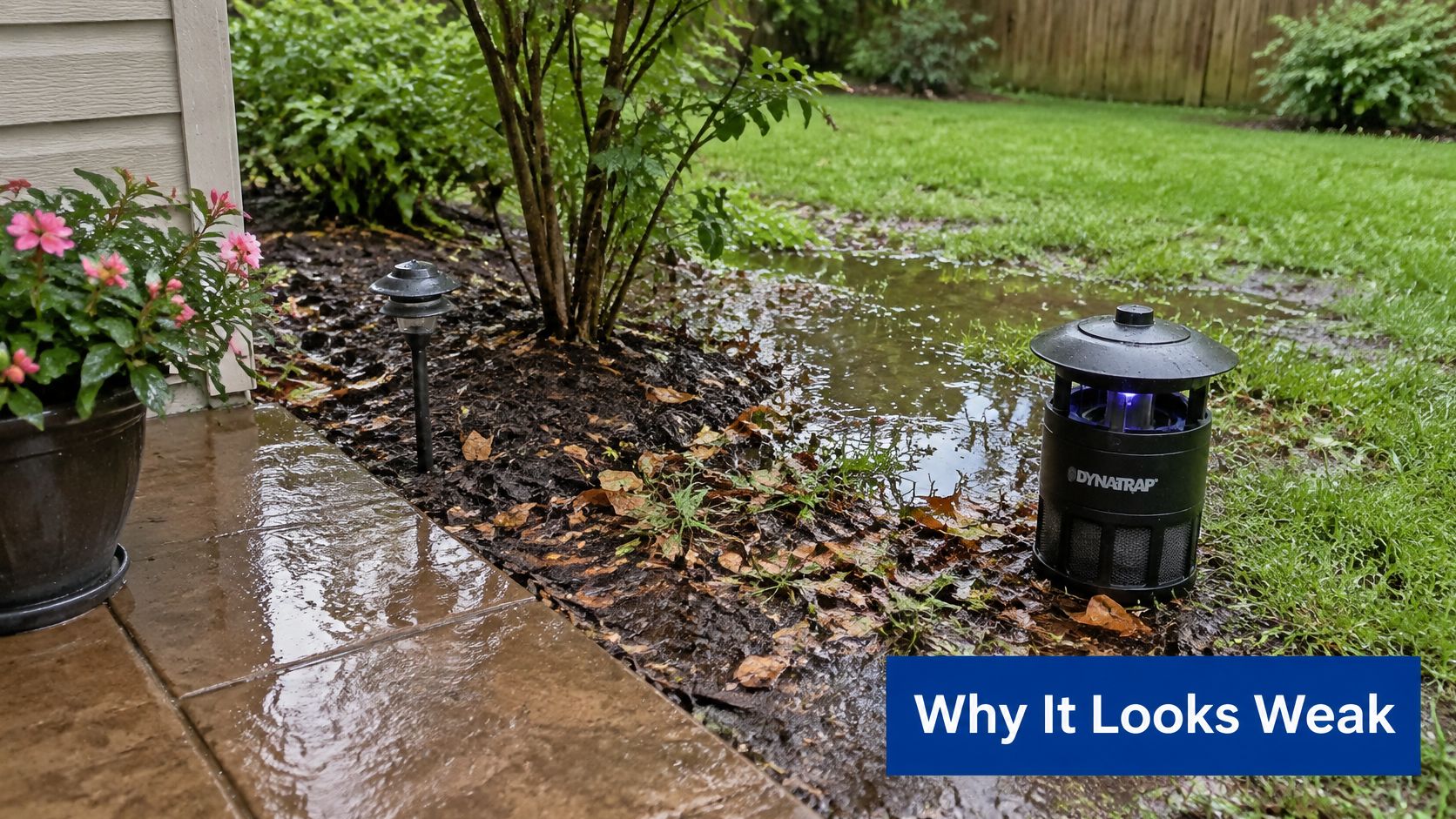
Start with the symptom that matches the timing. Check the product, the rain record, and the application log before you blame resistance.
| Symptom | Likely cause | What to check |
|---|---|---|
| Control lasts only a day or two after rain | Residual washed off or product broke down | Product type, rain timing and reapplication interval |
| Mosquitoes return within a week of treatment | Reinvasion from untreated sites | Neighbouring yards, ditches, containers and wooded edges |
| Each treatment works less well than the last | Developing resistance | Active ingredient history and rotation records |
| Patchy results across the property | Missed vegetation or shaded areas | Shrubs, tall grass, fence lines and undersides of leaves |
| Adults controlled but larvae still present | Breeding source left untreated | Larval habitat survey of standing water |
What the puddle is telling you
Say the barrier looked perfect on Tuesday and the yard is loud again after Thursday's storm. That pattern fits wash-off or a fresh hatch, not a need to spray twice as often. Low spots that hold water after Gulf rains keep feeding that cycle. A clear guide to drainage for Austin homeowners walks through grading and outlets that stop those puddles from becoming nurseries, and the same logic applies to a Southeast Texas lot.
Spraying more often, or "stronger," is not automatically better. Exceeding the label selects for survivors and adds exposure without fixing a ditch you never treated.
Before the next visit, ask three questions. Which species and which chemical classes are already in use nearby? Is the pressure adults, larvae, or reinvasion from untreated sites? What evidence supports changing the active ingredient instead of shortening the interval?
Balancing Chemical Use Against Disease Risk
Sorting products into "chemical" and "eco-friendly" skips the key decision. Cutting applications can raise disease risk if you ignore which stage is biting, when the season peaks, and whether a public-health alert is active. CDC integrated vector-management guidance calls for less overall chemical use and less persistence, local rather than blanket treatments, less frequent applications when that still holds the population, and higher action thresholds except during alerts or outbreaks. Early signs of fading control are the moment to change strategy, not the moment to stack extra sprays.
Three questions before anyone mixes a tank
Which stage is causing the complaint? Flying adults justify a barrier or a timed mist on resting sites. Wigglers in a ditch justify a larvicide. Treating both by default wastes product.
Can the source be removed instead? Dumping a saucer or clearing a gutter removes the need for another adulticide round. Standing water left in place is why barrier schedules creep shorter every month.
Is there a public-health alert? Routine nuisance control can wait for a higher threshold. An alert for West Nile or a similar virus is a reason to treat sooner and to document why. Mosquito control in disease prevention is that judgment, not a weekly calendar.
Places the spray should not go
Pollinator habitat. Skip open blooms. Bees visit those flowers the same day you want a residual on leaves.
Ponds. Fish and other aquatic life sit in the water adults only fly over. Keep adulticides off the surface.
Drains. A product that belongs on a shrub does not belong in a storm inlet that reaches a creek.
Play areas. Swing sets and sandbox edges are skin-contact zones. Treat the vegetation behind them, not the equipment.
Pet-access zones. Move bowls and keep animals off wet surfaces until the spray has dried.
Label compliance is the resistance tool you already own. Staying at the labeled rate, and skipping a visit that is not justified, slows selection. Switching products with no record of failure just adds another class to the local exposure without solving the habitat.
Safety for Homes, Pets and Pollinators
The label is the legal instruction. Rate, site, re-entry interval, and any limit on water use are printed there because those are the conditions under which the product was evaluated. "A little extra" is not a safety margin. It is an off-label application.
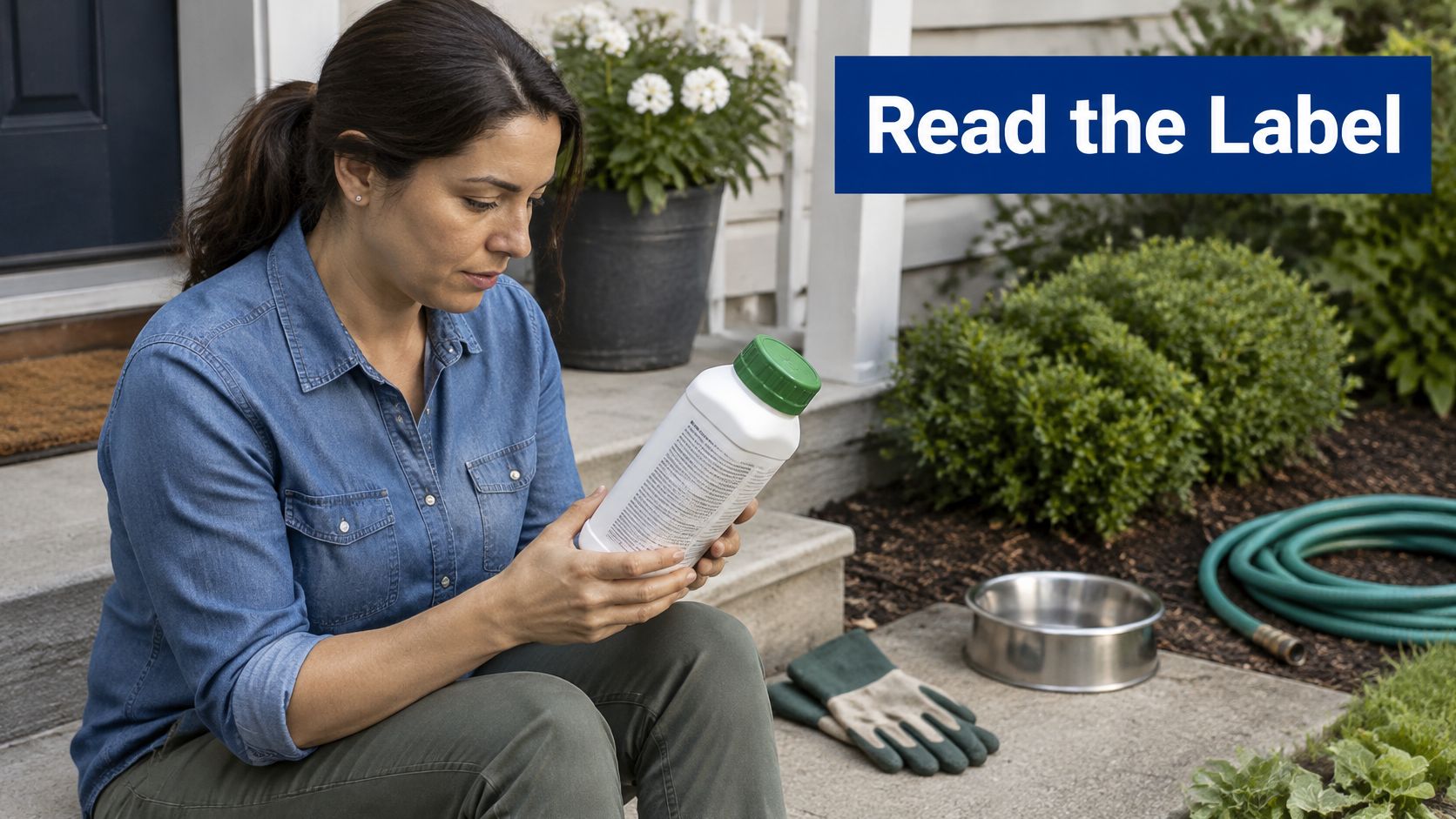
Where exposure actually happens
People meet these products four ways. Spray drift and mist contact skin and lungs during application. Dried residue sits on railings, toys, and pet paths. Pollinators pick up deposits from flowers that were in the spray pattern. Runoff carries product from hard surfaces into ponds, drains, and creeks.
Actions that match those pathways
- Keep people and pets off treated surfaces until the spray has dried, then honor the re-entry time on the label even if the leaves look dry sooner.
- Shift play areas and pet bowls out of the direct pattern before the technician starts.
- Do not apply an adulticide to water unless that exact product is registered for aquatic use.
- Aim barriers at shaded foliage, not at blooms, fish ponds, or storm drains.
Bti is aimed at mosquito and black fly larvae in water and leaves most other insects alone, though it does not last, so new hatches need another treatment. Pyrethroid adulticides are a different profile. Keep them off fish habitat and flowering plants. If you want the lower-toxicity options spelled out for a family yard, start with safe and eco-friendly mosquito control and then match any product to the label in front of you.
The safety data sheet, the label, and the re-entry time belong in the written plan you ask for before the truck arrives. If those three items are missing, the visit is not ready.
Ask for a Written Chemistry Plan Before Treatment
Do not schedule a treatment until you have a written chemistry plan for that address.
- Active ingredients and classes. Names, not just "mosquito spray," so a later visit can rotate for real.
- Target stage and habitat. Adults on shrubs, larvae in a ditch, or both, each tied to a product.
- Label rate and method. Barrier, mist nozzle, or fog, at the rate on the label.
- Re-entry and water-use limits. When kids, pets, and irrigation can return.
- Past products on the property. The history that shows whether you are repeating one mode of action.
- A follow-up window. A date to judge knockdown and rebound before anyone adds another application.
We use integrated pest management and apply the lowest level of insecticide needed for the pest in front of us. Mosquito work is one of three forms: misting systems, residual barrier sprays, and fogging. Barrier sprays and automated misting systems are the options people near creeks, wooded lots, and lake edges usually want during peak season, because that is where adults rest and where water stays.
A written plan is also a job-safety document. Crews in other trades use a safe work method statement to spell out the task, the hazards, and the controls before work starts. You should expect the same clarity for a pesticide on your lot.
Magnolia is a specific place, not "greater Houston"
Magnolia is an incorporated city in southwest Montgomery County. The City of Magnolia maps place it at the junction of FM 1774 and FM 1488, about 45 miles northwest of Houston and 25 miles southwest of Conroe, and about 20 miles from both Interstate 45 and U.S. 290. The 2020 Census QuickFacts for Magnolia city counted 2,359 residents on 2.87 square miles. That is the legal city, a compact area, not the whole trade area people mean when they say Magnolia.
The city's own location profile describes a greater Magnolia area reaching about 12 miles in every direction and estimates more than 138,000 people in that broader area. An outlying street may sit inside that circle and still fall outside a given route. Confirm the exact street address with us before you book, and ask directly whether a property in the surrounding area is on the schedule.
If your yard in Magnolia, Conroe, Kingwood, or a nearby Southeast Texas address is loud again a few days after treatment, send us the last product name, the date, and where the standing water sits. We will match the chemistry to the life stage, check whether the address is in our coverage, and put the label limits in writing before anyone sprays.