1500+ reviews


Two in the morning, and something is scratching inside the wall behind the headboard. Or you open the pantry and find a chewed corner on the bag of rice and a scatter of dark pellets along the shelf edge. The kitchen was wiped down on Saturday. The trash can has a lid.
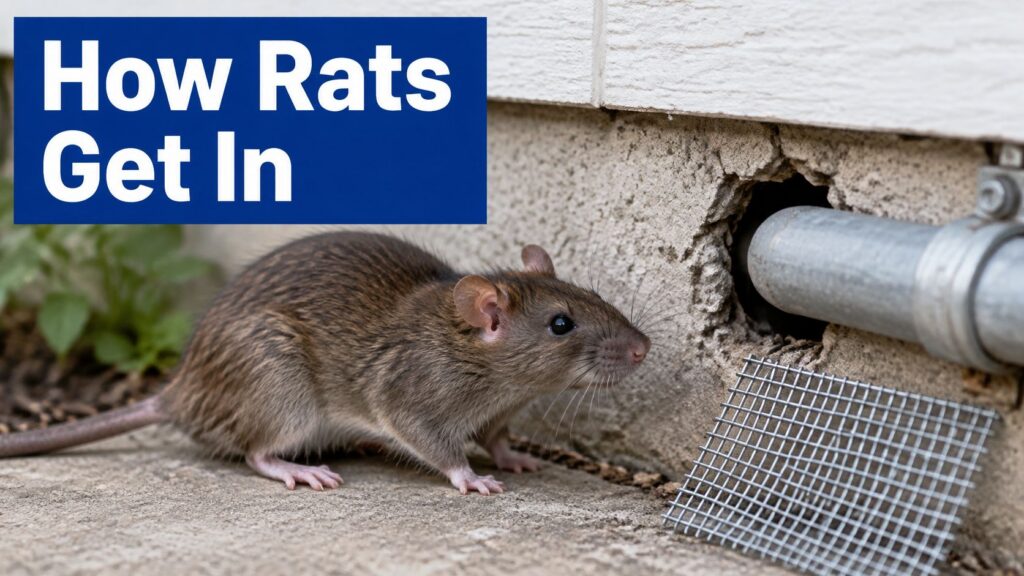
That mismatch between a clean house and a rat problem confuses a lot of homeowners, and it's why so many traps get set in the wrong place. The answer to how do rats get in house is almost never about hygiene. It's about geometry: a gap the width of your thumb, a vent screen that rusted through, a foundation crack that widened over two winters.
Where Rats Get Into a House From Outside
Rats don't need a broken wall. They need a seam where two materials meet, and every house has dozens. The CDC's rodent control guidance lists the openings rats use most: gaps around electrical, water, gas, sewer, cable and plumbing lines, spaces beneath or behind kitchen cabinets and appliances, floor and dryer vents, attic and crawl-space vents, and the joint where the foundation meets the ground.
Walk the outside of the house with that list in hand. The table below turns it into a checklist you can finish in one afternoon, with the sign that tells you an opening is live.
Exterior entry points and what to check
| Entry point | Where to look | How rats use it | Sign to check |
|---|---|---|---|
| Utility penetrations | Electrical, water, gas, sewer, cable and plumbing lines entering walls | Gnawing and existing gaps around pipes and conduits | Gaps or unsealed holes where lines enter |
| Floor and dryer vents | Ground-level vents and dryer ducts | Openings with damaged or missing screens | Loose, rusted or torn mesh |
| Attic and crawl-space vents | Roofline and foundation vents | Unscreened or damaged vent covers | Holes or gaps around the vent frame |
| Foundation-to-ground joint | Where the slab or wall meets the soil | Cracks and deteriorated mortar enlarged by gnawing | Cracks, crumbling mortar or gaps at grade |
| Doors and garage-door edges | Exterior doors and garage thresholds | Gaps under doors without weather stripping | Daylight at the edges or worn door sweeps |
| Fascia, eaves and roof penetrations | Roof edges and wall-to-roof junctions | Damaged fascia and openings where wires or pipes exit | Soft or hollow fascia, unsealed penetrations |
| Window frames | Window sills and sashes | Gnawing on wooden frames and gaps at sills | Rotted wood or loose screens |
Utility penetrations are the row people skip, because the gap usually hides behind a plate. Pull back the meter box cover, follow the AC line set into the wall, and look under the hose bib. The hole drilled for the pipe is almost always wider than the pipe.
Vents fail. A dryer vent flap that no longer closes, a crawl-space screen pushed loose by a lawn mower, an attic vent with rusted mesh: each is a doorway at a height rats reach easily.
The foundation joint matters most on older slabs. Mortar at grade crumbles, and rats start working the soft spot with their teeth.
Roof edges deserve their own look. Soft fascia is more than a paint problem, and if the board crumbles under a screwdriver, check this guide on when to replace damaged soffit panels before sealing anything, because new mesh over rotten wood won't hold.
A gap you can slide a pencil into is a gap a rat can start working on.
What makes all of this worth checking is how unremarkable the openings look. None of them require a visibly broken wall or an open doorway, and several sit behind trim, siding or a shrub.
How Small a Gap Lets a Rat Through
A homeowner looks at a crack the width of a coin and decides it is cosmetic. That guess is where most exclusion efforts fail. A rat does not need an opening that looks like a doorway. It needs a gap its skull can pass and material around the edge soft enough to work with its teeth.
| Opening size | Who can get through | What to do |
|---|---|---|
| 0.25 inch (6 mm) | Screening threshold for sealing gaps; not a species limit | Seal every gap this size or larger |
| About a quarter | Rats | Repair with metal or cement, not foam |
| About a dime | Mice | Seal with mesh or metal, and recheck after rodent activity |
The CDC's seal-up guidance recommends closing gaps larger than 0.25 inch, or 6 millimeters, around pipes, vents, windows, doors and service lines. Read that number as a screening rule rather than a body measurement. Anything at or above it gets sealed, because whether a given rat fits through depends on the species and the animal's age.
For the rat-sized end of the scale, San Diego County's rodent-exclusion guidance puts rats at holes about the size of a quarter or larger, and mice at dime-sized holes or larger. The same guidance names the repair material: 1/4-inch, 18 to 22 gauge wire hardware cloth, plus metal weather stripping for door gaps.
Coins make a practical field gauge here. Carry a quarter and a dime on your inspection walk. If a quarter slides into the opening, treat it as a rat route. If only a dime fits, mice can still use it, and a rat can widen it.
Say the gap around the pipe where a water line enters the wall measures just over a quarter inch. That calls for hardware cloth cut to overlap the opening on every side, not a bead of caulk. The same logic applies to a window sill with rotted wood. If that frame also shows fogging between the panes, Superior Home Improvement's foggy window guide explains what a failed seal means, and a failing seal and a rotting sill often show up together.
Gnawing changes the math over time. Rats enlarge openings in soft wood and weak mortar, so a hairline crack today can become a usable hole within weeks. Measure every gap you find, and treat anything at or above a quarter inch as an active entry point until durable material closes it.
Why Rats Choose Your House Over the Yard
A spotless kitchen still gets rats, and that fact alone tells you the problem isn't dirt. Something else is going on, and it splits into two separate questions: what brings rats close, and what lets them inside.
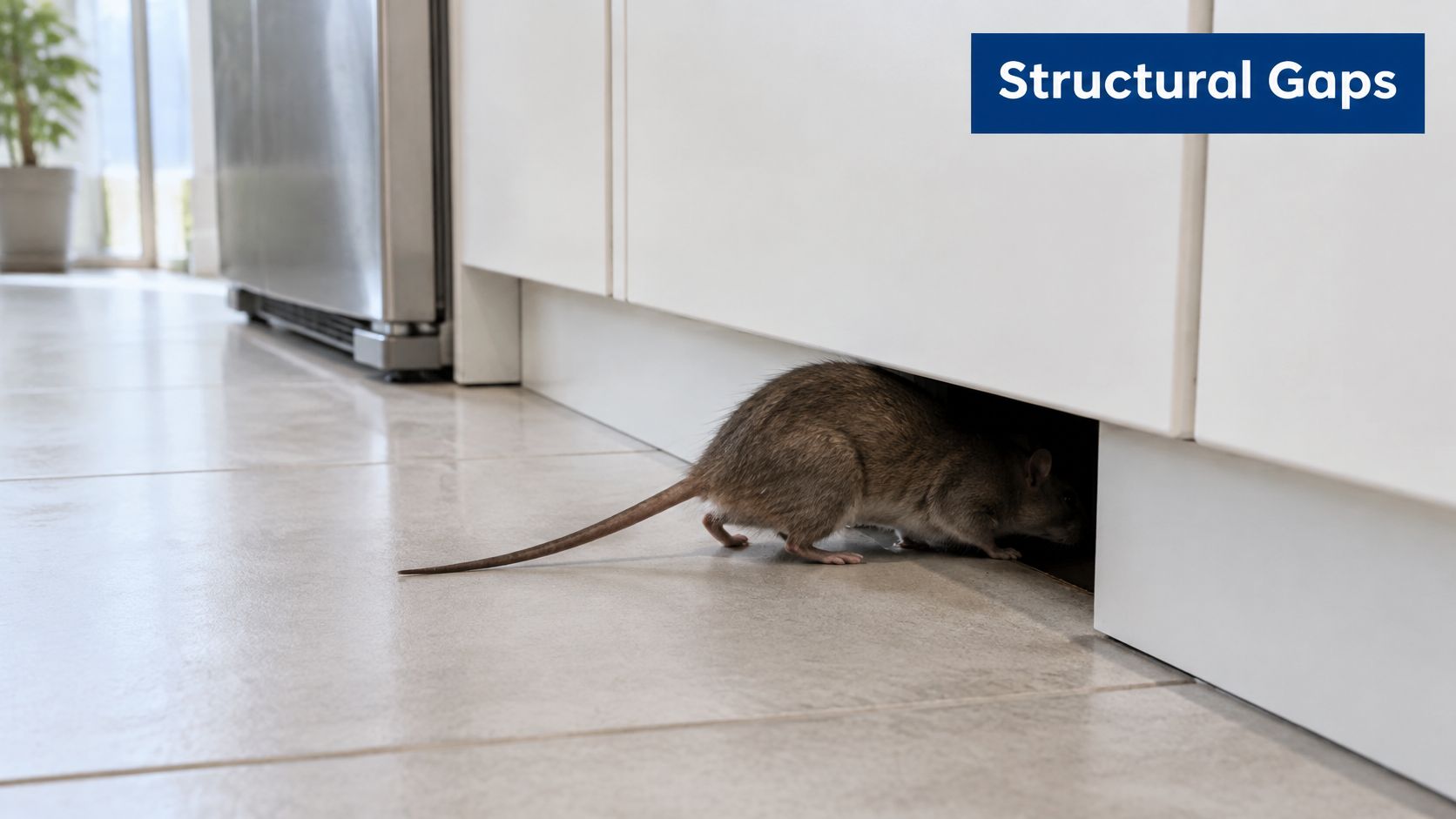
Attraction and access are different problems
Attraction is food, water and shelter near the structure. Access is a defect a rat can squeeze through or widen. Attraction decides whether rats hang around your wall; access decides whether they end up in your pantry.
Outdoor conditions do most of the attracting:
- Leaf piles and deep mulch: warm, damp cover right against the slab.
- Pet food and open compost: a reliable calorie supply, often within a few feet of the wall.
- Standing water: clogged gutters, leaking hose bibs, overwatered beds.
- Woodpiles and debris: stacked against the foundation, they double as shelter and a ladder.
In warm, humid Southeast Texas, shelter and water stay available for months at a stretch, so the yard becomes a standing invitation rather than a seasonal one, as CDC guidance on sealing a home against rodents implies when it recommends removing all three attractants at once.
Picture a neighbor's open compost bin beside a house with an unscreened crawl-space vent. The bin pulls rats to the wall. The vent lets them in. Neither problem alone produces an infestation, and neither fix alone ends one.
A clean kitchen reduces how long rats stay. It doesn't change whether they can get in.
Trapping by itself keeps failing for the same reason. The EPA's rodenticide and prevention guidance notes that rodents released outside may return unless entry points are sealed. You can carry out ten rats and still have an open vent. There's a useful breakdown of yard-level attractants in this guide to what attracts rats to your yard if you want to work the outdoor side properly.
The working rule is simple: pull the attractants back and close the access in the same effort. Sanitation supports exclusion. It doesn't replace it.
Walk the Property for Entry Points in Magnolia
Magnolia sits in southwestern Montgomery County at the intersection of FM 1488 and FM 1774, northwest of The Woodlands and about 20 miles southwest of Conroe, with Porter and Conroe as the nearest communities in the same service region, according to a Houston guide to Magnolia. Those two farm-to-market roads are the practical reference points when you're describing a property to a service company: a home off 1488 near the high school and a rural place out past 1774 are both Magnolia, but they sit on different routes.
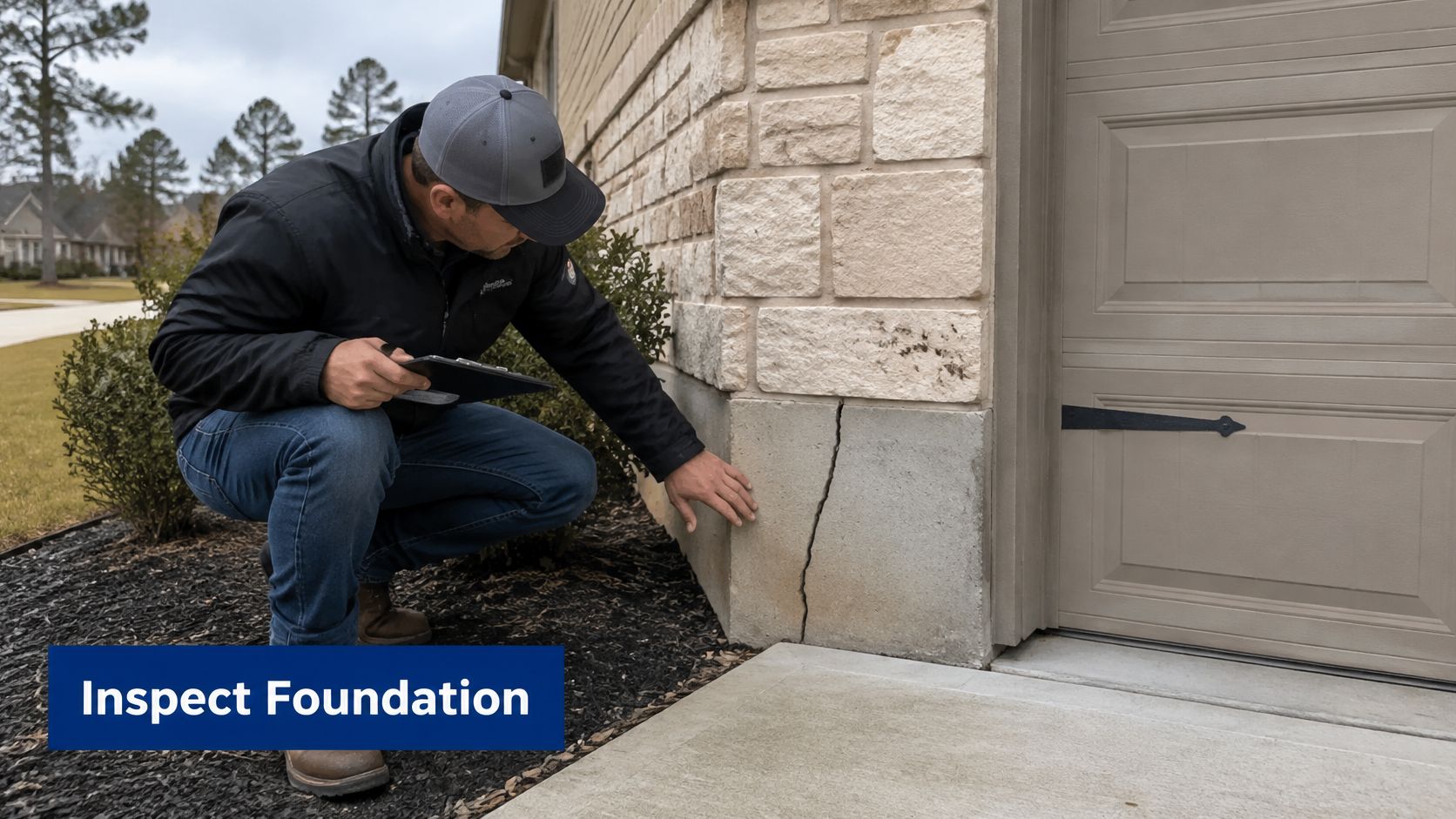
Here's the walk-through, in the order that finds the most openings.
- Start at one corner at dusk with a flashlight. Rats are active then, and a low angled beam shows gaps that vanish in daylight.
- Trace the foundation-to-ground joint all the way around. Mark every crack wider than a quarter inch with painter's tape so you don't lose track of it.
- Follow each utility line from the ground to the wall. Meter boxes, AC line sets and hose bibs hide the widest gaps on most houses.
- Check every vent and screen, then look for daylight at door edges. A garage door that shows a bright strip at the threshold is an open invitation.
- Inspect the roofline, fascia, soffit and attic access. This is the step homeowners skip, and it's where the most common miss lives.
- Go inside and check under sinks, behind appliances and inside closets. Anywhere a pipe or vent passes through a wall, look at the collar around it.
- Record each opening with a photo, a measurement and a location on a rough sketch. A list you can hand over beats a memory you can't.
The most common miss is the attic or fascia gap, largely because it isn't visible from ground level. Stand back across the street with binoculars and look along the roofline; lifted soffit, a gap at the wall-to-roof junction, or a pipe boot pulled away from the shingles all show up from there.
When our technicians run this kind of inspection, they look at entry points, moisture problems and hiding areas to find what keeps a pest problem going, because a gap near a leaking hose bib gets used far more than a dry one. The first step of our process is a full inspection of the property to identify pests, entry points and the underlying causes, and that's the stage your notes feed straight into.
Your record should list every opening with three things: size, location and photo. Before booking anyone, confirm that the exact Magnolia address falls inside the provider's service area, since coverage lines in this part of Montgomery County don't follow ZIP codes neatly.
Rodent-Resistant Materials That Seal Gaps for Good
Rats gnaw. That single fact rules out a large share of the products sold for sealing cracks. CDC rodent-proofing guidance from the stacks archive is blunt about it: hardware cloth or metal screening should protect vents, openings around utilities should be closed with sheet metal, cement, mortar or comparable rodent-resistant materials, and caulk or expanding foam alone may fail where gnawing pressure is possible.
| Gap type | Rodent-resistant fix | Avoid using |
|---|---|---|
| Utility penetrations | Sheet metal, cement or mortar | Caulk or expanding foam alone |
| Vents and mesh openings | 1/4-inch, 18 to 22 gauge hardware cloth | Thin plastic or fine window screen |
| Door and garage-door gaps | Metal weather stripping or metal door sweep | Loose foam or soft rubber strips alone |
| Window frames | Metal reinforcement or replacement of rotted wood | Caulk on gnawed wood |
| Foundation cracks | Mortar or cement repair | Surface sealant or paint |
The order that makes a repair last
- Clear the opening. Dig out loose material, old caulk and debris so the new patch bonds to something solid.
- Cut the patch to overlap by about two inches on every side. A flush-cut piece of hardware cloth can be pushed or chewed loose at the edge.
- Fasten it with exterior screws or bed it in cement. The goal is a barrier that can't be pulled away by an animal working at it.
- Close the remaining edges with mortar or cement. This is what stops a rat from starting a new gap beside your patch.
- Recheck the same spot after two weeks. Fresh gnaw marks or droppings tell you the repair missed a second opening nearby.
Material rule: if a rat can put its teeth on it, it needs to be metal, mortar or concrete.
Foam is where people get burned. Picture a homeowner who packs expanding foam around a gas line entering the siding, then paints over it. Rats chew through that foam in weeks, because it's soft, and the pipe behind it gives them something to brace against. Sheet metal flashed around the pipe and sealed with mortar holds for years.
Rats also reach openings above ground by climbing, using ledges, pipes, wires, vegetation and rough masonry, which is why a vent eight feet up still counts as accessible. CDC guidance notes they may enlarge openings in poor-quality brick or mortar, so a small crack in a chimney or a garden wall can become progressively more usable. On a Southeast Texas house, prioritize slab-to-wall joints, garage-door edges, attic vents, roof penetrations and utility entries, because those interfaces combine weather exposure with an easy travel path.
Seal first, trap second. A trap catches the rat that's already inside. A sealed route means the next one has nowhere to go.
Hidden Rat Spots Inside and Safe Cleanup
Inside, rats stay out of sight, so the search has to go where light doesn't. Federal CDC rodent-proofing guidance names the concealed locations worth opening up: underneath or behind kitchen cabinets, inside closets, around floor and dryer vents, behind dishwashers, washing machines and stoves, around plumbing beneath sinks, and along electrical, water, gas and sewer-line chases.
Look for four kinds of evidence:
- Droppings along shelf edges, in drawer corners, and on top of stored boxes.
- Gnaw marks on wire insulation, packaging and the corners of plastic containers.
- Dark greasy rub marks where a body has brushed the same wall line repeatedly.
- Shredded nest material, which is often insulation, paper or fabric pulled into a loose pile.
Evidence can also sit inside wall voids, around the furnace or water heater, and behind ventilation screens, which is why the smell and the sound matter as much as what you can see.
Cleaning up without stirring the dust
- Open a window and put on gloves and a mask. Air movement and a barrier matter more than the brand of cleaner.
- Spray droppings and nest material with disinfectant and let it soak. Wetting the material keeps particles out of the air.
- Wipe up with paper towels and seal them in a bag. Double-bagging keeps the trash can from becoming the next problem.
- Never sweep or vacuum dry droppings. This is the step people get wrong, and it's the one that turns cleanup into an exposure.
- Disinfect the surface, then wash your hands thoroughly. Soap and running water, not a wipe.
A large infestation inside a wall void is a different job. If the smell persists or the evidence keeps reappearing in the same cavity, that calls for professional removal rather than a homeowner reaching into a wall. For a closer look at where rodents settle and what a nest looks like, this piece on where rats nest in a house is worth five minutes before you start pulling out insulation.
Once everything is sealed, revisit the same spots after a week. No new droppings means the route is closed. Fresh ones mean you missed an opening.
Book a Rat Inspection Before the Next Sighting
Seal the entry points now, because trapping without exclusion means repeat visits. That's the whole decision in one line.
Run your notes against three triggers:
- Any gap at or above a quarter inch: seal it this week with metal, hardware cloth, mortar or cement.
- Droppings in a hidden space: clean them up safely and close the route before you set a trap.
- An opening in a wall void, attic or roofline you can't reach safely: call a professional rather than working from a ladder.
FullScope Pest Control handles rodent control that covers excluding and controlling mice, rats, rodents, squirrels and raccoons in homes and businesses, and the company offers a free rodent control estimate. Rodent and wildlife work starts with a free inspection and assessment, and solutions are recommended based on what that inspection finds. If you want the trapping and exclusion side handled in one pass, see how professional rat control fits with the sealing work you've already done.
Confirm your exact Magnolia address against the service area before booking, then bring your walk-through notes, sketch and photos to the inspection. Those records let the technician start from the openings you already found instead of beginning from zero.