1500+ reviews


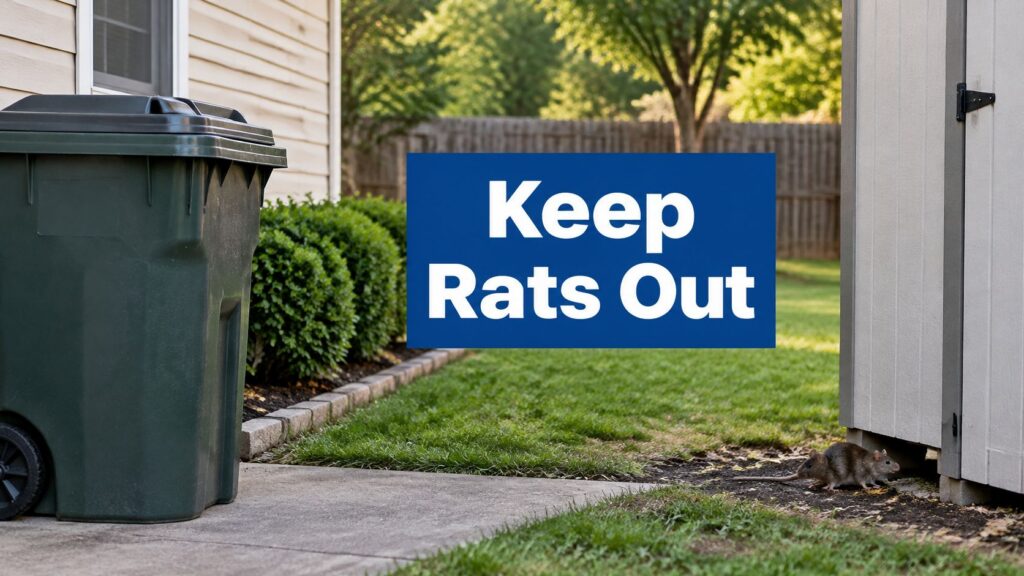
The bin goes out at dusk, you turn back toward the porch, and something dark slips along the fence and disappears under the shed. You tell yourself it was a cat. A week later there are droppings in the garage corner and a chewed lid on the compost, and the story changes.
That's how most rat calls start. Not with a dramatic infestation, but with one animal that found a shortcut and stayed because the yard pays it. Every rat runs on the same four needs: food, water, access and harborage, the combination municipal rodent programs have been chasing for a century.
Southeast Texas yards hand over all four without much effort. St. Augustine holds moisture, irrigation heads weep at the joint, pecan and citrus drop fruit, the bird feeder throws seed, the dog's bowl sits out, and the shed has a gap at the sill. None of it looks like a rat problem. All of it is one.
Knowing how to keep rats out of your yard is mostly a question of order: which problem to fix first, which fix to skip, and when a trap, a bait station or a technician is the wrong first move. This guide ranks the changes by impact, then works through signs, sealing, trapping, poison trade-offs, and what Magnolia and the surrounding Montgomery County area look like on the ground.
Which Yard Changes Stop Rats First
Stand at the door you use most, look across the yard, and name the first food, water or cover you can see. That's your starting point. It's almost never the rat itself.
Yard changes ranked by impact
| Priority | Yard Change | Why It Ranks Here | Quick Check |
|---|---|---|---|
| 1 | Lidded garbage bins and compost | Most reliable food source | Lids close fully, no spill at bin base |
| 2 | Fallen fruit and spilled seed | Food keeps rats near the yard | Ground clear each morning |
| 3 | Dripping faucets and irrigation leaks | Water keeps rats in the yard | No standing water after irrigation runs |
| 4 | Pet food left outdoors | Easy, high-calorie meal | Bowls indoors or picked up at dusk |
| 5 | Brush, lumber and clutter | Shelter for nesting and travel | Piles off the ground and away from walls |
| 6 | Vegetation touching the house | Concealed route to eaves and vents | No growth touching walls or roof |
The order isn't arbitrary. Food pulls rats toward the wall, water holds them on the property through a dry spell, and shelter lets them stay long enough to breed. A bin with a cracked lid outranks a brush pile at the back fence, because it feeds animals that are already within a few feet of your slab.
The EPA's rodent control guidance treats prevention as three controls, exclusion, repair and sanitation, and sanitation is what makes the other two hold. The same pattern shows up at city scale. New York's sanitation department reported a 6.4% overall decrease in rat sightings in its 2024 year-over-year comparison and a 14.3% decrease in designated Rat Mitigation Zones after trash-container reforms (NYC Department of Sanitation). Containers did what bait alone had not.
What to fix first: the resource nearest the house. Distance is the whole game in a suburban yard.
Fixing half the problem wastes the other half. Sealing the house while the compost stays open leaves the outdoor population in place and hunting for the next gap. Cleaning up without closing entry points invites the same animals back within a week. Yard work starts with what the property gives rats, not with what you can buy to kill them.
For the plant side of that work, landscaping choices that influence pest activity around your home matter as much as the trash can does. Walk the yard once this week, fix the highest item you can reach that day, and put the rest on a calendar.
Read the Signs and Map Rat Activity
A yard tells you where to work before it tells you what to buy. Rat sign clusters on the same edges night after night, so the marks are less a mystery than a route map.
| Sign | What It Suggests | Where to Check |
|---|---|---|
| Dark droppings along walls | Active travel route | Under decks, shed corners, fence lines |
| Gnaw marks on containers, wood or cords | Repeated access to food or an entry | Bin lids, garage door bottoms, shed corners |
| Greasy rub marks along walls or pipes | Regular runway | Pipe runs, fence bottoms, foundation edges |
| Burrow openings about 2 inches wide | Active nesting below | Beside sheds, fences and the foundation |
Droppings along a wall are the sign homeowners spot first, and they matter most when they repeat in the same line. A few pellets under a deck can be old. Fresh droppings at the same post for two nights is traffic.
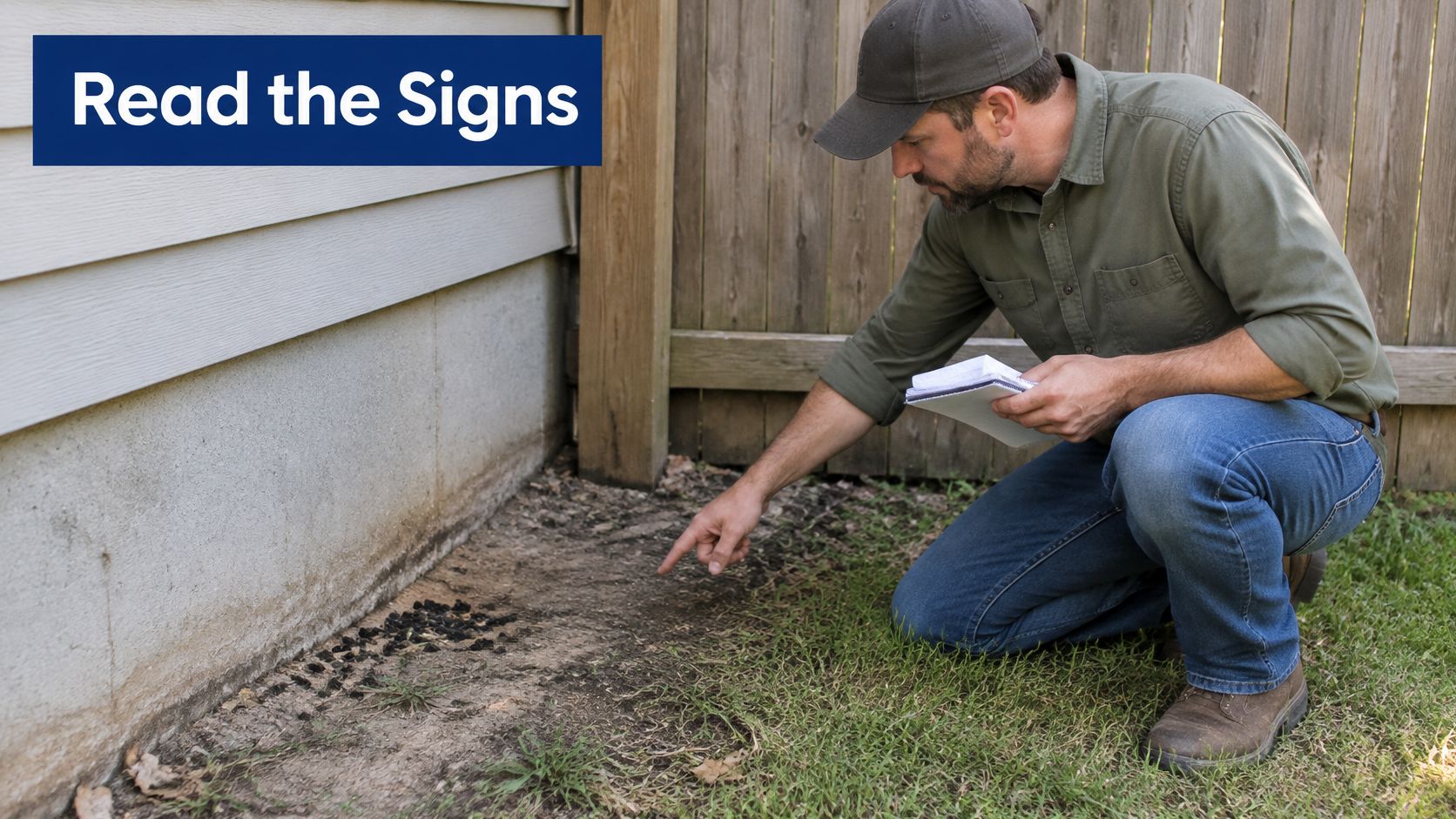
Turn the marks into a drawing before you move a single bin:
- Walk the perimeter at dusk and again at dawn. Those quiet windows show use; midday mostly shows old sign.
- Flag every mark. Droppings, gnaw points, rub lines and burrow mouths each get survey tape or a stake.
- Recheck the flags across three or four nights. A route repeats. A single stray dropping does not.
- Note the resource at each end. Every runway connects shelter to food, water or both.
- Sketch the yard and draw the routes on it. One page: house outline, fence line, shed, bins, feeders, woodpiles.
Read the sketch by distance. Marks tight against the foundation mean the payoff is close, often a bin, pet bowl, feeder spill or compost edge within a few feet of the wall. Marks that stay at the far fence, woodpile or dense hedge and never approach the slab point to harborage, where rats can stage out of reach and commute only when pressure is low.
The same compound approach holds at the curb: sealed storage for food and pet food, brush, rocks, junk and cluttered firewood cleared, entry points closed once activity is quiet, and tight-fitting lids on trash and compost. Remove one attractant while the rest stay put and the traffic reroutes rather than stops.
I'd treat the finished sketch as the priority list. The resource at the end of the hottest route gets removed first, then the next closest one to the house.
How to Seal Entry Points and Clear the Foundation Edge
Physical exclusion is measurable work, not guesswork. EPA housing guidance on pest-proofing notes that a mouse can enter through a hole the size of a dime, and the same guidance calls for exterior doors fitted with weatherproof sweeps and a bottom gap under 1/4 inch. A gap you'd walk past is a doorway to something with a body that fits it.
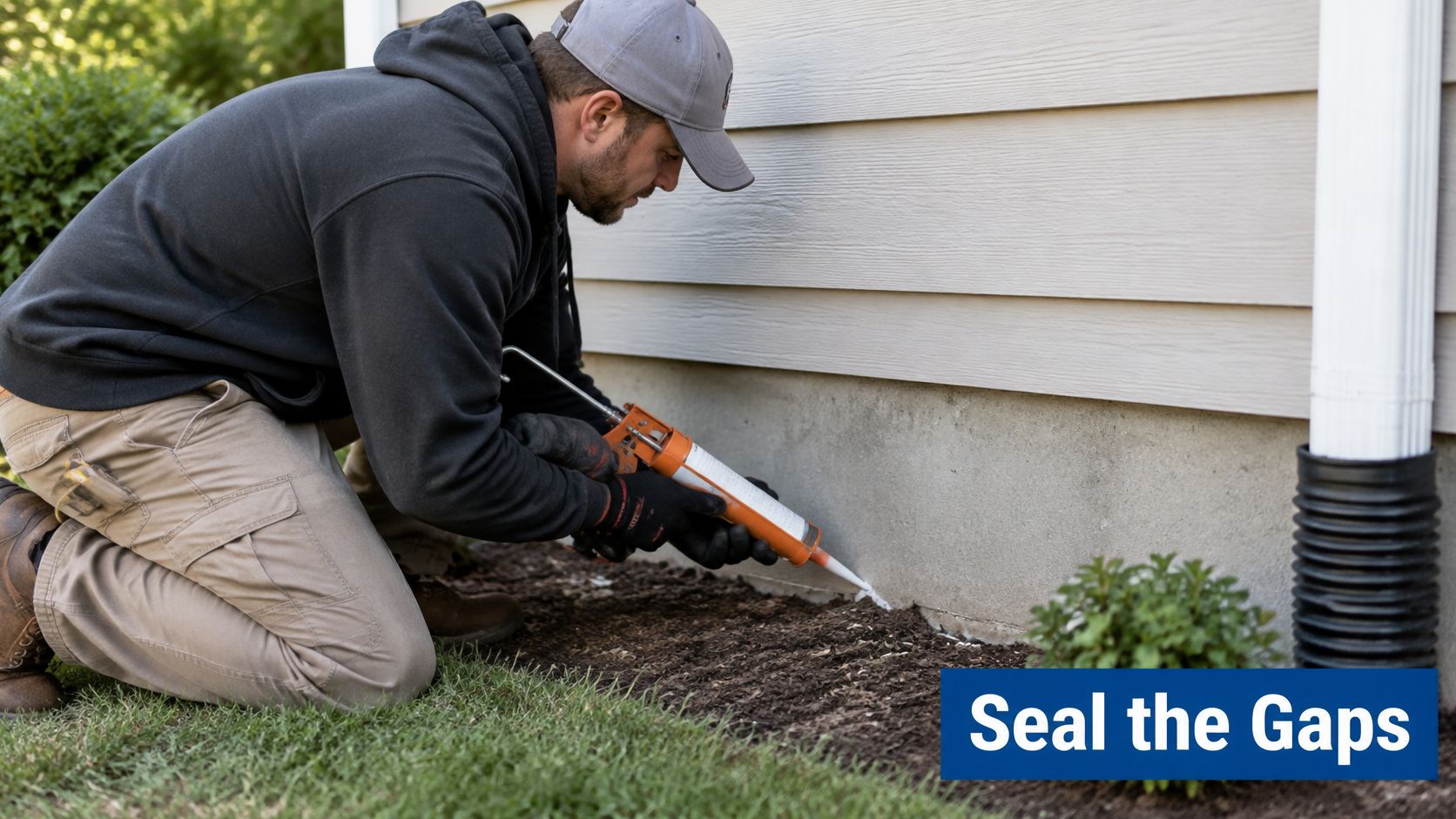
The timing rule comes before any sealing. If rats are still using an opening, closing it pushes them into wall, attic or crawlspace voids, where the problem gets expensive fast. Trap first, watch the opening for a few quiet days, then seal.
Here's the order I'd work in:
- Inspect high and low. Cover the foundation, crawl-space vents, eaves, roofline, garage door bottoms, shed walls, pipe and cable penetrations, and the joints where a deck or porch meets the house, because a half-sweep misses the animals that climb.
- Mark every opening wider than about 1/4 inch. A dime-sized hole admits a mouse; a young rat needs barely more.
- Seal confirmed inactive openings with chew-resistant material. Mortar, concrete, sheet metal or hardware cloth, fastened so it can't be pushed aside.
- Skip the soft fixes. Unprotected expanding foam, steel wool on its own and chicken wire all fail, because rodents chew the foam, pull the wool and walk through poultry netting.
- Fix the doors. A weatherproof sweep on every exterior door, bottom gap under 1/4 inch, and doors kept closed when they aren't in use.
- Clear the foundation edge. Mulch, vines, stored lumber and debris come back off the wall so nothing offers cover along the base.
Norway rats work the low line near the slab and foundation vents. Roof rats climb, so gable vents, eaves and the roofline need the same look. Along the base, extension guidance on rat burrows recommends a weed-free or gravel strip of roughly 24 inches plus chew-resistant seals such as mortar, concrete, sheet metal or 1/4-inch hardware cloth secured so it can't be pulled loose.
Here's the same thinking applied around a structure, from the low entry points up:
Exclusion also works better in company. A sealed building is far less attractive when the outdoor food, water and shelter are gone, which is why the sealing pass belongs after the cleanup, not before it. Finish by standing outside one sealed spot and looking for daylight, gaps and loose material. If air moves through it, a rat will too.
How to Trap Active Rats Safely in Yards
Trapping earns its place once rats are already using the yard, but the order matters. Traps clean up the animals that sanitation and exclusion haven't yet pushed out, and they buy you quiet time before you close the gaps.
- Map before you set. A few nights of notes on droppings, gnaw marks, rub lines and burrow mouths beats a guess about trap position.
- Use several traps, not one. Rats are wary of anything new, and a single device in a large yard mostly teaches them the route.
- Set perpendicular to the wall with the trigger facing the wall. Rats travel with their fur against a vertical surface, so the trap body should meet them nose-first.
- Pre-bait unset traps for a couple of nights. Leave them unarmed with bait until the animals are taking it freely, then set them.
- Secure anything a child or pet can reach. Traps go in locked boxes or behind a barrier, and crawlspace traps get anchored so a caught rat can't drag them into a void.
- Check daily and keep checking after the last catch. A quiet week after the final capture is the signal, not the day you stop seeing animals.
- Close inactive burrows with concrete or packed soil. Leave a burrow that's still in use open until trapping has removed the occupants.
Safety note: dampen droppings before you touch them. A dry broom sends whatever the rat was carrying into the air you're breathing.
Cleanup is the step people rush. Droppings don't get swept or vacuumed dry; dampen them with a disinfectant, wipe them up, and wear gloves and respiratory protection such as an N95 (eXtension guidance on rat burrows). Same gloves for the trap line, every visit.
Trapping while the food stays out is the most common way homeowners burn a month. Birdseed on the patio, a bowl of cat food by the door, open compost and a run of dense groundcover will keep a population fed and confident no matter how well the traps are placed. When nothing is producing, the question isn't which bait to switch to. It's what's still on the ground. If you want the fuller sequence, this walkthrough on how to catch a rat follows the same logic.
Fix the attractant, then run the trap line. Reverse that order and you'll be restocking traps all season.
Poison Risks and Control Options Compared
A stronger bait is not better yard management. It's a bigger dose of the same unresolved problem, and it moves risk onto whatever else eats the bait or eats the poisoned rat.
EPA's review of rodent control pesticide safety sets the terms plainly. Consumer rodenticide products have to sit inside bait stations that securely contain the poison, and outdoor placements where children, pets or wildlife may be present need tamper- and weather-resistant stations. Non-target animals can be poisoned by eating bait directly or by eating a poisoned rodent, and second-generation anticoagulants carry the greater non-target risk. Dead rodents come off the property promptly for exactly that reason.
| Method | Best For | Non-Target Risk | Placement Note |
|---|---|---|---|
| Exclusion and sanitation | Every yard, always first | None to pets or wildlife | Whole property perimeter |
| Snap traps | Reachable active rats | Low when secured out of reach | Set out of reach of children and pets |
| Tamper-resistant bait stations | Outdoor bait where the label allows | Higher for pets, raptors and wildlife | Locked station placed per the label |
| Professional inspection and treatment | Repeat or large infestations | Managed by trained staff | Site-specific plan |
The order I'd use: exclusion and sanitation because they remove the reason rats are there, snap traps for animals you can reach and contain, bait only where the label permits and the station locks. Consumer products and professional-use products aren't the same thing, and the label, not a dosage recipe from a forum, controls legal placement and handling.
If pets, children or raptors share the yard, take the non-bait row and stay on it.
Magnolia Seasons When Rat Pressure Rises
Magnolia is an incorporated city in southwest Montgomery County, per the City of Magnolia's government resource page, which puts the local picture far enough from "north Houston" to be worth treating as its own market. The numbers back that up. The Census Bureau recorded 2,359 residents in 2020 against 1,393 in 2010, a rise of about 69.3%, with density climbing from 491.8 to 821.4 people per square mile.
That density change matters more than it looks. Closer neighbors mean shared bin pads, shared fence lines and more sheds per acre, so one household's loose lid feeds a block. Larger wooded lots and drainage-edge properties run the opposite problem: plenty of cover, fewer people watching it.

The seasonal pattern in this part of Texas runs roughly like this, with one check attached to each turn:
- Spring. Warming weather and new growth lift feeding activity, so finish the mapping and sanitation pass while the pressure is still low.
- Late summer. Dry spells push rats toward irrigated lawns and standing water, so start with the irrigation system.
- Autumn. Cooling nights move animals toward sheds, garages and woodpiles, so get the gaps sealed before the first cold spell.
- After heavy rain. Displaced rats look for dry cover, so walk the drainage features, decks and outbuildings.
A simple yearly timeline covers it: a late-winter check, a pre-summer irrigation review, an autumn sealing pass and a post-storm walk. Properties near creeks, wooded lots or ditches should shorten the interval between checks.
Decide Whether to Call a Rodent Specialist
Some yards need a technician. The signs are specific:
- Rats inside voids. Scratching in walls, the attic or a garage ceiling after the obvious gaps are sealed.
- Captures keep coming. Traps still producing two weeks after sanitation and exclusion.
- No findable entry. You've walked the perimeter twice and can't locate the run.
- A large population plus pets, children or raptors. Bait is off the table and the numbers are past what snap traps will handle.
Coverage is the next question, and it deserves a direct answer rather than a vague promise. Our crews work out of Cleveland, Kingwood, Conroe and Porter, and the published service list covers Atascocita, Coldspring, Huffman, Humble, Livingston, Montgomery, New Caney, Splendora, Spring and Willis. Magnolia is not on that list, so I won't tell you it's covered. Call and ask about your address; Conroe and Montgomery are the closest listed locations, and both are a short drive from the Magnolia city limits. If your street falls outside the route, everything in the seven steps above still works, and it costs a weekend rather than a service call.
For the addresses that are covered, rodent and wildlife work covering rats, mice, squirrels and raccoons starts with a free inspection and assessment, and any plan comes from what the inspection finds, with a free estimate before anything is scheduled. That sequence matters here, because whether pest control can get rid of rats depends on the resource problem being fixed at the same time.
Before you call anyone, finish the marked sketch and check it against the four criteria above. That one page tells a technician more in five minutes than an hour of searching.
If you're in Conroe, Montgomery, Willis, Spring, Kingwood, Porter, Cleveland or anywhere else on the published coverage list, request the free inspection and assessment and bring the yard sketch with you. If you're in Magnolia, make the call first and confirm your address is served before booking anything. And if it isn't, don't wait on a company to do work you can start tonight: shut the bin lid, pull the pet bowl in at dusk, and stand at the back door until the yard has nothing left to offer.