1500+ reviews


The most popular advice about mosquito control non toxic options is also the most misleading. Buy something plant based, light it, spray it, or plug it in, and you're told the yard is handled. In Magnolia, that promise usually fails by the first humid evening, not because every mild product is useless, but because non toxic isn't one job. Protecting your ankles for two hours, lowering the number of adults in your shrubs, and reducing disease risk over a season are different tasks. A product that helps with one can do almost nothing for the others, and the safest feeling choice can leave you with the bites you were trying to avoid.
What Non Toxic Means for a Magnolia Yard
Picture a wooded lot near FM 1774 or FM 1488 just after an afternoon storm. The air is still warm, the grass is wet, and a citronella candle on the porch smells reassuring. Mosquitoes land anyway. That scene confuses people because the candle feels like yard control, when at best it's brief, personal comfort in a small area.
Three Jobs People Mix Together
Most buying mistakes start here, before any product name enters the conversation.
- Stopping bites on skin: You need protection on a person, for a cookout, a ballgame, or an hour on the patio.
- Lowering adults in the yard: You need fewer mosquitoes resting in grass, ivy, and shrubs, and fewer new adults emerging each week.
- Reducing disease risk over a season: You need a sustained plan that cuts breeding, blocks entry to the house, and lowers contact week after week.
A bracelet can't do the second job. A yard barrier can't protect a child at a park. Naming the job first keeps you from grading a product on work it was never built to do.
Labels That Sound Like Proof
Plant based, DEET free, and minimum risk pesticide describe ingredients or a regulatory category. They don't prove how long protection lasts. A review summarized by Wirecutter on essential oils as bug repellents found tested oils generally lasted no more than one to two hours, often at concentrations higher than consumer products, while CDC recommended repellents include DEET, picaridin, IR3535, and oil of lemon eucalyptus rather than most essential oil products.
That's the trade off many labels skip. A scented oil may be fine for a short walk to the mailbox. It's a poor plan for a shaded Magnolia backyard at dusk, where heat, sweat, and new hatches after rain keep pressure going long after the scent fades.
Think of oils and candles like a porch fan. They can make one seat more comfortable while they're running, but they don't change how many mosquitoes are born in the saucer under your planter.
Oil of lemon eucalyptus belongs in a different conversation from a decorative candle because it's a recognized repellent active, not just a fragrance. Even then, it protects treated skin. It doesn't empty water, kill larvae, or clear adults from the fence line. Before you compare methods, decide whether tonight's problem is skin, shrubs, or the whole season.
Which Lower Toxicity Method Fits the Job
Start with the comparison, then pick one row to begin. Most Magnolia households don't need all eight methods. They need the right first step for the job they named, done consistently enough to survive rain, heat, and a busy week.
| Method | Best job | How long it lasts | Kids and pets | Main limit |
|---|---|---|---|---|
| Weekly standing water removal | Stop larvae before they fly | Ongoing if done weekly | Safest, no spray | Misses hidden or neighbor water |
| Screens, fans, and shade cuts | Fewer bites indoors and on porches | Years if screens stay intact | Safest | Does not shrink the yard population |
| Bti biological larvicide | Treat ponds, drains, and catch basins | Days to weeks by formulation and rain | Low risk when used on label | Does not kill flying adults |
| Essential oils, candles, and patches | Brief personal comfort outdoors | About 1 to 2 hours | Skin and pet reactions vary | Too short for yard control |
| CDC skin repellents | Bite protection on people | Several hours by product and label | Follow age directions | Does not treat breeding sites |
| Reduced risk barrier spray | Adults resting in grass and shrubs | Often weeks until rain or new hatch | Keep off until dry | Not a breeding site fix |
| MistAway timed misting | Heavy pressure on wooded or creek lots | Short bursts on a daily timer | People and pets inside during mist | More chemistry than habitat work |
| Mass or passive traps | Lower Aedes near containers | Only with density and upkeep | No broadcast spray | Partial cuts, not zero bites |
The Baseline Rows Come First
Weekly standing water removal and intact screens are the foundation because they need no insecticide and they work every week you maintain them. Dump the saucer, and larvae in it never become adults. Repair a torn screen, seal a door gap, and add a fan where people sit, and you've cut contact without spraying anything.
Fans deserve more credit than they get. Mosquitoes are weak fliers, so moving air on a porch makes landing harder. Screens and fans won't shrink the population in the back corner of the lot, but they're the safest row in the table for homes with toddlers, dogs, and open windows, and they don't wash off in a storm.
Rows That Treat Water or People
Bti belongs on water you can't dump, such as an ornamental pond, a French drain outlet, a catch basin, or a ditch that refills after storms. It's a larvicide, so it stops the next generation. It does nothing to the adults already biting tonight, which is why people who expect instant relief from a dunk often call it a failure.
Skin repellents work the opposite way. A labeled product with DEET, picaridin, IR3535, or oil of lemon eucalyptus can protect a person at an event for hours, and it does nothing to the shrub line. Essential oils, bracelets, and candles sit in the short row for a reason. Use them, if you like them, as brief comfort, not as a season plan.
Starting rule: If you can tip it, tip it. If you can't tip it, consider Bti. If the problem is a person, use a repellent made for skin.
Rows That Target Flying Adults
A reduced risk barrier spray targets adults where they rest during the day, on the undersides of leaves, in dense shrubs, and in shaded grass. Results typically fade with heavy rain and new hatches, and everyone stays off treated areas until they're dry. It's an adult tool, not a breeding site fix, so it performs best after water work is done.
MistAway timed misting is the heavy option for creek, lake, and deep shade lots. Nozzles fire short bursts on a schedule, which means more frequent applications than a periodic barrier visit. That convenience suits families who use the yard most nights, but it's still scheduled chemistry, not habitat repair.
Traps sit at the end for a practical reason. They can help near container breeding sites, but only when enough homes participate and someone services the units. Pick your starting row, run it for a few weeks, and measure bites at dusk before you buy the next device.
Integrated Mosquito Management Sequence
Swatting adults off the patio while larvae develop twenty feet away is like wiping up a leak while the faucet still runs. Integrated mosquito management, or IMM, turns the faucet down first. The CDC integrated mosquito management toolkit describes surveillance, source reduction, control of all mosquito life stages, resistance monitoring, education, and outcome evaluation as core elements.
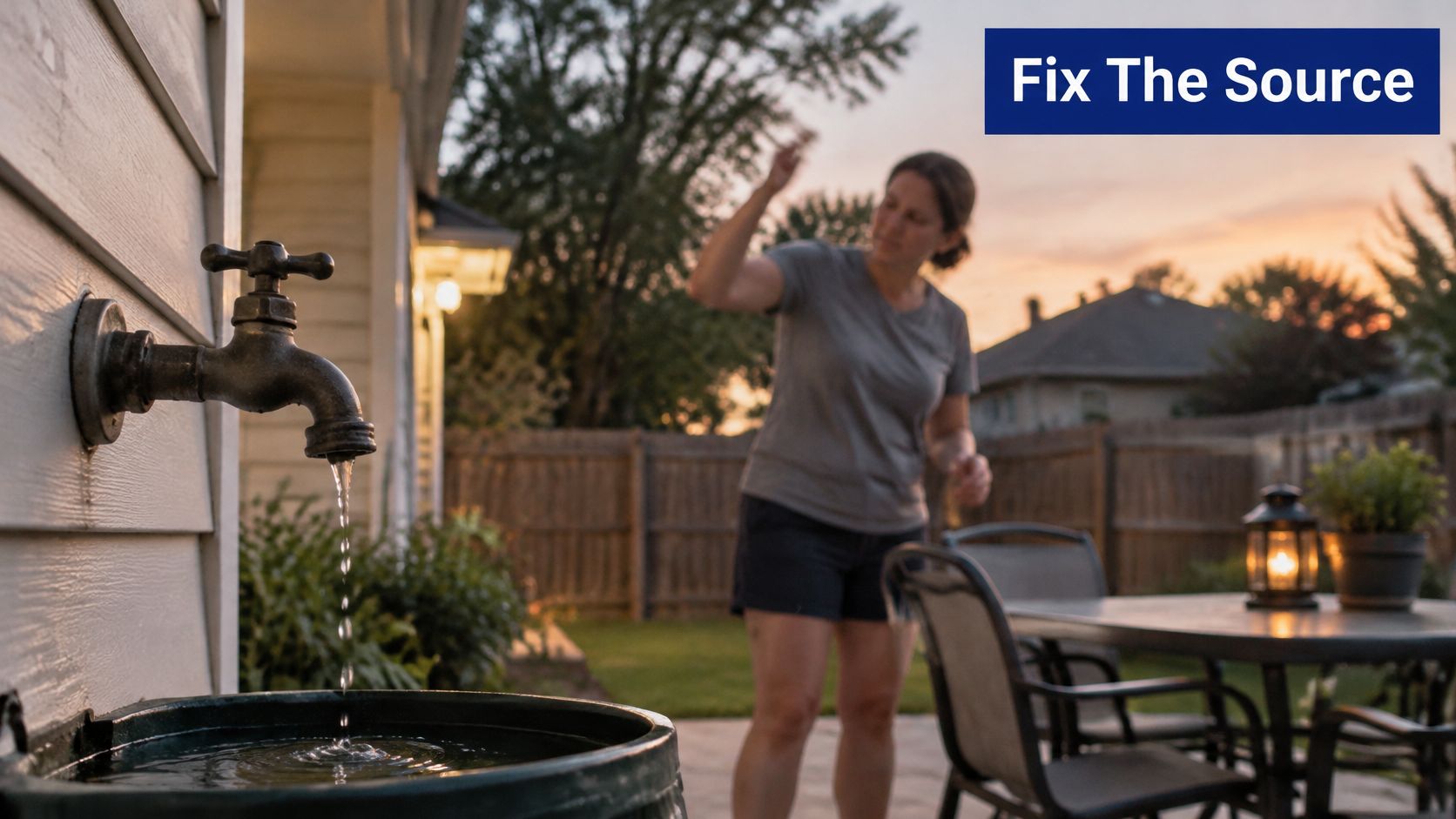
A water barrel under a faucet shows the daily version of the problem, where a useful container becomes a breeding site if nobody checks it.
The Six Steps in Order
- Surveillance and habitat mapping: Walk the lot and list every standing water site, from plant saucers and toys to low spots that appear after a Montgomery County storm. Write the list down, because memory misses the bucket behind the shed.
- Source reduction: Remove, drain, or redesign breeding sites first. In warm water, eggs can become biting adults in about a week, so a weekly rhythm matters more than a monthly cleanup.
- Larval and pupal control: Treat only water that must stay, while larvae are still concentrated there and can't fly away.
- Limited adult control: Add a barrier spray or misting only when monitoring still shows high biting pressure after the first three steps.
- Insecticide resistance testing: A professional program that uses adulticides checks whether local mosquitoes still respond to the product being applied.
- Evaluation: Record breeding site findings, treatment dates, larval activity, and dusk landing counts. Recheck after rain instead of judging by how one evening felt.
Source reduction carries the most weight because it stops larvae from becoming dispersing adults, and that lowers the need for any insecticide later. It's also the step homeowners control directly, without a sprayer, a timer, or a reentry wait. Our own approach follows the same logic described in our guide to integrated pest management practices, where inspection and habitat come before chemistry.
The short video below walks through the life stage idea in plain terms, so you can see why timing matters before adults emerge.
Keep the order even when you're frustrated. Spraying adults first can give a quiet weekend, but if the gutter still holds water, the next hatch replaces them. Mapping, dumping, and counting sound plain, and they're what make every lower toxicity tool after them work better.
Habitat Cuts and Bti for Water You Cannot Dump
You don't need special equipment for the highest value work in a Magnolia yard. You need a Saturday walk, a pair of gloves, and a habit of checking again after storms. Rain refills containers fast in Southeast Texas, so the routine matters more than one big cleanup in spring.
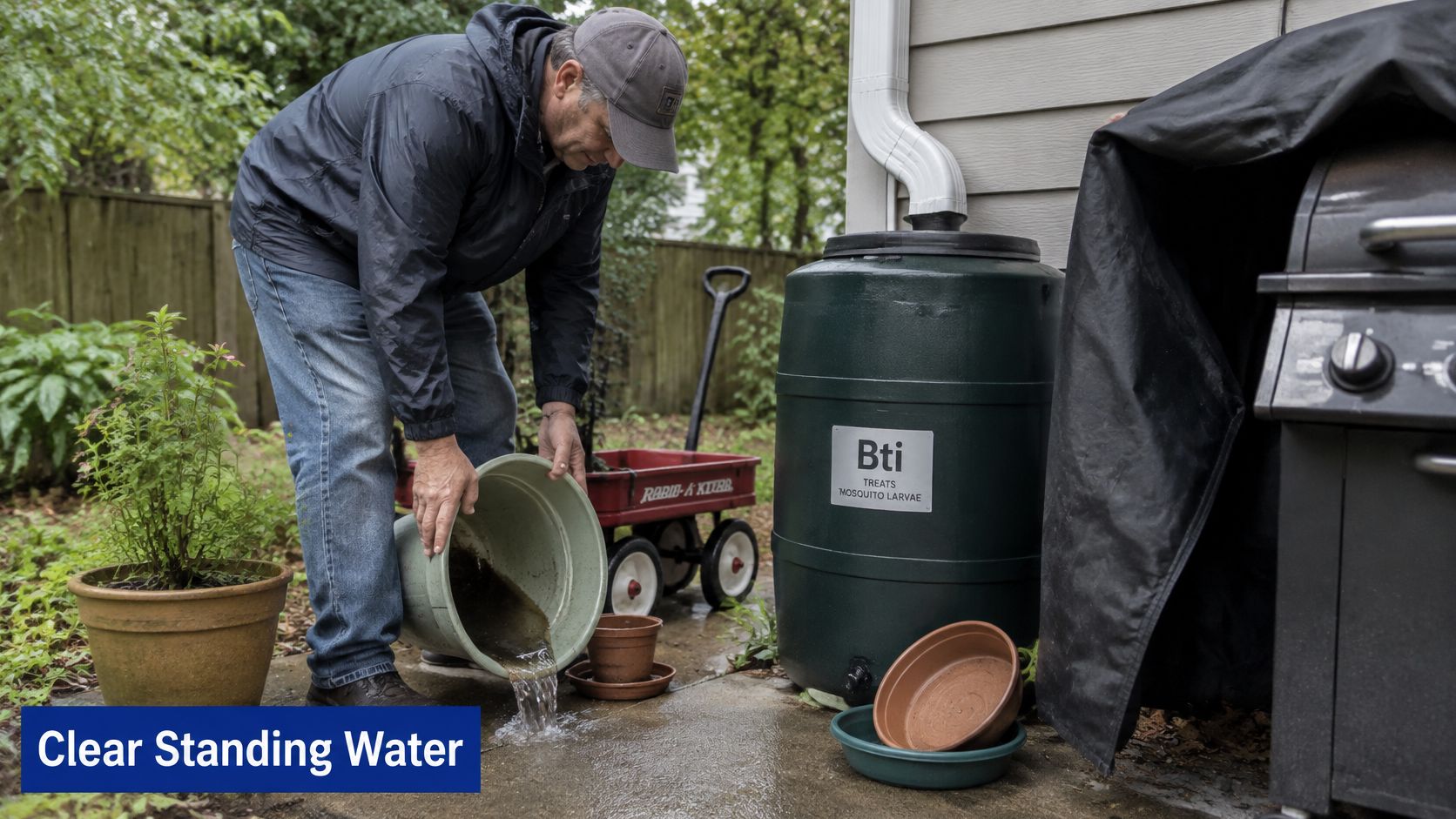
Pouring out a single bucket can remove a whole batch of larvae before any of them fly.
The Weekly Walk in Five Moves
- Tip everything that holds water: Buckets, plant saucers, wagon beds, grill covers, dog bowls left outside, and toys with hollow spaces. Scrub saucers and pet bowls when you empty them, because eggs can cling to the sides.
- Clear gutters and flat covers: A clogged gutter, a sagging tarp, and a flat trailer bed can each hold a shallow film that's easy to miss from the porch.
- Fix irrigation puddles: Adjust heads that soak the same spot against the foundation, and repair low areas where runoff sits after every watering cycle.
- Refresh birdbaths: Change the water every few days, or add a small fountain or wiggler so the surface keeps moving and females can't settle to lay eggs easily.
- Store trouble items under cover: Tires, unused pots, and spare buckets belong in a shed or turned upside down, not stacked where each rim catches rain.
After the walk, look at shade. Adults rest in cool, dense vegetation during the day, so thinning overgrown beds near seating, mowing regularly, and improving airflow around the patio make the use area less inviting. You don't have to clear a wooded lot. Focus on the ten to twenty feet where people sit, grill, and let kids play.
Larvae are the easy target because they can't leave. One treated or emptied pool prevents a cloud of adults that you'd otherwise chase for weeks.
Where Bti Fits and Where It Doesn't
Some water has to stay. An ornamental pond without fish, a rain garden, a French drain, a catch basin, or a roadside ditch can't be tipped into the grass. That's where Bacillus thuringiensis israelensis, called Bti, earns its place.
The EPA page on Bti for mosquito control states that Bti activity is specific to larvae of mosquitoes, blackflies, and fungus gnats, that it does not pose a risk to humans when used according to the label, and that it is approved for organic farming pest control use. Bti produces spores and crystalline toxins that act after larvae eat them, so it interrupts the life cycle at the least mobile stage.
Use it with limits in mind. Bti isn't a yard fog, it doesn't kill adults resting in shrubs, and it isn't permanent. Retreatment intervals depend on the formulation you buy, how long the water persists, rainfall, and new water flowing in. Match the product label to the exact water body, don't guess at a heavier dose, and check for wiggling larvae on your next walk to confirm it's working.
If the same low spot refills after every storm and needs dosing all season, treat that as a drainage repair, not a subscription. Regrading, extending a downspout, or clearing a blocked drain can end the habitat for good. For a room by room style checklist of breeding spots, our guide on how to reduce mosquito breeding around your property covers the containers and drainage features Magnolia homeowners miss most often.
Barrier Sprays MistAway and Traps on Real Lots
A mild-feeling option can still miss the job. A barrier spray targets adult mosquitoes resting on foliage, a timed misting system applies treatments through positioned nozzles, and a trap reduces numbers near its placement. Lot size, shade, nearby water, and how often you use the yard all affect which approach fits.
Three Magnolia Area Scenes
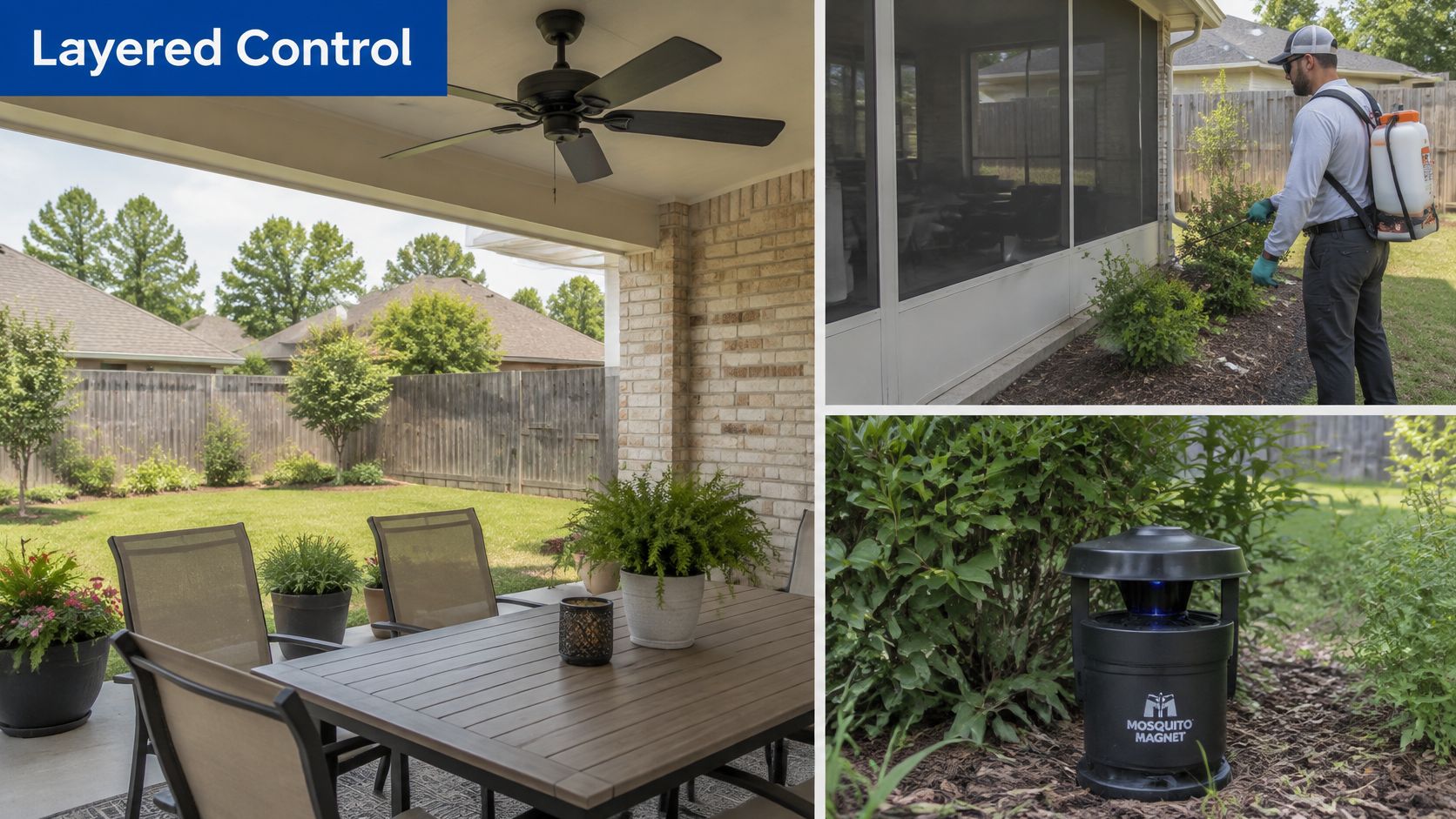
A fenced suburban lot with a few containers may need only a weekly habitat check and a fan near the patio. A barrier spray could be an occasional option before an outdoor gathering, while skin repellent can help protect people from mosquitoes that drift in from nearby yards.
A shaded lot beside woods or a creek presents a different challenge. Adult mosquitoes can rest in dense vegetation, then move into the yard at dusk. A residual barrier spray treats resting areas and can reduce mosquitoes for a period. Rain and new mosquito emergence can shorten that relief, so one application may not cover the entire peak season.
A property used outdoors most nights may be a candidate for a timed misting system. FullScope offers Mosquito Misting Systems by MistAway, which apply treatments on a timer through positioned nozzles. The convenience comes with scheduled applications, even when mosquito activity is low. Fogging is another option for short-term adult mosquito control, but it does not address larvae.
What Traps Can Honestly Do
A 2025 cluster randomized trial in six peri urban French communities found mass trapping reduced mosquito abundance by 36% to 64% in some communities. The strongest results were associated with high trap density and house coverage, while effectiveness declined when residents had difficulty maintaining the system.
Treat those results as evidence of possible population reduction under specific conditions, not a guarantee from one device in one yard. A trap beside an undumped bucket is competing with a nearby breeding site. Traps are better considered one part of a broader approach, with appropriate placement and regular servicing.
Check whether a tool is helping by counting mosquito landings in the area where you sit at dusk. Repeat the count on the same weekday and note the date and recent rain. A sustained drop suggests the approach is helping; little change means it may not be addressing the main source of bites.
Kid Pet and Garden Safety by Situation
Safety starts with one rule that covers almost every product in this guide. After any spray or mist, people and pets stay out until the label dry time is over. That includes reduced risk and botanical sounding products. Pick up toys, shoes, and pet bowls before treatment, keep edible gardens out of the spray pattern unless the label allows that use, and let surfaces dry fully before bare feet and paws return.
Where Caution Changes by Product
Habitat work and Bti in labeled ornamental water don't need a reentry wait, which is one reason they suit homes with toddlers and dogs. Skin repellents belong on skin or clothing exactly as directed, not sprayed across the lawn, and adults should apply repellent to their own hands first when putting it on a child. Oil of lemon eucalyptus is a repellent active with label directions. A scented candle with a similar smell is not the same thing.
Cats and fish are the edge cases people overlook. Don't assume a botanical oil is gentle for every animal, and never add a larvicide to a stock tank, fish pond, or aquarium unless that exact site appears on the label. When you're choosing plantings for beds near patios and play areas, it helps to find plants for homes with pets so the landscaping itself doesn't create a second safety problem while you're solving the mosquito one. Households weighing treatments around dogs can also review our notes on pet safe mosquito control and heartworm prevention before they schedule anything.
| Situation | Start with | Add if bites continue |
|---|---|---|
| Small lot, containers you can tip | Weekly dump and screen check | Event day skin repellent |
| Ornamental pond or ditch that stays wet | Bti on the labeled water body | Barrier on resting foliage |
| Party this weekend, mild pressure | Repellent plus fans | One barrier visit, then reassess |
| Wooded or creek lot, nightly bites | Habitat walk plus barrier interval | Timed misting discussion |
| Kids, pets, or vegetable beds in the use area | Habitat and Bti first | Spray only with a dry time plan |
| Water on a neighbor lot or roadside | Document the site | Professional or city follow up |
Read the table as a ladder, not a shopping list. A small city lot in Magnolia with tippable containers rarely needs to climb past the first row. A pond that can't be drained adds one targeted step. Nightly misery on a wooded lot justifies a harder conversation about barriers or misting, with the understanding that nozzles never substitute for dumping water.
No non toxic plan promises zero bites. A good plan promises fewer mosquitoes, a clear reason for each product, and a yard your family can reenter with confidence.
Call for Magnolia Help When DIY Stalls
A Magnolia address does not automatically confirm that a pest control company serves your home. FullScope Pest Control serves communities across north Houston and nearby parts of Southeast Texas, but confirm coverage for your street address before arranging a visit.
City Limits Versus a Magnolia Address
The incorporated city is small. The U.S. Census Bureau QuickFacts page for Magnolia city, Texas reports a 2020 population of 2,359 and a 2020 land area of 2.87 square miles. A Magnolia mailing address may be outside the city limits, so a ZIP code alone may not establish whether a company can serve your home.
Stall Points That Justify a Call
- You've done the weekly walk for several weeks, but dusk landing counts remain high.
- Water sits beyond your control, such as at a creek edge, on a neighboring tract, or in a roadside right of way.
- You need advice on treatment around kids, pets, and garden beds, including when people and animals can return to treated areas.
- The same low spot refills after storms, and the recurring water may need attention rather than another mosquito treatment.
A call can help clarify which problem you are trying to solve: bites during outdoor activities, mosquito numbers in the yard, or water that keeps producing mosquitoes. FullScope Pest Control uses Integrated Pest Management and offers completely green pest extermination solutions. Its mosquito services include a Mosquito Control Barrier Spray and MistAway automated misting systems, which apply treatments on a timer through positioned nozzles. Ask what fits your yard, how to follow product directions, and whether your address is in the service area.
Notes on where water collects and when bites are worst can make that conversation more specific. They help distinguish a recurring breeding-site problem from adult mosquitoes resting in yard vegetation.
If DIY measures have not brought relief, contact FullScope Pest Control with your street address and ask the company to confirm coverage. A clear explanation of the problem can help you discuss suitable mosquito control options without treating every yard the same way.