1500+ reviews


You find a mud tube beside a window, then notice that the trim feels soft. The house was treated, and you remember buying a warranty, so you expect the pest company to handle both the termites and the damaged wood.
That expectation might be right, but the word warranty doesn't settle it. Your agreement's remedy, maintenance conditions, and paperwork determine what happens next. For a Magnolia-area property, you also need confirmation that the exact address qualifies for service.
Termite Warranty Coverage Types Compared
Termite warranty coverage types compared
| Coverage type | Re-treats termites | Repairs termite damage | Typical limit | What to verify |
|---|---|---|---|---|
| Retreatment-only | Yes, during the contract period | No | Not applicable | Renewal terms and how quickly the provider responds |
| Retreatment plus damage repair | Yes, during the contract period | Yes, for covered damage occurring after the initial treatment | Stated dollar cap specified in the proposal | Whether the cap is per claim or total, and which damage is excluded |
| No warranty or guarantee | No obligation beyond the visit | No | Not applicable | Whether the provider will re-treat at a set price |
Say you discover termites eighteen months after treatment. That's a hypothetical timeline, but it exposes the first question: is the agreement still active? Even an active agreement might pay for renewed treatment without paying for the windowsill.
The North Carolina Department of Agriculture and Consumer Services homeowner guide describes defined service periods, commonly one year after initial treatment, during which providers must take the corrective action promised in the agreement. Its distinction between retreatment-only and repair-inclusive coverage matters more than the word printed across the proposal.
Think of a car maintenance plan. The shop commits to specified work for a stated period, not to making sure your car never breaks down. A termite treatment warranty works similarly: termites can return, and the agreement defines the provider's response.
The financial difference becomes clearer when you separate treatment from repair.

Treatment and repair are different promises
A dentist analogy helps. A retreatment-only plan is like agreeing to refill a cavity that returns. A repair-inclusive plan also contributes toward the crown, subject to its coverage limit and conditions.
Neither arrangement means every dental problem is covered. Likewise, repairing termite damage can involve framing, flooring, finishes, or access work that the contract treats differently. Ask whether opening a wall and restoring its finish count toward the repair allowance.
Compare the treatment method separately from the financial promise. These termite control options can help you frame questions about soil treatments, monitoring, and other approaches, but a treatment description isn't a substitute for warranty language.
Read the proposal for these distinctions
- When damage occurred: Does the agreement cover only damage occurring after the original treatment? Finding damage later doesn't establish when termites caused it.
- How the cap works: Is the repair allowance available per claim, per property, or across the entire agreement? Ask whether earlier repairs reduce what's left.
- Which termites qualify: Check the wording for subterranean termites, drywood termites, and Formosan termites. Don't assume a broad heading overrides a specific species exclusion.
Repair coverage isn't universal: in 2023, 31% of pest-management company locations offered termite-damage warranties, according to Pest Control Technology's State of the Termite Market survey. Compare actual offers rather than assuming competitors promise the same remedy.
A lower-priced proposal may provide retreatment only. That can be a reasonable choice if you can absorb the repair risk, but it shouldn't be an accidental choice.
A termite warranty isn't homeowners insurance or a promise of permanent prevention. Find the term, the remedy, and the conditions before comparing prices.
What Termite Warranties Usually Exclude
Don't assume coverage disputes happen only because termites survived treatment. What a homeowner changes afterward can be just as important: a new irrigation trench, untreated addition, or unresolved leak can affect the provider's obligations.
Think of treated soil as a protective fence around the building. Digging through it can create an opening, although the actual treatment system is more complicated than a continuous physical fence.
The Termite Registry guide to repair bonds and retreatment-only agreements discusses exclusions involving untreated additions, disturbed soil, and moisture or building defects. Those are contract issues to investigate, not grounds for assuming every alteration automatically cancels all coverage.
Property changes to flag before work starts
- Untreated additions: A sunroom or detached shed may fall outside the original treatment footprint and covered structures.
- Disturbed soil: Trenching, grading, new planting beds, irrigation lines, and utility work can interrupt previously treated areas.
- Uncorrected moisture: Plumbing leaks, poor drainage, and excessive moisture may affect coverage, particularly when the provider documented the condition and requested correction.
- Wood touching soil: Stacked lumber, buried wood, or mulch piled against siding can create conditions the agreement requires you to remove.
- Earlier or hidden damage: Pre-existing damage and areas that couldn't be inspected may be excluded. Ask how the company distinguishes old damage from new activity.
- Structural defects: Foundation openings, inaccessible construction, and other building conditions may require correction before the provider accepts responsibility.
Keep the change in writing
Before a contractor digs beside the foundation, send the pest provider the work description and photos. Ask which areas need inspection or treatment afterward, who pays, and whether coverage remains active during construction.
Get the answer before work begins. A contractor's assurance that the trench is shallow doesn't amend your pest agreement.
The same maintenance-versus-coverage distinction applies elsewhere in a house. Aastro Roofing Company's resource on installation mistakes that invalidate roof warranties offers a useful parallel when coordinating contractors, though roofing conditions don't determine termite coverage.
Practical rule: Treat a property alteration as a paperwork event as well as a construction project.
Exclusions follow your contract and applicable local rules. A Texas homeowner shouldn't assume that an exclusion or consumer protection described for another state applies to a Magnolia property.
How Long Coverage Lasts and What Renewal Costs
A homeowner pays renewal invoices for years, misses one during a busy season, and learns the agreement lapsed before the swarmers appeared. Term and renewal terms decide whether that scenario ends in a covered retreatment or a new bill.
Warranty term, renewal and documentation benchmarks
(Florida's administrative rule appears below as one state's worked example, not a general standard.)
| Term element | What an agreement may say | What to check |
|---|---|---|
| Initial coverage period | The initial term stated in the signed agreement | Whether coverage starts with initial or final treatment |
| Written warranty delivery | One state's example: delivery within 30 days of the specified treatment date, an initial term of at least one year, and, when a previous renewal was purchased, annual extension options for at least four additional years under the Florida administrative rule | When the warranty arrives and which renewal conditions apply |
| Renewal option | Annual extension under the Florida example, subject to its conditions | Whether renewal is automatic and whether an inspection is required |
| Annual renewal fee | Approximately $300–$700 in 2025, reported by FixItInTheHome | Whether the fee includes inspection and treatment |
| Retreatment if contract expires first | Under the Florida example, a written offer to complete agreed retreatment within 90 days at no additional cost, subject to the rule's conditions | Whether your contract or applicable rule protects unfinished retreatment |
| Corrective retreatment trigger | Retreatment after documented reinfestation or barrier disruption, scheduled by evidence rather than a fixed calendar | Whether the agreement ties retreatment to inspection findings |
Separate product performance from contract duration
A treatment product's expected performance doesn't establish how long the company owes you service. A long warranty also may not include repairs, free inspections, or unchanged renewal fees.
Read each row as a question to bring to your own contract rather than as a standard the provider must meet. The Florida examples show how precisely an agreement can define delivery deadlines, renewal rights, and unfinished work. Your Magnolia contract needs that same precision in writing, matched to your specific service address.
Timing works like a race against the expiration date. Ask what happens if you report activity while coverage is active but the provider schedules the work after expiration. Don't rely on a verbal assurance that someone will take care of it.
Budget for keeping coverage active
The reported renewal range is a planning reference, not a Magnolia quote. Property conditions, treatment systems, and the promised remedy can affect the proposal you receive.
When comparing termite prevention costs, ask whether inspection, monitoring-station service, corrective treatment, and repair coverage are separate charges. Ask whether the company can change renewal pricing and how it will notify you.
A lapsed renewal works like an extended car warranty voided by skipped maintenance: coverage can stop right when you need it. Confirm any grace period before you need it, and ask what reinstatement requires, whether that means a new inspection, a new treatment at full price, or a waiting period.
Keep a simple warranty folder containing:
- The contract: Signed agreement, covered address, amendments, and treatment date.
- Payment evidence: Renewal invoices and receipts showing the covered period.
- Inspection history: Reports, treatment diagrams, and documented correction requests.
- Activity notices: Emails, photographs, appointment confirmations, and the provider's replies.
Transferring a Warranty When a Home Sells
A wood-destroying insect inspection report, usually called a WDI report, and a termite warranty serve different purposes. The report records inspection findings and limitations at that time; the warranty establishes obligations for future service.
A clean report doesn't promise future protection. Conversely, an active warranty doesn't remove the need for an inspection required by a buyer, lender, or transaction agreement.
For sellers
- Retrieve the complete file: Find the current warranty, treatment history, amendments, and renewal receipts. A payment confirmation alone might not identify the actual coverage.
- Request written transfer terms: Ask whether ownership changes require notice, re-inspection, a transfer fee, or a new signed agreement.
- Check the renewal window: Establish whether coverage will remain active through closing and who will handle an upcoming payment.
- Coordinate disclosure: Give the appropriate documents to your agent or closing team, following the contract and applicable transaction requirements.
Don't describe a warranty as transferable until the provider confirms it. Some agreements permit transfer only after the new owner completes specified steps.
Closing expenses also deserve a separate budget line. Homes By Carmen's guide to Chicagoland seller closing costs illustrates the value of itemizing transaction costs, but its local details shouldn't be treated as Texas charges.
For buyers
- Identify the agreement: Confirm the provider, warranty name, start date, covered structures, and remaining term.
- Check payment status: Obtain confirmation that required renewals are paid and no reinstatement process is pending.
- Review the inspection: Check the report date, inaccessible areas, and recommendations. This explanation of a termite inspection report for closing helps distinguish the report from continuing service.
- Complete the transfer: Get the exact fee and required signatures in writing, then obtain confirmation in your name.
Suppose a Magnolia-area buyer learns before closing that the seller's warranty has lapsed. The parties can negotiate who pays for inspection or reinstatement, but payment alone may not restore the old terms.
Resolve that uncertainty before signing closing documents. The useful result is an accepted transfer or new agreement, not merely the seller's old paperwork.
How to File a Termite Warranty Claim
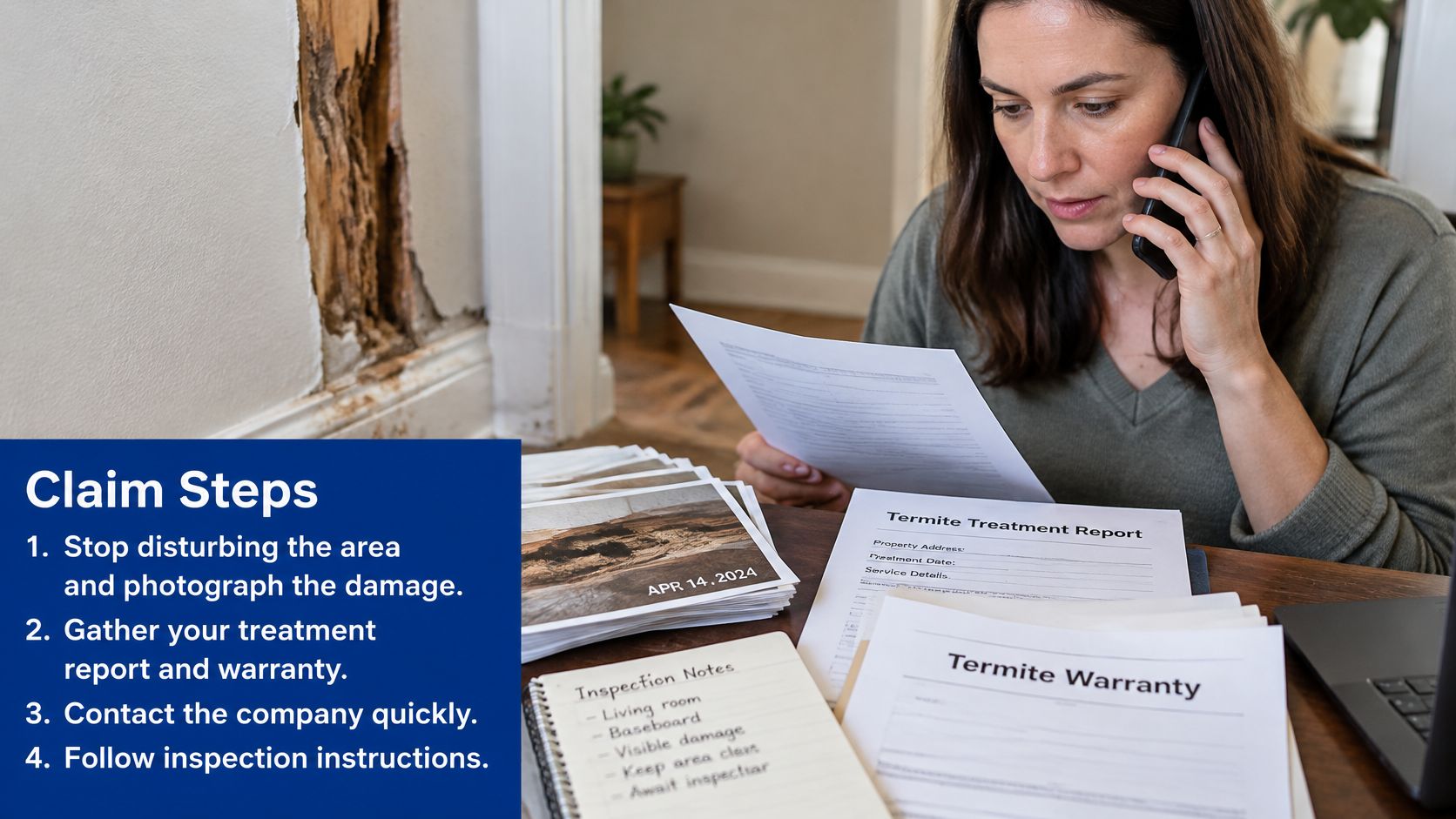
A claim is easier to evaluate when the provider can connect the evidence, treatment history, and contract conditions. Follow the agreement's reporting procedure, and avoid changing the affected area before the provider documents it.
Keep photographs and paperwork together so the inspector can match them to the location.
Preserve evidence and request a decision
Stop disturbing the area. Photograph mud tubes, discarded wings, damaged trim, or other evidence, with dates and room locations. Avoid scraping tubes away or applying household insecticide before inspection.
Notify the provider promptly in writing. Include the contract number, covered address, treatment date, and a concise description. Check the agreement's notice deadline and use its specified reporting method.
Gather the records. Assemble the signed agreement, renewal receipts, previous inspection reports, treatment diagram, and earlier termite notices. Include messages about additions, leaks, landscaping, or other property changes.
Attend the inspection when possible. Show the inspector the original evidence and explain what changed without guessing when damage began. Request written findings that distinguish active termites, old damage, moisture damage, and inaccessible areas.
Match the findings to the remedy. Ask whether the provider classifies the issue as covered retreatment, covered repair, or an exclusion. Have the company identify the relevant contract provision rather than offering only a verbal conclusion.
Confirm the retreatment scope. Ask where the technician found activity or a treatment-system breach and which areas need corrective work. Localized treatment may be appropriate; an annual renewal doesn't automatically mean another whole-structure pesticide application.
Authorize repairs through the required process. Check whether the agreement requires an approved contractor or estimate before work begins. Confirm how access, demolition, finish restoration, and the repair cap affect approval.
Request a written explanation for a denial. Ask which exclusion applies, what evidence supports it, and whether a re-inspection is available. Preserve copies of the decision and your response.
Avoid changing the evidence
Waiting months to report activity can complicate the timeline. Repairing damaged wood or re-digging the affected soil before inspection can also make the cause harder to establish.
If a damaged component appears unsafe, protect people first and obtain appropriate professional help. Photograph the condition before necessary emergency work whenever it's safe to do so.
Use the video alongside your written checklist, not as a replacement for your contract.
Magnolia Coverage and FullScope's Service Options
Magnolia is an incorporated city in southwest Montgomery County within the Houston metropolitan area. The U.S. Census Bureau's Magnolia profile records 2,359 residents and 2.87 square miles of land area in 2020, while the City of Magnolia's community information describes a municipal size of approximately 5.7 square miles.
Those geographic descriptions aren't interchangeable service boundaries. An address outside municipal limits can still use Magnolia as its mailing locality, so the place name alone doesn't establish eligibility.
The City of Magnolia's location guide identifies FM 1774 and FM 1488 as its primary location, approximately 45 miles northwest of Houston, 25 miles southwest of Conroe, and about 20 miles from both Interstate 45 and U.S. 290. Use the street address, not proximity to those roads, when requesting coverage.
Match the service to the property need
FullScope Pest Control is one regional option described as a licensed, QualityPro-certified provider with service locations in Cleveland, Kingwood, Conroe, and Porter. Its described services include termite inspections, monitoring, targeted treatment, real-estate WDI reports, scheduled preventive plans, and emergency response; obtain current written confirmation of credentials, availability, and termite-specific terms before contracting.
FullScope service options to confirm for a Magnolia address
| Need | FullScope offering | What to confirm for Magnolia |
|---|---|---|
| Real estate WDI inspection | Inspection and written report for transactions | Report timing, fee, and whether the lender needs it |
| Termite control and monitoring | Inspections, monitoring, and targeted treatments | Warranty type, term, and coverage of the exact address |
| Preventive plan | Quarterly or biannual schedules to confirm | Renewal fee and whether termite inspections are included |
| Emergency response | Urgent service subject to availability | Response window and whether it applies to warranty claims |
| Service address | Locations described in Cleveland, Kingwood, Conroe, and Porter | Whether the specific Magnolia property qualifies |
A nearby office isn't a coverage commitment
For an owner staying in the home, monitoring and preventive service may be the useful starting point. For a buyer or seller, the immediate need is usually the transaction report and any required follow-up.
Don't assume a general pest maintenance schedule includes termite warranty inspections. Ask the provider to identify the termite service separately.
The described service-area list includes Conroe, Montgomery, Spring, Willis, and other north Houston communities, but doesn't expressly name Magnolia. That's a reason to ask, not proof of either inclusion or exclusion.
Have the provider name the covered street address and structures in writing. A mailing city, nearby office, or regional service description isn't enough.
Confirm These Terms Before You Sign
Choose the agreement whose obligations you understand and can maintain, not the proposal with the longest headline term. A useful warranty gives you an identifiable remedy and a practical way to keep it available.
Before paying, put the unresolved questions into an email and ask the provider to answer them against a sample agreement.
Get address-specific answers
- Covered property: Does the warranty name the exact address, covered structures, and any excluded areas? Is the Magnolia location accepted in writing?
- Sample agreement: Will the provider supply the actual proposed terms before you sign, rather than a general brochure?
- Inspection charges: Who pays for required inspections, and does the renewal fee include them?
- Claim handling: What response commitment applies, and will the provider issue its coverage decision in writing?
- Planned work: How will your addition, remodel, planting bed, or irrigation trench affect the agreement? Will the provider inspect and re-treat disturbed areas, and at whose expense?
It helps to organize home warranties by responsibility rather than by sales label. Homeowners can similarly review roof warranty details through JA Edwards of America Roofing when assembling their property records, while keeping each contractor's conditions separate.
Choose the risk you can carry
A repair-inclusive agreement deserves close consideration for an older home or a purchase where unexpected wood repairs would strain the budget. It can also suit a planned renovation, but only if the provider expressly accepts the construction changes; broader coverage doesn't cancel exclusions.
Retreatment-only coverage can suit a tighter budget when the owner knowingly accepts responsibility for damaged wood. It shouldn't be sold or understood as repair protection.
Your next action is concrete: request a written proposal and sample warranty for the exact property address. Keep the signed agreement with every renewal record and written amendment.