1500+ reviews


Yes, house mice climb, especially rough vertical surfaces, while smooth, polished surfaces are much harder for them. They can also jump onto a surface about 10 inches above the floor, but a jump measurement isn't a limit on how high they can travel.
If you've sealed the gaps around your foundation, what's stopping a mouse from reaching an opening near the roof? The useful question isn't just "do mice climb?" It's which connected surfaces lead to an opening in your home? Following those connections gives you a more reliable inspection plan than looking only at floor level.
Which Surfaces Mice Can Climb and Which Stop Them
House mice are capable climbers because their claws can grip small irregularities. Rough construction materials offer repeated purchase points, while an uninterrupted polished surface offers little to hold.
The University of California Integrated Pest Management house-mouse guide describes house mice as able to run up rough vertical surfaces and travel horizontally along wires or cables. That distinction matters: a mouse doesn't have to climb the broad face of a wall if a seam, bracket or cable provides an easier route.
The illustration shows how masonry texture can support an upward climb.
Climbability of common building and yard surfaces
These are practical inspection ratings, not guarantees for every finish or installation.
| Surface | Climbability | Why it matters |
|---|---|---|
| Rough brick or mortar joints | Easy | Mortar gaps give claws continuous footholds |
| Unfinished or weathered wood | Easy | Grain, splits and gaps provide grip |
| Textured stucco or unfinished concrete | Easy | Small irregularities work as steps |
| Wood, vinyl or fiber-cement siding with seams | Easy to moderate | Overlaps and seams create ledges |
| Wire mesh and screening | Easy | Closely spaced wires act like rungs |
| Horizontal cable, wire or rope | Easy to walk along | Lets mice bridge between structures |
| Pipes and utility conduit | Moderate | Diameter, material and mounting brackets determine available grip |
| Vines, shrubs and tree trunks | Easy | Branching gives continuous routes to rooflines |
| Smooth painted drywall or glazed tile | Hard | Few footholds for claws |
| Polished metal or glass | Hard | Substantially more difficult to scale |
Hard to climb doesn't mean mouse-proof. Smooth drywall beside a cabinet, for example, may be irrelevant if a mouse can use stored boxes, shelf brackets and plumbing behind the cabinet instead.
Paint also doesn't automatically make a wall smooth. Painted brick may retain deep mortar joints, while a glossy panel can still have climbable trim along its edge.
Practical rule: Judge the entire route, not just the material in the middle of the wall.
A smooth lower exterior wall therefore doesn't establish that the attic is protected. The important connection may be beside it, where siding seams, vegetation or utility hardware continue upward.
How Far and How Fast Mice Can Climb and Jump
Climbing is a repeatable mouse behavior, not an unusual accident. When a surface supplies usable footholds, a mouse can ascend and then continue along an upper edge.
In a 2018 laboratory study of BALB/c mice, researchers recorded top vertical speeds of 32–64 centimeters per second on wire mesh. The animals reared against the surface, climbed upward and moved along the top, demonstrating a sequence that matters when evaluating shelves, screens and structural ledges.
What measured abilities tell a homeowner
The following figures describe different movements. They shouldn't be combined into a single maximum height or treated as promises about what every mouse will do.
| Ability | Reported capability | Practical meaning |
|---|---|---|
| Vertical jump | About 10 inches onto a surface | Low shelves or stored objects can provide an initial step |
| Horizontal gap crossing | Roughly 3 feet | A break between objects isn't necessarily a complete barrier |
| Running speed | Approximately 4–6 miles per hour | An exposed crossing can happen quickly |
| Vertical fall | Survival of about 9 feet | A drop isn't a dependable control measure |
| Laboratory vertical ascent | 32–64 centimeters per second on wire mesh | A suitable climbing surface can allow rapid upward movement |
The jump, gap-crossing, running and fall measurements are reported in Nebraska Extension's house-mouse guidance; the ascent measurement comes from the laboratory experiment. Surviving a fall doesn't mean falling is harmless, and none of these figures is a reason to handle or test a live mouse.
A laboratory mesh wall also isn't equivalent to every wall in a house. Surface geometry, the animal's condition and the available landing points affect what happens.
A jump height describes a jump from a starting point. It doesn't describe the highest opening a mouse can reach through connected surfaces.
Say a mouse reaches a low storage bin, then a shelf bracket, then the shelf itself. Its final elevation reflects several movements, not one leap from the floor.
The same reasoning applies to counters and rooflines. Don't declare an opening safe because it sits above a quoted jumping measurement, and don't assume a mouse can scale a clean glass panel merely because it climbed mesh in an experiment.
Routes Mice Use Above Ground Level
Consider a brick ranch house in Southeast Texas with a fence beside an attached garage and a shrub near a roof return. A mouse approaching that corner may have several possible connections before it ever encounters an interior wall.
It could climb the brick corner, move onto attached utility hardware and follow a cable toward a penetration. Alternatively, it could travel along the fence, enter the shrub and reach vegetation touching the fascia.
Following a connected route
In this hypothetical house, a shrub touching trim could help connect the ground to a vent 15 feet up. That's an example of the opening's location, not a measured climbing limit.
The final vulnerability might be a loose soffit panel, damaged vent screening or an unsealed cable opening. A mouse reaching intact construction still needs an entry point before it can get indoors.
Laboratory observations support treating upward movement as normal behavior: a published climbing-behavior study describes mice spending approximately 40% of repeated 10-minute sessions climbing in a mesh-lined cylinder and cites a separate experiment in which 80% climbed a novel vertical wall without training. Those findings describe experimental conditions, not the likelihood that mice will enter a particular home.
For an exterior inspection, distinguish the route from its destination:
- Attic and gable vents: Examine the screen and its attachment to the frame, not just the open vent area.
- Soffits and roof returns: Look for separated joints where horizontal and vertical construction meet.
- Pipe and cable entries: Check the opening around the service line rather than assuming the cover plate seals it.
- Garage connections: Inspect the junction between the garage roof, wall and main house.
Why upstairs signs can be misleading
Droppings in an upper cabinet don't prove that a mouse climbed the painted wall beneath it. Plumbing openings, cabinet backs and adjoining voids may provide concealed access.
Likewise, scratching in a wall doesn't identify the exterior entry by itself. Understanding how mice get into walls helps separate the place you notice activity from the place that needs repair.
Give roof-to-wall junctions deliberate attention. They're easy to miss from the yard because trim can conceal the opening, especially where an attached garage interrupts the main roofline. Don't stop at the most visible vent if the connected route continues behind it.
How to Block Climbing Routes Step by Step
Effective exclusion closes the destination and interrupts unnecessary access routes. The University of Nebraska–Lincoln Extension guide to controlling house mice supports combining durable repairs with removal of nearby climbing aids rather than relying on repellents alone.
The illustration highlights vegetation clearance and protected openings.
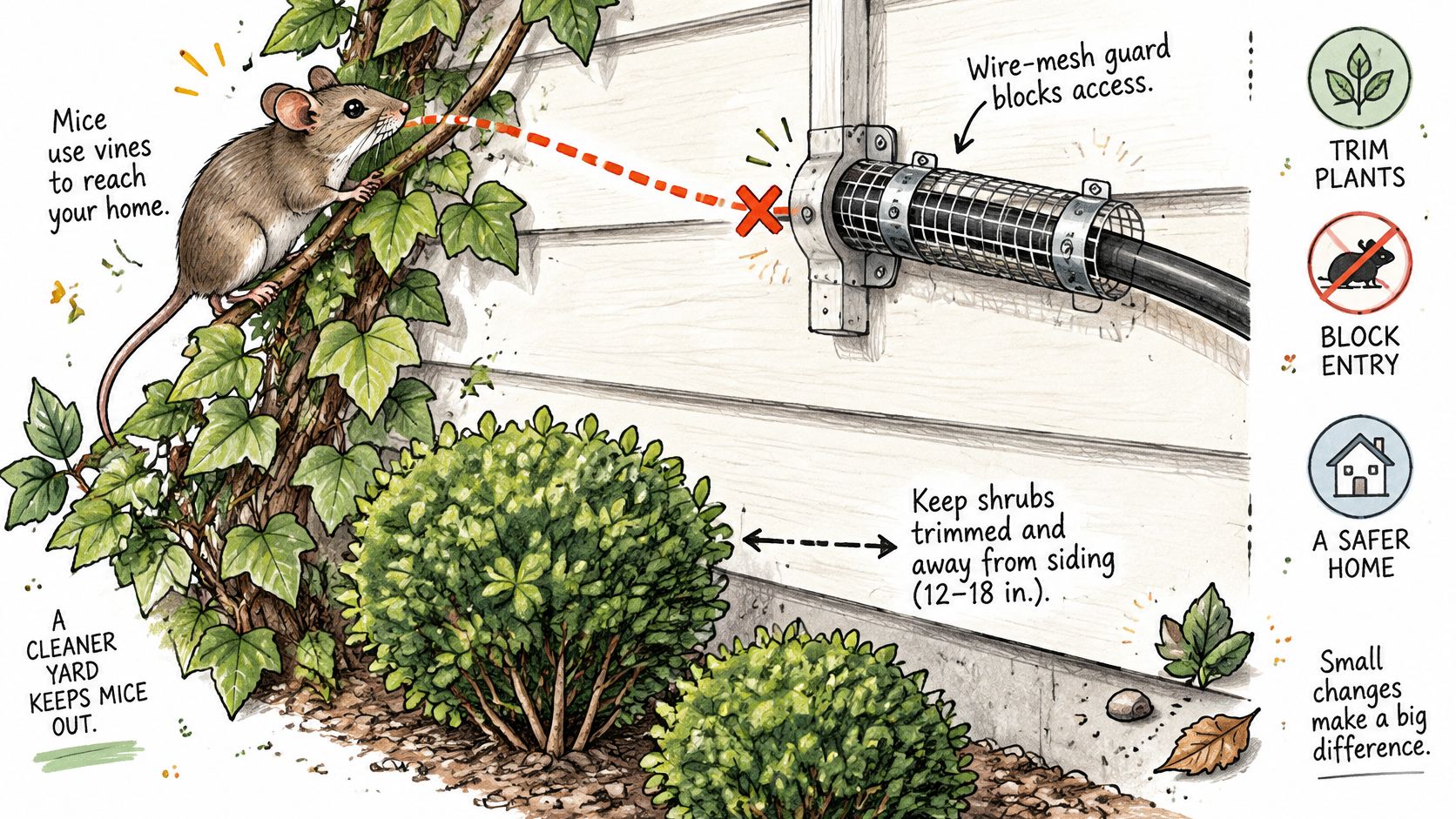
Inspect and repair in a deliberate order
Map the routes. Walk the full perimeter with a flashlight and photograph rough corners, siding seams, fence connections and vegetation touching the building. Mark the destination of each route so you don't repair an isolated gap while missing the opening beside it.
Check upper penetrations. Examine attic vents, soffit joints, roof returns and pipe, cable and HVAC entries. Use binoculars from the ground for preliminary observations; don't climb onto a roof to confirm a suspected mouse opening.
Choose durable repair materials. Secure metal mesh or fitted sheet metal to sound construction, then finish suitable edges with compatible sealant. Packed steel wool backed by sealant can suit some small repairs, but exposed material can deteriorate; chewable expanding foam alone isn't a durable exclusion barrier.
Close lower openings too. Repair door sweeps, foundation defects and gaps around utility entries. Don't let concern about attic access distract you from an obvious opening beside a garage door.
Remove bridges safely. Trim vegetation away from walls and roof edges, and relocate stored ladders or building materials. Have the appropriate utility provider or qualified contractor assess cables; don't move electrical service lines yourself.
Reduce indoor access and resources. Clear boxes from beside shelving, store food in rigid containers with fitted lids and remove accessible nesting materials. Keep inspection paths open behind appliances and in storage rooms.
Recheck the repairs. Look for fresh droppings, gnawing and renewed gaps, and arrange a follow-up inspection rather than assuming a quiet night proves success. Coordinate trapping and sealing so activity inside the building is addressed as well.
For a repair-by-location reference, use this guide to identifying and sealing common rodent entry points.
If fence maintenance accompanies vegetation clearance, XTREME EDEALS post cap sizing advice from XTREME EDEALS INC. can help you select a properly fitting replacement cap. A post cap is a fence-maintenance component, not a mouse barrier.
Know when to bring in a technician
High rooflines, concealed penetrations and work near electrical equipment call for qualified professionals. Ask a licensed pest technician to identify the exclusion work, then involve a roofer or other trade where the repair affects roofing, utilities or ventilation.
Use the video as a visual companion, not a substitute for checking your building's actual connections.
Where to Place Bait and Traps Along Climbing Routes
Put traps on confirmed travel routes, not randomly on climbable surfaces. A rough wall tells you where movement is possible; droppings, gnawing and repeated activity help identify where a device belongs.
Choose stable, accessible locations where you can inspect and service the device. Don't balance a snap trap on a pipe or place unsecured equipment overhead.
Trap and bait placement by location
| Location | Typical route | Placement advice |
|---|---|---|
| Ground-floor perimeter | Foundation walls, slab edges and door sweeps | Set snap traps flat against the wall line where mice run |
| Wall-to-roof junction and soffits | Rough fascia, vent screens and vines | Place monitors on the nearest safely accessible climbing route, not on the roof |
| Attic access and vents | Gable vents, roof returns and pipe penetrations | Secure traps on a stable surface beside the rafter or pipe route leading to the opening |
| Kitchen and pantry shelving | Shelf brackets, stored boxes and cabinet tops | Use enclosed bait stations on shelf edges only where the product label permits, and clear clutter |
| Commercial storage racking | Pallet edges, cable trays and conduit | Secure monitors on racking uprights and cable trays where droppings appear, subject to facility rules |
| Utility penetrations | Cable and pipe entries and HVAC lines | Trap at the entry, then seal the gap because traps alone don't stop reentry |
For conventional snap traps beside a wall, keep the base flat and position the trigger end toward the wall. Follow the device's instructions, especially for enclosed traps with a defined entrance.
The important exception around food
An enclosed station doesn't make every bait appropriate for every location. Use rodenticide only where its label permits, and don't place loose bait on pantry shelves, food-contact surfaces or accessible storage areas.
Tamper-resistant stations help restrict access and contain bait, but they still require careful placement away from children, pets and non-target animals. In food-storage areas, enclosed mechanical traps may be the more appropriate choice.
A trap beside an entry catches activity at that moment. It doesn't repair the opening.
Keep a written checking schedule and record catches or fresh signs by location. A property manager can label devices on a floor plan so staff don't move them during cleaning or stock rotation.
Bait selection also matters, but placement comes first. The guide to choosing mouse bait can help with lure selection once you've identified a usable, safe trap location.
If activity continues without catches, reassess the route and device position before adding more bait. A trap across an open room may miss mice using a concealed cabinet edge nearby.
Confirm Climbing Risks in Magnolia Before Mice Reach the Attic
Magnolia is in southwestern Montgomery County at FM 1774 and FM 1488, about 45 miles northwest of Houston and 25 miles southwest of Conroe, with Interstate 45 and U.S. 290 each about 20 miles away, according to the City of Magnolia's location reference.
Magnolia, Texas service-area reference
The population and land figures below come from the U.S. Census Bureau's Magnolia profile; the road and distance entries reflect the city's location reference.
| Item | Value |
|---|---|
| Population (2020 Census) | 2,359 |
| Land area | 2.87 square miles |
| Population density | 821.4 per square mile |
| Population estimate (2025) | 8,095 |
| Distance to Houston | About 45 miles southeast of Magnolia |
| Distance to Conroe | About 25 miles northeast of Magnolia |
| Interstate 45 and U.S. 290 | Each about 20 miles away |
| Junction | FM 1774 and FM 1488 |
That growth makes both established homes and newer subdivisions relevant to inspection planning. Older properties may have weathered wood and separated joints; newer properties still need checks around fences, landscaping and utility installations.
FullScope Pest Control offers rodent inspection and exclusion, with listed service locations in Cleveland, Kingwood, Conroe and Porter. Magnolia isn't among those listed locations, so confirm coverage for your exact address before booking.
Ask the office:
- Inspection scope: Will the technician trace upper routes as well as foundation gaps?
- Repair responsibility: Does exclusion include roofline and penetration work, or require another trade?
- Follow-up: What reinspection window applies to the proposed work?
If damaged roofing needs separate assessment, America Roofing's professional roof inspection resource explains an inspection option; confirm its service availability independently.
Contact the office with your Magnolia address and photographs of suspected access points. Once coverage is confirmed, book an inspection that traces connected routes from the yard to the attic and provides a written repair and follow-up plan.