1500+ reviews


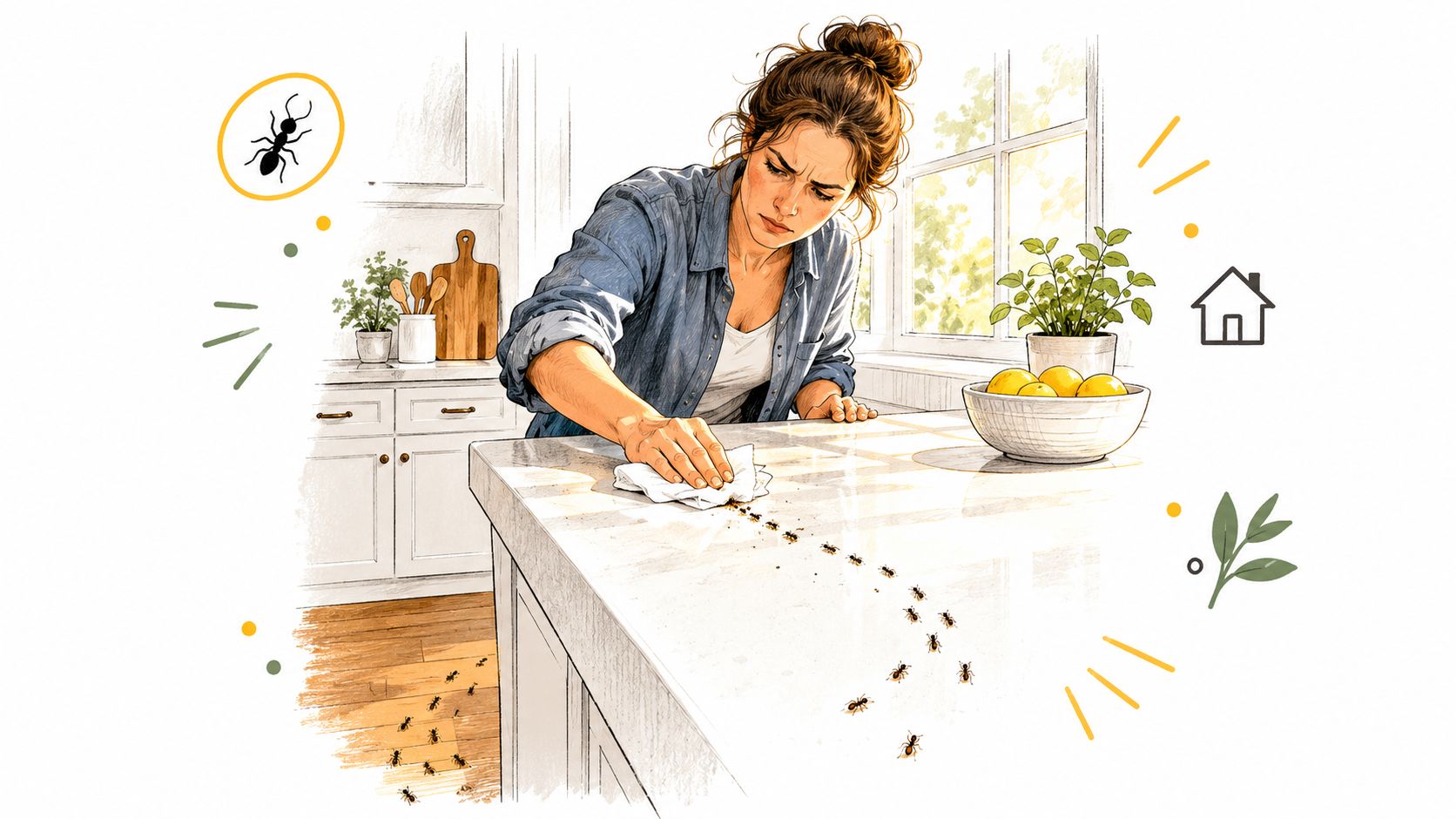
You're making coffee in your Magnolia kitchen, and there's the line again. Ants cross the counter, drop down the cabinet face, and vanish behind the dishwasher. You wiped them up yesterday afternoon, sprayed the baseboard, and woke up to a fresh trail. That pattern usually means you're killing foragers, not locating the colony. Learning how to find ant nest inside house problems starts with resisting the spray can long enough to watch where the workers go.
Why the Trail You See May Not Lead to the Nest
A homeowner in Magnolia can scrub the same counter for a week and still lose ground. The ants return each afternoon because the visible line is mostly a food route. Workers lay chemical pheromone trails and repeatedly follow established paths between food, water, and the colony, so the route tells you where they're feeding before it tells you where they live.
University of Maryland Extension guidance on indoor ants recommends watching ants travel to and from food because direction and consistency can reveal whether the source is indoors or outside. That's the first decision you've got to make. If the nest is outside in soil by the foundation, mulch, a pavement crack, a flowerpot, or firewood, treating a kitchen wall won't solve it. If the nest is inside a damp wall void, treating only the patio won't either.
Why Southeast Texas Makes the Call Harder
Humidity, slab construction, and plumbing penetrations give ants hidden travel lanes. A trail can disappear under flooring, behind a cabinet, or around a pipe opening and reappear in another room. That disappearance point is a clue, not proof, because many species enter only for food or moisture. Species matters here too, and this comparison of fire ants, odorous house ants, carpenter ants, and pavement ants helps separate outdoor foragers from ants more likely to exploit damp indoor voids.
Don't wipe the trail the moment you see it. You'd be erasing the only map the workers are giving you.
Aggressive cleanup feels productive, but it can scatter workers and force a new route. You'll get a quieter counter for a few hours and less information than you had before. Watch first, document where the line starts and ends, then decide whether you're dealing with visitors or residents.
Running a Trail-Following Inspection
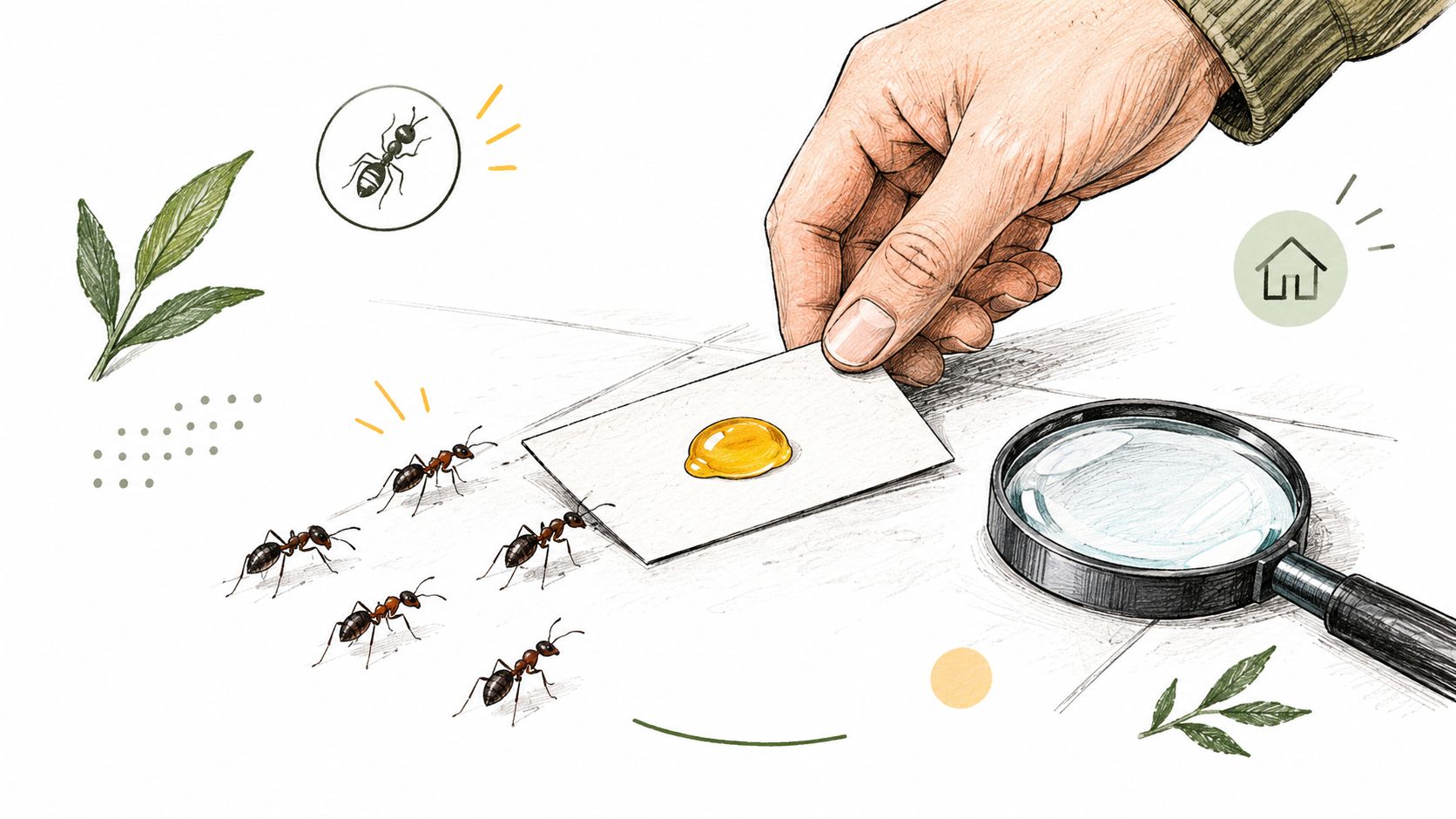
Start by removing competing food and water. Wipe crumbs, rinse the sink, empty the pet bowl area, and dry standing moisture. Then place a small dab of honey on an index card near the sighting. The card gives ants one clear destination and gives you one route to follow instead of scattered workers across the counter.
Set the Route and Follow It Away From Food
Oregon State University Extension reporting summarized in Illinois Department of Public Health ant guidance notes ants often establish a route to and from an attractant within about one hour. Once traffic forms, don't disturb it. Follow workers away from the food along baseboards, carpet edges, cabinet joints, pipe penetrations, window frames, and appliance gaps. Note exactly where they disappear.
Repeat the observation after sunset, when carpenter ants and several other species are more active. A trail that looks thin at noon can be obvious at night. If workers vanish into a wall, go outside and inspect the opposite wall, foundation joint, sill, and nearby plumbing penetration. The colony may be outdoors, inside the void, or traveling through it.
This short walkthrough shows the observation habit in practice before you record your own findings.
Record What a Technician Would Ask
- Entry and disappearance points: Mark them with painter's tape so you don't rely on memory.
- Time and direction: Note when traffic peaks and whether loaded workers move toward or away from the wall.
- Moisture nearby: Write down leaks, condensation, damp cabinets, or wet flooring along the route.
- Food being carried: Workers carrying food usually point back toward the colony.
The common failures are mopping or spraying before tracing the route, following only ants nearest the food, and assuming every indoor trail means an indoor colony. If you're thinking beyond today's inspection toward longer term prevention, this permanent ant removal guide is useful background, but it won't replace the trail record you build in your own house.
Mapping the High-Probability Nest Sites Room by Room
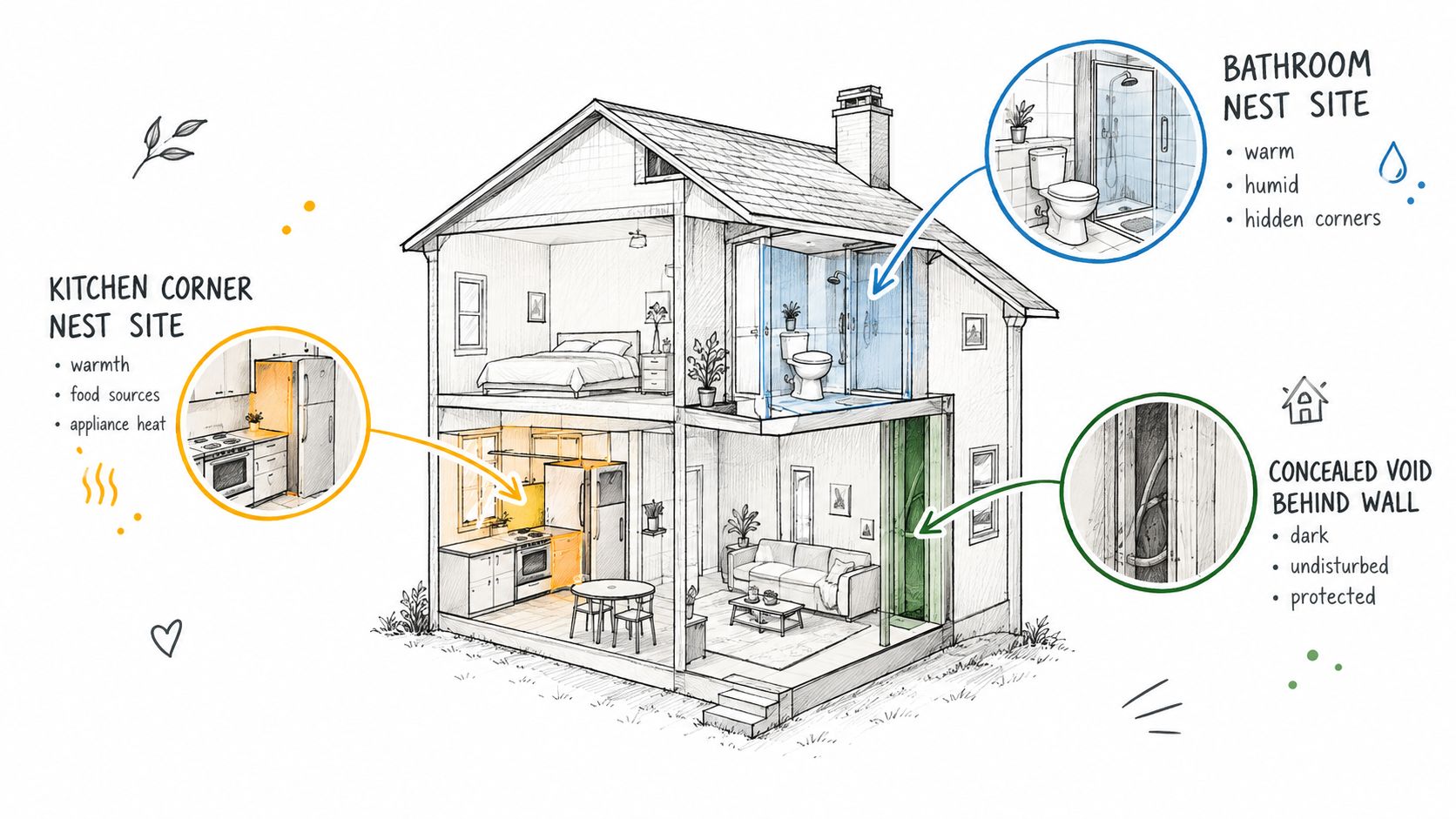
Once a trail disappears, search by pattern, not by panic. Indoor colonies cluster where moisture, warmth, and concealed voids overlap. Utah State University Extension information on pavement ants and indoor nesting sites identifies bathrooms, sink and drain areas, wall voids with warm pipes, and spaces beneath baseboards or carpet edges as recurring locations.
Start Where Water Meets a Hidden Space
- Bathrooms: Check beneath toilets and showers, around tub access panels, under vanities, and where supply lines enter the wall.
- Kitchens: Inspect sink cabinets, dishwasher sides, refrigerator water lines, and cabinet joints that stay damp or warm.
- Laundry and utility areas: Look beneath washing machines, behind water heaters, and around drain penetrations.
- Floors and trim: Follow baseboards, carpet edges, cracked slabs, and gaps where flooring meets exterior walls.
- Attic and roof edges: Examine insulation, fascia, window and door sills, and wood touched by roof leaks or condensation.
Add the Carpenter Ant Layer
Carpenter ants point you toward damp or decayed wood caused by plumbing leaks, roof leaks, condensation, poor drainage, or inadequate ventilation. Probe suspicious sills and trim gently, and look for staining, soft spots, or bubbled paint. The strongest clue is frass, coarse material that looks like pencil shavings and gets pushed from galleries. Frass below a sill or baseboard means the nest is likely close to that deposit, not across the house.
Practical rule: A trail tells you the road. Moisture, frass, and soft wood tell you the neighborhood.
Large numbers of winged ants indoors are another strong warning that a colony may be established inside. One or a few winged ants don't prove indoor nesting, so don't overread a single swarmer near a window. Also accept a limit early. Colonies between floors, inside walls, or in decaying wood may stay inaccessible without opening building materials, and knowing that boundary saves you from tearing into the wrong wall.
Tools and Baits That Actually Reveal a Nest
Separate diagnostic tools from control products. A flashlight doesn't kill a colony, and a spray can doesn't locate one. Confusing those jobs is where most DIY effort gets wasted.
Inspection Tools and Baits at a Glance
| Tool or Bait | What It Reveals | Best Use in the Inspection | Limits |
|---|---|---|---|
| Index card with honey | A readable route to and from food | Placed near activity after competing food is removed | Shows traffic, not the exact nest chamber |
| Flashlight and inspection mirror | Trails inside cabinets and behind appliances | Checking pipe gaps, toe kicks, and dark joints | Can't see inside sealed wall voids |
| Moisture meter | Damp drywall, trim, or subfloor | Testing stained or soft areas near plumbing | Moisture alone doesn't confirm ants |
| Slow acting gel or liquid bait | Whether workers feed and carry material back | Placed beside an undisturbed active trail | Needs time and the right food preference |
| Broad contact spray | Very little about colony location | Limited spot use away from bait trails | Kills visible workers and can erase the trail |
Why Bait Needs an Untouched Trail
When bait is being used, workers need to carry it along their normal route. Spraying that same line works against you. The workers die or avoid the area, the pheromone route breaks, and you're left with no traffic to follow. I've walked into plenty of Southeast Texas kitchens where the homeowner had bait in one corner and fresh spray across the trail leading to it. The products canceled each other out.
Choose bait placement from evidence, not from the label photo. Put it where workers already travel, keep competing food cleaned up, and give it time. Pantry sanitation matters for the same reason, and these Eco Clean Solutions cleaning tips are a practical companion when stored food is part of the problem. For a plain breakdown of household products, this guide to DIY ant killers and what will and won't work helps you avoid buying three versions of the same dead end.
A moisture meter deserves special mention. It won't find ants, but it can tell you whether drywall under a window or behind a shower valve is wet enough to deserve priority. That distinction keeps the inspection honest.
Proofing and Immediate Control That Pair with the Inspection
Seal after you've mapped the route, not before. If you caulk the first gap you see while the colony and active route remain untouched, ants may emerge in the next room. Proofing works when it follows evidence.
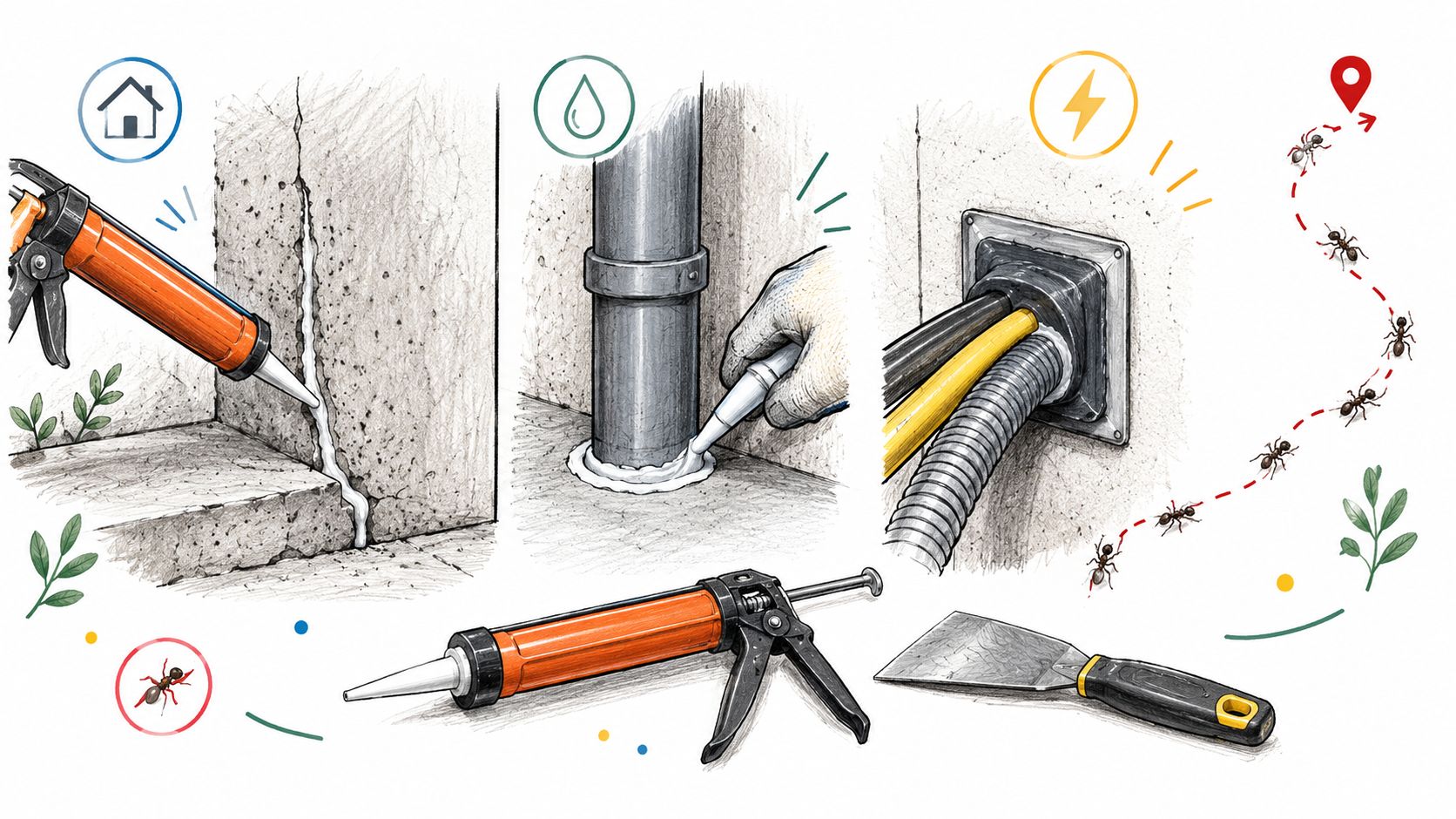
Seal the Route You Actually Found
- Pipe penetrations: Seal gaps around sink, toilet, tub, and washing machine lines where trails disappear.
- Foundation and slab cracks: Close joints that connect exterior soil, mulch, or pavement to indoor voids.
- Utility entries: Check electrical routes, HVAC lines, and cable entries on both sides of the wall.
- Window and door gaps: Repair failed weatherstripping and cracked trim near recurring trails.
EPA integrated pest management guidance on ants specifically recommends inspecting heating, plumbing, food areas, and the building perimeter rather than assuming the visible kitchen trail is the nest. That perimeter check matters in Magnolia, where irrigation and heavy rain can keep foundation soil damp. If the exterior side shows the main entry, your proofing belongs there first.
Remove the Reason They Keep Coming Back
Fix leaking faucets, supply lines, and drain traps. Dry condensation, clear clogged gutters, redirect irrigation overspray, and replace wood that stays wet against soil. Those repairs aren't housekeeping extras. They're why a treatment holds or fails. A homeowner can bait correctly and still see new ants if a shower valve keeps feeding moisture into the wall.
Sanitation supports bait by removing competition. Store pantry food in sealed containers, wipe sweet spills, rinse recycling, and don't leave pet food out overnight during active baiting. Keep the sequence simple. Map first, bait the active route, correct moisture, then seal confirmed entries. Reversing that order usually creates more work.
When to Bring in a Magnolia-Area Technician
Call for help when your inspection points somewhere you can't verify or treat safely. A trail ending inside a wall void, carpenter ant frass, soft or stained wood, recurring moisture, or repeated trails after baiting all cross that line. Winged ants appearing indoors in numbers also justify a professional inspection. At that point, another can of spray isn't persistence. It's delay.
What Local Coverage Means in Magnolia
Magnolia is an incorporated city in Montgomery County, and the U.S. Census Bureau QuickFacts page for Magnolia recorded 2,359 residents in the 2020 Census. Don't assume a provider using a broad northwest Houston label covers your street. Ask specifically about Magnolia, Montgomery County.
Geography matters for scheduling and follow up. Magnolia sits at FM 1774 and FM 1488, approximately 25 miles southwest of Conroe and about 45 miles northwest of Houston, according to this local overview of living in Magnolia, Texas. Postal coverage also varies. Magnolia ZIP code information from MyTownView associates 77354 and 77355 with Magnolia, while broader listings also associate 77353 with the Magnolia area, so verify coverage by street address if you're in an unincorporated area.
FullScope Pest Control is a QualityPro certified local provider with offices in Cleveland, Kingwood, Conroe, and Porter, and it covers Magnolia area homes and businesses. Its residential ant control service is the relevant hand off when the evidence points to a concealed nest or recurring moisture driven activity. If repeated trails trace back to a worn door, poor threshold, or damaged frame, this exterior door buying guide for Atlanta offers useful selection criteria, even though your contractor and climate details will be Southeast Texas specific.
Bring your trail notes to the visit. Photos, times, tape marks, and moisture observations shorten the inspection and reduce guesswork.
A Short Decision Framework for the Next Ant Sighting
Keep this sequence where you'll use it, on the fridge or in your phone. It's short because the order matters more than owning more products.
Observe, Identify, Seal, Call
- Observe: See a trail, don't spray it. Remove competing food and run the index card test.
- Identify: Find where workers disappear, then inspect both sides of that wall, cabinet, baseboard, or pipe penetration.
- Seal: Correct moisture first or alongside control, then seal confirmed entries after the route is mapped.
- Call: Get a Magnolia area technician involved if the trail returns, frass or winged ants appear, or the evidence points inside a wall void.
If you can't name the disappearance point and the nearest moisture source, you aren't ready to choose a treatment yet.
That one pause changes the outcome. You'll know whether you're feeding outdoor foragers at a bait station, drying out a bathroom void, or dealing with a structural carpenter ant problem. Each answer leads to a different fix, and guessing usually picks the wrong one.
If your trail disappears into a wall, you've found frass, or ants keep returning around Magnolia in the 77354, 77355, or 77353 area, book a local ant inspection and bring your notes, photos, and tape marked entry points. A technician can verify whether the colony is inside the structure or entering from outdoors, then target treatment and moisture corrections to the route you've already documented.