1500+ reviews

You've just seen a dark, fast-moving insect near a back door, under a sink, or beside the garage in Magnolia, Texas. It looked enough like a roach to cause concern, but size alone can't confirm a cockroach. Beetles, crickets, water bugs, earwigs, and other insects can share a dark color, flattened profile, or quick ground-level movement.
Start with the details you can observe safely: body shape, markings, antennae, head visibility, habitat, movement, and time of day. A bug near a porch light may have a different explanation from one found behind a refrigerator. A specimen found in a dry bedroom deserves a different interpretation from one found beside a leaking pipe.
If you can, take a clear photo or capture the insect in a sealed container without touching it. Record where you found it and whether it ran, jumped, flew, or stayed hidden. Those details can help FullScope Pest Control technicians serving Magnolia identify the insect and recommend a targeted response instead of relying on guesswork.
1. American Cockroach Periplaneta americana
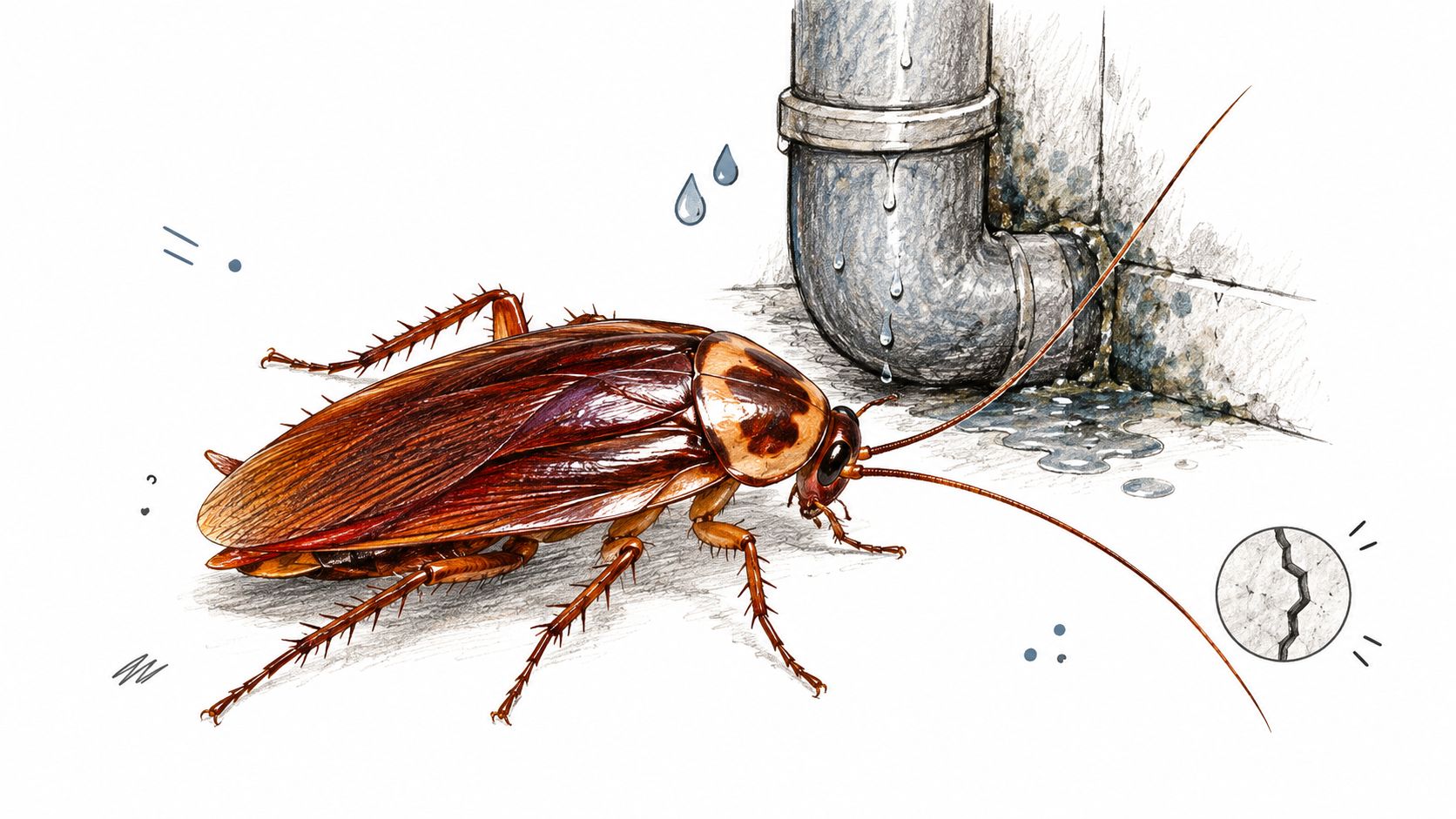
A large reddish-brown insect near a drain, crawl-space entrance, or plumbing line may be an American cockroach, not a harmless beetle. This species has the classic cockroach profile, a broad, flattened oval body, long thread-like antennae, spiny legs, and a head partly covered by the pronotum.
American cockroaches are among the most conspicuous roaches in Southeast Texas homes and commercial buildings. Their appearance can vary with lighting, dust, and wear, so color should support identification rather than determine it. Look for the combination of a smooth oval outline, long antennae, fast movement toward cover, and a shield-like pronotum that hides much of the head.
Where Magnolia homeowners find them
Moisture is the strongest clue. Check crawl spaces, basement sumps, utility rooms, plumbing chases, and areas around floor drains. A sighting near a leaking pipe or foundation opening may indicate that the insect entered from outside or is using a damp harborage.
Magnolia properties can also have entry opportunities around settling foundation joints, drainage pipes, and utility penetrations. Outdoor debris, firewood, mulch, and dense vegetation near the structure may provide additional shelter.
Practical rule: A large roach-like insect near moisture deserves inspection of both the insect and the entry point. Treating the visible bug without correcting the opening or leak may not solve recurring activity.
Seal foundation cracks and gaps around pipes, repair leaks, improve ventilation, and keep stored materials away from walls. Photographing the insect, location, and time of day gives a technician useful context when checking Magnolia homes, nearby Conroe properties, or commercial sites in the broader service corridor.
2. German Cockroach Blattella germanica
A small tan insect with two dark parallel stripes behind the head is more consistent with a German cockroach than with a dark ground beetle. The stripes sit on the pronotum, the shield-like section immediately behind the head, and they're often the quickest visual clue when the insect is still.
German cockroaches are strongly associated with indoor food and water sources. Look in kitchens, bathrooms, break rooms, cabinet hinges, and spaces beside refrigerators, dishwashers, ovens, and microwaves. They usually move at night, but seeing them during daylight can signal that hiding spaces are crowded or activity is widespread.
Look beyond the individual insect
One small roach-like bug may be easy to dismiss, especially if it disappears under an appliance. Search for droppings, shed skins, egg cases, unusual odor, and additional insects along wall edges. Sticky traps placed under appliances and beside cabinets can show whether activity is limited to one area or spread through the room.
Magnolia restaurants, apartment properties, and small businesses need a more organized response than a quick spray. Sanitation, food storage, leak repairs, monitoring, and treatment must work together. Remove food residue promptly, store ingredients in sealed containers, clean under equipment, and avoid leaving pet food out overnight.
For a useful species comparison, see this guide to the difference between American and German roaches. If the insect has the German roach pattern and you're finding young insects as well as adults, arrange a professional inspection rather than waiting for sightings to increase.
3. Brown-Banded Cockroach Supella longipalpa
Not every cockroach hides beside a sink. A small tan insect found in a bedroom closet, upper cabinet, linen storage area, attic, or behind a wall-mounted appliance may be a brown-banded cockroach. Its name comes from the lighter bands that cross the wings and abdomen.
This species can be mistaken for a beetle because its markings may look like bands on a hard-backed body. Check the antennae and overall form. A true cockroach generally has long, thread-like antennae, a flattened oval body, a partly concealed head, and quick movement toward a crack or sheltered edge.
Why location matters
Brown-banded cockroaches favor warm, relatively dry areas rather than the damp plumbing zones associated with some other roaches. In a Magnolia home, inspect upper cabinets, crown molding, closets, storage boxes, interior wall spaces, and areas around light fixtures or thermostats.
Cardboard, paper, fabric, and clutter create hiding places. Reduce stored materials, seal cabinet seams and upper wall gaps, and use monitoring traps in raised locations as well as along floors. A perimeter-only approach may miss insects established in upper rooms.
Real estate inspections in Magnolia, Conroe, and surrounding communities should document suspicious insects rather than relying on a general label such as “roach.” A captured specimen or sharp photograph can help distinguish a brown-banded cockroach from a beetle or another household invader. FullScope technicians can then focus inspection and treatment on the areas where evidence appears, including upper cabinets and wall voids.
4. Smokybrown Cockroach Periplaneta fuliginosa
A nearly black roach-like insect that flies toward or emerges from an attic, soffit, roof void, or exterior wall may be a smokybrown cockroach. Its dark color can make it look like a beetle at a glance, but the body structure gives stronger evidence. Long antennae, a flattened oval shape, spiny legs, and a hidden head point toward a cockroach.
Smokybrown cockroaches are closely tied to moisture and exterior conditions. Roof leaks, clogged gutters, dense vegetation, damp attic insulation, and condensation around equipment can create attractive harborage. Their climbing ability also helps them reach higher parts of a structure, which explains why a sighting near an attic access or soffit may not begin at floor level.
Trace the route from outside
Inspect gutter discharge, roof flashing, soffit gaps, vent screens, chimney openings, and branches touching the roofline. Trim vegetation away from eaves, repair leaks promptly, and screen openings where insects can enter. Keep yard debris from collecting against exterior walls.
A Magnolia homeowner might notice one during humid weather and assume it wandered in randomly. That's possible, but repeated sightings around the same roof edge or attic entrance suggest a route worth investigating. Property managers in Kingwood and Conroe can also benefit from documenting which elevations and roof areas produce sightings.
A professional inspection can connect the insect to moisture, entry points, and harborage instead of treating rooms at random. If the insect is captured, don't crush it before photographing it. The intact body, wing condition, color, and proportions may help with identification.
5. Asian Cockroach Blattella asahinai
A small light-brown insect near a porch light, bright window, or exterior door may be an Asian cockroach, especially if it flies readily. Asian cockroaches can resemble German cockroaches closely, but their behavior and preferred setting provide important clues.
The key contrast is simple. German cockroaches are associated with indoor harborage, while Asian cockroaches commonly live outdoors and may enter when attracted by illumination or warm conditions. A roach-like insect repeatedly circling outdoor lights or appearing at lit windows deserves a different first response from one found deep inside a kitchen cabinet.
Reduce attraction at entry points
Inspect mulch beds, leaf litter, dense ground cover, and gaps around doors, windows, and utility lines. Outdoor lighting can draw insects toward the structure, so use motion sensors where practical and position lights away from entrances when possible. Weather stripping and door sweeps can reduce the openings insects use to move indoors.
Magnolia homes with outdoor lighting may see more activity around exterior-facing rooms during warm seasons. If indoor sightings are limited to doors and windows, place sticky monitors near those points and record when the insects appear. If they're found throughout the kitchen, cabinets, or appliances, don't assume outdoor attraction is the whole explanation.
A perimeter inspection can determine whether landscaping, lighting, or structural gaps are contributing. It can also separate an outdoor visitor from an indoor population that requires more focused treatment.
6. Cockroach Nymphs and Early-Stage Identification
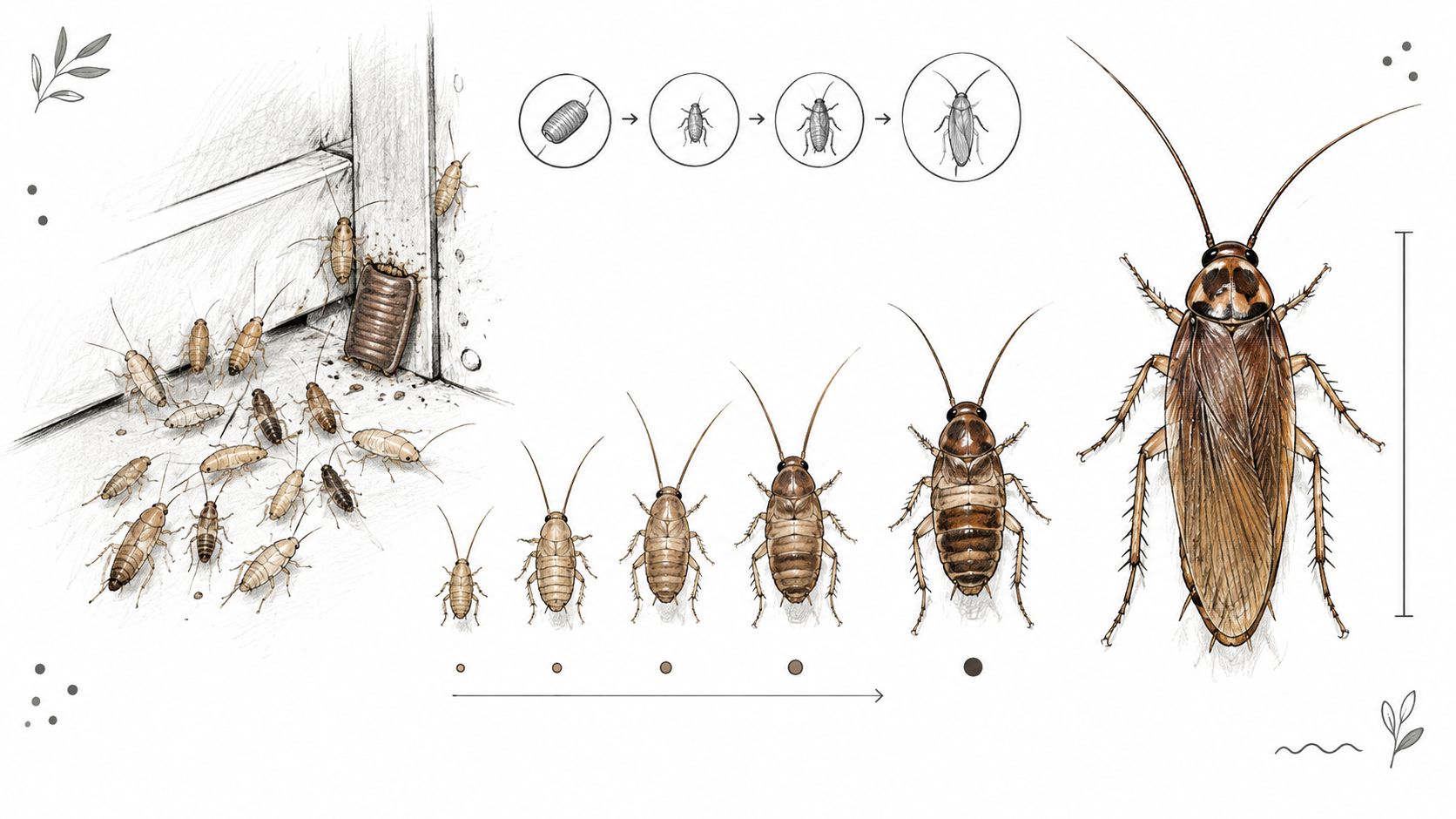
The smallest roach-like insects often create the most confusion. Cockroach nymphs are wingless immature stages, so they don't have the full adult appearance homeowners expect. Their bodies may be darker or lighter than adults, and their compact shape can resemble a small beetle, cricket, or other crawling insect.
Look for the same core anatomy in miniature. Long antennae, a flattened body, a head partly tucked beneath the pronotum, and tail cerci support cockroach identification. Nymphs usually stay close to cracks, cabinet seams, plumbing gaps, appliances, and other protected locations, so the place where you find one matters as much as its size.
Treat young sightings as useful evidence
Finding nymphs suggests that adult activity may be nearby, even if you haven't seen an adult. Note whether they appear in a kitchen, bathroom, bedroom closet, upper cabinet, or commercial food-preparation area. Place monitors along edges and under equipment, then preserve any captured specimens for inspection.
For visual reference, use this cockroach appearance and identification guide. Avoid spraying every surface before the insect is identified. Broad applications can scatter insects, obscure evidence, and expose people or pets unnecessarily.
A nymph sighting is small evidence with potentially large significance. Record it, photograph it, and arrange an inspection if sightings recur.
This short visual resource can help homeowners understand how appearance changes across life stages before they compare a specimen with reference images.
7. Prevention and Professional Identification Service for Cockroach Look-Alikes
Some insects look enough like roaches to cause alarm but need a different response. Ground beetles, crickets, camel crickets, water bugs, earwigs, and winged termites can all be confused with cockroaches during a brief sighting. Beetles are among the most frequent sources of confusion, partly because many have dark bodies and fast ground-level movement.
Use a quick field comparison before deciding what the insect means. True cockroaches typically have long filiform antennae, a head hidden beneath the pronotum, and visible tail cerci. Beetles often show hard wing covers meeting in a straight line. Crickets have enlarged jumping hind legs, while water bugs are associated with aquatic settings rather than ordinary indoor scavenging.
Match the response to the evidence
A large insect near a damp foundation may point toward water-related conditions, while a jumping insect in yard debris may be a cricket. A small dark insect in stored food could be a beetle, making sanitation and food storage more relevant than cockroach treatment. Winged termites require prompt attention because misidentification could delay a structural pest inspection.
When a homeowner in Magnolia, Kingwood, Conroe, Porter, or a nearby community finds a suspected look-alike, save the evidence:
- Capture safely: Place the insect in a sealed bag or container if you can do so without touching it.
- Photograph clearly: Take close images from above and from the side, preferably with a familiar object nearby for scale.
- Record context: Note whether it was indoors, outdoors, near water, near food, on a wall, or on the floor.
- Describe movement: Record whether it ran, jumped, flew, hid, or remained exposed.
Professional identification helps prevent unnecessary pesticide use and helps technicians check for more than one pest condition. Practical prevention guidance is available in this cockroach infestation prevention resource. A FullScope inspection can then connect identification with exclusion, sanitation, moisture correction, monitoring, and targeted treatment.
7-Item Comparison: Cockroach Look-Alikes
| Item | Implementation Complexity 🔄 | Resource Requirements ⚡ | Expected Outcomes 📊⭐ | Ideal Use Cases 💡 | Key Advantages ⭐ |
|---|---|---|---|---|---|
| American Cockroach (Periplaneta americana) | Moderate 🔄, exclusion + moisture remediation | Moderate–High ⚡, sealing, dehumidifiers, quarterly treatments | Moderate 📊, durable control when moisture/entry sealed; reinfestation risk from outdoors ⭐⭐ | Homes with basements/crawl spaces and moisture problems | Large size aids detection; outdoor source allows targeted exclusion ⭐ |
| German Cockroach (Blattella germanica) | High 🔄, multi‑stage treatments & sanitation enforcement | Moderate ⚡, repeated treatments, sanitation, monitoring traps | High 📊, rapid elimination with 3–4 treatments and IPM; risk if delayed ⭐⭐⭐ | Kitchens, bathrooms, multi‑unit buildings with indoor infestations | Fast reproductive suppression when treated promptly; indoor containment simplifies tactics ⭐ |
| Brown‑Banded Cockroach (Supella longipalpa) | Moderate 🔄, targeted upper‑area inspection/treatment | Low–Moderate ⚡, localized sprays, traps, clutter reduction | Good 📊, slower reproduction aids control; hidden upper harborage can delay detection ⭐⭐ | Well‑insulated homes, upper cabinets, attics, closets | Visible upper sightings simplify ID; lower reproduction rate improves treatment windows ⭐ |
| Smokybrown Cockroach (Periplaneta fuliginosa) | Moderate–High 🔄, attic/roof access and exterior exclusion | High ⚡, roof/gutter repair, tree trimming, attic treatments | Moderate 📊, effective if roof/landscape issues fixed; flight/climbing complicates control ⭐⭐ | Homes with attic/soffit activity, roof leaks, dense tree cover | Exterior/upper‑structure focus allows preventive maintenance to reduce populations ⭐ |
| Asian Cockroach (Blattella asahinai) | Low–Moderate 🔄, light and landscape management plus perimeter work | Low ⚡, light replacement, landscape modification, perimeter treatments | Good-seasonal 📊, prevention reduces indoor incursions; not a nesting indoor pest ⭐⭐ | Properties with exterior lighting, mulch beds, seasonal influx (spring–fall) | Outdoor-focused measures (lighting, mulch removal) are highly effective and low cost ⭐ |
| Cockroach Nymphs & Early‑Stage Identification | High 🔄, life‑stage targeted IGRs and timely follow‑ups | Moderate ⚡, IGRs, insecticides, monitoring, rapid inspection | Very High 📊, early treatment prevents population explosion; nymphs more susceptible ⭐⭐⭐ | Early infestation detection during inspections or routine monitoring | Early detection enables cost‑effective eradication and reduces treatment cycles ⭐ |
| Prevention & Professional Identification (Look‑Alikes) | Low 🔄, inspection and species confirmation | Low ⚡, technician visit, minimal targeted action if needed | Very High 📊, correct ID prevents inappropriate treatments and cost waste ⭐⭐⭐ | Uncertain sightings, real estate inspections, homeowner uncertainty | Accurate diagnosis enables targeted, cost‑effective interventions and reduces unnecessary pesticide use ⭐ |
Turn a Mystery Bug Into a Clear Next Step
A bug that looks like a cockroach doesn't automatically mean your home has an established infestation. The most useful first step is to preserve information. Take a sharp photograph, or safely place the insect in a sealed container. Note the exact location, time of day, lighting, nearby moisture, food or stored materials, and whether the insect ran, jumped, flew, or disappeared into a crack.
Next, inspect the surrounding conditions without disturbing the area. Check under sinks, beside appliances, around drains, near doors and windows, inside cabinets, and around crawl-space or attic access points. Look for leaks, condensation, damaged seals, clutter, mulch against the foundation, and gaps around pipes or utility penetrations. These clues can explain why the insect appeared and help a technician find the source.
Avoid broad pesticide use while identification is uncertain. A beetle, cricket, water bug, earwig, termite, and cockroach may require different control decisions. Spraying without knowing the insect can also remove useful evidence or push hidden pests into other areas.
Arrange professional inspection when sightings recur, when you find nymphs, when insects appear during daylight, or when activity occurs in a restaurant, warehouse, apartment complex, office, or other commercial facility. Those patterns deserve more than a one-time guess. The same applies when a roach-like insect appears near roof leaks, damp crawl spaces, foundation openings, or suspected termite conditions.
FullScope Pest Control provides identification, inspection, targeted treatment, and ongoing protection options for Magnolia-area properties. Its broader service corridor includes nearby communities such as Conroe, Kingwood, and Porter, along with other north Houston and Southeast Texas locations. Share your photos, sighting notes, and property location when you contact the team so the inspection can focus on the most likely entry points and harborage areas.
If you've found a suspicious insect in Magnolia, don't wait for repeated sightings to create uncertainty. Photograph or capture it safely, document where and when you saw it, and contact FullScope Pest Control through its official website to request an inspection and discuss the appropriate next step.