1500+ reviews

You glance under the kitchen sink in your Magnolia home, see something brown flash across the tile, and that one quick movement leaves you with more questions than answers. Was it a cockroach, a beetle, or just a shadow moving too fast to trust your eyes? In homes across Magnolia, that first sighting often happens at night, in a damp corner, or near food and plumbing, and the challenge is not just spotting a roach, it's knowing what do cockroaches look like before the problem spreads.
Understanding Why Cockroach Appearance Matters
A homeowner in Magnolia usually doesn't get a perfect, stationary view of a roach. They get a blur near the pantry, a fast shape slipping behind a refrigerator, or a small insect that disappears before they can react. That's why appearance matters so much. A quick visual ID can tell you whether you're dealing with a large outdoor invader, a small indoor pest, or a mix of adults and younger stages hiding deeper in the home.
Historically and biologically, cockroach appearance is one of the most recognizable insect body plans, and that recognition has real value in pest control. Sources describe the group's flattened body shape and the head concealed under the pronotum as defining features across species, which is part of why they're so easy to miss until they're already established Texas A&M cockroach biology and management guide. The same guide notes that the American cockroach can reach about 4 cm, or 1.6 inches, and some references place adults at 1.5 to 2 inches, while the German cockroach is roughly half an inch long and much lighter in color.
Practical rule: size, shape, and markings matter more than a quick glance at color alone.
That difference is exactly why Magnolia homeowners need a careful eye. A large reddish-brown roach in a garage looks very different from a small tan roach in a kitchen cabinet, and those clues help narrow down where the insects are nesting, how they're entering, and what kind of response makes sense. When you can read those details early, you stop guessing and start targeting the problem.
Recognizing Cockroach Anatomy and Traits
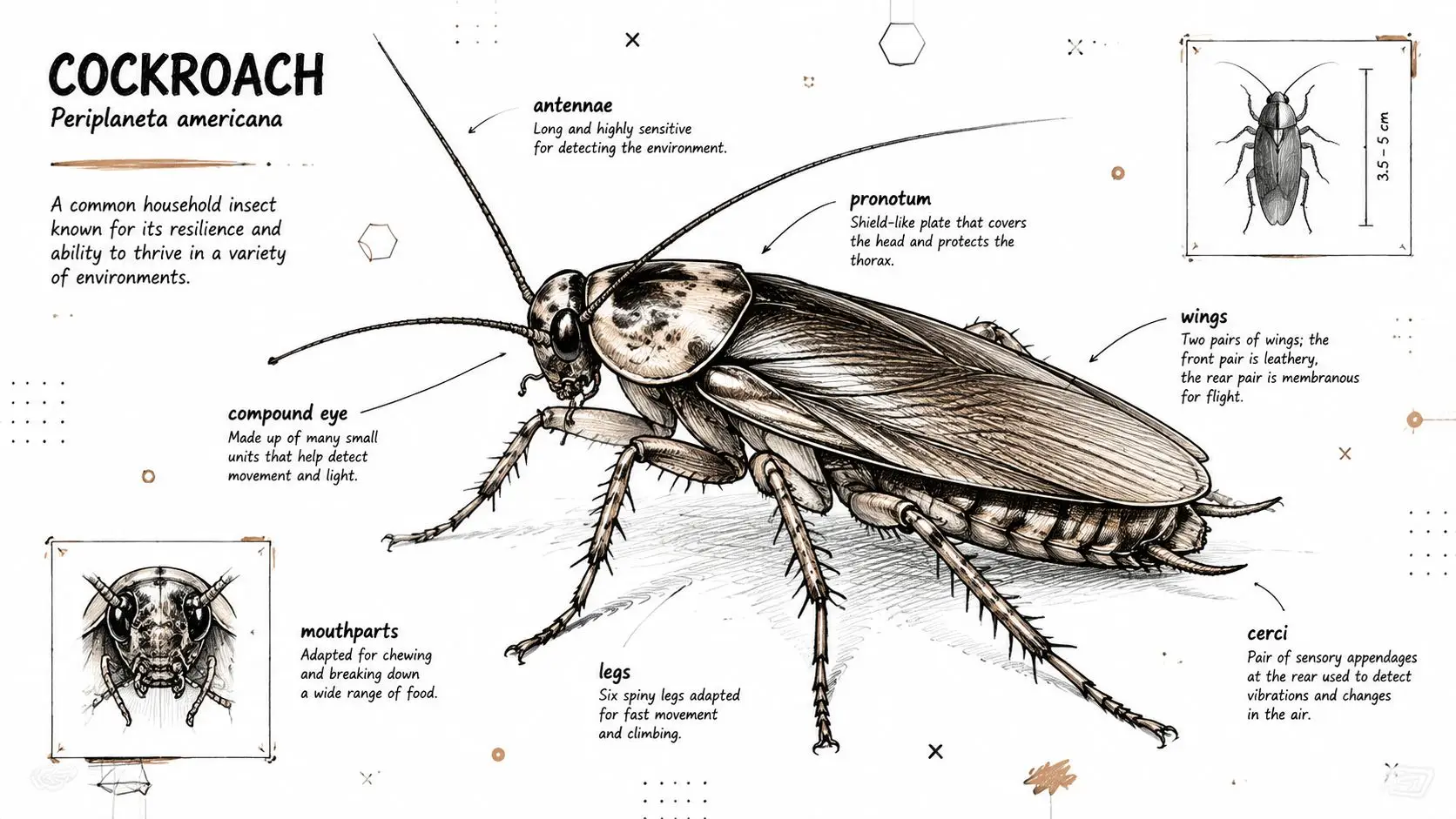
The easiest way to remember cockroach anatomy is to picture a low, smooth insect built to slide into tight spaces. Most species have a flattened, oval body, a small head tucked under a shield-like pronotum, six spiny legs, and long threadlike antennae that help them move through cracks and find food in the dark cockroach identification traits. The head often seems hidden because the pronotum works like a little protective hood.
That shape is not accidental. It lets roaches press flat against surfaces, move under trim boards, and vanish into the narrowest gaps around pipes, cabinets, and baseboards. The spiny legs also matter, because they give cockroaches traction while they run and climb. When a homeowner says a pest seemed “flat” or “hardly shaped like a normal bug,” that's usually the first clue they saw a cockroach rather than a beetle or cricket.
What the head and antennae tell you
The antennae are often longer and more obvious than the body itself when a cockroach is moving. They sweep ahead like feelers, helping the insect find its way in low light and detect food or shelter. Britannica describes the head as bent downward, with mouthparts pointing backward rather than forward, which gives cockroaches that tucked, armored look Britannica cockroach anatomy.
A roach rarely looks “open” or delicate. It usually looks compact, low, and hard to grab with the eye.
For Magnolia homeowners, that means the first shape to notice is not the legs or wings, it's the silhouette. If you see a small oval insect moving fast along a dark edge, especially at night, the flattened profile is one of the strongest visual clues you have.
Identifying Common Cockroach Species in Magnolia Texas
Magnolia homes can attract different roaches, but two species cause most of the confusion indoors. The German cockroach is typically about 13 to 16 mm long, light brown to tan, and marked by two dark parallel stripes on the pronotum Illinois cockroach guidance. The American cockroach is much larger, around 1.5 to 2 inches long, reddish-brown, and has wings capable of flight Michigan State Extension on American cockroaches. Those differences are useful in Magnolia because the wrong ID leads to the wrong response.
A third species, the Oriental cockroach, is often part of homeowner comparisons, especially when people are trying to sort out dark, shiny roaches seen near damp areas. Rather than guessing from memory, use size, color, and markings side by side.
| Comparison of Common Cockroach Species | Adult Size | Color | Distinctive Markings |
|---|---|---|---|
| German cockroach | 13 to 16 mm | Light brown to tan | Two dark parallel stripes behind the head |
| American cockroach | 1.5 to 2 inches | Reddish-brown | Yellowish margin on the pronotum, wings usually obvious |
| Oriental cockroach | Smaller than the American cockroach, but still visibly larger than a German roach | Dark brown to black | Less striped, darker overall look |
For a visual comparison that many homeowners find helpful, this Magnolia-focused roach guide shows how the most common indoor species differ in body size and markings.
The key is not to fixate on one trait. A German cockroach can look “plain” until you catch the pronotal stripes, while an American cockroach can seem almost beetle-like until you notice its bulk and coloring. In Magnolia kitchens, laundry rooms, and attached garages, that difference often decides whether the issue is a hidden indoor infestation or a stray insect that wandered in from outside.
Spotting Adult and Nymph Stages of Cockroaches
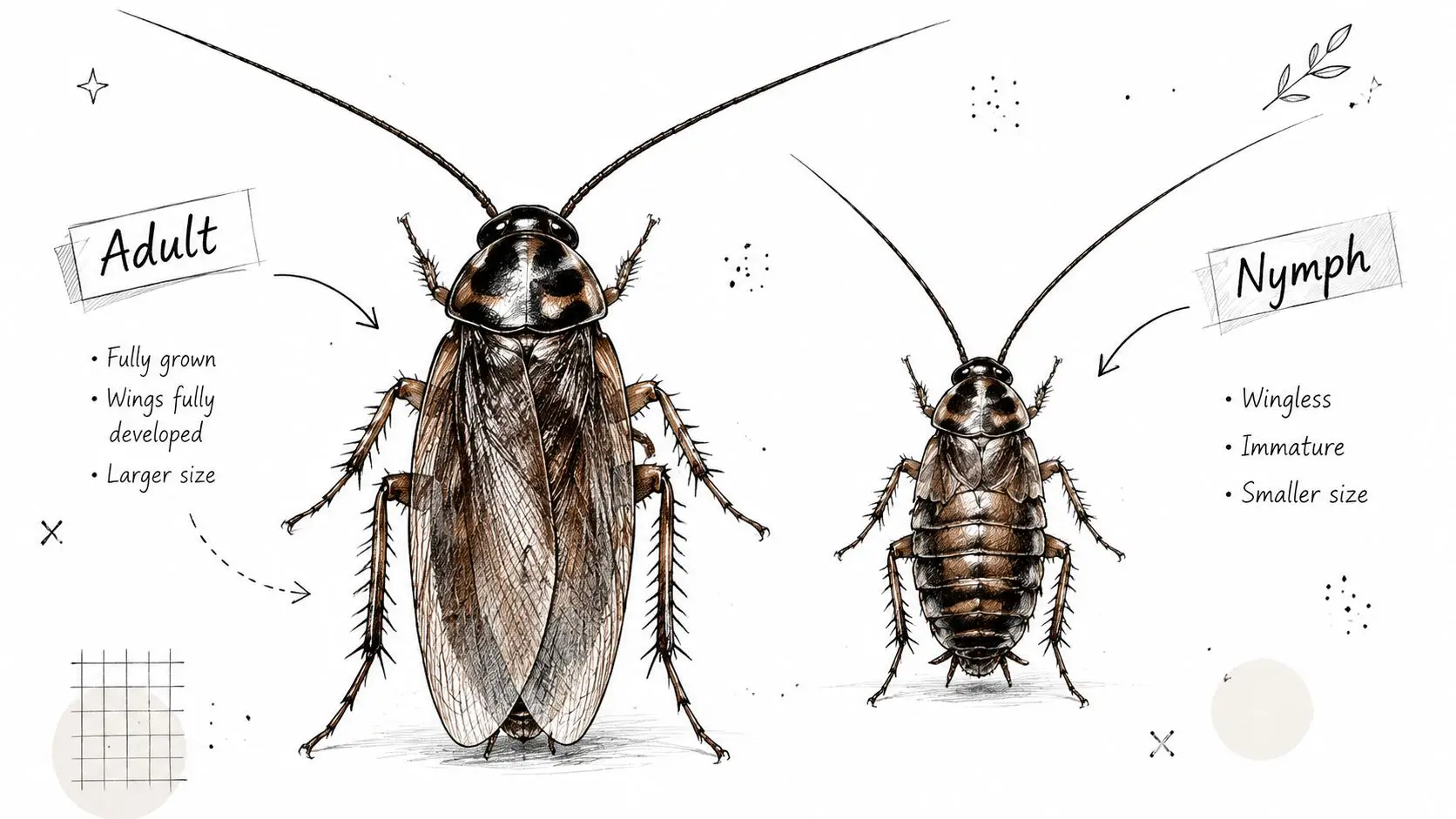
A cockroach nymph is not a different insect. It's a younger stage of the same pest, and it often looks like a smaller, less finished version of the adult. That's why many Magnolia homeowners mistake nymphs for tiny beetles or ant-like bugs, especially when the insect is pale, fast, and hard to catch in good light.
How to separate nymphs from adults
Adults usually show fuller wing development, while young stages may be wingless or only show wing pads. The Australian Museum notes that cockroaches can range from about 3 mm to 70 mm in length overall, and that wings may appear as two pairs, with forewings hardened and hindwings membranous Australian Museum cockroach identification. That range is one reason life-stage ID matters, because size alone won't always tell you whether you're looking at a young German roach or a small adult of another species.
If you're trying to sort out growth stages in more detail, this German cockroach life-cycle guide is useful for matching what you see to the insect's development. In practice, the biggest clues are simple. Nymphs are smaller, often less visibly winged, and may appear lighter before they fully darken with age.
Helpful rule for homeowners: if the insect looks like a miniature version of an adult roach, assume there may be more hiding nearby.
That assumption matters because seeing nymphs usually means roaches have already been breeding in the home for a while. A single adult can wander in, but repeated sightings of small roaches, especially in kitchens or bathrooms, suggest a nest nearby, not just a random visitor.
Recognizing Signs of Cockroach Infestation
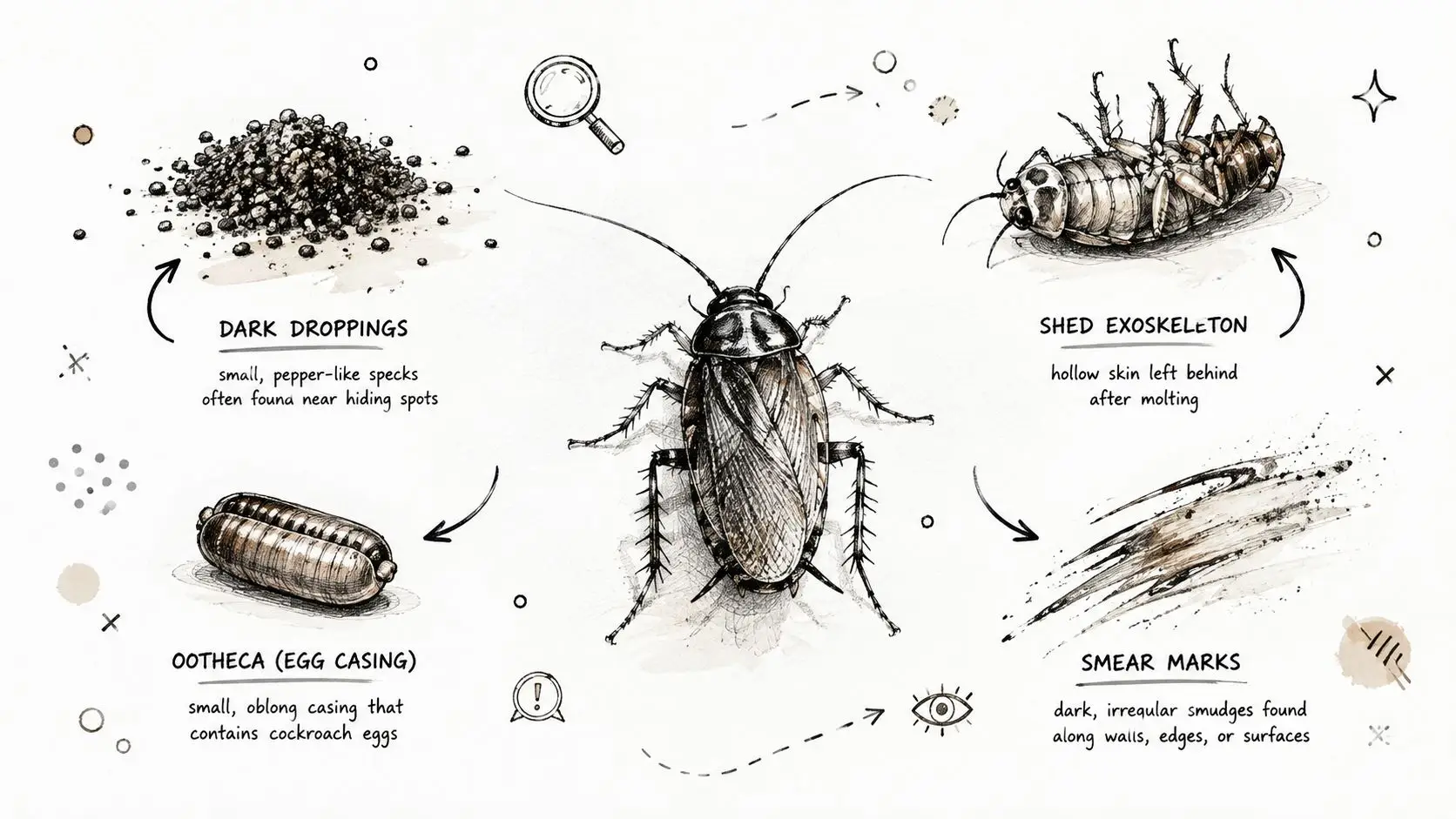
A single sighting can be unsettling. Multiple signs together tell a more complete story. Droppings, shed skins, egg casings, and smear marks often show up before homeowners ever see the insects themselves, especially in hidden places like cabinet corners, under appliances, and around plumbing penetrations.
What the clues usually mean
Dark droppings can resemble coffee grounds or pepper-like specks, and shed skins signal that young roaches have been growing in place. Egg cases mean reproduction is happening. Smear marks along walls or edges can appear where cockroaches repeatedly travel in damp or greasy areas. The Terminix identification guide notes that cockroaches have a low, flattened body and six long, spiny legs, which help them squeeze into cracks and move quickly through hidden routes, so these signs often show up before the insects do Terminix cockroach identification.
That's why visual evidence matters so much. A homeowner in Magnolia may only see one roach in the open, but the surrounding evidence often says more than the insect itself. If the kitchen has fresh droppings near a dishwasher, or if bathroom baseboards show recurring marks, the infestation is probably using that area as a regular travel path.
The pattern is what raises concern. One roach near a door can be a stray. Repeated signs in the same room point to an established hiding place, and that's when inspection becomes more important than guesswork. If you're trying to decide whether the issue is isolated or active, this infestation checklist for homeowners gives a practical way to compare what you're seeing against common warning signs.
Preventing Cockroach Problems in Magnolia Texas Homes
Prevention works best when it targets the places roaches use. In Magnolia homes, that usually means sealing small openings, reducing moisture, and removing easy food access before insects can settle in. The goal is not perfection, it's making the house far less usable for a pest that depends on cracks, shelter, and reliable food scraps.
Start with entry points
Look at foundation gaps, utility penetrations, and door thresholds first. Cockroaches use tiny openings far better than most homeowners expect, especially around plumbing lines and weathered trim. Seal what you can with appropriate caulk or exclusion materials, and pay close attention to spaces near sinks, dishwashers, water heaters, and laundry hookups.
Cut moisture before it becomes an invitation
Roaches are much more likely to linger where water is easy to find. That means fixing leaks, drying sink basins at night, and keeping bathroom floors from staying damp. In Magnolia's climate, even routine humidity can create the kind of environment roaches like, so ventilation matters as much as cleaning.
Make food and clutter less useful
Store pantry items in sealed containers, empty trash regularly, and avoid leaving pet food out overnight. Clutter also gives roaches protected routes, so cardboard piles, storage boxes, and crowded shelf edges need attention. A quick flashlight inspection in dark corners is often more effective than waiting for a random sighting.
For homeowners who want a service-based option, FullScope Pest Control offers residential roach control as part of its pest services in north Houston and nearby communities. That kind of inspection-and-treatment approach can be useful when a home has multiple hiding areas or recurring sightings.
When to Seek Professional Cockroach Treatment
DIY steps can help with prevention, but persistent sightings usually mean the roaches have already found the structure useful. If you keep seeing insects after sealing gaps and improving sanitation, the problem may be deeper than a surface-level cleanup. That's especially true when you keep finding droppings, shed skins, or nymphs in more than one room.
Professionals are worth calling when the signs keep returning in kitchens, bathrooms, or utility spaces, or when the insects seem to move from one hiding area to another. An inspection can trace where the roaches are nesting, where they're entering, and which conditions in the home are helping them stay active. That's much more efficient than repeatedly spraying visible insects and hoping the problem goes away.
Magnolia homeowners also call sooner when children, pets, or health concerns make a long-running infestation harder to manage calmly. A structured treatment plan is more useful than guesswork when the roaches are established. The value is in diagnosis first, then targeted control.
If your Magnolia home keeps showing the same signs, schedule a professional inspection and ask for a treatment plan that matches the species and life stage you're seeing. For local help, contact FullScope Pest Control and request a cockroach inspection for your Magnolia, Texas property.