1500+ reviews

You're buying a home in Magnolia, Texas, and the closing file has started to fill with inspection documents, disclosures, and lender conditions. One form may look brief, but the wood destroying insect report can influence whether the transaction moves forward, who pays for treatment, and whether a damaged area needs more investigation.
The most important point is also the one buyers miss most often: a WDI report is a documented inspection of visible evidence and conducive conditions, not a promise that the house is structurally sound or permanently pest-free. Read it as a decision document. The findings, limitations, diagrams, and recommended next steps matter more than a simple “clear” or “not clear” impression.
Why Your Texas Real Estate Deal Depends on This Report
A buyer in Magnolia receives the WDI report shortly before closing. The form says no active termites were found in accessible areas, but it also notes earth-to-wood contact near the rear porch and an inaccessible section beneath part of the structure. The buyer sees the first line and feels relieved. The lender and inspector focus on the second and third.
That reaction is common. Buyers often expect the report to answer one question, “Does this house have termites?” Texas transactions require a more useful answer. The official form documents the visible presence or absence of wood-destroying insects and conditions that could support infestation, so the report helps the parties evaluate transaction risk rather than approve or reject a property. Texas' department-prescribed WDI report form identifies the property and records those findings in a standardized format.
Why each party pays attention
- Buyers need clarity: The form can identify active evidence, prior evidence, visible damage, and conditions that deserve correction or further review.
- Sellers need disclosure support: A complete report gives the seller a documented basis for discussing treatment, repairs, or access limitations.
- Lenders need risk information: A WDI report helps a lender determine whether pest-related conditions require treatment or additional documentation before closing.
- Agents need a negotiation record: Standardized findings give the parties something more concrete than verbal statements from a walkthrough.
A general home inspection still matters. It evaluates broader components of the property, while the WDI inspection concentrates on wood-destroying insects and related visible conditions. Neither document replaces the other.
Practical rule: Treat the WDI report as one part of a broader property due diligence framework, not as a substitute for the full inspection file.
Wood-destroying insect reports have been part of U.S. housing transactions for decades. Federal housing practices used termite inspections in the mid-to-late 1970s, and HUD adopted the National Pest Control Association's Form NPCA-1 in 1995, helping standardize expectations for lenders, buyers, and sellers. North Carolina's official guidance also describes the report's purpose as disclosing the presence or absence of wood-destroying insects and revealing visible evidence found by the pest control operator. North Carolina's homeowner guidance illustrates the broader due-diligence role these reports serve.
What a Texas Wood Destroying Insect Report Actually Covers
The Texas form becomes easier to read when you treat each field as evidence about a specific property, not as administrative filler.
Start with the property identity
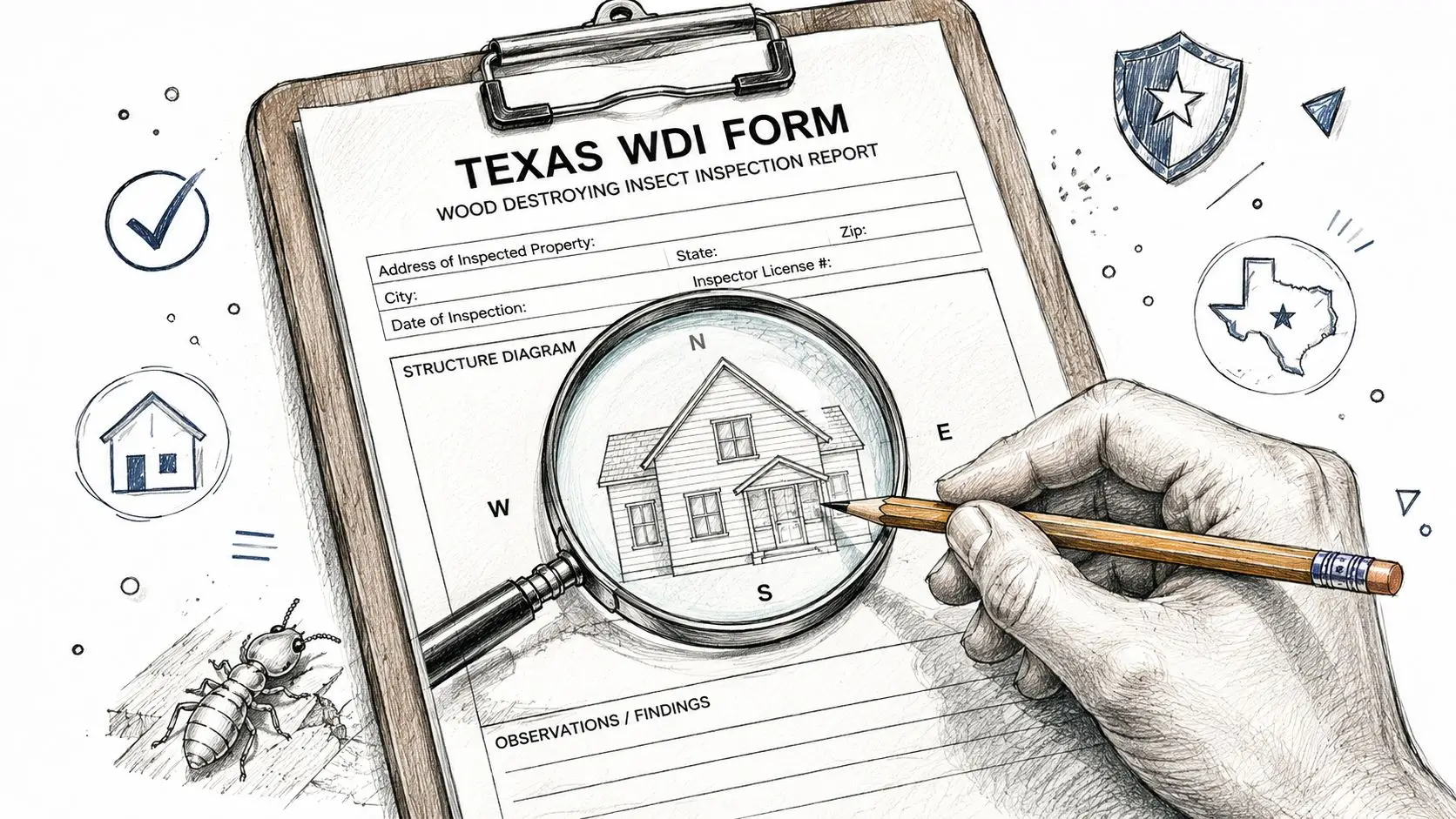
The report requires the inspected address, city, and ZIP code. In a Magnolia transaction, confirm that the form identifies the correct property and that the location matches the contract and lender file. An address error can create confusion about which structure was inspected, especially when a property includes detached garages, workshops, additions, or other buildings.
The inspector also provides a diagram for all structures inspected. Don't skim past it. The diagram helps you connect a finding to a location, such as a porch, garage wall, crawlspace edge, or detached structure. Texas instructions require the report to be completed by a certified applicator or a technician licensed in the termite control category, and the purchaser of the inspection service must receive a copy. The Texas WDI instructions explain those requirements.
Read the findings as categories
The form focuses on:
- Visible insect evidence: Signs of termites or other covered wood-destroying insects found in accessible areas.
- Visible damage: Wood damage that may require treatment, repair, or a separate evaluation.
- Conditions conducive to infestation: Features such as faulty grade levels or earth-to-wood contact that can increase risk.
- Inaccessible areas: Locations the inspector couldn't evaluate fully, which must be identified rather than treated as clear without comment.
The typical scope includes termites, carpenter ants, carpenter bees, and reinfesting wood-boring beetles, as described by NPMA form information. A finding outside that scope may need separate diagnosis. For example, moisture-related deterioration, fungus, or damage from a non-insect cause shouldn't automatically be labeled a WDI conclusion.
For additional background on species and signs, buyers can review this guide to wood-destroying insects in Texas. The report itself remains the controlling transaction document, and its location notes are more useful than a generic pest list.
How Often Reports Uncover Real Problems
A WDI report isn't a ceremonial checkbox. Historical Hawaii inspection data show why lenders and buyers treat it as a practical risk-management document. Across an average of 82,000 reports submitted by licensed pest control operators over seven three-month periods, inspectors found termites, wood rot, beetles, and conditions that could support future activity. The Hawaii study material provides the underlying findings.
Common WDI Report Findings
| Finding | Percentage of Inspections |
|---|---|
| Subterranean termites | 43% |
| Drywood termites | 33% |
| Wood rot | 21% |
| Faulty grade level | 41% |
| Earth-to-wood contact | 33% |
| Beetles | 2% |
| Dampwood termites | Less than 1% |
| No infestation or apparent conducive conditions | 26% |
The percentages come from that historical Hawaii dataset, not from a current Magnolia sampling. They shouldn't be used to predict the result for a particular Texas home. They do show that inspectors often find more than active insects. Conducive conditions can exist before a visible infestation becomes obvious, and wood rot can complicate the interpretation of damaged areas.
That distinction changes the buyer's next question. Instead of asking only, “Did they find termites?” ask:
- What evidence was documented?
- Where is it located on the diagram?
- Is the issue active, previous, or a condition that could support future activity?
- Was any area inaccessible?
- Does the finding call for treatment, repair, or another professional evaluation?
A report with no active evidence can still contain useful warnings. Faulty grading or direct soil-to-wood contact may help explain why an inspector recommended correcting drainage or clearance. Those repairs address risk conditions, but they aren't the same as termite treatment.
The report also helps lenders manage uncertainty. A lender can evaluate a documented condition more effectively than an informal assurance that “the house looks fine.” That's why a complete, properly prepared form carries more weight than a quick visual opinion with no diagram or location detail.
What the Report Does Not Tell You
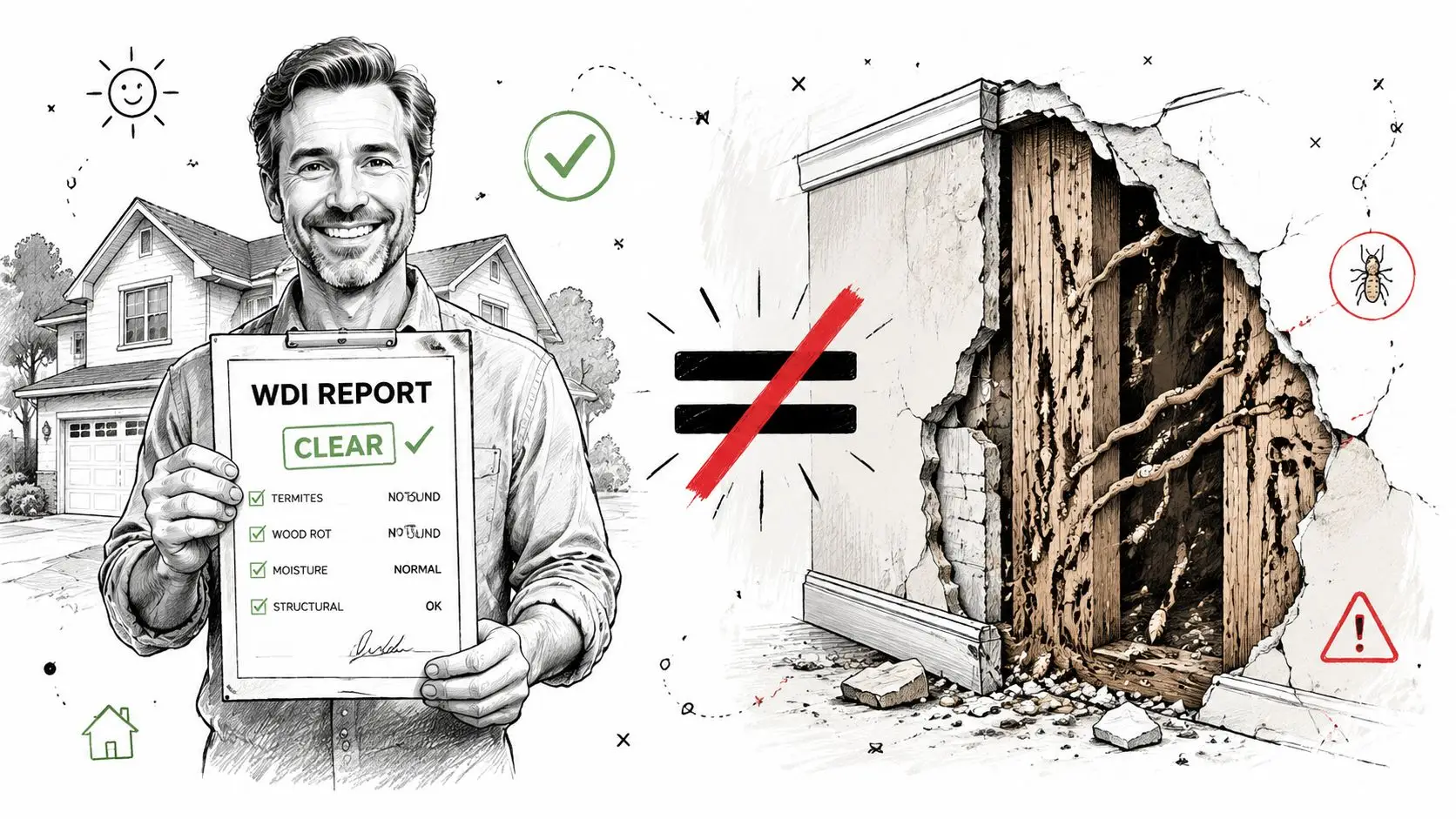
A clear WDI report doesn't certify the home's structural safety. It also doesn't guarantee that hidden insects or future activity won't exist.
The report is limited to visible evidence in readily accessible areas. Official federal guidance states that the inspection isn't a structural damage report or a warranty, and that inaccessible areas must be identified. The HUD-prescribed NPMA-33 form makes that limitation central to how buyers should interpret the document.
A “clear” result has boundaries
An inspector may not be able to see behind finished walls, beneath fixed flooring, inside concealed framing, or throughout tightly restricted crawlspace and attic areas. A notation that an area is inaccessible isn't an accusation against the property or the inspector. It's a boundary on the conclusion.
That boundary matters because termites can occupy concealed spaces, and visible damage doesn't always reveal its full extent. The report can document what the inspector observed, but it can't promise that no hidden condition exists where the inspector couldn't safely or reasonably gain access.
A general home inspection adds broader information about structure, moisture, drainage, roofing, plumbing, and other systems. If either inspection raises concern about load-bearing wood, extensive deterioration, or an unexplained defect, the appropriate next step may be a qualified contractor, structural specialist, or engineer. Invasive evaluation should be authorized and coordinated carefully because it can affect finishes and repair responsibility.
Read the limitations as carefully as the findings. An inaccessible area is not the same thing as an inspected area with no evidence.
The report also isn't a long-term protection plan. Conditions can change after the inspection, and the document doesn't function as a warranty against later infestation. If the home has moisture problems, soil contact, poor clearance, or neglected drainage, correcting those conditions can reduce risk even when the current report doesn't document active insects.
For a visual explanation of how report findings and physical damage can differ, review the accompanying material here:
The Inspection and Reporting Process in Texas
The process starts with the transaction deadline, not the inspection appointment. Buyers should ask the agent or lender when the completed WDI report must be available, then schedule enough time for questions, treatment, repairs, or a reinspection if the first visit identifies a problem.
Step 1, confirm the qualified inspector
Texas instructions limit who can complete the form. The inspection must be performed by a certified applicator or technician licensed in the termite control category. That requirement protects the transaction from an informal pest opinion that doesn't satisfy the state-prescribed reporting process.
When scheduling, give the inspector accurate information about all structures on the property. Mention detached garages, sheds, additions, crawlspaces, attic access, and known moisture or drainage concerns. A property with multiple structures needs a report that makes clear what the inspector examined.
Step 2, prepare access
The inspector examines accessible areas for evidence of covered wood-destroying insects, visible damage, and conducive conditions. Clear stored items away from walls and crawlspace entrances where possible, provide access to detached structures, and identify areas that may be unsafe or blocked.
The inspector won't treat a blocked area as fully inspected. Instead, the final document should identify limitations so the buyer and lender can decide whether additional access or evaluation is needed.
Step 3, document the property
The inspector records the inspected address, city, and ZIP code, then creates a diagram for the structures inspected. Findings should be tied to locations, not left as vague statements about the house. That location detail helps the buyer compare the report with the general inspection and obtain a focused repair estimate.
The completed form goes to the purchaser of the inspection service, and Texas instructions require that purchaser to receive a copy. Ask for the final document, not just a phone summary. For practical planning, buyers and agents can also review this Texas WDI inspection cost guide, while remembering that the inspection price and any treatment or repair cost are separate decisions.
How to Respond When the Report Flags Issues
The right response depends on the category and location of the finding. Active evidence, old damage, and conducive conditions shouldn't be handled as though they carry identical meaning.
Active evidence usually calls for a treatment decision
If the report documents active termites or another covered insect, ask the pest professional to explain the treatment scope, affected areas, access assumptions, and follow-up process. Treatment addresses the insects. It may not repair damaged framing, trim, flooring, or other building components.
The buyer and seller should establish who will arrange treatment, who will pay, what documentation the lender needs, and whether a clearance or supplemental report is required. Don't accept a vague promise that the issue will be “handled” after closing without written terms.
Visible damage may need a separate building evaluation
A WDI inspector can document visible damage, but the report isn't a structural damage report. If the diagram points to a beam, sill, joist, wall, or other important component, obtain an evaluation from an appropriately qualified contractor or engineer. The treatment decision and the repair decision are related, but they aren't interchangeable.
Previous damage also needs context. The buyer should ask whether the condition appears active, whether repairs are visible, and whether the cause was insect activity, moisture, rot, or something else. A treatment proposal alone doesn't answer those questions.
Conducive conditions are prevention issues
Grade problems, soil contact, moisture, and poor clearance can create a favorable environment even when the report doesn't show active infestation. Sellers may correct the condition before closing, buyers may negotiate a credit or repair, or both parties may document a maintenance plan.
Use this wood-destroying insect prevention guide for homeowners to identify practical prevention measures, but tailor the response to the actual report and property.
When walking away makes sense
Walking away isn't the automatic answer to every finding. It becomes more reasonable when the parties can't establish the scope of concealed damage, the lender won't accept the proposed resolution, the repair cost is uncertain, or the seller won't provide access for necessary evaluation.
A useful negotiation sequence is simple:
- Clarify: Get the finding, location, and accessibility limitation in writing.
- Separate: Distinguish insect treatment from structural repair.
- Verify: Request qualified follow-up when the report raises structural or concealed-damage questions.
- Document: Put responsibility, timing, and deliverables into the contract or amendment.
- Reassess: Let the lender and inspection professionals review the proposed resolution.
Local WDI Inspections for Magnolia and Southeast Texas
Magnolia sits in Montgomery County, and local service planning should reflect the communities and property layouts buyers encounter. City reference sources list Magnolia ZIP codes 77353, 77354, and 77355. Those ZIP codes provide a practical service-area anchor for scheduling WDI inspections, confirming the property address, and coordinating access with agents and sellers. Magnolia's community reference information lists those locations.
A Magnolia inspection may involve more than the main house. Detached garages, sheds, additions, porches, crawlspaces, and areas affected by moisture or soil contact all deserve clear attention. A technician who documents the structure diagram carefully gives the buyer a better basis for deciding whether a finding requires treatment, repair, or further evaluation.
What to look for in a local provider
Choose a company that can meet the Texas reporting requirements and explain the result in plain language. Useful questions include:
- Credentials: Is the person completing the form a certified applicator or technician licensed in termite control?
- Scope: Will the inspection cover all structures identified in the service request?
- Documentation: Will the report include the required property details, diagram, findings, and inaccessible areas?
- Follow-up: Can the provider explain treatment or prevention options without treating the WDI form as a warranty?
- Coordination: Can the company provide documentation that helps the agent and lender understand the resolution?
FullScope Pest Control is a QualityPro certified provider serving Magnolia, Conroe, Kingwood, and nearby Southeast Texas communities, with licensed technicians trained in termite control and services covering Montgomery County ZIP codes 77353, 77354, and 77355. Its process can include the inspection, completion of the Texas-prescribed form, and follow-up treatment or prevention planning when the findings justify it.
Homeowners should also address non-termite entry and moisture issues around outbuildings. For separate storage-shed rodent prevention ideas, Firm Foundations' rodent prevention guidance can complement, but not replace, the WDI inspection.
If you're buying or selling in Magnolia, Conroe, Kingwood, or a nearby Southeast Texas community, schedule the WDI inspection before the transaction deadline. Provide the complete property address, identify every structure, arrange access, and request the finished Texas form so you can make a documented decision before closing.
Schedule your Magnolia-area WDI inspection with FullScope Pest Control today. Ask for a licensed termite-control professional, confirm that the Texas-prescribed report will cover every requested structure, and have the completed form sent to the inspection-service purchaser for review with the lender and real estate agent.