1500+ reviews

You step outside to enjoy your yard in Magnolia, and within minutes you're swatting at your ankles, your neck, and your arms. The patio is fine for a few minutes, but the moment the air gets still and the shade settles in, the mosquitoes take over. On a larger property, that problem usually isn't coming from one spot. It's coming from several.
That's why mosquito control for large yards has to be more deliberate than grabbing a fogger from the hardware store and hoping for the best. In Southeast Texas, warm weather, humidity, dense vegetation, and scattered water sources give mosquitoes exactly what they need. If you want your yard back, you need a system that matches how they live and where they hide.
The Integrated Framework for Taking Back Your Yard
Most failed mosquito programs have one thing in common. They focus only on the flying adults you can see.
That feels logical, but it's usually a losing battle in a large yard. Adults are only the visible part of the problem. If larvae are developing in hidden water around the property, and adults are resting deep in shaded vegetation, a one-step spray approach won't hold up for long.
Think in three moves
The simplest professional framework is Assess, Reduce, Treat. It's a practical version of integrated pest management, or IPM. If you want a deeper look at how that approach works across pests, FullScope outlines its integrated pest management practices.
Assess means finding where mosquitoes are breeding and where they're spending the day. In Magnolia yards, that often means low wet areas, tree lines, heavy shrubs, clogged drainage paths, ornamental water, and anything that catches rain.
Reduce means removing what you can before you ever think about adulticide. Drain containers. Clean up yard clutter. Open up dense plantings. Keep water from sitting long enough to become a production site.
Treat means applying the right control to the right place. That can mean larval control in standing water that can't be drained. It can also mean targeted adult mosquito treatment in shaded resting zones, not random spraying across the whole property.
Practical rule: If you haven't identified the water and shade on your property, you don't yet have a mosquito plan. You have a reaction.
Why the lifecycle matters
Mosquitoes don't need much to keep the pressure on. A large yard gives them options. Some species breed in containers close to the house. Others use ground depressions, drains, or water features farther out. Adults then move into cooler, shaded foliage and wait until feeding time.
That's why broad, occasional spraying often disappoints homeowners. It may knock down activity for a short stretch, but it doesn't change the conditions that keep the yard productive. The better approach attacks multiple stages at once and keeps the pressure low instead of letting it rebound.
What works and what usually doesn't
A working plan usually includes:
- Regular inspection of the whole use area, not just the patio
- Water management that becomes part of weekly maintenance
- Targeted treatment in places where adults rest
- Follow-up based on weather, vegetation, and yard layout
What usually doesn't work is treating the center of the lawn, relying on citronella gadgets as the primary plan, or spraying every plant on the property without any habitat work. Large yards reward strategy. They punish shortcuts.
Your First Line of Defense Is Habitat Control
The most productive mosquito work on a large property often starts with a walk, a trash bag, and a plan.
Source reduction is the foundational pillar of mosquito control, with 90% of mosquito populations driven by standing water that can be eliminated through routine homeowner maintenance. The US EPA mandates that water in bird baths, fountains, and potted plant trays must be emptied and changed at least once a week to eliminate potential habitats according to the review at the NCBI mosquito control reference.
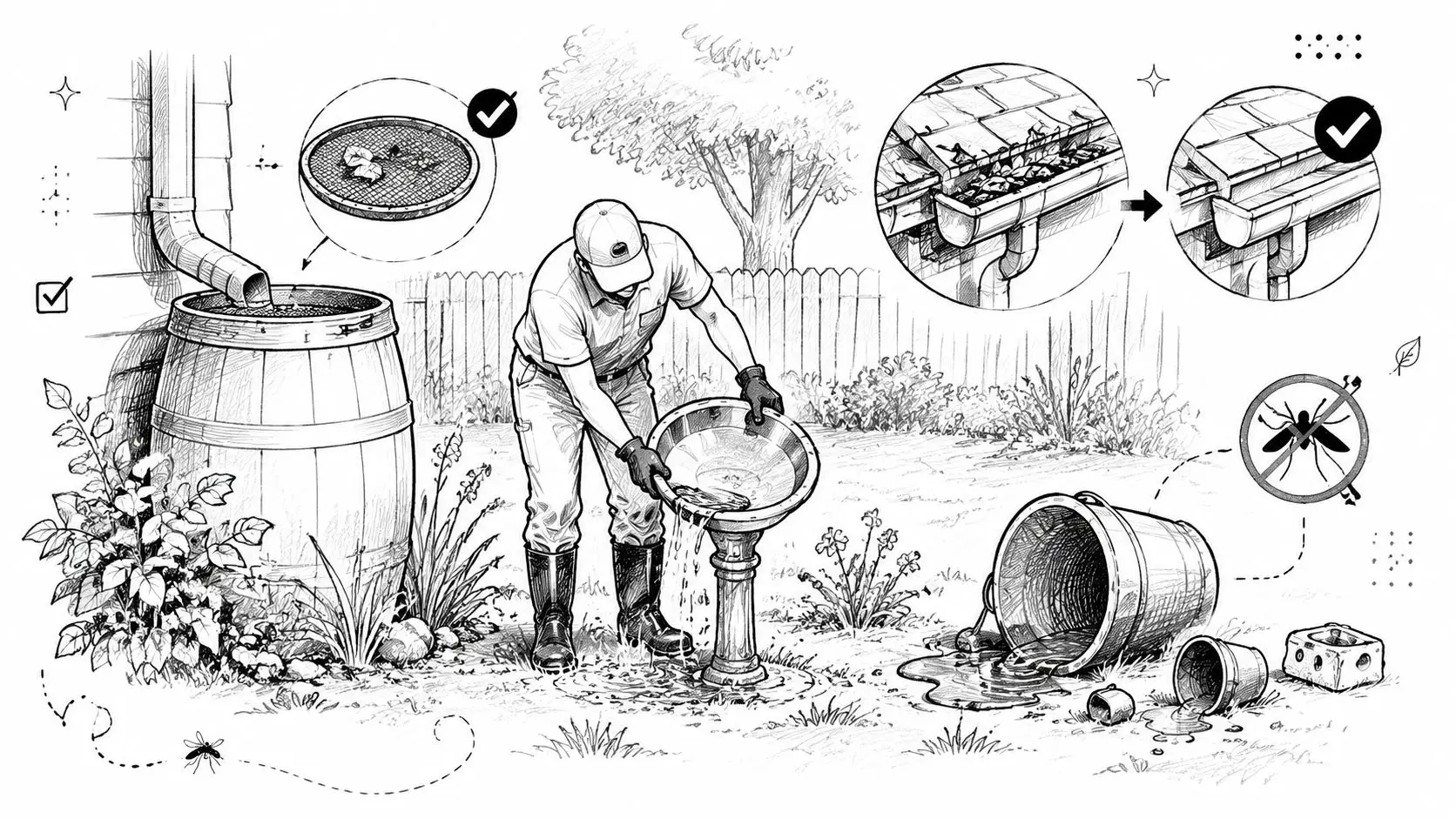
In a large Magnolia yard, the obvious water sources are only part of the story. Buckets and bird baths matter, but so do the hidden spots that stay wet after rain or irrigation. If you're serious about mosquito control for large yards, your first weekend project should be a full property water audit.
Walk the yard with a checklist
Start at the house and move outward. Check the places that collect water near living spaces first, then the perimeter, then the back edges of the lot.
- Containers near the home: Empty buckets, toys, wheelbarrows, flowerpot saucers, trash can lids, and anything stored upside down that now holds water.
- Decorative items: Refresh bird baths and small fountains on schedule, and don't forget plant trays on patios and porches.
- Drainage trouble spots: Look for clogged gutters, splash blocks that dump into low spots, compacted areas, and edges of walkways where water lingers. If your yard stays wet because the soil won't drain well, a resource on solving Utah clay soil drainage is useful for understanding how poor drainage turns into chronic standing-water problems, even though the climate is different.
- Hidden breeding sites: Check tarps, folded plastic, kid equipment, tire swings, fence rails, old stumps, corrugated drain ends, and any depression under dense groundcover.
- Remote zones: Large back corners often get ignored. That's where abandoned pots, brush piles, or poorly draining areas can keep mosquitoes coming toward the house.
What to do with water you can't dump
Some water can't be drained without creating a different problem. Rain barrels, ornamental ponds, and certain water-holding features need larval control instead.
When water has to stay, use Bacillus thuringiensis israelensis (Bti) products such as dunks, briquettes, or pellets. They're used for larval control in standing water and fit well into a practical home program. If you want examples of the kinds of sites that repeatedly produce mosquitoes in this region, this guide to Texas mosquito breeding grounds is worth reviewing.
A lot of mosquito pressure comes from places homeowners stop noticing. The clogged gutter behind the detached garage matters just as much as the bird bath by the patio.
For permanent ponds, maintenance matters as much as the product. Organic buildup, stagnant edges, and neglected margins can still support activity if the feature isn't managed well. The point isn't to sterilize the yard. It's to stop producing fresh adults every few days.
Make habitat control a routine, not a cleanup event
Large yards don't stay corrected on their own. Rain, irrigation, and outdoor storage create new problems fast.
A practical rhythm looks like this:
- Do a weekly walk. A focused pass through the yard catches new standing water before it becomes a repeating issue.
- Trim for airflow. Dense lower shrub growth holds moisture and shade. Open it up where possible.
- Keep storage tight. Cover, hang, or store items so they don't collect water.
- Watch after storms. The day after rain is when a lot of hidden problem spots reveal themselves.
A short visual refresher can help you spot trouble areas you might miss on your own.
Upgrading to Professional Mosquito Treatments
DIY habitat control lowers the baseline. Professional treatment changes what happens in the parts of the yard where mosquitoes rest and return.
That distinction matters. Homeowners often think in terms of open space, but mosquitoes spend much of their time tucked into protected vegetation. The treatment has to go where the insects are, not where the yard is easiest to spray.
Barrier sprays work because placement matters
Peer-reviewed research found that yard-scale mosquito control using barrier sprays combined with larval habitat management achieved a 70 to 90% reduction in Aedes mosquito populations for about 21 days per treatment, with details published in the Journal of Medical Entomology review. That same research describes how technicians target the undersides of leaves in shrubs and the lower 8 feet of trees, which are common daylight resting areas for adult mosquitoes.

That tells you why most homeowner sprays underperform. The issue usually isn't effort. It's access, coverage, and technique. Dense shrubs, fence lines, tree canopies, and humid leaf surfaces require targeted application, not a quick pass across visible surfaces.
Automated systems solve a different problem
Some properties need more than periodic barrier service. Large entertaining spaces, complex landscaping, and yards with persistent pressure often benefit from a fixed system that delivers short, timed applications on a schedule.
FullScope Pest Control delivers mosquito management specifically via barrier sprays and MistAway automated misting systems, offering two distinct solutions for large yard mosquito control in Magnolia and surrounding areas. Their process includes inspection, a custom treatment plan, and ongoing protection as described on the FullScope mosquito control site. If you want a closer look at how residual applications are designed to work, this guide to mosquito barrier treatments is a useful technical overview.
Barrier sprays are for treated zones. Automated misting is for consistent suppression in spaces that people use all the time.
MistAway-style systems aren't a replacement for source reduction. They're a control tool for properties where daily usability matters and where mosquito pressure rebounds quickly without regular intervention.
When hiring a pro makes more sense
Professional service becomes the smarter investment when:
- Your lot is too large to inspect thoroughly every week
- You have permanent water features or dense ornamental landscaping
- The family uses the yard often enough that interruptions matter
- DIY products haven't changed the pressure around seating areas, pools, or play zones
- You want low-toxicity options handled with clear application protocols
On large Magnolia properties, the question usually isn't whether mosquitoes can be reduced. It's whether you want the job done occasionally or managed properly.
Comparing Your Options Cost Effort and Safety
Choosing a control method gets easier when you stop asking, "What kills mosquitoes fastest?" and start asking, "What can I maintain, what level of control do I need, and who is around the treated area?"
Those answers usually narrow the field fast. Some homeowners can get good results with disciplined habitat work plus selective larval control. Others need a protective zone around the spaces where people spend time. Some want the yard ready every evening without having to think about it.
What each option asks of you
The biggest trade-off isn't chemistry. It's effort.
DIY habitat control asks for consistency. You have to inspect, dump, clean, trim, and re-check after storms. It works best for homeowners who are detail-oriented and enjoy managing the property.
Barrier treatments ask less weekly effort from the homeowner but depend on timing and proper application. Research on residential efficacy found that barrier sprays combined with larval habitat management can achieve a 70 to 90% reduction in Aedes populations for about 21 days per treatment, which is why treatment cadence matters on active properties, as noted in the earlier peer-reviewed source.
Automated misting systems reduce day-to-day homeowner effort even further, but they make the most sense when the yard sees frequent use and the property layout supports installation.
Mosquito Control Strategy Comparison for Large Yards
| Strategy | Initial Cost | Ongoing Effort | Effectiveness | Best For |
|---|---|---|---|---|
| DIY source reduction and larval control | Low to moderate, depending on tools and water features | High. Requires regular property walks, cleanup, and repeat attention after rain | Strong for prevention when done consistently, but limited if adult resting areas stay untreated | Hands-on homeowners who can stay on top of weekly maintenance |
| Professional barrier sprays | Moderate | Low for homeowner, recurring service schedule required | Strong around living areas and vegetation where adults rest | Families who want the patio, pool, or play space usable without weekly spraying |
| Automated misting system | Higher than periodic service | Low day-to-day homeowner effort, plus system maintenance and monitoring | Strong for ongoing suppression in frequently used outdoor zones | Large properties with heavy pressure and regular outdoor use |
Safety for children and pets
This is where professional handling matters.
Licensed applicators don't just choose a product. They choose the placement, timing, and target zone. They also work within label directions and can adapt the program when a home has pets, children, pollinator-sensitive areas, or water features.
FullScope states that it offers eco-friendly, low-toxicity mosquito control options suitable for homes with children and pets in Magnolia, and that technicians use integrated pest management and targeted chemistry applied by licensed professionals. That's the kind of operating standard you should look for from any provider, whether you hire this company or another local operator.
Store-bought products often look simple because the label is short. The real challenge is applying them to the right surfaces, at the right interval, in the right amount.
What doesn't deserve your budget
A few things tend to disappoint on large yards:
- Treating the entire property evenly: Broad coverage sounds thorough, but it often wastes material on open areas where mosquitoes don't rest.
- Relying only on fogging for relief: Contact kill can feel dramatic, but it usually doesn't replace a structured plan.
- Ignoring the perimeter near living spaces: The whole lot doesn't need the same level of intervention.
- Buying multiple retail gadgets instead of solving habitat issues: If the yard is still producing mosquitoes, accessories won't fix the core problem.
For larger properties, a focused perimeter approach is often more practical than trying to treat every remote corner the same way. One industry comparison specifically recommends a 50 to 100-foot wide band around the home and high-traffic outdoor zones for large yards, rather than attempting to chemically treat the entire property, according to this discussion of treatment approaches by property size.
The decision most homeowners eventually make
If your yard is small, a disciplined DIY routine may be enough.
If your Magnolia property is large, features extensive outdoor areas, and is used often, property owners typically combine homeowner habitat work with either barrier service or a misting system. That's not because DIY is pointless. It's because large-yard mosquito pressure usually comes from more than one source, and comfort around the house depends on targeted professional control where residents spend time outdoors.
Your Mosquito Control Calendar for Magnolia Texas
Magnolia doesn't give you much room for complacency. Warm conditions arrive early, vegetation fills in fast, and moisture hangs around long enough to keep mosquito pressure active whenever water is available.
That means your mosquito plan should follow the yard's conditions, not just the calendar on the wall.
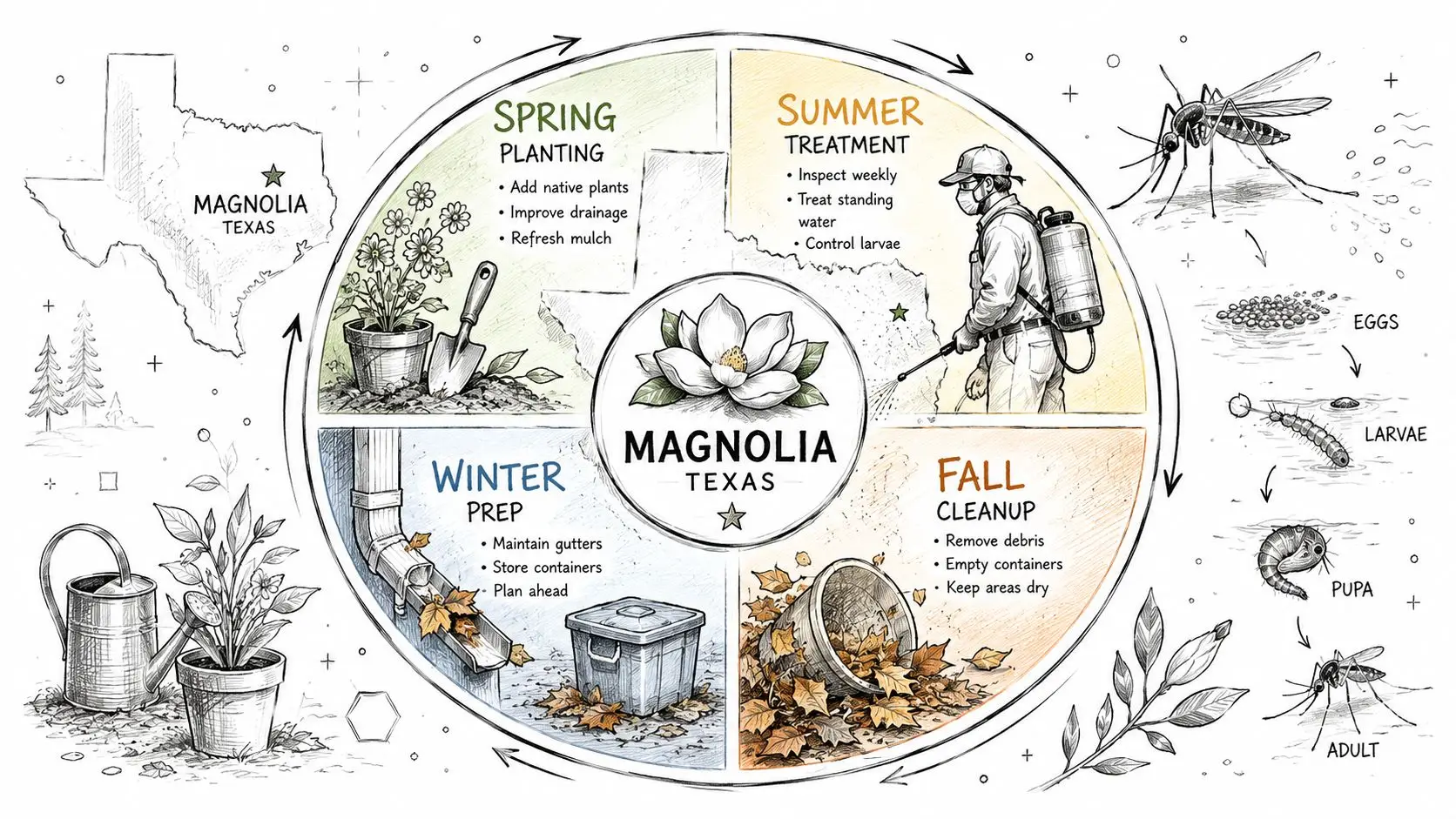
Spring starts earlier than most homeowners think
Early spring is when neglected problem sites begin producing. Before the yard looks lush, inspect drains, containers, gutters, and shaded low areas. This is also the time to thin shrubs and reset any pond or rain-barrel larval control before mosquito pressure builds.
If you wait until bites are obvious, you're already behind. The first goal is to keep the season from gaining momentum.
Summer is maintenance season
Summer in Magnolia is when outdoor comfort can disappear fast. Dense foliage, irrigation, afternoon storms, and humid evenings create reliable pressure around patios, play sets, and pool areas.
During this stretch, stay strict about your weekly water check and don't let the back half of the lot become a blind spot. If you use professional treatment, summer is when scheduling discipline matters most because missed intervals show up quickly in heavily used yards.
In Southeast Texas, mosquito control isn't a one-time event before a barbecue. It's ongoing property management.
Fall still requires attention
Homeowners often back off too early in fall because the worst of summer has passed. That's a mistake on many Southeast Texas properties. As long as conditions stay favorable, mosquitoes can keep breeding and resting in the same protected zones they used all summer.
Fall is a good time to clean up accumulated debris, reset storage areas, and handle drainage corrections you put off during the hotter months. It also helps to evaluate which parts of the yard were consistently worst so next season starts with a better plan.
Winter is planning season, not ignoring season
Even when mosquito activity drops, the property still tells you what next year will look like. This is the best time to notice grading problems, failing drainage, overgrown screening vegetation, and neglected water features without summer growth hiding them.
Magnolia homeowners also benefit from local service knowledge. FullScope Pest Control explicitly lists Magnolia, Texas as a designated service location, with trained local technicians who perform thorough inspections and serve the community alongside Conroe, Spring, and The Woodlands, according to the company's Magnolia service page.
That local footprint matters because Magnolia yards aren't all the same. Some are tightly designed subdivisions. Others have broader lots, tree cover, drainage ditches, ponds, or semi-rural edges. A provider familiar with these layouts usually identifies pressure points faster than someone applying a generic program.
Enjoy Your Yard Again on Your Terms
The most effective mosquito control for large yards isn't built on one product. It's built on a system.
Assess, Reduce, Treat keeps the work in the right order. First identify where the mosquitoes are coming from and where they're resting. Then remove the breeding opportunities you can control. After that, use targeted treatment where it changes day-to-day comfort.
That approach is realistic for Magnolia. It respects the local conditions instead of pretending a single weekend spray will solve everything for the season. It also gives you options. You can handle the habitat work yourself and tighten up your property. You can add professional treatment when the yard size, vegetation, or mosquito pressure makes DIY less practical.
Start with the water audit. Walk the whole property, not just the places you see from the patio. Dump what you can, correct what you can, and mark the areas that stay wet or heavily shaded.
Then decide how usable you want your yard to be. If you want occasional improvement, keep up with habitat control. If you want a lasting plan that protects the parts of the property you live in, schedule a professional consultation and build a treatment program around your yard's layout, water sources, and outdoor use.
If your yard has reached the point where mosquitoes are limiting how you use it, don't keep guessing. A large property needs a property-specific plan.