 1500+ reviews

7 Insects That Damage Wood: Signs and Treatment
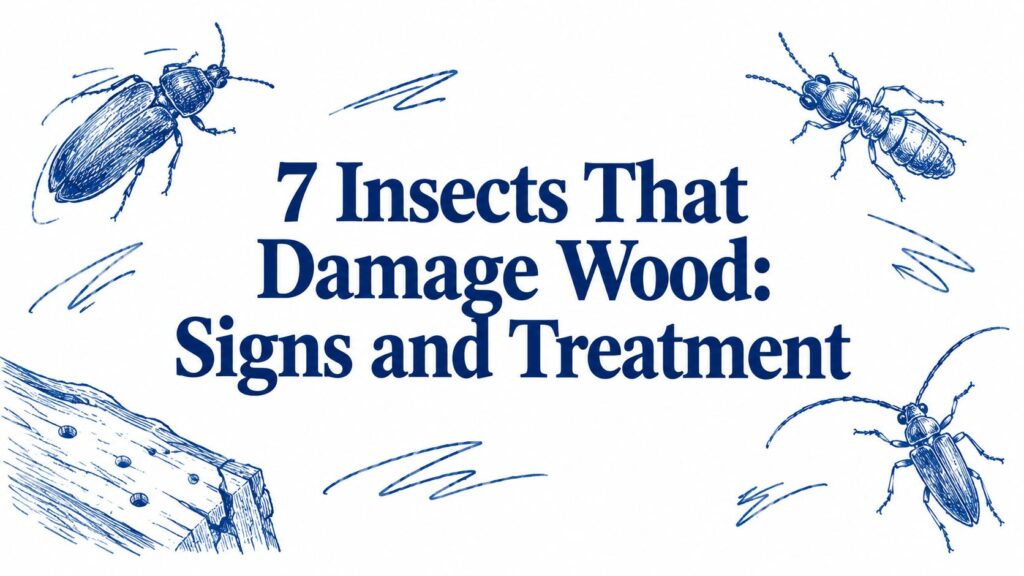
Small holes and sawdust get attention. The damage that changes repair costs is often the activity you can't see. Termites alone account for major U.S. losses. A USDA Forest Service bulletin says annual damage estimates are commonly around about $1 billion, with some estimates as high as $7 billion. That's why wood damage in Magnolia, Texas can't be judged by one clue. The insects that damage wood don't all behave the same way. Some eat it. Some excavate it. Some need persistent moisture. Others can live inside dry lumber or arrive in furniture, trim, or firewood. If you're trying to sort out risk around Magnolia, look at five things first: the insect itself, any frass or mud tubes, nearby moisture, where the wood sits in the building, and when the activity showed up. That's also where a real wood-destroying insect inspection earns its keep. In Texas real estate transactions, the state requires the WDIR process, completed by a licensed certified applicator or technician in the termite and wood-destroying insect category, and the report must document visible evidence of infestation or conducive conditions under Texas wood-destroying insect inspection rules. For Magnolia homes, rentals, and commercial sites, that distinction matters because old damage, active infestation, and harmless hitchhikers aren't the same problem. 1. Subterranean Termites (Reticulitermes flavipes) Subterranean termites rank first here for structural risk and only mid-pack for inspection difficulty. In Magnolia, they are common, they stay hidden, and they can move from soil to framing for a long time before a room shows obvious damage. The usual pattern is hidden feeding first, visible evidence later. That risk is well established in termite literature and industry guidance. The practical problem is simple: the feeding happens out of sight, so the first clue is often mud tubing on a pier, soft trim near a bath trap, blistered flooring, or swarmers at a window after rain. By the time a homeowner notices hollow-sounding wood, the colony may have been active for months. In Magnolia and nearby communities, I put the first inspection attention on slab cracks, expansion joints, plumbing penetrations, porch attachments, and pier-and-beam crawl spaces. Older homes on pier-and-beam foundations deserve extra scrutiny because support posts, subfloor framing, and skirting can hold clear evidence if moisture has been present. Newer homes are not exempt. Hidden leaks, mulch piled against siding, and foam or insulation details that cover the foundation edge can make termite entry harder to spot. What Magnolia owners should document Good documentation helps separate inspection from treatment. Inspection answers whether evidence is active, where the termites are entering, and how far the risk extends. Treatment answers how to stop the colony and reduce re-entry pressure. Follow the route: Mud tubes from soil to wood matter more than isolated surface scarring. Check wood-to-soil contact: Posts, siding, trim, lattice, and stair stringers should not stay buried in soil or mulch. Check moisture conditions: Wet crawl spaces, poor drainage, and leaking hose bibs often show up in the same areas as termite activity. Probe suspicious wood: Baseboards, window trim, sill plates, and subfloor edges that feel thin or break easily need closer inspection. Practical rule: Spraying the visible tube is rarely the fix. Subterranean termite control works better when the entry points, soil contact, and monitoring plan are addressed together. The main trade-off in treatment is speed versus coverage. A narrow spot treatment may make sense for very limited, confirmed activity, but it can miss connected foraging areas. A broader soil treatment or baiting plan usually gives better long-term control when activity is tied to the foundation or multiple entry points. If swarmers have shown up indoors, or tubes reappear after being removed, it makes sense to schedule a FullScope Pest Control inspection and review how to get rid of termites and protect your home before choosing the scope of work. Repair decisions come after control, not before. Cosmetic patching can hide active evidence and make later inspection harder. If termites have affected finished flooring, the pest work and finish carpentry are separate scopes, and services such as wood floor restoration after termites may be part of the next step once the infestation is stopped. A quick visual can help you compare tubes, galleries, and feeding patterns: 2. Drywood Termites (Incisitermes minor) Drywood termites create a different inspection problem than subterranean termites. They can stay inside the wood itself, so the first clue in a Magnolia home is often debris at the surface rather than evidence at the slab or soil line. In my experience, they show up less often here than subterranean termites, but they are easier to miss early because there may be no mud tubes and no obvious moisture pattern pointing you to the source. Their risk ranking sits in the middle to upper half for structure, but high for inspection difficulty. A small colony in trim or furniture may stay localized for a while. Hidden activity in fascia, eaves, roof framing, or a detached shop can go unrecognized much longer, especially in homes with stained wood details, attic heat, and areas that do not get routine close-up checks. The field mistake I see most often is overreading pellet piles. Pellets matter, but only if the pattern fits drywood termite activity. Fresh frass usually collects below a kick-out hole, below a trim joint, or on a horizontal surface under the same member over and over. Old pellets, beetle frass, and plain deterioration can send you in the wrong direction if nobody checks the wood itself. Risk clues worth documenting Start with the wood members that stay dry but are easy to ignore. Window and door trim, exposed rafters, fascia boards, porch ceilings, attic framing near vents, and stored wood furniture are common inspection points in this part of Texas. I would also look closely at pergolas, detached buildings, and salvaged lumber brought onto the property. A few clues carry more weight than others: Recurring pellet piles in the same spot: Clean them up once, then monitor. If they return
Big Black Ants in House Identification and Control Guide
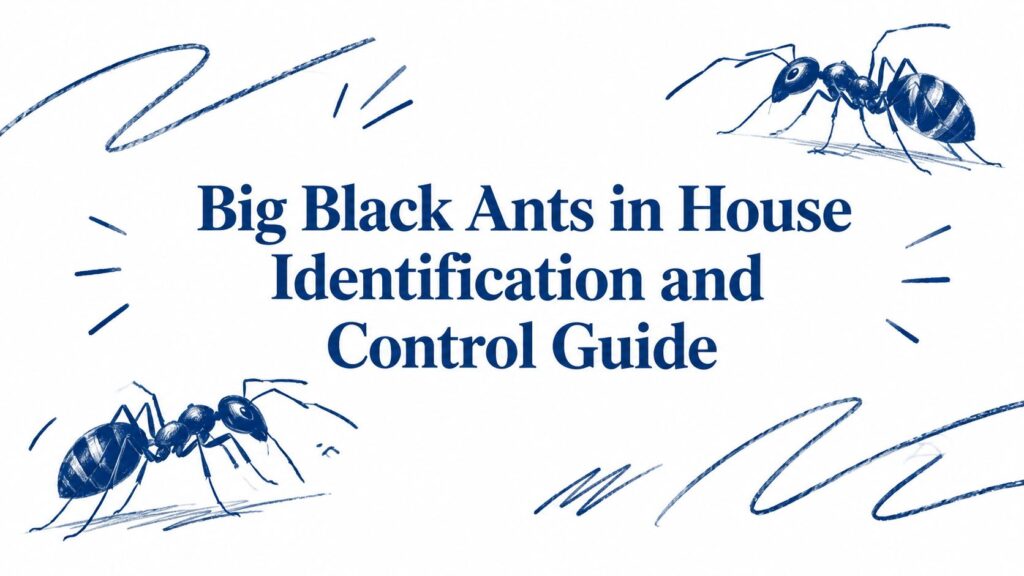
You notice them first on the kitchen counter, then on the bathroom floor near the baseboard. They're much larger and darker than the tiny ants that usually gather around a sweet spill, so the question becomes immediate: are these just visitors from outside, or are big black ants in the house nesting inside the walls? In North America, the leading suspect is usually a carpenter ant, particularly the black carpenter ant, Camponotus pennsylvanicus. But color and size alone don't settle the question. The more useful diagnosis asks where the ants are traveling, whether they appear when outdoor activity is unlikely, and whether moisture has softened nearby wood. A few ants around a window may be scouts or outdoor foragers. Repeated activity in a bedroom, bathroom, attic, or several rooms can point to an indoor nest. This guide walks through the distinction step by step, from a quick physical identification to a room-by-room moisture inspection, then to treatment decisions for homes in Magnolia and surrounding Southeast Texas communities. Introduction to Big Black Ants Inside Your Home A large dark ant on a countertop can mean several things. It may have followed a gap around a window, crossed a plumbing penetration, or wandered indoors while searching for food. One sighting doesn't automatically mean your framing is damaged. The concern changes when the pattern repeats. Suppose you see one ant near the kitchen sink on Monday, several along the bathroom baseboard on Wednesday, and another on a bedroom windowsill after rain. The locations matter because carpenter ants often use damp wood and enclosed voids as nesting space, then send workers into nearby rooms to forage. Practical rule: Treat the ant as a clue. Treat the moisture condition and travel pattern as the diagnosis. Carpenter ants are the classic big black ants in house pest in North America. University extension guidance identifies the black carpenter ant as the species most commonly nesting in homes, although roughly 12 carpenter ant pest species occur across North America according to North Carolina State Extension's carpenter ant guidance. Workers commonly measure about 1/4 to 1/2 inch, while some state guidance describes the black carpenter ant as reaching up to 3/4 inch through the National Pest Management Association's ant identification information. That size makes them noticeable, but it isn't the main reason to worry. Carpenter ants excavate galleries in wood softened by moisture. They don't eat wood like termites do, yet their tunnels can hollow out wood over time and weaken already compromised framing as explained by North Carolina State Extension. The practical questions are straightforward: What does the ant look like from the side? Is there frass, or coarse sawdust-like material, near wood? Are the ants appearing in rooms without exposed food? Can you find a leak, damp void, or damaged window frame? Are they entering from an exterior nest or emerging indoors? Answer those questions before reaching for a surface spray. Killing visible workers may reduce what you see, but it won't necessarily reach the colony or correct the condition that made your home attractive. How to Identify Big Black Ants Correctly Start with the easy clues, then move to the traits that separate carpenter ants from lookalikes. Step one is size and overall color Indoor carpenter ant workers are typically about 6 to 13 millimeters long, and Texas A&M describes common Texas carpenter ant workers as approximately 1/4 to 3/8 inch long in its household ant guide. The largest species found in Texas, the black carpenter ant, commonly measures 1/4 to 1/2 inch according to Texas A&M AgriLife Extension. Many are dull black, but some Texas carpenter ants have a black abdomen with a reddish-brown head and thorax. Winged adults may appear entirely black, so color can shift within the same general group. That's why “large and black” is a useful starting description, not a final identification. Check the waist and antennae Look for a single node, or small raised segment, between the thorax and abdomen. Carpenter ants also have elbowed antennae. Termite swarmers, one of the most important lookalikes, have straight antennae and a thicker, less pinched waist as described in Texas A&M's identification guide. The waist is easy to remember with a simple image. A carpenter ant looks as if its body has been fitted with a narrow belt. A termite looks more like a straight-sided tube between its front and rear sections. For additional background on common ant types and their habits, see this overview of ant species and control considerations. Use the thorax as your deciding feature Color and length overlap among dark ants. The thorax, viewed from the side, gives you a better clue. Carpenter ants have a smoothly rounded thorax profile, while many dark field ants have a different outline. Think of the thorax as a small hill. A carpenter ant's profile rises and curves evenly, without a sharp dip or step. Photographing that curve is more useful than taking a blurry top-down image. Place a ruler or familiar object nearby only for scale, and avoid handling the insect. A clear side-view photograph showing the head, antennae, waist, and thorax can help a pest professional confirm whether the visitor is likely a carpenter ant. Why Moisture and Wood Condition Matter More Than Size The important question isn't why the ant is large. It's why the wood near your home has become suitable for excavation. Carpenter ants create galleries for nesting. They remove wood particles rather than consuming the wood as food, leaving coarse debris or frass near openings. Chronic dampness softens framing and makes excavation easier, which is why roof leaks, wet window frames, plumbing leaks, and water-damaged structural wood deserve more attention than the ant's body length. Follow the moisture trail room by room In the bathroom, inspect the cabinet beneath the sink, the wall behind plumbing fixtures, window trim, and areas around the tub. A small leak can keep an enclosed void damp even when the visible surface looks normal. In the kitchen, check beneath the sink,
Do Big Black Ants Bite: What Homeowners Should Know

Yes, big black ants, mainly carpenter ants, can bite with their mandibles, but the bite is usually a brief pinch with mild burning from formic acid. Serious reactions are rare. A 2021 review found 95 reported human cases worldwide, with medically significant outcomes concentrated in a small group of ant species rather than ordinary household ants (systematic review of medically important ants). You may be asking after spotting one large, dark ant on the kitchen counter following rain, or after seeing a line crossing the porch at dusk. In Magnolia, the more useful question isn't just whether big black ants bite. It's which ant you're looking at, where it came from, and whether the activity points to a nest in soil, damp wood, or a wall void. What You Probably Saw and Why It Matters The direct answer is yes. Carpenter ants, black field ants, and some large black fire ants can bite, but they don't all create the same hazard. Carpenter ants use strong mandibles and generally bite defensively, while fire ants bite to hold on and then sting repeatedly. The Cleveland Clinic's ant-bite guidance also distinguishes ordinary localized ant reactions from the more serious risks associated with stinging species. A typical Magnolia sighting starts innocently. One dark ant appears beside the sink after a wet spell. Several large ants move along a porch edge near a shaded fence. Or winged ants gather near a window during a spring swarm. A single outdoor forager doesn't prove that a colony is inside, but repeated indoor trails, sawdust-like debris, or swarmers deserve closer attention. The species changes the response Carpenter ants are the primary concern when the issue is the house itself. They don't eat wood, but they excavate galleries in damp or decaying wood, including tree cavities, porch supports, window frames, and moisture-damaged wall areas. That makes them a wood-destroying pest concern, even when the bite is minor. Fire ants create a different problem. Texas A&M explains that red imported fire ant workers first bite with their jaws, then inject venom through a stinger, often producing a burning sensation and a whitish pustule or fluid-filled blister after a day or two (Texas A&M fire ant field guide). A carpenter ant pinch and a fire ant sting shouldn't be handled as though they're the same event. This guide covers four practical identification buckets: Carpenter ants, the main wood-related concern. Black field ants, usually outdoor soil and mound foragers. Large black fire ants, capable of both biting and stinging. Black crazy ants, recognized more by their erratic trailing behavior than by size alone. Identify the ant before choosing a bait, spraying a trail, or assuming a bite is harmless. Identifying Big Black Ants by Look and Behavior Start with the body, then watch the behavior. You don't need a microscope, but you do need a clear view and a sense of where the ant is traveling. Carpenter ants are commonly described as large, dark ants measuring about one-quarter to one-half inch (carpenter ant identification guide). Other dark ants may look large at a glance but have different waists, body profiles, or movement patterns. A field comparison Species Size Color & Finish Body Shape Nest Location Foraging Clue Carpenter ants Large, about ¼ to ½ inch Black or black with reddish tones, usually smooth Single waist node, evenly rounded thorax in profile Damp or decaying wood, tree cavities, wall voids Steady trails up trunks, siding, porch columns, or window frames Black field ants Medium to large Dark brown to black, often matte Single waist node, more uneven profile Soil mounds, logs, garden edges, beneath rocks Outdoor lines between mounds, turf, gardens, and food sources Large black fire ants Variable, often visibly robust Dark workers, sometimes with lighter reddish areas Two waist nodes, uneven profile Disturbed turf and soil mounds Fast activity around sunny lawn areas and mound entrances Black crazy ants Smaller than carpenter ants Dark, sometimes slightly hairy Two waist nodes, long legs and antennae Protected ground spaces, cracks, patios, and building edges Fast, irregular trails along edges, wires, and patio borders In Magnolia, carpenter ants may forage up oak or pine trunks after spring rain, especially where dead limbs or damp wood are nearby. Fire ant mounds are more likely in sunny lawns, including residential areas near 1488 and 2978, while black crazy ants may trail across patios in neighborhoods near The Woodlands. For a broader Texas comparison, use this guide to the different types of ants in Texas, then match the ant to its setting. A quick matching checklist Large ant on wood or climbing a tree: Check for carpenter ant traits and frass nearby. Ants emerging from a soil mound: Consider field ants or fire ants, then inspect the waist structure. Repeated fast, scattered movement across patio edges: Black crazy ants become more likely. Winged ants near windows: Look for a swarm source indoors, in a wall void, or immediately outside. Don't treat size and color as a complete identification. “Big black ant” is a homeowner description, not a species. How Carpenter Ants Actually Bite and Sting A carpenter ant bite is usually a mechanical pinch, not a venom injection. The ant clamps skin with its mandibles, often when it has been pressed against a person or trapped in clothing. That can happen under a hand towel, inside a gardening glove, beneath a sleeve, or during an attempt to swat the ant. The bite itself may feel sharp because carpenter ants have powerful jaws. After clamping down, the ant can apply formic acid to the wound. That chemical irritation often explains the brief burning sensation people notice. Medical information about ant bites describes the same basic distinction between the physical bite and the irritation caused by the ant's defensive chemicals. Defensive behavior looks different Carpenter ants typically don't chase people, swarm over exposed skin, or attack in coordinated waves. A worker found on a counter is usually foraging. A worker trapped against skin may bite because it is