1500+ reviews

You notice them first on the kitchen counter, then on the bathroom floor near the baseboard. They're much larger and darker than the tiny ants that usually gather around a sweet spill, so the question becomes immediate: are these just visitors from outside, or are big black ants in the house nesting inside the walls?
In North America, the leading suspect is usually a carpenter ant, particularly the black carpenter ant, Camponotus pennsylvanicus. But color and size alone don't settle the question. The more useful diagnosis asks where the ants are traveling, whether they appear when outdoor activity is unlikely, and whether moisture has softened nearby wood.
A few ants around a window may be scouts or outdoor foragers. Repeated activity in a bedroom, bathroom, attic, or several rooms can point to an indoor nest. This guide walks through the distinction step by step, from a quick physical identification to a room-by-room moisture inspection, then to treatment decisions for homes in Magnolia and surrounding Southeast Texas communities.
Introduction to Big Black Ants Inside Your Home
A large dark ant on a countertop can mean several things. It may have followed a gap around a window, crossed a plumbing penetration, or wandered indoors while searching for food. One sighting doesn't automatically mean your framing is damaged.
The concern changes when the pattern repeats. Suppose you see one ant near the kitchen sink on Monday, several along the bathroom baseboard on Wednesday, and another on a bedroom windowsill after rain. The locations matter because carpenter ants often use damp wood and enclosed voids as nesting space, then send workers into nearby rooms to forage.
Practical rule: Treat the ant as a clue. Treat the moisture condition and travel pattern as the diagnosis.
Carpenter ants are the classic big black ants in house pest in North America. University extension guidance identifies the black carpenter ant as the species most commonly nesting in homes, although roughly 12 carpenter ant pest species occur across North America according to North Carolina State Extension's carpenter ant guidance. Workers commonly measure about 1/4 to 1/2 inch, while some state guidance describes the black carpenter ant as reaching up to 3/4 inch through the National Pest Management Association's ant identification information.
That size makes them noticeable, but it isn't the main reason to worry. Carpenter ants excavate galleries in wood softened by moisture. They don't eat wood like termites do, yet their tunnels can hollow out wood over time and weaken already compromised framing as explained by North Carolina State Extension.
The practical questions are straightforward:
- What does the ant look like from the side?
- Is there frass, or coarse sawdust-like material, near wood?
- Are the ants appearing in rooms without exposed food?
- Can you find a leak, damp void, or damaged window frame?
- Are they entering from an exterior nest or emerging indoors?
Answer those questions before reaching for a surface spray. Killing visible workers may reduce what you see, but it won't necessarily reach the colony or correct the condition that made your home attractive.
How to Identify Big Black Ants Correctly
Start with the easy clues, then move to the traits that separate carpenter ants from lookalikes.
Step one is size and overall color
Indoor carpenter ant workers are typically about 6 to 13 millimeters long, and Texas A&M describes common Texas carpenter ant workers as approximately 1/4 to 3/8 inch long in its household ant guide. The largest species found in Texas, the black carpenter ant, commonly measures 1/4 to 1/2 inch according to Texas A&M AgriLife Extension.
Many are dull black, but some Texas carpenter ants have a black abdomen with a reddish-brown head and thorax. Winged adults may appear entirely black, so color can shift within the same general group. That's why “large and black” is a useful starting description, not a final identification.
Check the waist and antennae
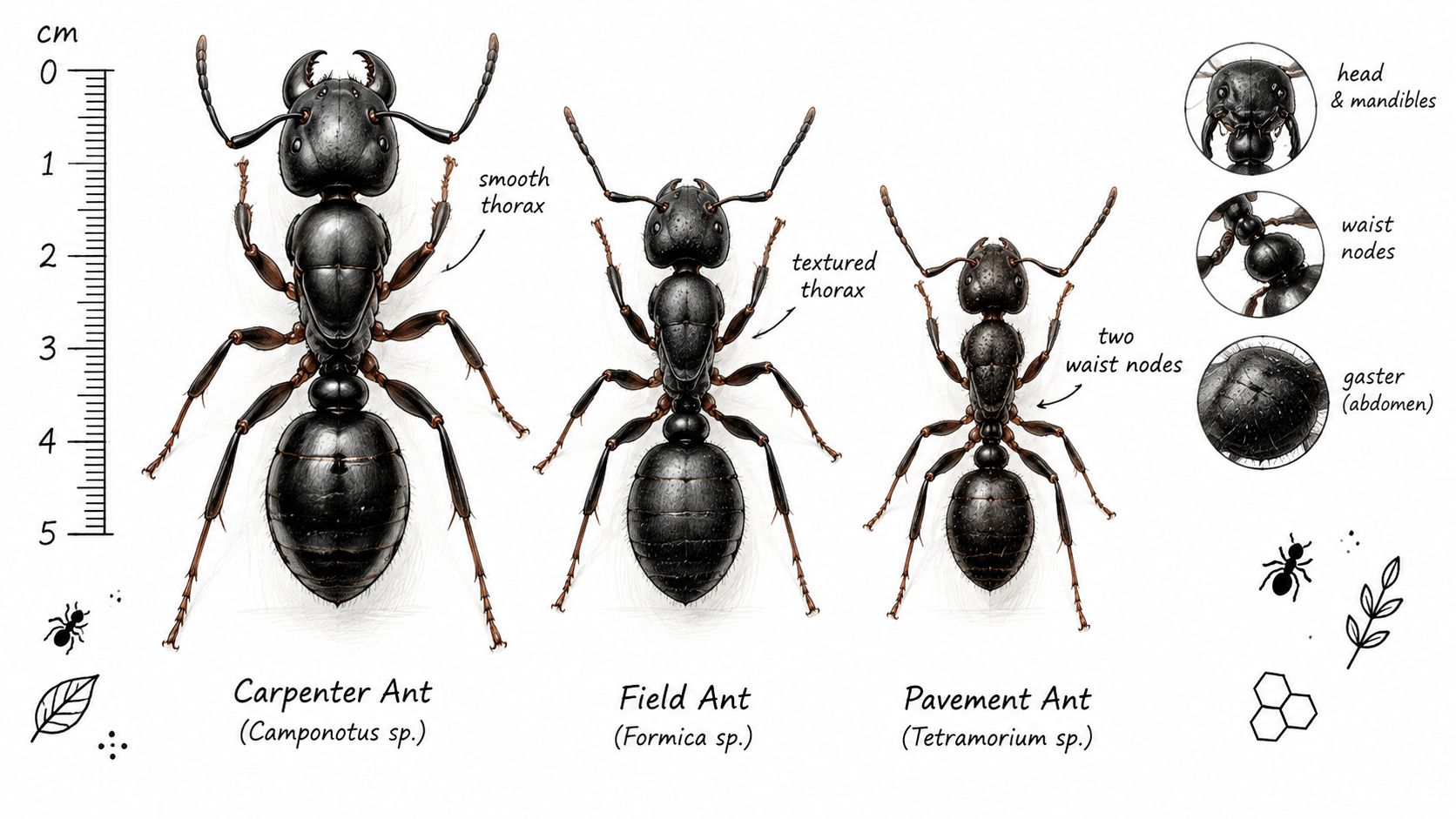
Look for a single node, or small raised segment, between the thorax and abdomen. Carpenter ants also have elbowed antennae. Termite swarmers, one of the most important lookalikes, have straight antennae and a thicker, less pinched waist as described in Texas A&M's identification guide.
The waist is easy to remember with a simple image. A carpenter ant looks as if its body has been fitted with a narrow belt. A termite looks more like a straight-sided tube between its front and rear sections.
For additional background on common ant types and their habits, see this overview of ant species and control considerations.
Use the thorax as your deciding feature
Color and length overlap among dark ants. The thorax, viewed from the side, gives you a better clue. Carpenter ants have a smoothly rounded thorax profile, while many dark field ants have a different outline.
Think of the thorax as a small hill. A carpenter ant's profile rises and curves evenly, without a sharp dip or step. Photographing that curve is more useful than taking a blurry top-down image.
Place a ruler or familiar object nearby only for scale, and avoid handling the insect. A clear side-view photograph showing the head, antennae, waist, and thorax can help a pest professional confirm whether the visitor is likely a carpenter ant.
Why Moisture and Wood Condition Matter More Than Size
The important question isn't why the ant is large. It's why the wood near your home has become suitable for excavation.
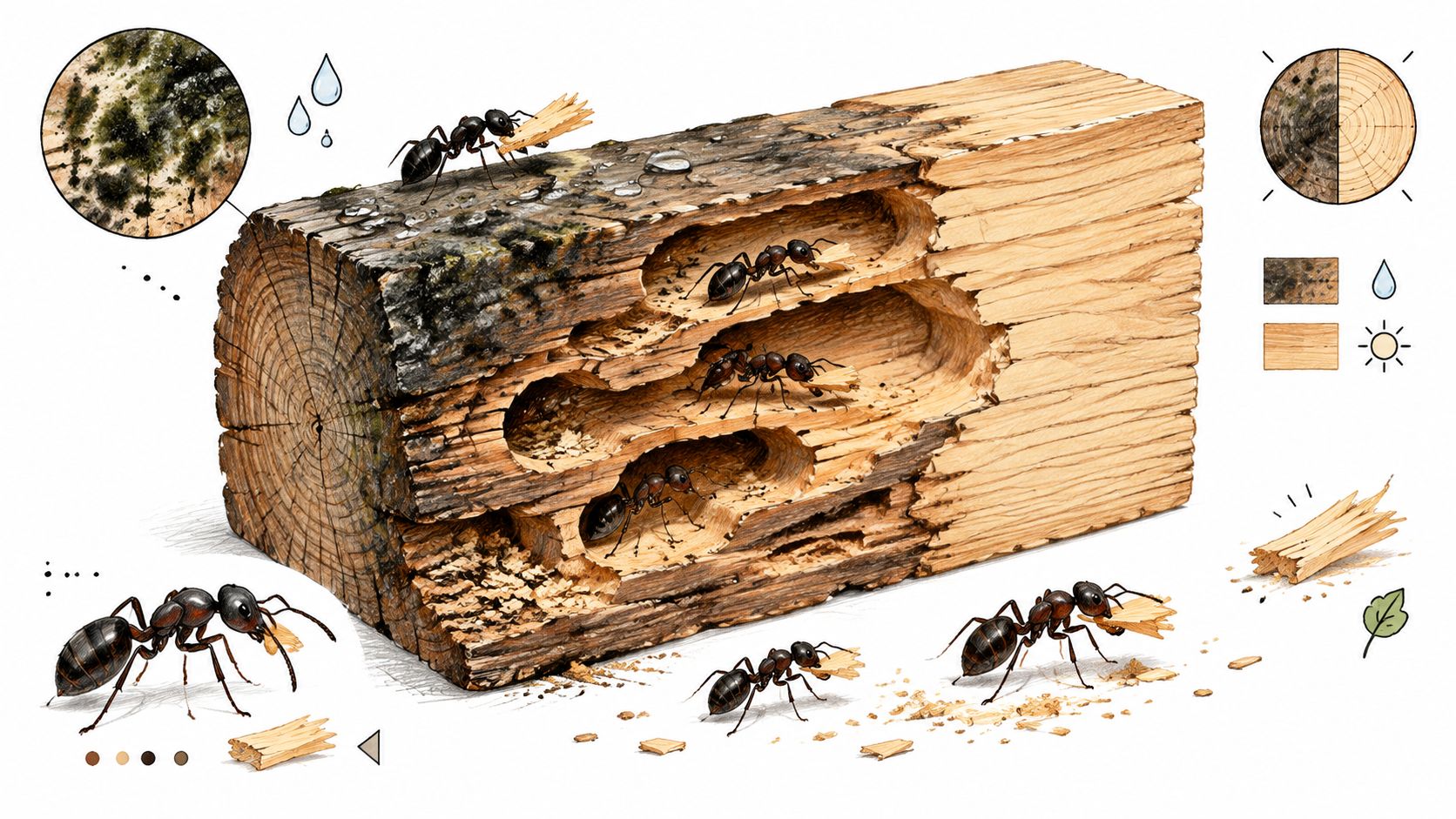
Carpenter ants create galleries for nesting. They remove wood particles rather than consuming the wood as food, leaving coarse debris or frass near openings. Chronic dampness softens framing and makes excavation easier, which is why roof leaks, wet window frames, plumbing leaks, and water-damaged structural wood deserve more attention than the ant's body length.
Follow the moisture trail room by room
In the bathroom, inspect the cabinet beneath the sink, the wall behind plumbing fixtures, window trim, and areas around the tub. A small leak can keep an enclosed void damp even when the visible surface looks normal.
In the kitchen, check beneath the sink, around the dishwasher, near refrigerator water lines, and along window frames. Food may explain why ants are present, but food doesn't explain frass or repeated activity near softened wood.
In the attic or roofline, look for stained sheathing, damp insulation, wet framing, and areas where flashing or roof penetrations may admit water. Around windows and doors, pay attention to swelling, peeling paint, soft trim, or recurring condensation.
Homeowners dealing with persistent dampness may also benefit from this guide to black mold in humid climates from AMPM Restoration Services. Mold concerns and carpenter ant concerns aren't identical, but both can signal that water is remaining where the building materials should stay dry.
Humidity can keep wood and concealed spaces favorable for pests, especially in warm regions. This explanation of the connection between humidity levels and pest proliferation provides useful context for why moisture correction belongs in the same conversation as ant control.
Understand what frass tells you
Fresh, coarse sawdust-like material near a baseboard, window frame, porch element, or other wood feature strongly supports nearby excavation. The debris may look more fibrous and irregular than ordinary household dust.
A carpenter ant colony doesn't need to sit directly behind the visible pile. Workers may push material through a small opening from a wall void, ceiling cavity, or framing joint. Still, frass narrows the search far more effectively than a trail across a counter.
Don't seal a suspected opening before documenting it. Photograph the debris, note the room and time, and inspect nearby moisture sources first. If water damage is present, repairing it is part of the pest solution, not a separate cosmetic project.
Carpenter Ants Compared to Other Large Dark Ants
Not every dark ant indoors is a carpenter ant. Field ants and pavement ants can enter homes while foraging, and termite swarmers can create alarm when they appear near windows or light fixtures.
Use the table as a screening tool rather than a substitute for a professional identification. A side-view photograph is still the most reliable homeowner-friendly next step.
Large Dark Ants and Lookalikes at a Glance
| Pest | Size and Color | Key Field Mark | Indoor Clue |
|---|---|---|---|
| Carpenter ant | Often black or black with reddish-brown areas, commonly about 1/4 to 1/2 inch for workers | Pinched waist, elbowed antennae, single node, smoothly rounded thorax | Repeated trails, winged adults, or coarse frass near wood |
| Field ant | Dark shades can overlap with carpenter ants | Thorax outline differs from the smoothly rounded carpenter ant profile | May forage indoors without an indoor wood nest |
| Pavement ant | Usually smaller and dark, though appearance varies | Different body proportions and field marks from carpenter ants | Trails near slabs, cracks, thresholds, and food |
| Termite swarmer | Color can range from pale to dark | Straight antennae, thick waist, wings of equal length | Swarmers or discarded wings, often without carpenter-ant frass |
Texas A&M's identification guidance highlights four useful carpenter ant traits: the pinched waist, elbowed antennae, single node, and evenly rounded thorax Texas A&M AgriLife Extension identification details. These structural features matter because color alone can mislead you.
Frass and mud change the investigation
Sawdust-like frass near wood suggests carpenter ant excavation. Mud tubes point the investigation in a different direction and warrant attention for possible termite activity. Don't apply the same treatment because both pests can be associated with wood damage.
Winged adults also deserve prompt attention. Indoor carpenter ant swarms can indicate a nest within the structure, while termite swarmers have a different body shape and wing arrangement. Capture a specimen or photograph it without crushing the key features, then have the identification confirmed before choosing a control method.
How to Tell Foraging From an Indoor Nest
The homeowner's real question is usually not “What species is this?” It's “Are they living here?”
Begin with the number and location of sightings. A few large dark ants near a door, porch, or kitchen food source may be outdoor foragers. Repeated activity across multiple rooms is more concerning, especially when the rooms don't offer obvious food.
Use the room and timing test
Extension guidance uses a practical benchmark: seeing five or more carpenter ants per day in a room without food, such as a bedroom or bathroom, often indicates an indoor nest North Carolina State Extension's carpenter ant guidance. The benchmark isn't a diagnosis by itself, but it tells you when casual monitoring should become a structured inspection.
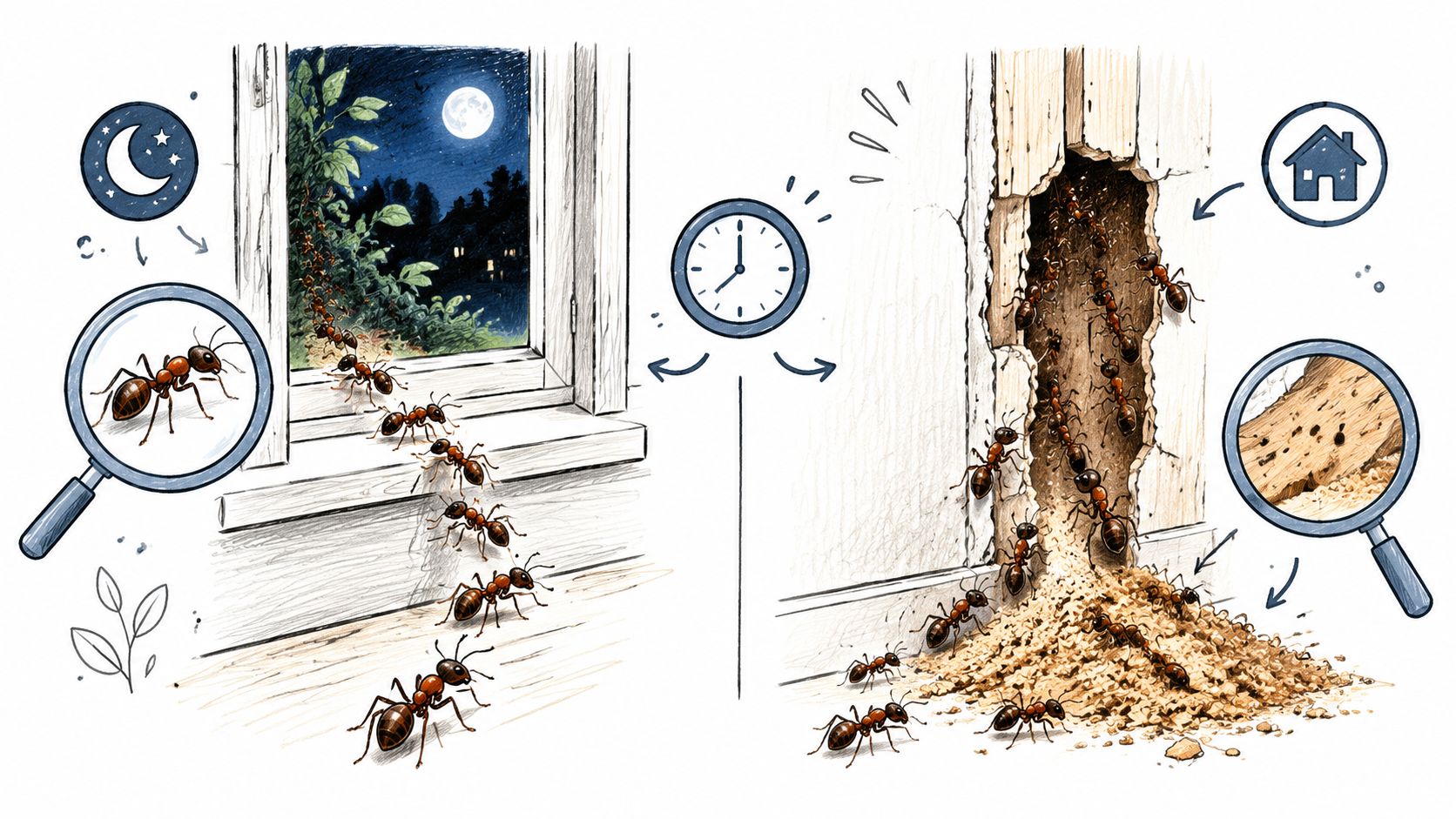
Winter sightings or activity on cool, rainy days also increase suspicion of indoor nesting. Outdoor foragers are less likely to remain active under those conditions, so ants appearing inside during them deserve closer attention.
In Southeast Texas, humidity and moisture can keep favorable conditions in place across a broad part of the year. A sudden increase after rain may reflect changing foraging routes, but repeated activity shouldn't be dismissed as weather alone.
Trace the route without disturbing it
Watch where workers disappear. Check the junctions around baseboards, window trim, door frames, vents, plumbing lines, electrical penetrations, and ceiling transitions.
Then look for physical evidence:
- Frass near wood: Coarse, sawdust-like debris can indicate active excavation close to the exit opening.
- Repeated wall entry: Workers vanishing into the same gap suggest a route worth tracing.
- Multiple-room activity: Ants appearing in bathrooms, bedrooms, and living areas suggest a broader structural pathway.
- Winged adults indoors: A swarm inside the building raises concern for a mature colony within the structure.
- Moisture nearby: Damp trim, roof staining, plumbing leaks, or softened framing gives the colony a plausible nesting site.
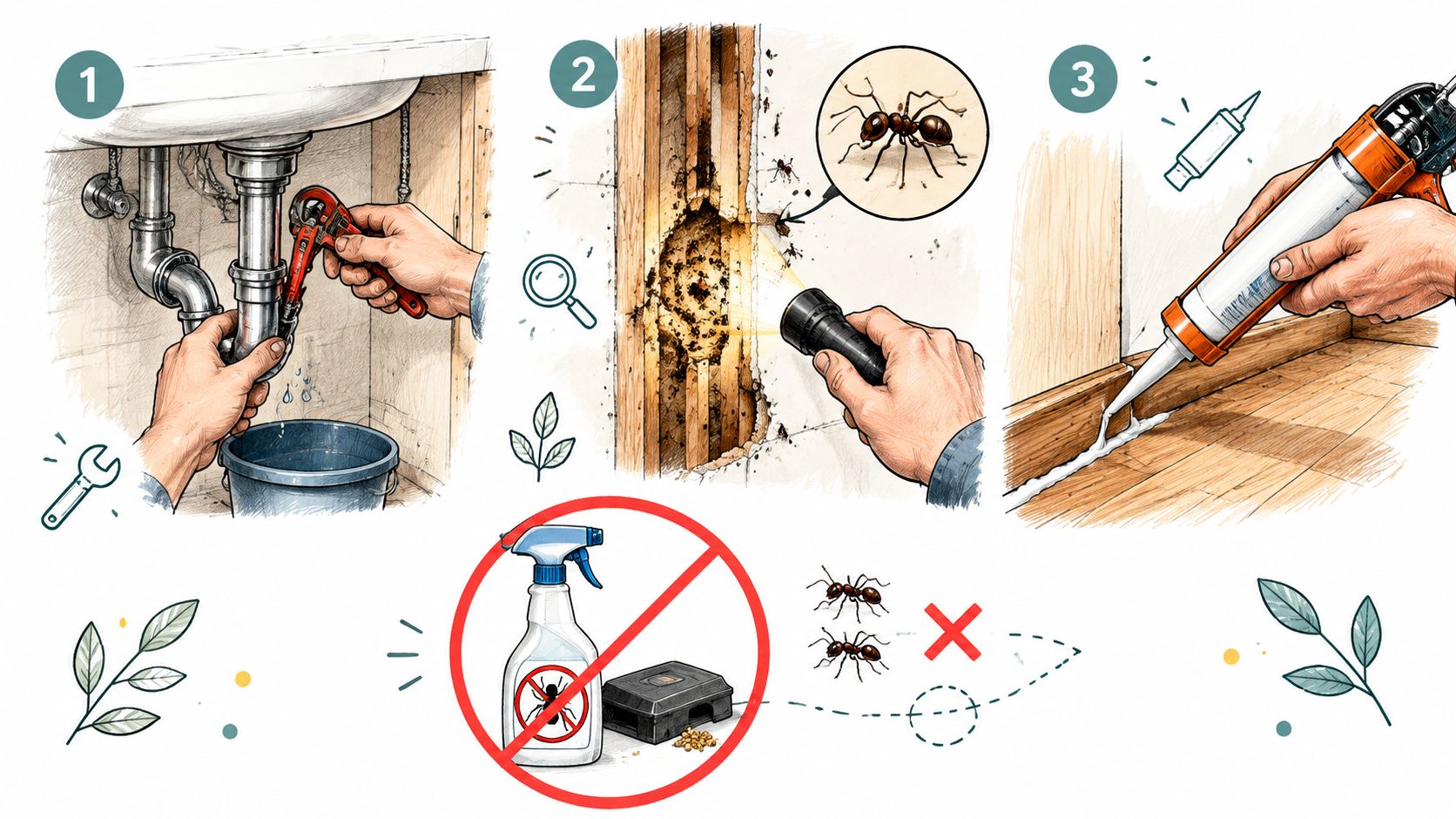
Don't plug the entry hole immediately. Sealing it may redirect workers into another room and erase useful evidence. Document the location, inspect the exterior opposite that wall, and check whether vegetation, siding gaps, or damp framing connects the inside route to an outdoor nest.
If activity stays limited to one occasional ant near a food source and there's no frass or moisture damage, clean the area, seal accessible gaps, and monitor. If the pattern repeats, especially in a room without food, schedule an inspection focused on locating the nest rather than counting dead ants.
Treatment and Prevention Options That Actually Work
Effective control follows the source. Surface sprays can kill exposed workers, but they may miss the main colony or satellite nests hidden in wall voids, damp framing, attics, or other inaccessible spaces.
Correct the condition first
Repair roof leaks, plumbing leaks, wet window frames, and damaged flashing. Improve ventilation in damp voids, address drainage that keeps exterior wood wet, and replace structural material that has already deteriorated.
Inside, clean spills and store food in sealed containers, particularly sweet foods and pet food. Outside, reduce direct routes by trimming vegetation away from the building, moving organic debris away from walls, and keeping wood from providing a convenient bridge into the structure.
Locate and target the colony
A technician may follow trails, inspect moisture-prone areas, examine frass, and use targeted baiting or direct nest treatment based on access and colony location. The aim is to reach the colony, not merely reduce the visible trail.
Baiting requires patience and correct placement. Spraying directly across an active trail can interfere with worker movement and make it harder to determine where the ants are coming from. Children and pets also make product placement and label compliance especially important.
Build a barrier against return visits
After treatment, seal gaps around windows, doors, utility penetrations, and siding transitions. Correct the water problem before closing a void, because sealing damp wood without repairing the source can preserve the condition that attracted the ants.
A sensible follow-up check includes:
- Recheck the original trail: Confirm whether activity has stopped at the entry point.
- Reinspect damp areas: Look for recurring condensation, staining, leaks, or soft trim.
- Review exterior routes: Examine branches, fence connections, wood piles, and foundation edges.
- Document new evidence: Photograph any fresh frass or winged adults instead of relying on memory.
Integrated pest management works best here because it combines identification, repairs, exclusion, targeted treatment, and monitoring. Low-toxicity options may be appropriate for some homes, but the product and placement should match the pest, nest location, household occupants, and label requirements.
Next Steps for Magnolia Homes and When to Call a Pro
Magnolia sits at the junction of FM 1774 and FM 1488, about 45 miles northwest of Houston and 25 miles southwest of Conroe. The city describes the greater Magnolia area as spanning about 12 miles in all directions, with an estimated population of more than 138,000 on its location and economic development page.
For a Magnolia homeowner, call for an inspection when any of these conditions appear:
- Repeated large-ant activity in bedrooms, bathrooms, or other rooms without food.
- Coarse frass near baseboards, windows, trim, attic framing, or porch wood.
- Winged ants emerging indoors.
- Ants appearing during winter or cool, rainy weather.
- Visible roof, plumbing, window, crawl-space, or framing moisture.
- Activity continuing after cleaning, sealing, and correcting obvious food access.
A structured inspection should connect the indoor trail to exterior entry points, moisture defects, and possible nesting areas. Treatment may include targeted colony control, recommendations for repairs, exclusion work, and follow-up monitoring rather than a single spray around the room where you first saw ants.
FullScope Pest Control provides residential, termite, and ongoing protection services in north Houston communities and nearby locations including Magnolia, Cleveland, Kingwood, Conroe, and Porter. Homeowners can review when to hire pest control for your home when deciding whether recurring activity has moved beyond a simple nuisance.
The clearest plan is simple: photograph the ant from the side, record where and when you see it, look for frass, find the moisture source, and get help when the evidence points inside the structure.
If you're seeing recurring big black ants in your Magnolia-area home, contact FullScope Pest Control to arrange an inspection focused on identification, moisture conditions, entry routes, and nest location. Include the rooms where you've seen activity and any photographs of the ants or frass so the technician can begin with useful evidence.