1500+ reviews

You hear it right around dusk. A faint scratching above the ceiling, then a quick flutter, then silence. The next evening it happens again. By the third night, you’re standing in the hallway looking up, wondering if you’ve got mice, squirrels, or something worse.
In Magnolia Texas, that pattern often turns out to be bats.
They don’t usually announce themselves in a dramatic way. Most colonies start as a quiet attic problem. A few animals slip in through a roof gap, a loose soffit, a gable vent, or a construction joint near the eaves. Then the colony settles in where it’s dark, warm, and protected. Homeowners usually notice the sounds first. The smell and staining tend to come later.
Bats matter to the environment, and nobody in this line of work should talk about them like they’re just vermin. But inside a house, they create real problems. The risk isn’t only the animals themselves. It’s also the guano, the odor, the contamination, and the damage that follows when entry points stay open. That’s why professional bat removal has to be approached as wildlife control, building repair, and health protection all at once.
That Scratching in the Attic Might Be More Than Mice
A lot of homeowners call after trying to explain away the noise for a week or two. They’ll say it started as a light tapping or a fast, papery flutter near sunset. Then one night they hear chirping, or they find a dark pellet on the patio below the roofline, or they spot something slipping out from under the fascia at dusk.
That progression is common with bats because they stay hidden so well during the day. Unlike some attic pests, they’re not stomping around overhead all afternoon. Their movement clusters around exit time and return time. If the activity seems strongest near dawn or dusk, bats move higher on the suspect list.
Why homeowners miss it at first
Serious wildlife problems are often expected to be loud. Bat colonies often aren’t.
A small colony can stay out of sight for a long time, especially in a tall attic or a section of the roof you rarely inspect. By the time the smell becomes noticeable, the colony has often been there long enough to leave waste in insulation, around framing, and below roosting spots. At that point, the issue isn’t only how to get the animals out. It’s how to make the structure safe again.
Practical rule: If the sounds are concentrated at dusk and you’re seeing droppings or staining near upper roof edges, stop guessing and get the structure inspected before anyone starts sealing holes.
Why the solution has to be professional
Homeowners understandably want a quick fix. They ask about sprays, ultrasonic gadgets, bright lights, mothballs, or closing up the opening they found over the weekend.
Those aren’t reliable solutions for bats in a structure. In the field, what works is a controlled exclusion plan that matches the season, the species behavior, and the way the home is built. If that sounds more technical than ordinary pest control, it is. You’re not trying to kill or scare an insect colony. You’re trying to legally remove protected wildlife from a building without trapping it inside.
That’s why the right response starts with inspection, timing, and a full exclusion strategy. It also has to include what happens after the bats leave, because an attic with guano and contaminated insulation is not a finished job.
Identifying a Bat Infestation and The Dangers of DIY
Not every attic noise is bats. Squirrels make heavier, daytime movement. Raccoons sound bigger and clumsier. Rats often create repeated scratching inside walls and around ceiling lines. Bats have their own pattern, and once you know what to look for, the clues usually line up.
Signs that point toward bats
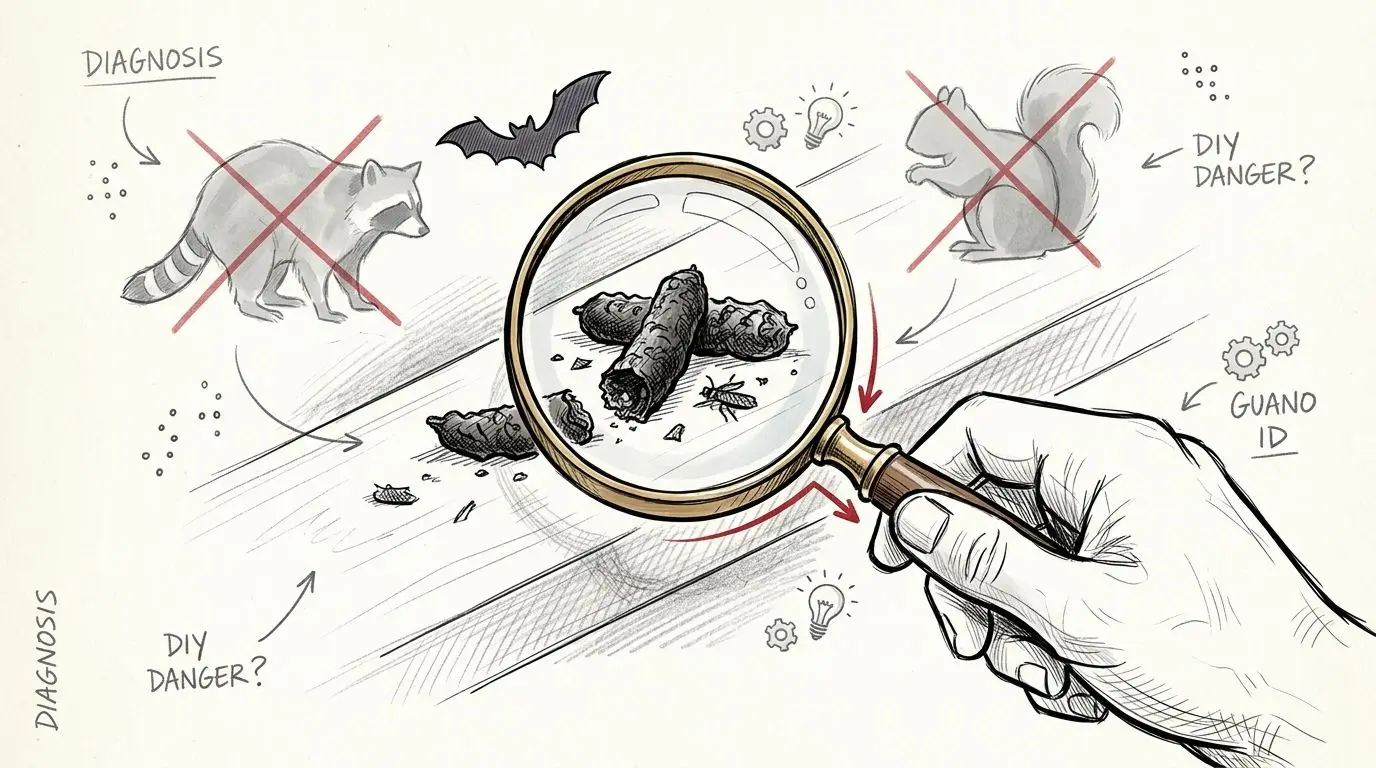
The first clue is often guano. Bat droppings tend to collect below entry areas, on attic insulation, on window ledges, or on the ground below roof joints. Homeowners often describe it as dark pellets that gather in small piles where animals are squeezing in and out.
Another giveaway is greasy staining near the opening. Bats repeatedly use the same access point, and the oils from their fur can leave dark marks around small gaps, especially on soffits, trim, and vents.
Listen for these patterns too:
- High-pitched chirping: This often shows up near sunset, especially if a colony is active near an attic opening.
- Soft fluttering instead of heavy running: Wings sound different from feet. The motion is lighter and more erratic.
- Odor that gets stronger over time: A larger colony can create a sharp, stale smell that drifts from the attic into upper rooms or garage spaces.
If you want a quick comparison of common warning signs before calling, this guide on top signs that you may have bats is a useful homeowner checklist.
Why DIY goes wrong
The biggest DIY mistake is simple. A homeowner finds one hole and seals it.
That can trap bats inside the attic or walls. Then they spread through the structure looking for another way out. I’ve seen that lead to bats dropping into living spaces, dying in inaccessible voids, and creating a much messier cleanup than the original problem.
The second issue is legal and humane handling. Professional protocols rely on one-way exclusion, not poisoning, trapping, or killing. As noted later in the removal process, accepted bat control practices are built around letting the colony leave safely and then preventing re-entry. Shortcuts put both the animals and the homeowner in a bad position.
If a person’s plan depends on repellents, fumigants, or “just sealing the main hole,” it usually isn’t a bat plan. It’s a guess.
Roofline problems are often part of the story
Bat entry points usually overlap with building defects. Loose flashing, damaged trim, warped fascia, separated soffits, and aging vents all create access. That’s one reason I tell homeowners to think beyond the animal itself and look at the envelope of the house. If you’re unsure what roof-related weak spots can open the door to wildlife, this article on expert roof inspection advice gives a good overview of what to pay attention to from the exterior.
DIY identification also creates health risk. A live bat in a room, especially one found where people were sleeping, is not something to handle barehanded or chase with a towel. Cornered wildlife behaves unpredictably. Even when a bat seems weak or still, direct contact is a mistake.
The Professional Bat Removal Process Step by Step
Professional bat work isn’t about chasing animals around an attic. It’s a controlled eviction. The job succeeds when every active exit point is mapped, the colony leaves on its own, and the building gets closed up in the right sequence.
Early in the process, visuals help homeowners understand what that sequence looks like.
Inspection comes first
A proper inspection is part wildlife survey, part building audit. The technician checks roof transitions, ridge lines, gable vents, dormers, fascia returns, chimney intersections, and construction gaps where bats can slip inside.
Some access points look obvious from the ground. Others only show up when the inspector sees staining, guano deposits, or flight activity at dusk. The goal is to separate primary exits from secondary gaps. That distinction matters because the one-way devices go on the main travel routes, while the rest of the structure gets prepared for sealing.
A thorough inspection also identifies conditions that complicate the job:
- Steep or high roof sections
- Multiple architectural returns
- Evidence of roosting above insulation
- Shared problem areas around vents or utility penetrations
The exclusion phase
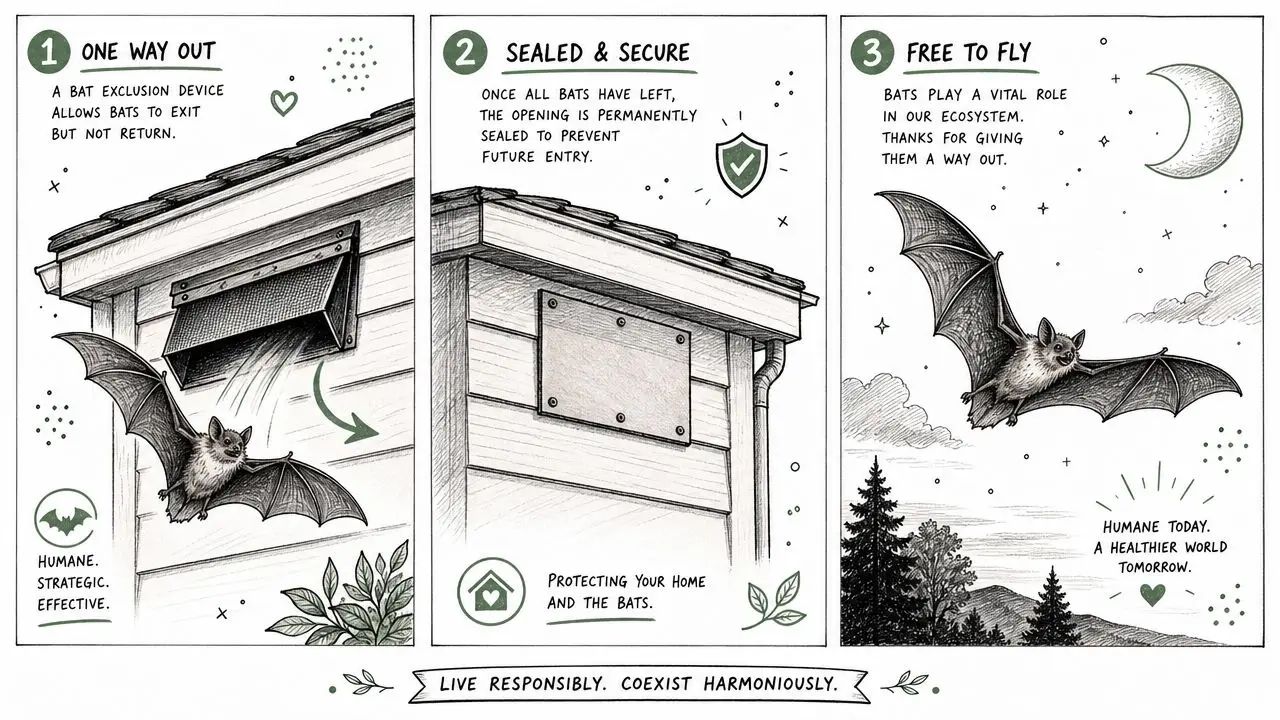
This is the heart of professional bat removal. The approved method is a one-way venting system installed at primary entry points, combined with complete sealing of all secondary cracks. According to Oregon’s bat control practices, it’s the only permanent, humane method, and the vents must stay in place for a minimum of five nights with suitable weather before final sealing occurs, including temperatures above 50°F and other conducive conditions in that period, as outlined in the bat control practices guidance.
Think of the device like a one-way turnstile. Bats leave to feed, pass through the exit, and can’t work their way back in.
That’s why exclusion takes planning. If a company installs one-way devices but leaves a dozen side gaps open, the colony can re-enter somewhere else. If they seal too aggressively before the colony is out, they can trap bats inside. The sequence matters as much as the materials.
For homeowners who want to see a visual example of the hardware and setup, this clip shows the general exclusion concept in action:
Final sealing and permanent repairs
After the exclusion period, the crew returns to remove the devices and close the final openings with durable materials suited to the structure. Depending on the location, that may include silicone-based sealant, hardware cloth, heavy-duty mesh, metal screening, or repair work around trim and vents.
Cheap work starts to show its flaws. A rushed seal-up might look finished from the driveway but fail at corners, ridge details, or roof-to-wall transitions. Bats only need a small construction gap to start using the structure again.
On the jobsite: The lasting fix usually has less to do with one “big hole” and more to do with every overlooked seam around it.
What a complete job includes
A real exclusion proposal should clearly address all three parts of the work:
- Inspection and mapping of active and potential entry points.
- Humane exclusion using one-way devices on the main exits.
- Permanent closure of remaining gaps after the colony is out.
Some local providers, including FullScope Pest Control, also combine wildlife exclusion with broader structural pest inspection, which can be useful when attic conditions suggest more than one issue is present.
If any estimate skips inspection details or treats sealing as an afterthought, that’s a warning sign. In bat work, details aren’t cosmetic. They’re the difference between a one-time removal and a repeat infestation.
Texas Bat Removal Timelines Legal and Seasonal Considerations
Timing controls everything in bat work. You can have the right crew, the right equipment, and the right building access, but if the season is wrong, the removal plan changes.
In Texas, that isn’t a paperwork issue. It’s a biology issue first, and then a legal one. Bat pups can’t fly for part of the year. If someone excludes the mothers at the wrong time, the young remain trapped inside. That’s inhumane, creates mortality inside the structure, and turns a removable colony into a sanitation emergency.
The standard exclusion windows
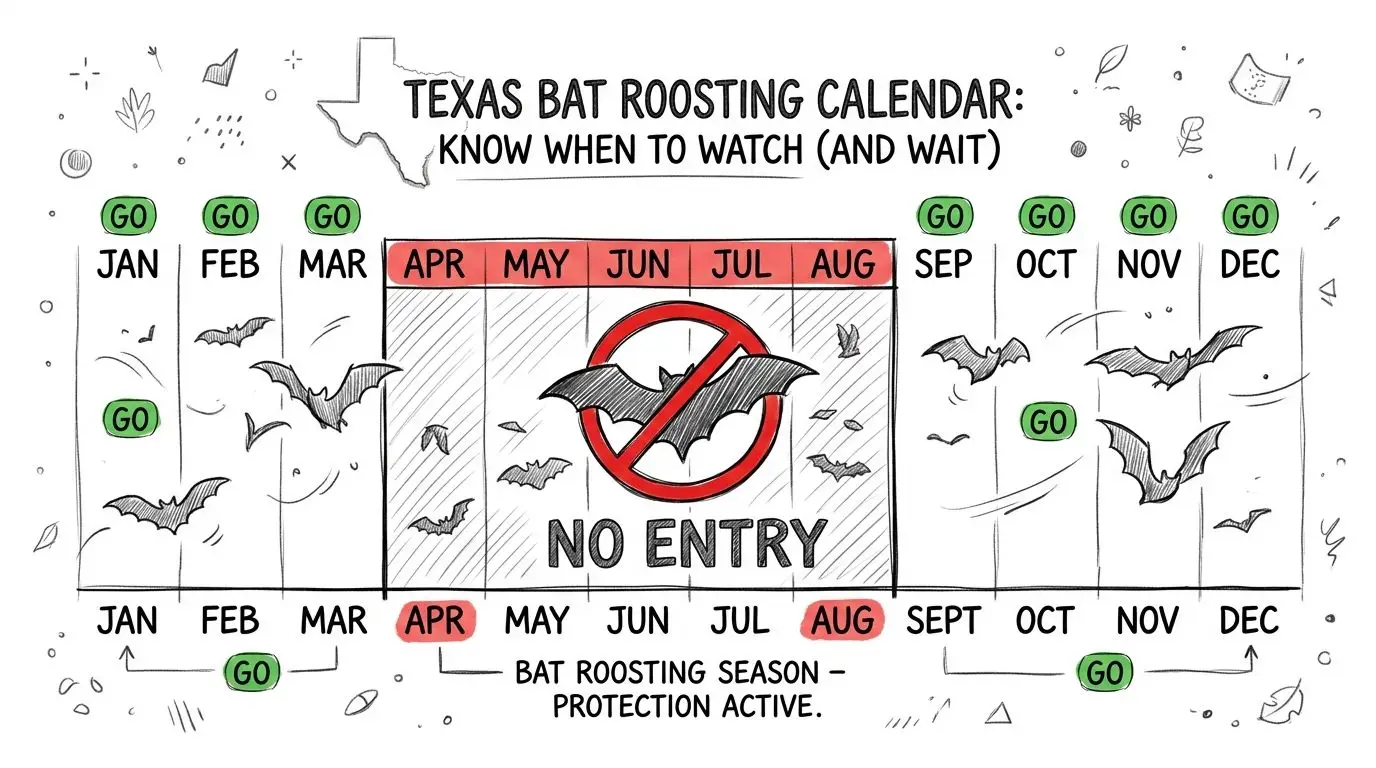
The most important seasonal rule for homeowners is this. Professional bat removal is legally restricted during the maternity season from late May to late August, and the commonly approved windows are March 15 to May 15 and August 5 to October 30, when temperatures allow and young bats are mobile, according to humane bat removal guidance from ABC Wildlife.
That means a bat problem found in summer may not be something a contractor can solve immediately with exclusion, even if the colony is active and obvious. A reputable company should explain that plainly. Anyone promising a fast eviction in the middle of maternity season deserves extra scrutiny.
Why winter deserves more attention
A lot of homeowners still hear the old advice that they have to wait for late summer or early fall. In practice, winter can also matter.
The underserved part of this conversation is winter exclusion. Some industry discussions now point to January and February as a safe, legal option in many places when pups are not present and seasonal behavior supports immediate closure. In Magnolia Texas, that matters because delaying action can give a colony more time to remain established in the structure and continue fouling insulation or using the same gaps.
The key point for a homeowner isn’t to memorize bat migration research. It’s to understand that timing isn’t always “wait until fall.” A qualified bat specialist should evaluate the current season, local conditions, evening temperatures, and signs of occupancy before deciding whether one-way exclusion or a different legal closure sequence is appropriate.
Winter is often when homeowners have the best chance to solve a bat problem before spring activity ramps up again.
What this means for your decision
If you discover bats, ask the company two direct questions:
- Is this an active exclusion window for my home right now?
- If not, what can be done safely and legally in the meantime?
Good answers might include monitoring, inspection, planning repairs, identifying all access points, or scheduling the exclusion for the first lawful window. Poor answers usually sound rushed, vague, or dismissive of seasonality.
Timing also affects what materials and methods make sense. In some periods, one-way devices are the correct path. In others, immediate closure after confirming absence may be the better route. The right plan depends on the bats’ life cycle, not on the homeowner’s calendar or a company’s open appointment slot.
Beyond Removal Guano Cleanup and Pathogen Remediation
A lot of bat jobs get judged too early. The colony is gone, the holes are sealed, and the homeowner thinks the problem is over.
Sometimes it isn’t.
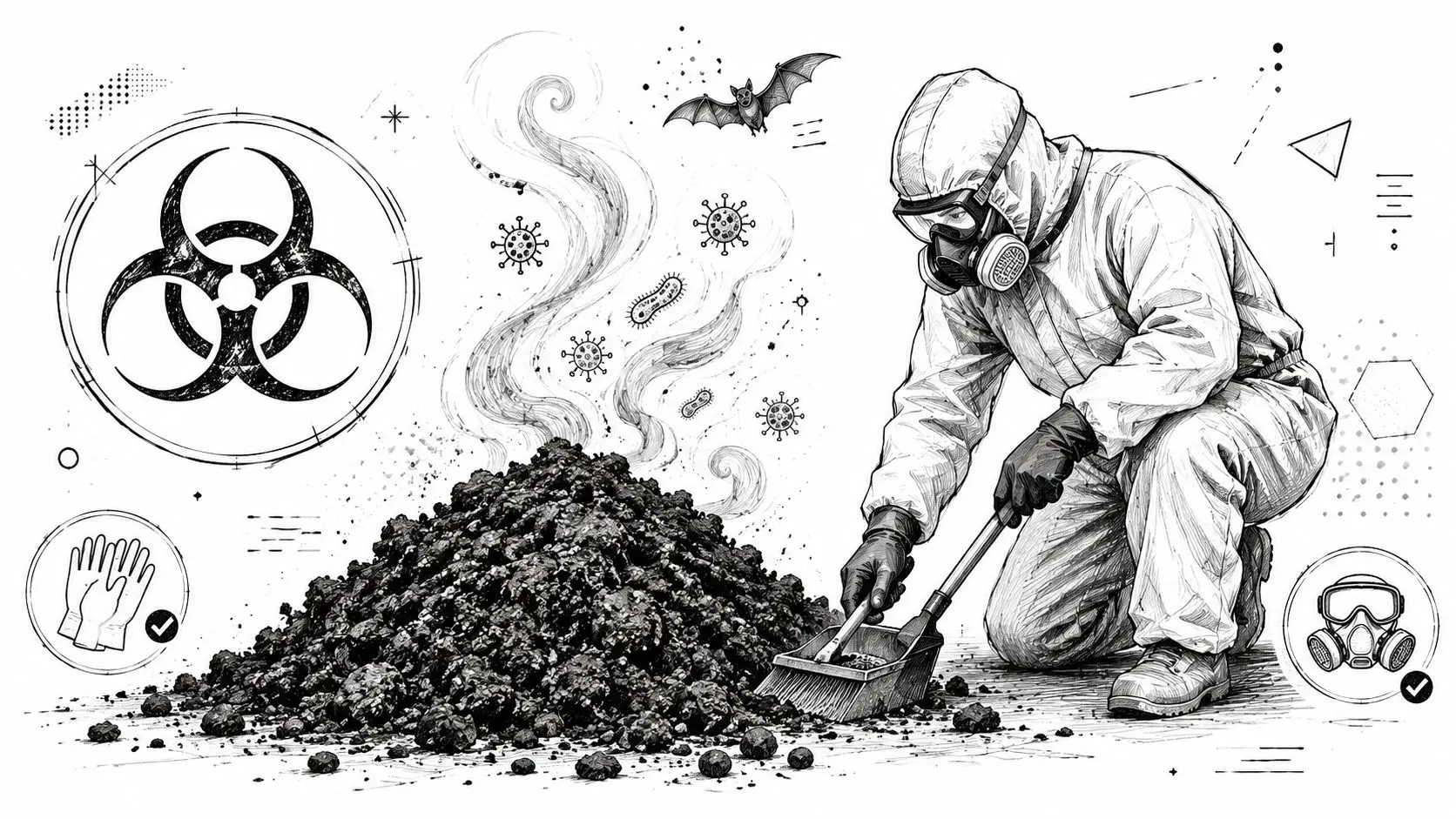
An attic can still be unsafe after successful exclusion if the waste, contaminated insulation, and residual biological material are left behind. This is the part many homeowners don’t see from below, and it’s where the words “cleanup” and “remediation” get mixed together as if they mean the same thing. They don’t.
Cleaning is not the same as remediation
Sweeping droppings, bagging debris, and spraying deodorizer might make an attic look better. That does not automatically make it safe.
A critical, often-missed step is pathogen-level sanitization. Standard cleaning is insufficient. Proper remediation requires HEPA-filtered negative air machines and a two-step chemical process to neutralize Histoplasmosis spores, according to this guidance on choosing a bat removal provider and asking the right remediation questions.
That distinction matters because guano contamination is not just a housekeeping problem. Once insulation is heavily soiled, the issue becomes containment, safe removal, and treatment of the affected area so particles aren’t spread through the attic and into living spaces.
What a serious remediation protocol looks like
When contamination is substantial, the crew should approach the attic like a controlled work zone. That usually means protective suits, respirators, containment procedures, and equipment designed to capture fine particles rather than recirculate them.
Look for a protocol that addresses these components:
- Containment first: The work area is isolated so debris and dust don’t drift through the house.
- HEPA-filtered negative air: This helps control airborne particulates during removal.
- Removal of compromised material: Soiled insulation and waste are physically removed, not just sprayed over.
- Two-step treatment: An oxidizing product addresses biological contamination, then an enzyme-based treatment helps break down residue and odor.
If a contractor’s version of remediation is “we’ll vacuum it out and fog the attic,” ask more questions.
A deodorized attic can still be a contaminated attic.
The insurance and documentation side
Extensive guano contamination can overlap with property damage concerns, especially when insulation replacement or other corrective work is involved. If you’re trying to understand how documentation, photos, and scope details affect reimbursement conversations, these expert property claim tactics offer a practical framework for homeowners preparing a claim file.
The main thing I want homeowners to understand is simple. Exclusion removes the animals. Remediation deals with what they left behind. Leaving out the second half saves money upfront, but it leaves the structure in a condition many families wouldn’t knowingly accept if they saw the attic before and after side by side.
Understanding the Costs of Professional Bat Removal
Bat removal pricing swings widely because the work changes so much from one house to the next. A single bat or a small group using one accessible opening is a different job from a colony spread across a steep roofline with contamination throughout the attic.
National industry data gives homeowners a reasonable starting point. Professional bat removal typically ranges from $309 to $974 on average, with a national mean around $488, while simpler jobs can run as low as $138 to $300 and complex removal can exceed $1,600 and reach $2,279 or more, based on bat removal cost data compiled by Thumbtack and HomeAdvisor.
What drives the price up or down
The first factor is colony size. That’s because a larger colony usually means more guano, more active exits to monitor, and more follow-up sealing. The same cost source notes that removing fewer than 50 bats generally ranges from $230 to $1,500, while 50 to 200 bats can cost $1,500 to $5,000. Colonies above that level can start at $5,000 and go much higher.
The second factor is building complexity. High peaks, multiple dormers, long eave runs, and difficult attic access all increase labor time. Homes with layered additions or older roof transitions often hide more than one entry route, which means more inspection time and more exclusion detail.
The cost that surprises homeowners
Guano cleanup is often the line item people didn’t expect. The same industry source reports that guano cleanup averages $500 to $8,000, and that doesn’t always include insulation replacement if the material is heavily soiled.
That’s why I tell homeowners not to compare quotes only on the exclusion number. If one company is pricing the wildlife work while another is including exclusion, cleanup, and restoration, those estimates are not talking about the same job.
For a broader look at how pest service pricing varies by problem type and scope, this 2024 exterminator cost guide comparing pest control prices gives useful context.
How to budget realistically
A good estimate should separate the work into categories. Look for line items related to inspection, exclusion setup, sealing and repairs, waste removal, and any insulation-related restoration. That format helps you see whether you’re being quoted a complete solution or only the first half of one.
Lowest price often means narrowest scope. In bat work, narrow scope is where repeat problems start.
Hiring a Reputable Bat Removal Pro in Magnolia Texas
This is one of those jobs where the contractor matters as much as the infestation. Plenty of general pest companies can handle insects well and still be the wrong choice for bats. The skill set is different. So is the liability.
When you start calling companies, pay attention to how they answer the phone and how clearly they discuss timing, exclusion, and sanitation. If a company struggles to explain the process during the first call, scheduling and follow-up can get rough later. For companies in this industry, reliable communication tools like pest control answering services can make a real difference in how quickly homeowners get triaged and scheduled when wildlife activity starts suddenly.
Hiring Checklist for Bat Removal Professionals
| Question to Ask | Why It’s Important | Ideal Answer |
|---|---|---|
| Do you handle bats with exclusion methods only? | Bat work should be humane and aligned with accepted wildlife practices. | They describe one-way devices, sealing, and legal timing. |
| How do you determine whether the season allows removal? | Timing mistakes can create trapped pups and serious contamination. | They explain maternity restrictions and evaluate the current window before scheduling exclusion. |
| Will you inspect the full exterior for secondary gaps? | Missing side gaps causes failed exclusions and reinfestation. | They describe a full roofline and structural inspection, not just one visible hole. |
| What materials do you use for final sealing? | Long-term results depend on durable closure work. | They mention materials suited to the location, such as hardware cloth, mesh, or professional-grade sealants. |
| Do you offer guano cleanup or pathogen remediation? | Exclusion alone may leave the attic unsafe. | They explain containment, safe removal, and sanitation steps in detail. |
| Are you insured for this kind of ladder and roof work? | Bat jobs often involve heights and difficult access. | They can confirm coverage and explain who performs the elevated work. |
Answers that should make you cautious
Some responses sound convenient but signal trouble:
- “We’ll trap them out.” Bat exclusion is not ordinary trapping.
- “We can do it anytime.” Season matters.
- “You only need that one hole sealed.” Most structures have more than one vulnerable gap.
- “Cleanup is just optional deodorizer.” That usually means the contamination side is being minimized.
One more useful screening tool is this guide on finding a pest exterminator near me. Even though it covers pest hiring more broadly, the vetting questions apply well to bat specialists too.
A good bat contractor doesn’t sell speed first. They sell process, legality, and closure quality.
Frequently Asked Questions About Bat Infestations
Will bats leave on their own if I wait?
Sometimes a few bats shift roosts, but homeowners shouldn’t rely on that. If the structure gives them safe access and shelter, they often keep using it. Waiting also gives waste and odor more time to build up.
Can I just install bright lights or use repellent?
Those tactics don’t solve a structural bat issue in a dependable way. If bats have active entry points, the durable answer is exclusion and proper sealing.
Is one bat inside the house always an attic colony?
Not always. A single bat can enter accidentally. But if you’re hearing repeated activity overhead, finding droppings outside, or seeing bats emerge at dusk, the odds of a larger problem go up.
Do I need cleanup if the colony seemed small?
Maybe, maybe not. The answer depends on where they roosted, how long they were there, and whether guano or urine affected insulation or framing. That’s why attic assessment matters after removal.
How long does professional bat removal take?
The timeline depends on inspection findings, weather, season, and whether cleanup is needed after exclusion. Humane bat work isn’t instant because the colony has to exit naturally before final closure.
What should I do tonight if I think bats are in the attic?
Don’t start sealing holes. Don’t climb into the attic trying to chase them out. Avoid direct contact with any bat that gets into living space, close off the room if you can do so safely, and arrange for a professional inspection as soon as possible.
If you’re hearing attic noises around dusk or you’ve found guano near the roofline, the safest next step is a professional inspection that looks at exclusion timing, entry-point sealing, and whether the attic needs real remediation after the bats are gone.