1500+ reviews

You hear it when the house goes quiet. A scratch near the water heater. A quick shuffle behind stacked holiday boxes. The next morning, you find a few dark droppings along the wall and start wondering whether you've got one mouse in the basement or the start of something bigger.
That moment is usually where homeowners make the wrong turn. They buy a couple of traps, toss them into the middle of the room, and hope the problem solves itself. Sometimes they catch one. The activity keeps going.
A basement mouse problem usually isn't a trap problem first. It's an access problem. If you don't find how the mice are getting in, trapping turns into maintenance instead of control. That matters in Southeast Texas, where homes range from older ranch properties and pier-and-beam structures to newer slab homes with hidden utility penetrations that are easy to miss during a quick DIY inspection.
Why Basement Mouse Problems Are Worth Taking Seriously
A basement mouse call usually starts with a homeowner trying to stay calm. There was a sound near the furnace, a quick run along the wall under the stairs, or fresh droppings beside stored boxes. They wait a few days, hoping it was nothing. Then the same corner shows activity again.
That repeat pattern matters because a basement mouse problem is usually an access problem before it becomes a trapping problem. In U.S. housing survey data, nearly 14.8 million occupied housing units reported seeing rodents in the previous 12 months, and about 2.9 million reported seeing both rodents and roaches, according to U.S. Census pest survey reporting. The same survey reporting also points out that basements and other lower areas often stay less disturbed and more useful for storage, which gives mice a quiet place to settle.
Lower levels get hit harder
Field work backs up what homeowners see. On lower floors, mice usually have easier access to foundations, utility penetrations, wall voids, and sheltered edges where they can move without exposure. That is why basement activity often shows up sooner and sticks around longer than activity on upper levels.
If you want a practical read on the signs that point to active mouse travel, this guide to mouse and rodent infestation signs is a useful reference.
If you have seen one in the basement, start with where it came from. Bait choice matters later.
Practical rule: A single basement sighting often points to a small structural opening that keeps giving mice the same route in and out.
What that means in a real house
In the field, the homes that clear up fastest are the ones where someone stops treating the mouse as the whole problem. The mouse is the symptom. The issue is usually a gap around a pipe, a worn door bottom, a foundation crack, a vent opening, or an unfinished transition where two building materials meet.
That is especially true in Magnolia and across Southeast Texas, where housing stock runs from older ranch homes and pier-and-beam construction to newer slab homes with utility entries that are easy to miss during a quick check. Humidity, stored items, and long stretches of quiet space give mice better cover once they get inside. In that setting, a basement mouse problem is usually a system problem with a small root cause, and finding that root cause comes before any trap setup.
Reading the Signs Mice Leave Behind in a Basement
Most homeowners do not see the mouse very often. They find the leftovers, and those traces usually tell the better story. A basement that keeps producing fresh signs is showing you where mice travel, where they pause, and whether the problem is current or just an old visit that left a mark.
Start with droppings and placement
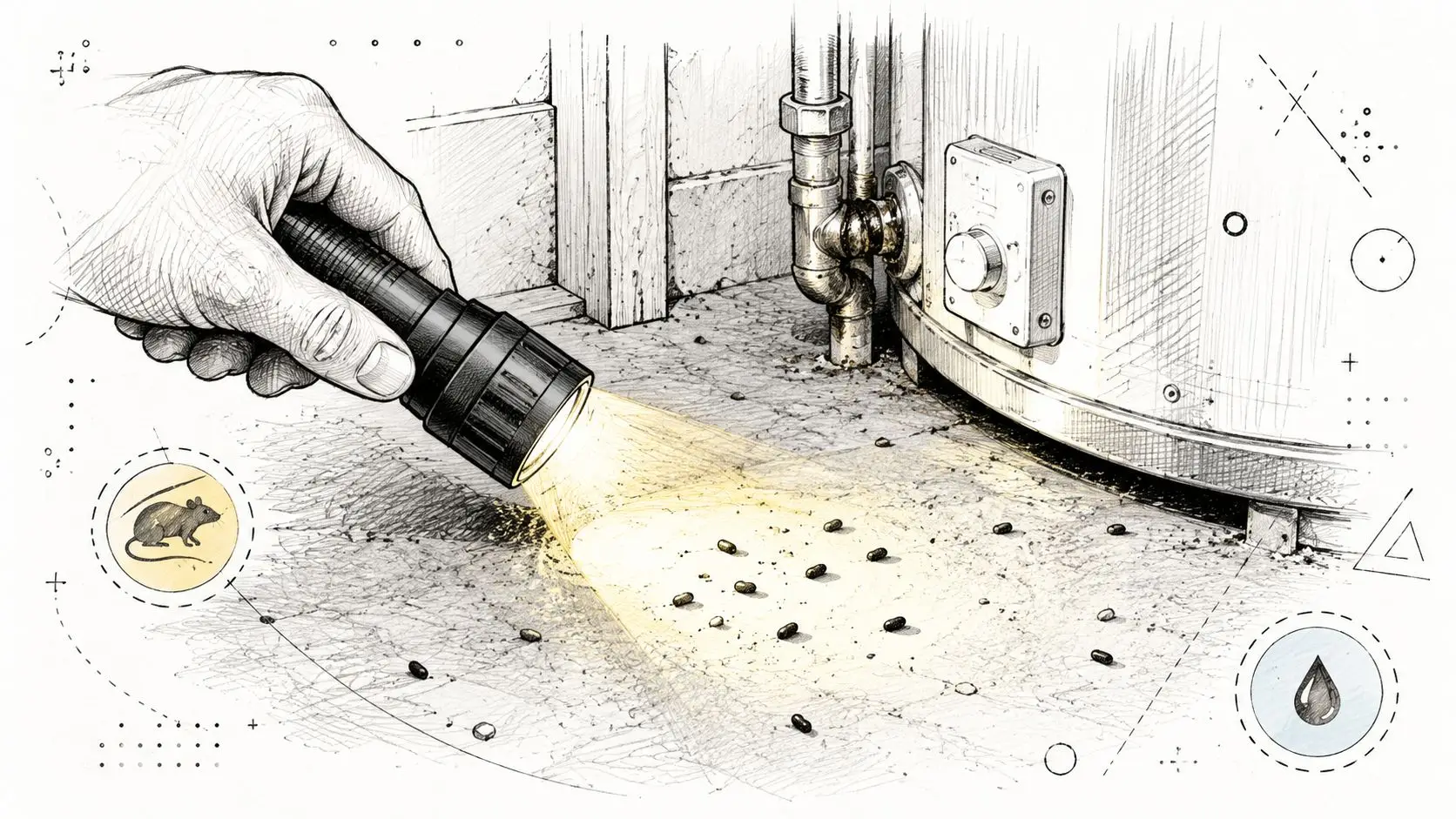
Droppings tell you more than a sighting does. Check behind storage bins, along the wall behind the water heater, beside the electrical panel, under basement stairs, and at the edges of shelving where boxes meet the wall.
The best field habit is simple. Clean up the droppings, mark the date, and check the same spot again the next morning. Repeated activity over a short span is the part that matters. Pest technicians often treat new signs over 48 to 72 hours as a practical reason to suspect a larger issue, and house mice reproduce quickly enough to turn a small opening into a real infestation. A single female can produce 6 to 10 litters per year with 5 to 6 pups per litter, or roughly 30 to 60 offspring in 12 months under favorable conditions, according to mouse infestation guidance from PCC.
Read the rest of the evidence
Mice rarely cross open floor space unless they have to. They stay tight to edges. That means the most useful evidence usually sits along baseboards, sill plates, lower framing, joists, and corners.
Look for:
- Grease or rub marks where the body brushes the same surface repeatedly. These often show up on dusty edges, painted block walls, and baseboards.
- Gnawing on cardboard, paper bags, seed sacks, pet food packaging, insulation facings, or soft wood near a sheltered corner.
- Odor pockets in enclosed basement sections. A stale, musky, ammonia-like smell often builds where mice nest or travel regularly.
- Night sounds that seem to come from nowhere. HVAC chases, utility cavities, and basement ceiling voids can carry sound farther than people expect.
If you want a visual checklist before you inspect, this guide to signs of mouse and rodent infestation is a helpful companion.
If the same corner keeps producing new droppings after cleanup, you are not dealing with a random visitor.
One mouse or settled activity
The easiest mistake is assuming quiet means empty. Early mouse activity is often light, edge-based, and almost entirely nocturnal. What separates a passing mouse from a settled pattern is repetition in the same lane.
Use this quick audit:
- One isolated sign in a basement that has not been checked in months may be recent.
- Fresh signs in two nearby spots usually mean a travel route has formed.
- Signs plus odor plus gnawing usually mean the mice are not just passing through.
- New droppings after cleanup within that 48 to 72 hour window means action should not wait.
In Magnolia and across Southeast Texas, the houses themselves shape the reading. Older ranch homes, pier-and-beam construction, and newer slab homes all leave different hiding places around utility entries, foundation edges, and unfinished transitions between building materials. Humidity and stored items make those areas easier for mice to use once they get inside. In that setting, the sign pattern matters more than the sighting itself, because the problem is usually a small access point feeding repeated activity.
Tracing How Mice Actually Get Into Your Basement
This is the part most DIY guides rush past. Sealing visible holes is easy. Finding the route when no obvious hole jumps out is what solves the job.
Use the quarter-inch rule
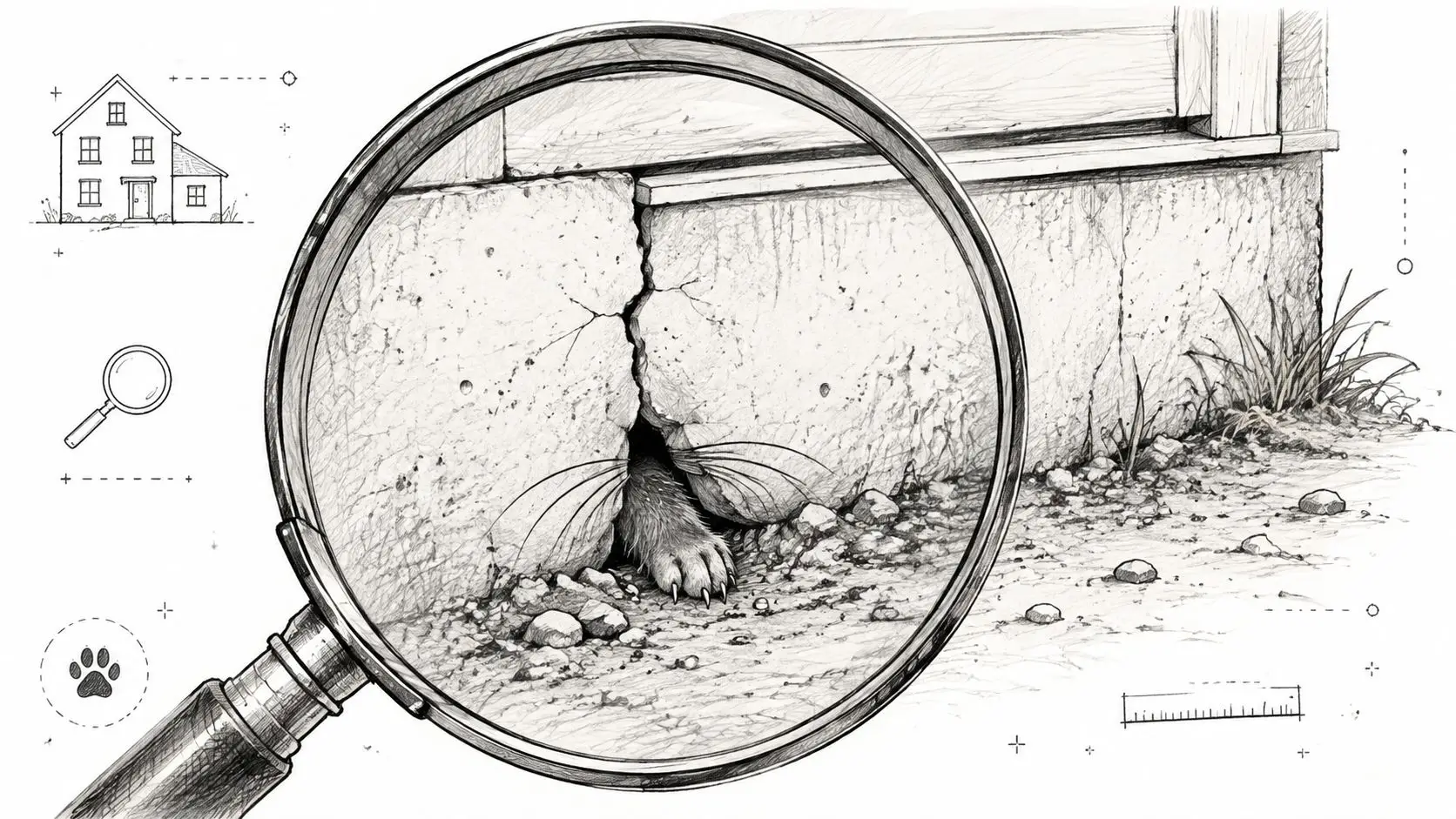
For house mice, the inspection benchmark is straightforward. Public health and housing guidance recommends sealing openings larger than 1/4 inch (6 mm), especially around pipes, vents, door bottoms, and foundation lines, as outlined in mouse control guidance for apartment buildings. Texas A&M AgriLife and Nebraska Extension also note that mice can fit through holes as small as 1/4 inch, and recommend heavy materials like mortar, sheet metal, or hardware cloth for those gaps in Utah State University Extension's summary of that guidance.
A quarter in your pocket is a decent field gauge. If the gap is around that size or larger, don't dismiss it.
Inspect in the right order
Random searching wastes time. Start outside, then move inward along the most likely travel routes.
Foundation perimeter
Check cracks, expansion joints, low utility penetrations, and places where siding or veneer meets foundation.Basement wall penetrations
Focus on water lines, gas lines, cable entry points, HVAC line sets, conduit, and dryer vent transitions.Floor-wall junctions
These are easy to ignore because they look finished. They often aren't sealed continuously.Drains and damp utility areas
CDC seal-up guidance specifically flags basements and crawl spaces, floor drains, and the floor-wall junction as priority points in its rodent seal-up recommendations.Window wells and vents
Basement windows, window well corners, foundation vents, and crawlspace vent covers often hide the opening itself behind debris or trim.
The hidden routes most people miss
The missed spots are usually the ones created after the house was built. Cable upgrades, internet lines, mini-split installs, generator wiring, irrigation control wires, and older plumbing repairs often leave imperfect seals.
In Magnolia, Texas, that matters because the housing stock isn't one thing. Some homes have older pier-and-beam foundations with vented crawl areas and multiple access points around the perimeter. Others are slab homes where the actual penetration is hidden behind a finished wall and only the interior evidence shows up in the basement-adjacent utility area. Older ranch homes on acreage can have add-ons, patched utility entries, and outbuilding connections that complicate the inspection.
A quick visual can help if you're mapping likely lanes before you seal anything.
What a good inspection feels like
A solid inspection isn't dramatic. It's methodical. You're following the evidence back from droppings, rub marks, and odor to the structure, then checking every transition where outside becomes inside.
The hardest basement jobs usually aren't the dirtiest ones. They're the ones with one tiny overlooked gap behind a line set, drain, or wall penetration.
If you skip that step, the rest of the work gets weaker fast.
Setting Traps That Actually Catch Basement Mice
Once the access routes are mapped, traps start doing real work. Before that, they are often placed in the wrong lane, and new mice keep coming in faster than the setup can keep up.
Placement beats product hype
For basement mice, the snap trap is still the main tool. Public guidance says to place traps flush to walls near droppings or gnaw marks, because mice travel along edges instead of crossing open floor space. The University of Kentucky notes that Canada's health guidance suggests 1 trap per metre (yard) along walls or 5 to 10 traps per visible mouse hole, and Orkin recommends 6 to 12 traps in a home for faster knockdown in this trap placement summary.
Put the trap where the mouse already wants to travel. Do not put it where it looks neat to you.
Trap Placement by Location and Evidence
| Sign Found | Trap Count | Placement | Trigger Direction |
|---|---|---|---|
| Fresh droppings along one wall | Multiple | Flush against the wall on the active run | Trigger end facing the baseboard |
| Gnawing behind storage bins | Multiple in parallel | Behind bins, tight to the edge mice use | Trigger end facing the wall |
| Activity near utility entry | Several close together | On both sides of the penetration area | Trigger end toward the travel line |
| Visible mouse hole | 5 to 10 traps per visible mouse hole | Clustered around the opening and nearby wall edges | Mixed orientation if space is tight |
The step people skip
Mice can be cautious around new objects. A basement setup often fails because the traps go live too early in a population that is already wary of the area.
A better approach is to let baited traps sit unset for a short period so the mice accept them as part of the room, then arm them. If you skip that acclimation step, you often get bait theft, trap avoidance, or a line that looks active but catches nothing.
If you are choosing among tools, let the house layout decide:
- Snap traps work best for focused basement runs along walls and under shelving.
- Multi-catch devices make sense in utility rooms, finished basement storage corridors, or properties where you are tracking recurring edge movement.
- Tamper-resistant bait stations are a safety choice around children, pets, or shared-use areas, but they do not replace interior diagnostics.
For bait selection, these mouse bait options give practical examples without turning the choice into a guessing game.
A related point matters in tight garage-and-basement homes, especially where the basement connects to the rest of the structure through utility space. If the door bottom or threshold is compromised, mice can keep using that path while you chase interior activity. The same logic applies to Northeast Ohio garage door seal help, even though the climate and housing details differ. The fix is still about cutting off the movement route first.
How long to trap before you judge the setup
Do not shift the whole setup after one quiet night. Judge the pattern, not the first result.
A basement trap line should be reviewed like this:
- No action and untouched bait means the traps are off the run or the mice do not trust the setup yet.
- Bait stolen and no catch usually means the placement or trigger sensitivity needs adjustment.
- One catch and then silence can mean the smaller problem was handled, or that the surviving mice changed lanes.
- Ongoing captures tell you the route is active and the exclusion work still matters.
Lower-level activity tends to stay tied to lower-level access, and recurring basement mouse problems usually point back to the same entry pressure rather than a one-night trapping miss. That is why trap lines should be adjusted with the house, not the calendar, in mind.
Sealing Entry Points So Mice Cannot Come Back
Trapping removes the current animals. Exclusion is what changes the house.
If a basement mouse problem keeps returning, the weak point is usually the seal-up work. People patch the obvious hole, miss the adjacent penetration, or rely on caulk where a chew-resistant repair is needed.
Match the material to the gap
North Carolina State University Extension recommends sealing holes, gaps, and cracks around walls, floors, ceilings, conduits, electrical wires, water pipes, exhaust vents, ducts, air conditioners, chimneys, and similar openings in its guidance on structure-invading mice. That list is useful because it forces you to stop thinking only about visible wall holes.
What works in practice:
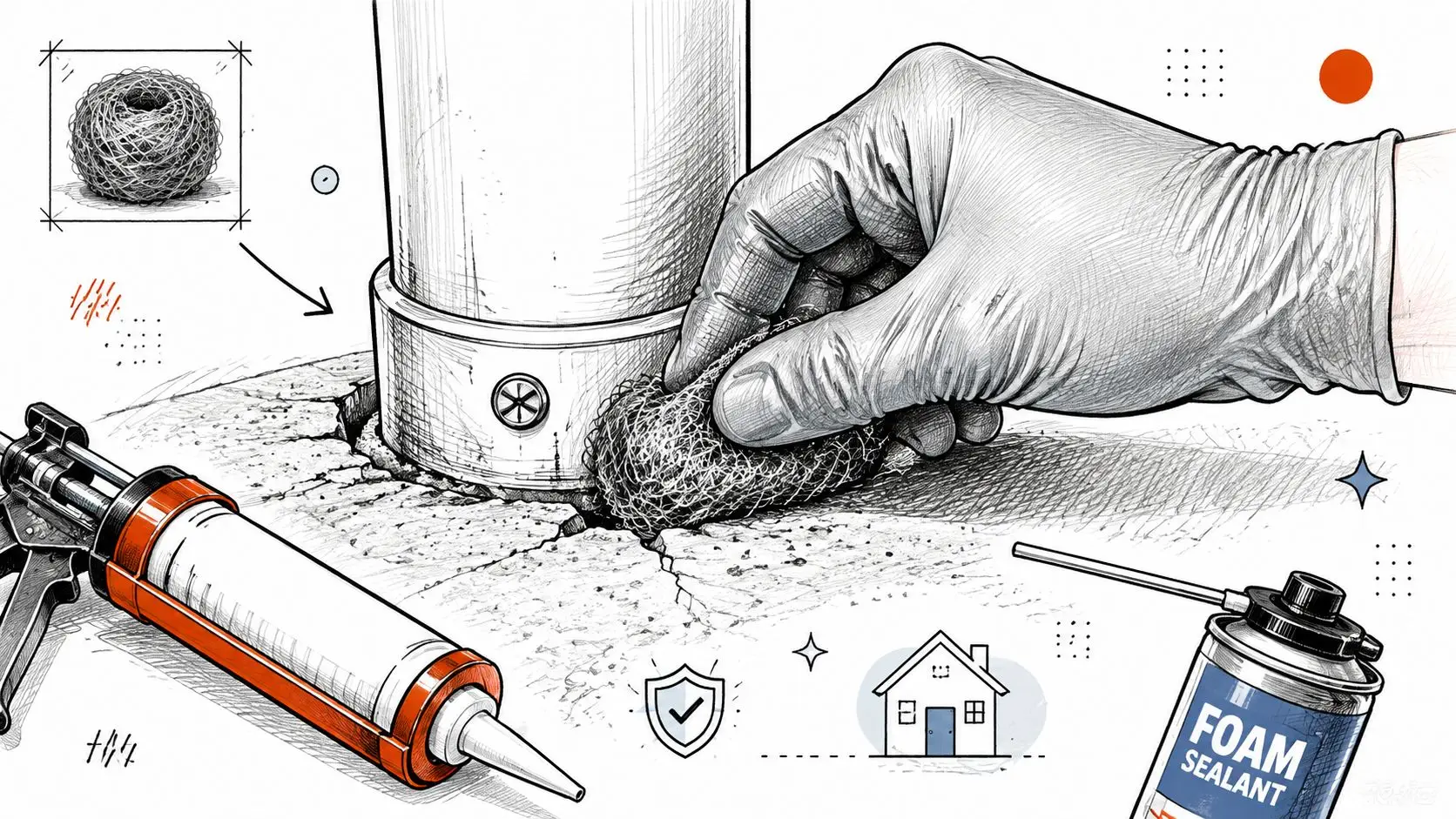
Small gaps around pipes and wires
Pack with steel wool, then cap with sealant or foam so the filler stays in place.Larger irregular openings
Cover with sheet metal fastened over the gap. This is stronger than trying to bridge it with sealant alone.Foundation cracks and masonry defects
Use concrete mortar or another hard repair that becomes part of the structure.Vents and vulnerable openings
Hardware cloth usually outperforms flimsy mesh where chewing pressure or weather exposure is likely.
Caulk alone often looks finished before it is finished. If the gap has movement, depth, or chew access, use a reinforcing material first.
Where homeowners usually miss one
The garage-to-basement transition is a common failure point, especially when the bottom seal is worn or the concrete has shifted. If your door bottom doesn't sit tight, that opening can undermine the rest of the seal-up plan. For a clear look at how worn bottom seals fail and what a proper replacement should cover, this guide on Northeast Ohio garage door seal help is useful even outside Ohio because the door mechanics are the same.
If you want a room-by-room walkthrough of typical rodent access points, this resource on identifying and sealing common entry points for rodents is worth keeping open while you inspect.
A practical basement seal-up checklist
Walk the space in this order:
- Foundation line for cracks, mortar loss, and daylight at transitions
- Sill plates and framing contact points where structure meets masonry
- Pipe penetrations under sinks, at water heaters, and near laundry hookups
- Electrical and data entries around conduit, cable, and service panels
- Dryer vents and exhaust penetrations where exterior hoods don't sit tight
- Meter and service box areas where old repairs often left uneven gaps
- Door bottoms and thresholds between garage, basement, and exterior access points
Good exclusion doesn't look random. It follows the evidence you already found.
Sanitation and Storage Habits That Keep Mice Away
A basement can be structurally sealed and still remain easy for mice to use if the interior gives them cover, food, and water. That's why clean-up and storage habits matter. Not as a substitute for exclusion, but as support for it.
Clutter changes the job
Cardboard boxes, paper files, stored fabric, holiday décor, and open bins create hidden travel lanes. They also make trap checks harder. When mice can move from one covered edge to another without crossing open space, they stay active longer and get harder to read.
You don't need a remodel. You do need cleaner edges.
Try this instead:
- Lift storage off the floor so you can inspect behind and underneath.
- Swap weak cardboard for sealed totes in the areas where you found droppings or gnawing.
- Open up wall lines by pulling stored items a short distance away from the perimeter.
- Keep utility corners visible so new signs stand out quickly.
Food and moisture keep a low-level problem alive
In Southeast Texas homes, pet food storage is a frequent issue. Bags of dog food or bird seed in a basement-adjacent room, garage corner, or utility area can support ongoing activity even after trapping starts to work.
Water matters too. Condensation lines, damp utility closets, and minor seepage give mice a reliable stop point. If your basement tends to stay damp, this Aureli Construction moisture guide is a practical reference for reducing the kind of moisture that supports odor, clutter decay, and hidden harborage.
A sealed house with cluttered, food-friendly storage can still hold mice longer than it should.
Build a maintenance rhythm
What works best is simple and repeatable:
- Weekly check of basement corners, behind stored items, and along utility walls
- Fast cleanup of spilled pet food, seed, and paper debris
- Routine bin review so old cardboard doesn't become permanent harborage
- Moisture watch near drains, condensate lines, and basement door thresholds
The goal isn't sterile. The goal is to make the basement easy to inspect and hard to use.
When DIY Works and When to Call a Local Pro
Some basement mouse jobs are completely manageable for a homeowner. Others keep circling because the access points are hidden, scattered, or physically difficult to reach.
DIY usually works when the problem is narrow
DIY is realistic when the evidence stays confined to one area, the route is accessible, and the house layout lets you inspect what matters.
That usually looks like:
- Light, localized activity in one basement zone
- A visible or strongly suspected entry point around a door bottom, pipe gap, or utility penetration
- Good trap response followed by no recurring signs after a sustained monitoring period
- Accessible construction where you can reach the foundation line or crawl access without guessing
In those cases, a disciplined homeowner can often handle the inspection, trapping, seal-up, and follow-up.
Call a pro when the structure gets in the way
Professional help pays off when the problem spreads beyond one lane or the house itself makes diagnostics difficult.
Call for help if you're seeing:
- Ongoing activity after a month of solid trapping and cleanup
- Evidence in multiple basement zones that doesn't map to one simple route
- Signs on upper levels as well as the basement
- Pier-and-beam or mixed-foundation conditions where entry points are scattered and hard to verify
- Finished walls hiding utility paths so you can't trace the route cleanly
That's also where a service built around inspection, exclusion, sanitation guidance, and trapping, such as FullScope Pest Control, fits as one local option in north Houston and nearby Southeast Texas communities.
Magnolia, Texas service area specifics
Magnolia is in western Montgomery County and had a 2020 population of 2,359, according to the local reference used for this service-area context. It sits within the greater Houston regional footprint and the same practical service corridor as nearby communities like Conroe, Montgomery, and Willis.
For homeowners, that matters because Magnolia isn't a one-style housing market. You'll see newer subdivisions, older ranch homes on acreage, detached shops, utility add-ons, garage conversions, and foundation conditions that vary from street to street. Some homes have straightforward slab penetrations. Others have older septic or utility layouts, crawl access, and patched exterior entries that take more time to diagnose.
If you're planning to sell, keep notes on where activity showed up, what was sealed, and when the follow-up checks came back clean. Rodent history and wood-destroying insect concerns often come up during real-estate diligence in this region, and clear documentation helps the next conversation go faster.
A mouse in the basement doesn't call for panic. It calls for a sequence. Read the signs. Trace the route. Trap the active lane. Seal the structure. Then clean up the conditions that helped the mice stay. That's what turns a basement mouse problem from recurring frustration into a finished job.