1500+ reviews

You hear light rustling over the ceiling just after sunset. A few mornings later, you notice small droppings on the insulation near the attic hatch, and now you're wondering whether you've got mice, birds, or bats. That's the point where many Magnolia homeowners make a rushed decision and seal a gap too soon.
That mistake can turn a manageable wildlife issue into a legal, sanitary, and odor problem inside the house.
If you want to know how to remove bats from attic spaces in Texas, the answer is simple in principle and tricky in practice. You have to identify the species activity correctly, time the work around maternity season, use humane exclusion, seal the structure completely, and handle cleanup like a contamination job, not a basic sweep-up. In Magnolia, Texas and nearby Southeast Texas communities, timing matters just as much as technique.
Confirming Your Uninvited Guests Signs of Bats in the Attic
Before you remove anything, make sure you're dealing with bats. Homeowners often confuse bat activity with rats, squirrels, or birds because all of them can make noise overhead. The clues are different once you know what to look for.
Look at the droppings first
Bat guano usually collects below roosting spots and below exterior entry points. It tends to break apart easily when disturbed, and you may notice shiny flecks from insect remains. Rodent droppings are usually firmer and more pellet-like.
If you see a concentrated pile under a narrow gap near the roofline or on top of attic insulation, that's a strong sign of bat use. You don't need to touch it to inspect it. A flashlight and careful visual check are enough for a first pass.
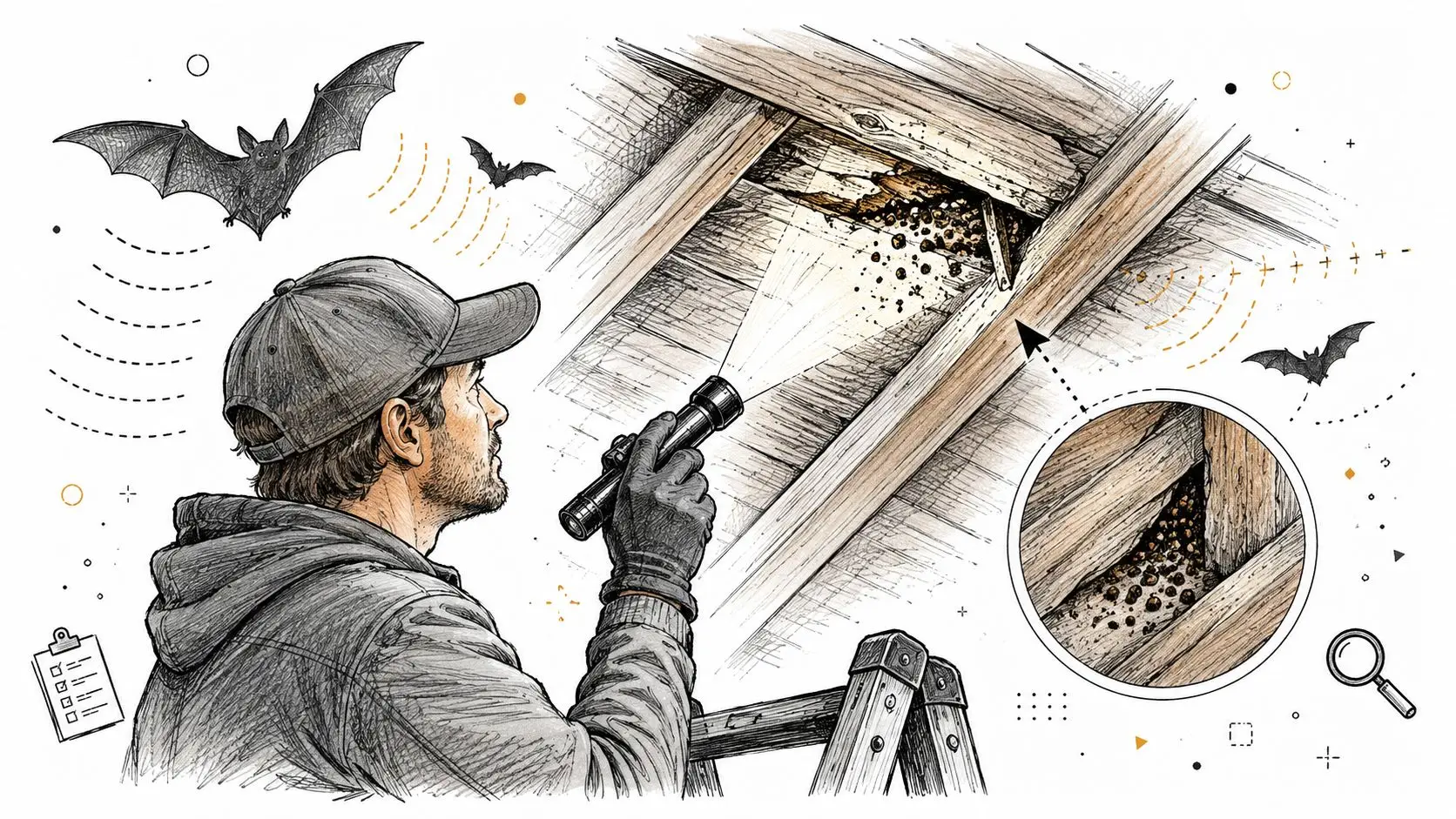
For a quick side-by-side list of common warning signs, this guide on signs that you may have bats is useful when you're trying to separate bat evidence from rodent evidence.
Listen for the timing of the noise
Rats and squirrels often make more obvious scrambling sounds through the night or early morning. Bats are different. In an attic, they usually make lighter chirping, faint scratching, or fluttering sounds around dusk and dawn when they leave or return.
That timing matters. If the house goes quiet all day and then you hear activity right around sunset, bats move higher on the suspect list.
Practical rule: If the sounds line up with dusk flight activity and the droppings are collecting under a roofline gap, inspect for bats before you assume rodents.
Check the exterior for staining and tiny openings
Bats don't need a large hole. They often use narrow construction gaps along fascia boards, soffits, roof intersections, vents, or flashing lines. Over time, repeated entry can leave dark staining or greasy smudges at the edge of the opening.
Walk the outside of the home in daylight and look up at:
- Soffit seams: Small separations where panels meet can become entry routes.
- Roofline joints: Fascia returns and trim intersections often open up with weathering.
- Gable and vent edges: Damaged screening or lifted edges deserve a closer look.
- Chimney and flashing lines: Narrow voids around flashing can serve as regular travel paths.
Magnolia homes with mature trees, mixed shade, and quiet attic voids often give bats exactly what they want. Warmth, darkness, and an easy exit route at dusk.
Notice the smell, but don't rely on it alone
A long-term colony can create a musty, ammonia-like odor from urine and guano. That smell may drift into a hallway, garage, or a room below the attic. Odor alone won't confirm bats, because rodents and birds can also foul an attic, but it helps build the case when paired with guano and dusk activity.
Do a simple dusk watch
One of the most reliable field checks is also the least invasive. Stand outside before sunset and watch the roofline where you suspect an opening. Use a flashlight only after the light drops enough to safely track movement without blinding yourself.
What you're looking for is repeat emergence from the same point. Bats usually don't burst out all at once. You may see one, then another, then several minutes of quiet, then more movement from the same seam or gap.
A good homeowner inspection answers three questions:
- Are the signs consistent with bats, not rodents or birds?
- Where are they exiting the structure?
- Is the activity centered on one main opening or several?
If you're seeing guano, stains at a gap, and evening flight from the roofline, you probably don't have a mystery anymore. You have an exclusion job.
Texas Bat Removal Laws and Maternity Season
The biggest mistake I see in Southeast Texas isn't poor sealing. It's bad timing.
A lot of online advice tells homeowners to “seal the hole and be done with it.” That's exactly how people trap baby bats inside an attic during maternity season. In Texas, especially around Magnolia and the north Houston corridor, that creates a humane problem, a sanitation problem, and in some cases a legal problem.
Why timing isn't optional
Most bat species are protected, and exclusion is the accepted humane method. Killing them or trying to solve the issue with poison or trapping isn't the right path. The complication is seasonal biology.
From May through August, dependent young may still be in the roost. During that period, mothers can fly out, but pups may not be able to leave. If you seal the structure then, adults get locked out and young bats remain inside to die. Humane World notes that many guides miss this nuance in Texas, and that 40% of homeowners who attempt DIY removal during summer unknowingly trap pups, violating state and federal laws in this context of summer eviction risk in Texas (Humane World on what to do about bats).
That's why immediate action isn't always smart action.
Bat removal seasonality in Southeast Texas
| Period | Bat Activity | Recommended Action |
|---|---|---|
| May through August | Maternity season with dependent young possible | Do not exclude. Confirm activity, plan repairs, and wait for a lawful safe window unless there is a direct living-space emergency |
| September through February | Safer exclusion window after young are volant and before spring return | Schedule full exclusion, sealing, and follow-up cleanup |
| Early spring | Conditions can vary by colony activity | Inspect carefully and confirm status before any exclusion work |
What Magnolia homeowners should do instead
If you're in Magnolia, Texas and you discover bats in June or July, don't start stuffing holes with foam that same afternoon. Document where they're entering, reduce unnecessary disturbance, and get a qualified inspection so you know whether you're dealing with a maternity colony.
That delay feels frustrating, but it usually prevents a worse outcome. Trapped pups lead to odor, decomposition, stained drywall, insect activity around carcasses, and heavy guano concentration in the same areas. The house ends up needing more repair than it would have if the exclusion had been timed correctly.
Legal and practical judgment go together
Homeowners sometimes think the law is the only reason to wait. It isn't. Even if you ignored the legal side, premature sealing still fails mechanically. You haven't removed the colony. You've just changed where the problem shows up.
A proper Texas bat job starts with one question: Is it the right season to exclude? If the answer is no, the right move is inspection and planning, not eviction.
Waiting for the correct window is part of the removal process, not a delay in the process.
For Magnolia, Conroe, Kingwood, Porter, and nearby Southeast Texas communities, that seasonal judgment is what separates a clean exclusion from a contaminated attic.
A Guide to Humane DIY Bat Exclusion
If you've confirmed bat activity and you're outside the restricted maternity window, exclusion is the method that works. Not repellents. Not poison. Not trapping. The Virginia Department of Wildlife Resources states that the only effective method to permanently remove bats is complete exclusion, using a one-way device over a primary entry and sealing the rest after the colony exits, with the best window generally between September and February (Virginia bat exclusion guidance).
That's the foundation for any homeowner trying to understand how to remove bats from attic spaces the right way.
Start with a dusk watch and map the openings
Don't begin on a ladder with sealant in hand. Start on the ground near sunset and watch the roofline carefully. You need to identify the main exit point, not just a possible hole.
Use a notepad or phone to mark:
- Primary exit location: The opening with repeated visible flight activity
- Secondary gaps: Other holes, cracks, or construction separations nearby
- Access type: Soffit gap, fascia seam, vent edge, flashing void, or trim defect
Bats often follow the same route night after night. If you misread the primary exit, you'll install the one-way device in the wrong spot and the colony may reroute.
Seal almost everything before the device goes up
Here, most DIY jobs go sideways. People focus on the one-way tube and ignore the rest of the structure.
Industry-standard exclusion work relies on single-point exclusion after sealing 95%+ of minor entry points larger than 0.25 inches, because bats can exploit very small gaps. The same methodology uses one-way devices and confirms clearance only after two to three consecutive bat-free nights at dusk, with 90–95% long-term success rates when the job includes sealing interior connections as well (bat exclusion methodology video reference).
For the sealing step, common materials include:
- Exterior-grade caulk for narrow stationary cracks
- Foam insulation where appropriate for non-chew pressure fills
- Hardware cloth over larger voids or vulnerable openings
If you want a straightforward explanation of what exclusion means in practice, this overview of wildlife exclusion work lays out the concept well.
Field note: The one-way device is not the whole job. It only works when every alternate route is already closed.
Build or install the one-way device correctly
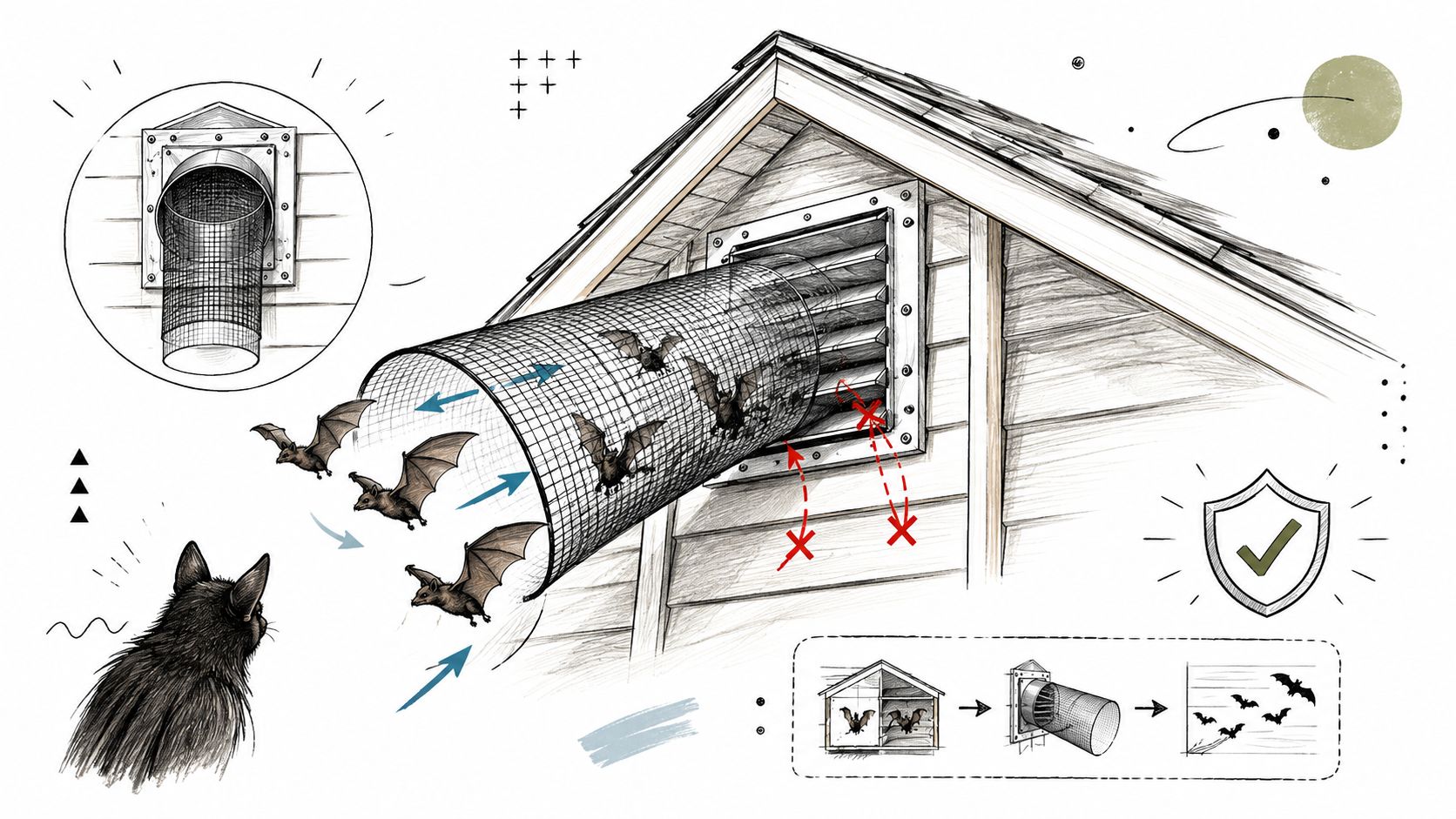
A common exclusion setup uses ¼ to ½ inch hardware cloth formed into a tunnel over the primary opening. The tunnel is typically 18 to 24 inches long and should allow bats to drop out and leave while making re-entry difficult when they return before dawn.
Basic principles matter more than fancy design:
- Cover the active opening fully. The device has to direct all exiting bats through one path.
- Keep the lower end open. The opening should face downward so bats can leave naturally.
- Don't crush the route. The tunnel must stay open and stable through weather and overnight use.
- Anchor the top and sides securely. Any loose edge becomes a re-entry point.
You can also use professional bat cones or netting systems, but the logic stays the same. One exit. No return.
Be patient and verify the attic is empty
Homeowners often rush this part because they don't want a device hanging on the house for several nights. Don't remove it too early.
Watch the home at dusk for several evenings. You're looking for zero emergence and no circling bats trying to re-enter. If you still see activity, either there's another opening you missed or the device isn't functioning the way it should.
A successful exclusion has a calm pattern at the end. No flight from the opening, no scratching overhead, and no fresh guano accumulating below the former exit.
What doesn't work
Some methods fail every year because they ignore bat behavior.
- Repellents: Sprays, scent products, and ultrasonic gadgets don't solve an established attic roost.
- Poison: It's inhumane, often unlawful, and leads to dead animals inside walls or insulation.
- Random sealing: Closing visible holes without exit monitoring can trap bats in the house.
- Trapping and relocation: That doesn't address the structural access points that created the problem.
DIY exclusion can work on a simple structure with a clearly visible exit and safe ladder access. It becomes far less practical on steep roofs, multi-level homes, tile details, chimney intersections, or houses with several competing gaps along the roofline.
Final Sealing and Safe Guano Cleanup
Getting bats out is only half the job. The house still has to be closed up correctly, and the attic has to be treated like a contaminated space if guano has built up.
Final sealing is a craftsmanship task. Cleanup is a health-risk task. Don't treat them like the same thing.
Seal the last opening only after clearance
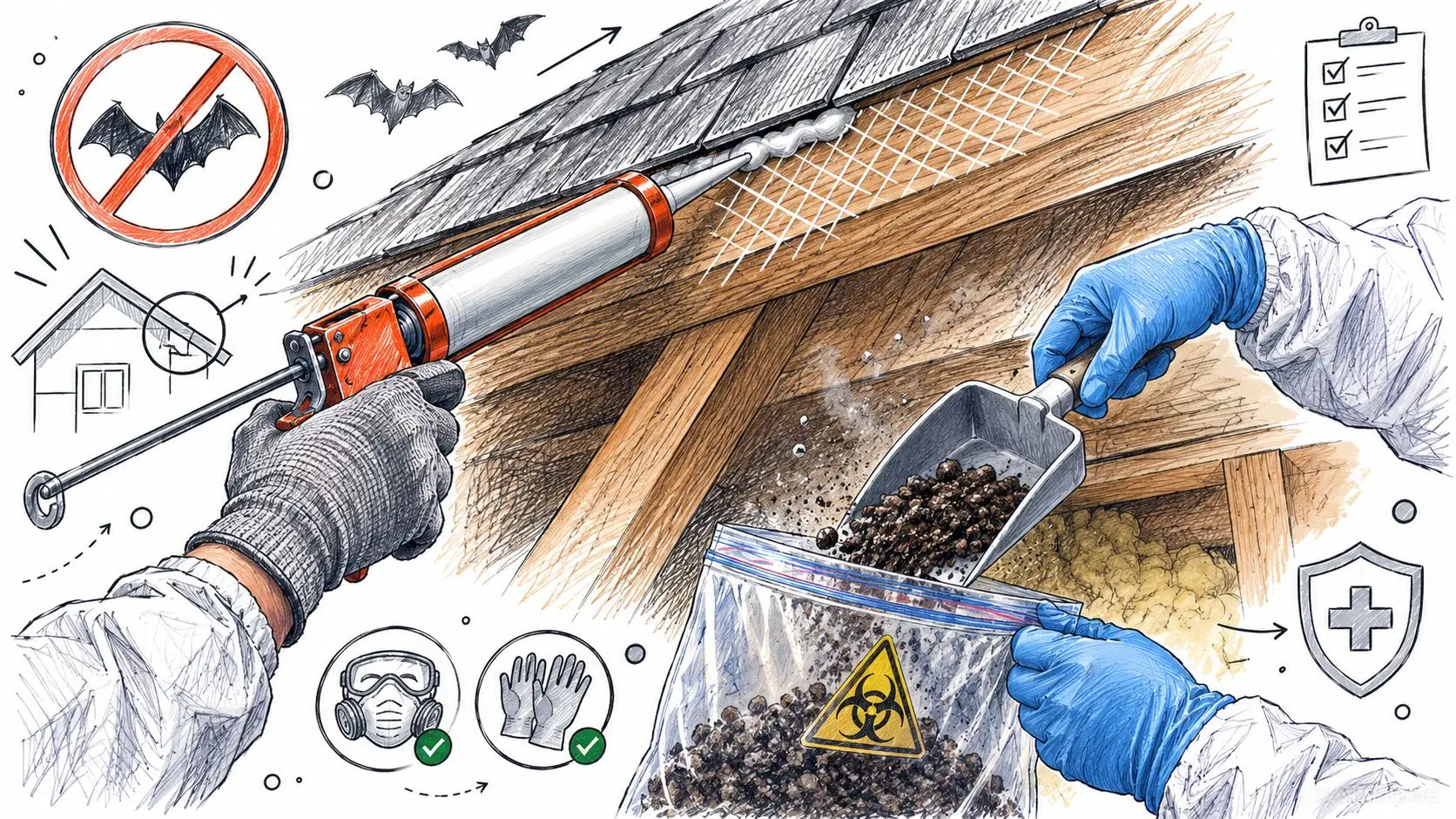
Once you've had the required clear evenings with no visible emergence, remove the one-way device and close that final primary opening permanently. Use materials that match the structure and hold up outdoors.
Good final sealing usually includes:
- Rigid closure materials: Hardware cloth or solid repair materials for larger defects
- Tight edge finishing: Exterior sealant around repair margins where needed
- Full perimeter review: Soffits, ridge transitions, fascia joints, vent screening, and flashing details
This is also the point where I check attic-to-living-space connections. If gaps exist around pipe chases, wiring penetrations, or top plates, contaminated dust can move downward into the home. The exclusion may be done, but the house still isn't protected until those transfer points are addressed.
Guano cleanup carries real health risk
Guano isn't just unpleasant. It can become hazardous when disturbed.
A key DIY failure isn't only bad timing. Cleanup itself can expose homeowners to airborne contamination. Professional guidance in the cited video source notes that guano can harbor mold spores that cause Histoplasmosis, and that sanitation requires HEPA-filtered vacuuming plus biohazard-rated PPE, including an N95+ respirator and gloves, because spores can become airborne during cleaning (bat guano cleanup guidance).
That means no leaf blower, no dry sweeping, and no shop-vac without proper filtration.
Disturbing dry guano without respiratory protection is where a bat problem can become a human health problem.
A safer cleanup sequence
If contamination is light and you're legally and physically able to work in the attic, the process has to stay controlled.
- Wear protective gear first. At minimum, use the respirator and gloves described above. Disposable coveralls help keep contaminated dust off clothing.
- Avoid stirring dust. Move slowly. Don't rake or sweep dry deposits into the air.
- Remove contaminated material carefully. Heavily soiled insulation often needs to come out in sealed bags.
- Use HEPA-filtered equipment. Standard household vacuums can spread fine particles.
- Sanitize affected surfaces. Use appropriate disinfectant products designed for contaminated wildlife waste areas.
Here's a visual walkthrough that helps homeowners understand what a cleanup zone can look like in practice:
When cleanup should stop being a DIY job
Some attics are too tight, too hot, too contaminated, or too difficult to access safely. If guano has soaked insulation, stained framing, or spread near HVAC components, that's no longer a light housekeeping task.
Call for professional remediation when:
- The contamination is widespread
- You can smell strong urine or decomposition odors
- Insulation is compressed or saturated
- The attic has poor footing or limited clearance
- Anyone in the home has respiratory vulnerability
The cleanup stage is where many homeowners underestimate the job. Exclusion removes the animals. Remediation removes the exposure.
Why You Should Call a Professional Bat Removal Service
Most attic bat problems look simpler from the driveway than they do on the roof.
A homeowner may spot one gap and assume that's the whole story. In practice, bat jobs often involve multiple construction defects, hard-to-see returns, and small entry points high above the grade. Add seasonal restrictions, rabies concerns, and guano cleanup, and DIY work starts carrying real liability.
The risk isn't only missing a hole
The CDC recommendation, as summarized in the cited insurance resource, is to use trained professional wildlife removal services because bat removal involves rabies exposure risk and the complexity of humane exclusion. The same source also notes that bat guano poses significant health hazards and requires protective cleanup measures (guidance summarizing CDC bat safety recommendations).
That's the practical reason many Magnolia homeowners call for help even when they understand the basic exclusion steps. Knowing the theory and executing the work safely aren't the same thing.

What a local Southeast Texas specialist adds
Local experience matters because bat behavior, home design, and seasonal conditions vary by region. In Magnolia, Texas, homes often have vent details, soffit conditions, and tree-lined lots that create repeat access opportunities. The same applies across Conroe, Kingwood, Porter, Cleveland, Huffman, Humble, Montgomery, New Caney, Spring, Willis, and nearby north Houston communities.
A qualified wildlife control specialist should be able to handle:
- Legal timing decisions: Knowing when exclusion can proceed and when it must wait
- Structure-wide inspection: Finding the small gaps homeowners usually miss
- One-way device placement: Selecting the true primary exit, not just an obvious crack
- Permanent repairs: Closing the building envelope after the colony clears
- Contamination response: Managing guano and soiled insulation safely
For homeowners comparing service models, Rescreen Rescue's animal removal experts offer a useful example of how broader wildlife removal services are typically framed and why species-specific handling matters.
Choosing a provider in Magnolia and nearby areas
Ask direct questions before you hire anyone:
- Do you exclude bats humanely rather than trap or poison them?
- How do you determine whether maternity season affects my home?
- Will you identify and seal all secondary entry points?
- How do you handle guano-contaminated insulation and cleanup safety?
- Are you licensed and insured for this kind of work?
For a homeowner who wants the process handled from inspection through exclusion and sealing, professional bat removal services are one local option in the north Houston and Southeast Texas service area. FullScope Pest Control also serves communities including Kingwood, Conroe, Porter, Cleveland, and surrounding areas, which is helpful when you need someone familiar with regional rooflines and bat activity patterns.
A bat job goes well when the crew understands both wildlife behavior and building details. You need both.
Protecting Your Home and Family from Future Invasions
A finished bat job should leave you with more than an empty attic. It should leave you with a tighter structure, cleaner air, and fewer chances for the colony to return.
The long-term fix is always the same combination. Correct identification, lawful timing, complete exclusion, permanent sealing, and careful cleanup. Skip one part and the problem often comes back in a different form.
Prevention also means paying attention to the roofline after the exclusion is done. Small construction gaps around eaves, fascia, vents, and drainage edges can reopen over time. Homeowners who are reviewing exterior vulnerabilities may also want to understand the risks of incorrect gutter gaps, since roof-edge detailing can create or expose openings that wildlife eventually exploits.
If you're in Magnolia, Texas or nearby Southeast Texas communities, the safest mindset is simple. Don't rush. Don't guess. Don't treat bats like rodents. Handle the timing correctly, close the house properly, and bring in certified help when the job moves beyond basic observation.
If bats are using your attic, the goal isn't just to get them out tonight. The goal is to remove them humanely, stay within Texas law, and make sure they can't get back in.