1500+ reviews


You hear it around two in the morning: a slow shuffle across the ceiling, then a clunk, like something small has dropped a stick on the drywall. Come daylight there's a heap of twigs and shredded insulation behind the water heater, a chewed extension cord, and a garage smell that won't air out. That sequence is the standard opening of a pack rat problem in Southeast Texas, and the animal behind it isn't the rat many people picture.
Most homeowners grab a box of poison or a few mouse traps and lose a week to it. The order that works is fixed: identify the animal, strip out the food and shelter it depends on, trap whatever is active, then seal the building so the next one can't move in. Skip that last step and you'll be running the same routine again next season.
Tell Pack Rats Apart from Other Rodents
The first useful question isn't "what kills rats," it's "which animal is in the building." Pack rats are woodrats, a different animal from the roof rats and Norway rats that share attics and crawlspaces across the Houston area, and that difference changes everything about where you set hardware and where you seal. Go by sign, not by the blur you catch at midnight.
| Sign | Pack rat (woodrat) | Roof rat | Norway rat |
|---|---|---|---|
| Nest | Stick and debris pile, often outdoors or in attics | Shredded material in attics, wall voids or shrubs | Burrows and runways at ground level |
| Droppings | Larger pellets grouped in piles near the nest | About 1/2 inch, spindle-shaped | About 3/4 inch, blunt-ended |
| Typical location | Crawlspaces, sheds, rock piles, dense landscaping | Attics, rooflines, tree canopy | Basements, ground floors, sewer lines |
| Hoarded items | Shiny objects, bones and debris stored in the nest | Food caches only, rarely objects | Food stored in the burrow, not collections |
The nest settles most arguments. A woodrat hauls sticks, seed pods, foil, bolts and bones into one spot and builds a midden that hardens over months. Roof rats shred insulation and gnaw fruit in the tree canopy, and Norway rats dig burrows along the foundation and travel the same ground-level runways every night.
What to document before you touch anything
Photograph and map these five things, because they tell you whether you're chasing an animal that lives indoors or one that commutes from the brush:
- Nest architecture: sticks and debris mean woodrat, shredded insulation means roof rat.
- Droppings and gnaw marks: photograph both next to a coin or a tape measure for scale.
- Night sounds: scratching at dusk and just before dawn points to a nocturnal rodent working a defined route.
- Entry points: every gap at roofline, soffit, vent, foundation and utility penetration.
- The active zone: indoors, attic level, or outdoors in brush, rock piles and sheds.
That outdoor habit is the part generic rat advice misses. The EPA's rodent identification and prevention guidance pairs exclusion with removing food, water and nesting opportunities, and that framing fits woodrats better than an indoor trapping campaign does.
Write it down before you move anything: a photo of the midden, the droppings and the gap you found is the only record you'll have once traps and sealant are in place.
Pulling one nest out of a shed almost never ends the problem. If the brush pile behind the fence, the fallen pears under the tree and the gap above the garage door stay put, another woodrat claims the space within weeks.
Remove the Food, Water and Nesting Cover They Need
Traps catch the rat that's there now. Habitat work decides whether a replacement shows up, which is why I'd spend the first afternoon on attractants instead of hardware. Woodrats follow shelter and food, and both are usually close to the building, within easy reach of the burrows and runways you mapped during inspection.
Start in the yard
- Fallen fruit: pick up what drops under citrus, pear and fig trees, because a ground-level food supply makes the yard a permanent territory.
- Brush and rock piles: clear them within a few feet of the foundation, since those piles are prime nest sites.
- Firewood and lumber: stack it off the ground and away from the wall, not against the siding.
- Dense shrubs and vines: trim them back so nothing touches the roofline or soffit, because woodrats climb.
Shut off the water
A dripping hose bib, an air conditioner condensate line, a pet bowl left out overnight and standing water in pots, tarps or clogged gutters all support a rat population through a dry Texas summer. Fix the washers, redirect the condensate, and empty the bowls at dusk.
That last point matters more than people expect. A rat that has to cross open ground every night to reach water is a rat considering the neighbor's shed instead.
Then tighten up indoors
Pantry goods and pet food go into hard-sided containers with lids that latch. Cardboard boxes, fabric scraps and old insulation in the attic are nesting material, so bag them and get them out. Check stored equipment, riding mowers and vehicles parked for weeks, because pack rats hoard shiny objects and chew wiring in engine bays and stored appliances.
Garbage deserves its own line. Open bins and overflowing bags feed rats and the insects they eat, so household trash needs lidded, latching containers rather than open cans. Larger sites handling real volume need purpose-built containment like these covered trash bins for venues rather than open containers.
This week, do three things: clear one yard zone completely, seal one feed source in a latching bin, and log what you removed. That gives you a baseline to compare against when you recheck the area.
Trap Active Pack Rats and Clean Up Safely
Walk the active zone with a flashlight before you set anything. You're looking for runways marked by droppings, greasy rub marks along walls, and nest material dragged into a corner, because those routes repeat night after night.
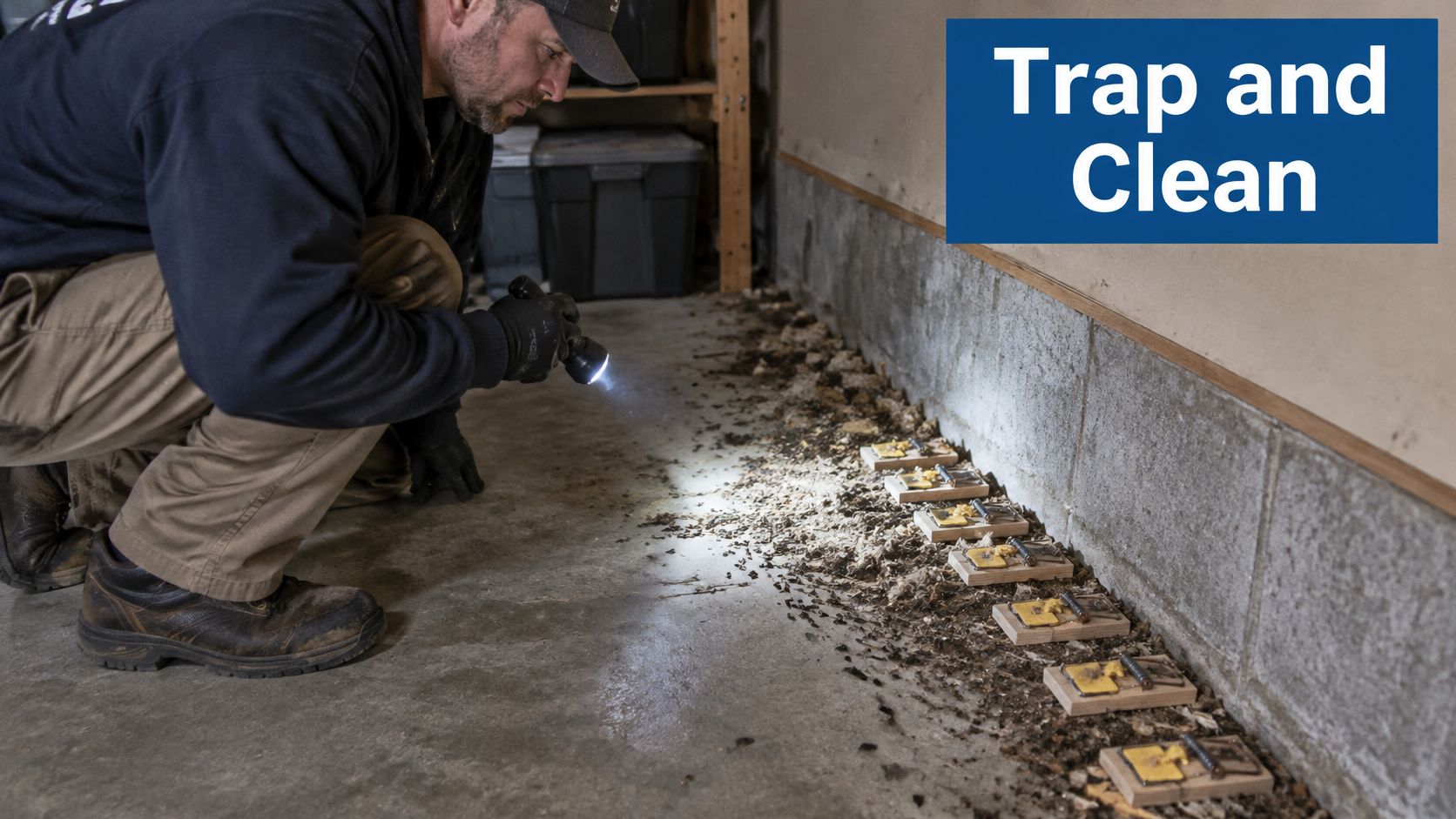
- Buy rat-sized snap traps, at least six of them. Mouse traps are too small and too weak for a rat. The University of Nevada Extension rat control guide recommends at least six traps for an indoor rat problem, spread across every active runway rather than piled in one corner.
- Set them against walls, behind objects, and beside droppings or nest material. Rats travel with their whiskers against a vertical surface, so a trap parallel to the wall and tight to it gets hit far more often than one in open floor.
- Wedge or tie the bait to the trigger. Dried fruit, nuts, oatmeal, a piece of biscuit, or the food they're already taking. If the bait can be lifted off without firing the trap, a woodrat will take it and leave.
- Bait unset for several days. Rats are wary of new objects. Leaving traps unset while they get used to the hardware removes that neophobia.
- Set every station on the same day, once bait starts disappearing. Setting one at a time educates the rest of the population.
- Check daily, wearing gloves, and leave traps in place at least a week before you move them. A quiet trap on day two is not a solved problem.
- Secure the traps against dragging and keep them out of reach of children, pets and poultry. This is why I don't recommend glue boards outdoors or traps scattered loose.
Clean Up Droppings and Nest Material Safely
Rodent waste can carry hantavirus, so never dry-sweep or vacuum a midden. Soak the droppings and nest material with a disinfectant or a bleach solution first, let it sit, then pick it up with gloved hands, double-bag it and put it in a covered outside bin. Wear a mask, keep your hands away from your face, and throw away the gloves rather than saving them.
Why Poison Is a Bad DIY Bet
Residential rat poison isn't a scatter-and-forget product. The EPA rule on pellet-form rat poisons restricts residential sales to block or paste bait inside approved bait stations and bans pellet products for homeowners, and some second-generation anticoagulants stay limited to professional use because of risks to children, pets and wildlife. A rat that dies inside a wall void leaves you with weeks of odor and a sanitation problem no trap will fix.
That's the case for trapping first. If you catch nothing in a week, the step-by-step rat catching guide covers placement troubleshooting, and then it's time to move to sealing.
How to Seal Every Entry Point Once Rats Are Out
Seal last, never first. A woodrat sealed inside a wall cavity or attic will die there or chew its way into living space, which turns a rodent job into a drywall and odor job.
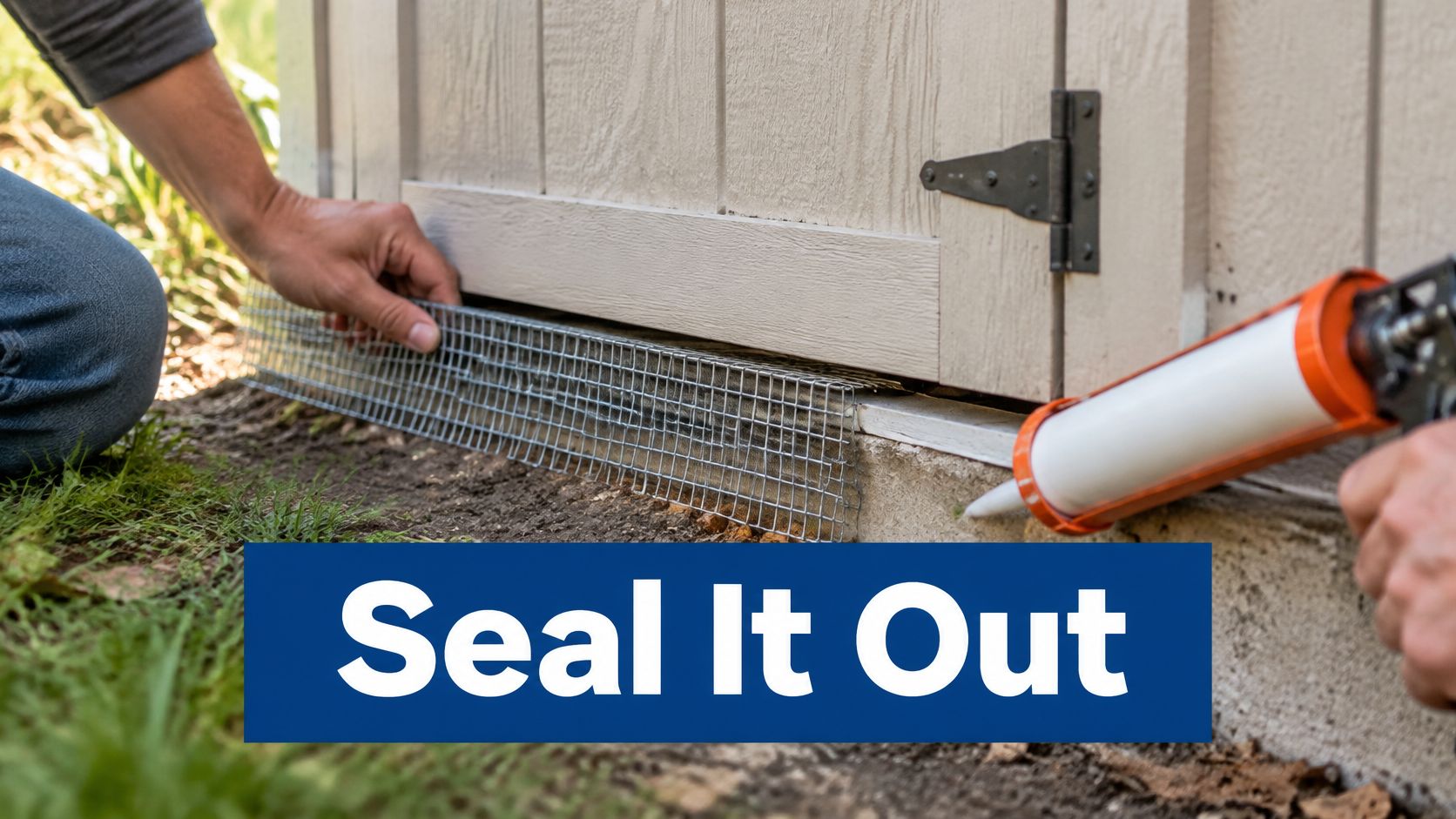
- Confirm the building is clear. No new droppings, gnaw marks or nighttime sounds for several days, and every trap station quiet.
- Inspect high and low. Roofline, attic, soffits, vents, foundation, doors, windows and utility penetrations. Woodrats climb, so attic-level gaps and roof edges matter as much as the foundation sill.
- Measure every gap against the table below. Sealing only the obvious large holes is the most common failure.
- Seal with metal, not foam alone. Metal flashing, concrete mortar or heavy-gauge hardware cloth. Foam gets chewed through in a season. Repair door sweeps and torn screens at the same time.
- Protect plants with smooth sheet metal. For a garden or a single prized shrub, a barrier at least 2 feet tall blocks climbing and feeding.
- Recheck at two weeks for fresh gnaw marks or droppings, and note anything that reappears.
The University of Arizona woodrat guidance treats exclusion and barriers as the most effective method once woodrats enter a structure, and it cites the Colorado State Extension standard that no opening larger than 1/2 inch (1.3 cm) should stay unsealed. The same document recommends clearing brush piles, stored debris and fallen vegetation, and notes that woodrats are capable climbers that often nest in attics. That last point is why a foundation-only walkaround misses so many Southeast Texas jobs, where rooflines, attic vents, dense landscaping and outbuildings all create routes.
| Opening size | Who can use it | Fix |
|---|---|---|
| Under 1/4 inch | Mice and very young rats | Seal with steel wool and sealant, or fine hardware cloth |
| 1/4 to 1/2 inch | Juvenile and adult rats, including pack rats | Seal with metal flashing, concrete mortar or heavy-gauge hardware cloth |
| Over 1/2 inch | Adult pack rats, squirrels and raccoons | Seal with heavy-gauge metal, after confirming no animal is inside |
A gap you can't reach, like a soffit joint behind a finished ceiling or a conduit run through a brick ledge, isn't a gap you should ignore. Photograph it, note the location, and have it inspected rather than stuffing a rag into it. Our guide to identifying and sealing common rodent entry points walks through the spots that get missed most often, including utility penetrations and garage door thresholds.
Decide Between DIY Control and a Professional
A single pack rat working a detached shed or one wall of a garage is a reasonable DIY job: a few traps, an afternoon of sealing, and a week of watching for fresh sign. The math changes when the animal is somewhere you cannot see it, or when the gap you need to close sits behind finished drywall.
| Situation | Start with DIY | Call a professional |
|---|---|---|
| Few droppings in one accessible area | Yes, trap and seal | Only if signs return after sealing |
| Activity in attic, wall void or crawlspace | Limited, only where access is safe | Yes, for inspection and exclusion |
| Raccoons, squirrels or other wildlife inside | No | Yes, for removal and exclusion |
| Children or pets near traps or bait | Limited, traps out of reach only | Yes, to plan the treatment |
| Multiple buildings or a commercial site | No | Yes, for a documented control program |
Service area, plainly stated
Magnolia is an incorporated city in southwestern Montgomery County, Texas, inside the Houston metropolitan area, with its municipal offices at 18111 Buddy Riley Boulevard (City of Magnolia). The incorporated city itself is small, at 2,359 residents across 2.87 square miles in the 2020 Census (U.S. Census Bureau).
Mailing coverage runs wider than the city limits. ZIP codes tied to Magnolia include 77353, 77354 and 77355 (Magnolia, Texas), so a home with a Magnolia address may sit well outside the incorporated boundary, in unincorporated Montgomery County.
That distinction matters when you call. Coverage follows the street address rather than the city name on your mail, and it varies from one provider to the next. FullScope Pest Control has provided pest control and rodent extermination to residents of The Woodlands, TX for several decades; confirm availability for your exact address before booking, and expect an honest answer either way.
What a professional visit includes
Rodent and wildlife work starts with a free inspection and assessment, and the recommendation follows what turns up in the attic, the crawlspace and along the foundation. A proper assessment does three things: it finds the entry points, reads the activity, and names the conditions letting the infestation continue. That last part is what a trap line alone never gives you, and it is why a removed pack rat so often gets replaced by a new one within the season.
Rodent control covers mice, rats, squirrels and raccoons in homes and businesses, with a free rodent control estimate before anything is scheduled. Treatment goes where the animals travel, nest and keep their activity going, and the plan is built around removing the conditions the pests rely on rather than swapping in a temporary fix. If DIY trapping and sealing haven't cleared the activity after two weeks, that inspection is the next step rather than a third round of traps, and our professional wildlife and rodent control services breakdown explains which situations call for an expert.
Budget realistically. Published cost guides such as Fixr's rat extermination cost data put a typical rat extermination job in the hundreds of dollars, with the final figure driven mostly by how many animals are present and how much sealing the structure needs. Weigh that against your own weekends.
Before you buy anything else, take twenty minutes with a flashlight: photograph the midden, map every gap you can reach, and clear the fallen fruit, pet food and brush within a few feet of the building. If traps and a weekend of sealing haven't ended the scratching within two weeks, request a free inspection and estimate and let an assessment tell you where the animals are getting in, rather than guessing at a hole you can see.