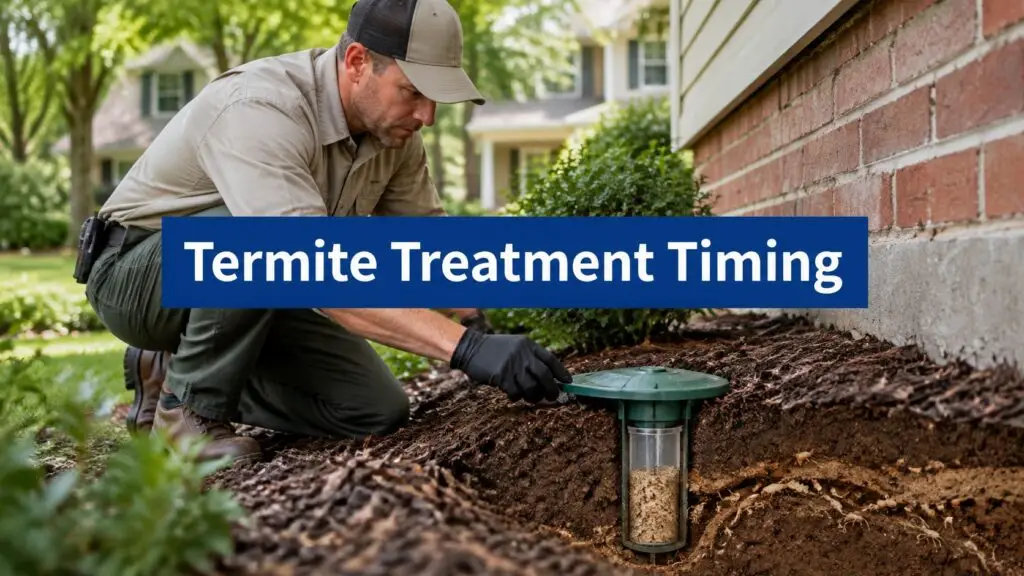
1500+ reviews


Schedule a professional termite inspection once a year, but don't automatically buy another chemical treatment: an intact liquid barrier is often considered for retreatment around 10 years, while bait stations need ongoing monitoring. The popular advice to treat termites annually confuses checking your protection with applying more pesticide.
For a Magnolia homeowner, that distinction affects both the maintenance calendar and the bill. A technician might inspect a foundation, service bait stations, or recommend treatment after finding activity, but those aren't interchangeable services. The right appointment starts with knowing what's already protecting your home and what has changed around it.
How Often Each Termite Method Needs Service
How often to treat for termites follows the method, not one calendar for every house. Start with your treatment paperwork, then match the method to the service it needs.
The intervals below reflect Mississippi State University Extension's termite control guidance, which explains that properly applied liquid treatments can sometimes remain effective for 12 years or longer, are often considered for retreatment near 10 years, and require a different maintenance approach from bait systems.
Termite service intervals by method
| Method | What happens first | Ongoing interval | When full retreatment is justified |
|---|---|---|---|
| Liquid soil termiticide | One application creating a treated soil zone | Professional inspection once a year | Near 10 years, or sooner if moisture or construction compromises the zone; residual can last 12 years or longer |
| In-ground bait stations | Stations placed around the structure; bait added when termites are found | At least annually; monthly during setup or confirmed feeding; quarterly for some systems, subject to the label | Not a one-time endpoint; continue monitoring for the life of the program |
| Spot or partial treatment | Treatment limited to the active area | Recheck that area at the annual inspection, with earlier follow-up when specified | If activity spreads, returns, or a soil barrier has failed |
| Warranty or annual service visit | Inspection and written notes rather than an automatic spray | Usually once a year while the agreement is active | Only with reinfestation, disturbed treated soil, or an expired residual, subject to the product label |
Find out what's already installed
Look for the application date, product name, treatment diagram, and service agreement. A receipt that says termite service without identifying the method isn't enough to plan future work. If you inherited the protection when buying the house, collect the seller's records rather than assuming the installation is still maintained.
A liquid soil treatment creates a treated zone termites must encounter as they move toward the structure. Its useful life isn't just a countdown from installation. Excavating beside the foundation, moving treated soil, or changing site conditions can leave a weakness before the product reaches its expected service life.
A bait program requires continued attention to the stations themselves. The presence of plastic station lids doesn't tell you whether a technician has checked their condition or whether the program is active. Our explanation of what homeowners should know about the Sentricon termite system helps distinguish installed hardware from maintained protection.
Compare methods without buying unnecessary applications
If you're weighing liquid treatment against baiting, consider access, soil disturbance, maintenance requirements, and household precautions together. The Green Advantage's guide to choosing a safe termite treatment is a useful companion when preparing questions about treatment options.
Practical rule: Keep the inspection appointment even when no new chemical application is due.
Don't interpret a long potential residual life as permission to stop checking the house. Equally, don't interpret an annual renewal notice as evidence that the entire property needs treatment again. The inspection findings and the actual product label should determine the next application.
Inspection Visits Versus Chemical Retreatment
Think of a liquid termiticide treatment as a protective fence made from treated soil around the foundation. Checking that fence is an inspection; repairing or rebuilding a compromised portion is retreatment. Paying for the check doesn't mean the technician must rebuild it.
North Carolina State University Extension explains that an annual contract generally means a yearly inspection, with retreatment triggered by evidence of active termites rather than an automatic application. That's an important distinction when comparing estimates that use the same word, service, for different work.
The label controls reapplication
The EPA-approved soil termiticide labeling and retreatment provisions restrict routine annual retreatment unless there's clear evidence of reinfestation, disruption of the treated zone, or breakdown of the barrier. A renewal date alone isn't an application trigger.
Applying more pesticide without identifying an entry route doesn't repair a plumbing leak, remove soil-to-wood contact, or explain why termites bypassed existing protection. A useful recommendation connects the finding to the proposed work: the location, the evidence, and the reason a localized repair or broader application is appropriate.
An inspection examines the foundation and surrounding conditions before that decision.

Expect documentation, not just a verbal all-clear
A useful inspection record should identify what the technician could access and what needs attention.
- Activity evidence: Mud tubes, live insects, swarmers, discarded wings, and damaged wood.
- Entry conditions: Foundation openings, plumbing penetrations, concealed edges, and wood near soil.
- Moisture changes: Leaks, drainage problems, damp crawlspaces, and irrigation against the foundation.
- Property changes: New landscaping, excavation, additions, and repairs near previously treated soil.
Our guide to why termite inspections matter for Texas homeowners provides additional context for what these visits accomplish. Ask for findings you can compare with the next report, not just a statement that someone visited.
The distinction matters financially, too. In 2024, post-construction treatment-only service averaged approximately $1,100, excluding ongoing monitoring, according to CCR Magazine. That's a treatment-cost reference, not a Magnolia quote or an inspection price.
Before authorizing work, have the proposal identify whether you're purchasing inspection, bait monitoring, localized treatment, or broader retreatment. If the recommendation is to treat again, the written explanation should connect that purchase to evidence rather than the anniversary of the last invoice.
Property Conditions and Signs That Move the Next Visit
In Magnolia's Southeast Texas setting, humidity, heavy rain, and irrigation make moisture management part of termite prevention. A sprinkler soaking the slab or water collecting under a raised house deserves attention even when your inspection anniversary is still ahead.
The local address also needs to be precise. The U.S. Census Bureau's Magnolia city profile reports 2.87 square miles of land in 2020, a compact municipal footprint that shouldn't be confused with every property using Magnolia as its mailing city. Whether you're inside that boundary or on a nearby county road, the condition of the property determines whether the next visit should move forward.
Match the inspection to the foundation
A pier-and-beam house needs attention beneath the living space, including piers, plumbing, framing, and damp soil. Don't enter an unsafe crawlspace or disturb questionable framing to investigate. Tell the technician about access restrictions so the inspection can account for them.
A slab home presents different access points. Keep foundation edges visible where practical, and flag plumbing openings, attached porches, and areas where landscaping hides the wall. Mulch, stacked firewood, or grading against the structure can conceal conditions that deserve closer examination.
Our explanation of what attracts termites to Southeast Texas homes can help you separate a correctable site condition from evidence of an infestation. Both matter, but they don't call for the same response.
Signs that warrant a prompt appointment
Don't wait for the scheduled renewal when you find a suspicious change.
- Live termites or fresh mud tubes: Arrange an inspection promptly, especially where tubes cross a pier, slab edge, or foundation wall.
- Hollow-sounding or soft wood: Have the area evaluated. Wood that yields easily to gentle screwdriver pressure may also have moisture damage, so don't assume the cause.
- Discarded wings: Photograph the location and save a sample if practical so the insects can be identified.
- Bubbling paint, sticking doors, or a musty smell: These aren't termite diagnoses, but they justify checking for moisture and concealed damage.
- Standing water or new irrigation overspray: Correct the water source and flag the affected area for inspection.
Photograph each finding and record its location and date. Leave shelter tubes intact until the technician has seen them, and don't cover suspicious wood with paint or filler before evaluation.
Construction can change an otherwise reasonable schedule
A porch addition, plumbing excavation, or regrading job can cut through treated soil. Contact the termite technician before work begins when possible, and share the contractor's excavation area. A damaged, buried, or missing bait station also warrants service rather than waiting for the next routine visit.
Wings on a windowsill justify identification and inspection, not an automatic decision to treat the whole house.
During our termite inspection, we identify the termite type, measure the extent of the problem, and choose the most suitable treatment. That process matters because moisture damage, old evidence, and current activity can look similar to an untrained observer. A warranty inspection documents conditions and protection; it isn't proof that more chemical is due.
Sample Schedules for Common Magnolia Homes
The most useful schedule ends with an appointment you can put on a calendar. These hypothetical Magnolia-area properties show how the same basic guidance leads to different next steps.
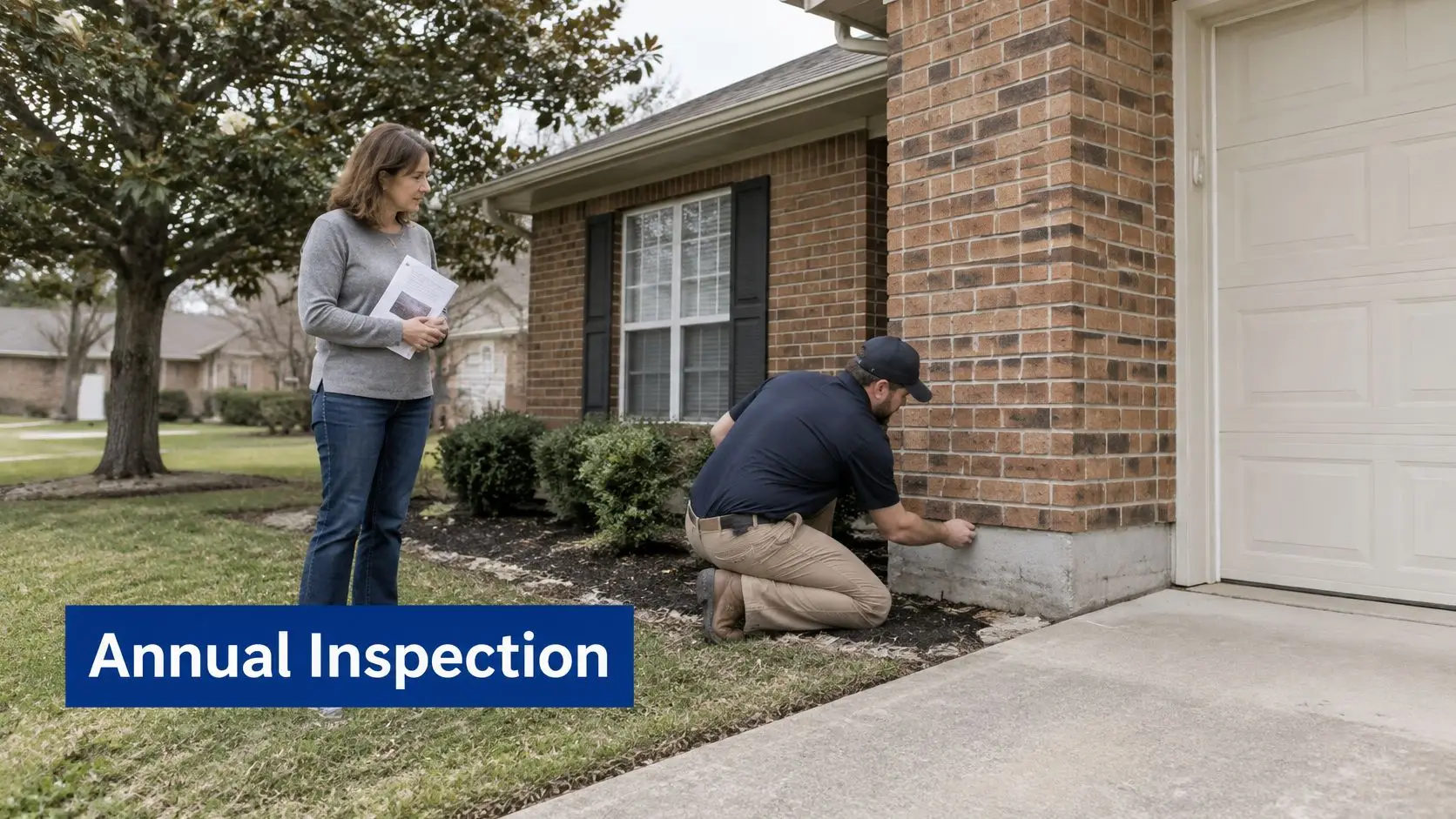
A foundation inspection should account for both the structure and the homeowner's record of changes.
A slab home with an established liquid treatment
Suppose a home inside Magnolia city limits received a liquid treatment four years ago. The owner has the application diagram, hasn't noticed activity, and hasn't excavated along the foundation. The next purchase is an inspection, not a repeat application based solely on elapsed time.
Now suppose the owner plans to enclose the porch and install new footings. The excavation becomes the immediate scheduling issue because it may disturb treated soil. Next calendar action: arrange the routine inspection if due, and contact the termite technician before the porch contractor digs.
A pier-and-beam home beginning a bait program
Consider a raised house where the initial inspection leads to baiting. Stations need to be accessible, documented, and checked during establishment rather than forgotten after installation.
Purdue Extension describes perimeter stations commonly spaced about 10 to 20 feet apart and rechecked monthly by a professional. The spacing is a general description, not permission to override a particular system's installation directions or site requirements.
In our baiting process, we place stations around the structure and monitor them regularly. When termites are detected, bait is introduced so it can spread through the colony. Baiting works gradually rather than instantly, making early detection especially useful before damage escalates.
The homeowner shouldn't move stations to make mowing easier or assume that visible feeding means the program has failed. The technician needs to assess bait consumption, station condition, and activity before changing the service plan.
The video offers another way to understand termite protection and follow-up.
Next calendar action: have the establishment and feeding checks entered into the service agreement, with the next visit booked before the technician leaves.
A home sale in unincorporated Montgomery County
A buyer orders a wood-destroying insect inspection for a property with a Magnolia mailing address outside the city limits. The report records accessible conditions and evidence at the time of inspection; it doesn't reset the age of an existing treatment.
The buyer should request the treatment record, station-maintenance history, and any transferable agreement. If records are missing, the closing date isn't a substitute for knowing what protection exists.
- Before the transaction deadline: Review the inspection findings and resolve any recommended further evaluation.
- After ownership changes: Put the documented method and its maintenance obligations under the new owner's name.
- Next calendar action: Book the service identified by the findings rather than starting an arbitrary treatment countdown from closing.
Magnolia Addresses and Nearby Service Towns
Give the street address, not just Magnolia or a ZIP code, when arranging termite service. A Magnolia mailing address may refer to a home inside the incorporated city or a property in surrounding unincorporated Montgomery County. Those locations can require different travel and follow-up arrangements even though the treatment principles stay the same.
Magnolia sits in southwestern Montgomery County within the Houston metropolitan area. Nearby place names that may help describe a property's location include Conroe, Montgomery, Tomball, and The Woodlands, along with rural county roads. Naming those communities provides geographic context; it doesn't establish that every address is on an available service route.
Confirming the property location is part of booking the right visit.
Municipal boundaries aren't treatment boundaries
A home inside Magnolia city limits doesn't automatically need a different pesticide interval from a similar home just outside them. What matters technically is the installed method, termite activity, foundation construction, moisture, and disturbance around the structure.
What can change is the practicality of ongoing service. A bait program requires return access to the stations, and an inspection agreement needs a workable process when the homeowner reports fresh evidence. Availability for the original installation doesn't, by itself, answer every follow-up question.
Confirm address eligibility before comparing warranty terms. A protection agreement needs to work at the property where the protection is installed.
We shouldn't promise Magnolia coverage based only on a mailing-city label. Ask us to confirm the exact property before you reserve a date or assume a nearby community is included.
Information that helps us confirm the visit
Provide enough detail to distinguish the mailing address from the actual inspection location.
- Complete property address: Include the street number, street name, and any unit or building designation.
- Location context: State whether you know the property is inside Magnolia city limits or in unincorporated Montgomery County.
- Access details: Mention gates, occupied rental units, crawlspace entrances, detached structures, or restricted areas.
- Existing protection: Identify any bait stations or previous liquid treatment so we can understand the purpose of the appointment.
For a rental or commercial property, identify who can authorize work and who will provide access. For a home sale, explain that you need a transaction-related inspection and report rather than assuming every inspection appointment includes the same documentation.
The useful answer is a clear yes or no for your address, followed by the scope of the visit and the follow-up arrangements. That is more valuable than a broad statement about serving north Houston.
Schedule an Inspection Instead of an Automatic Retreat
Choose the appointment that answers your property's current question. If you haven't seen activity and your liquid treatment remains within its expected life, an inspection can evaluate its condition without committing you to another full application. Bring the treatment record and notes about drainage, irrigation, or construction.
If you have bait stations, protect the monitoring calendar instead of treating installation as the end of the job. An overdue station check calls for service, not a guess about whether the system is still functioning. If you've found suspicious evidence, request an inspection that can establish the cause and extent before authorizing corrective work.
Book for the finding, not the anniversary
Use the condition you've observed to describe the appointment.
- No visible activity: Request a routine protection review and inspection.
- Installed bait stations: Request the monitoring and maintenance required by the program.
- Fresh evidence or disturbed soil: Describe the location and request evaluation of the affected area.
- A purchase or sale: Specify that you need a wood-destroying insect inspection and report.
For an additional homeowner perspective on maintaining an inspection habit, Pestless termite inspection timing advice from Pestless Inc. is a useful companion. The important decision remains specific to your home: what needs checking, and what evidence would justify treatment?
Confirm the scope and agreement
We offer free termite inspections for homes and businesses, along with termite control options and wood-destroying insect inspections and reports. Tell us which service you need so we can clarify the appointment and any reporting requirements before you book.
Our policy is to retreat at no additional cost if pests return between treatments. Before relying on that policy for a particular termite agreement, have us confirm the applicable coverage in writing, including whether retreatment is included, whether ongoing inspections carry a fee, and how often visits are required. Don't assume a free initial inspection defines every later service or transaction report.
Contact FullScope Pest Control to request the inspection that matches your existing protection or the signs you've found. Send your treatment paperwork and photos if available, ask us to confirm the warranty terms, and have us verify your exact address, whether it's inside Magnolia city limits, in unincorporated Montgomery County, or near a surrounding community, before locking in the appointment.