1500+ reviews


Personal repellents last a few hours, outdoor residual barrier sprays hold for about two to six weeks, and fogging is short-lived. But when you ask how long does mosquito spray last, do you mean how long it prevents bites, kills mosquitoes on treated surfaces, or keeps the yard's mosquito population lower?
Those are different outcomes. For homeowners in Magnolia, Texas, the useful answer isn't a single expiration date. It's a treatment window tied to the product, the places treated, and what happens in the yard afterward.
Typical Mosquito Spray Duration by Treatment Type
A duration claim only means something inside its own test. A repellent timed on skin, a mat rated per device, and a barrier spray measured on foliage are tracking different outcomes, so the rows below group them by treatment type rather than by a single day count.
Mosquito spray duration by treatment type
| Treatment type | Typical duration | What shortens or extends it | Reapplication guidance |
|---|---|---|---|
| Skin repellent with DEET | A few hours; higher concentrations extend protection | Concentration, formulation, sweat, water exposure | Reapply by label, typically every few hours |
| Skin repellent with IR3535 | A few hours per application | Sweat, swimming, wiping, clothing coverage | Reapply only as the label directs |
| Fogging | Short-lived | Wind, timing, mosquitoes arriving from outside the fog | Follow the product label |
| Thermacell-style mat, standard | Up to 4 hours per mat | Mat exhaustion and the operating conditions specified on the label | Follow the product label |
| Thermacell-style mat, extended | Up to 12 hours per mat | Mat exhaustion and the operating conditions specified on the label | Follow the product label |
| EPA-registered outdoor product | Up to 36 hours in a defined treatment area | Size of treatment area and label conditions | Follow the product label |
| Residual barrier spray, lambda-cyhalothrin | Several weeks of residual control | Rain, irrigation, sunlight, plant growth | Retreat by inspection and label, not calendar alone |
| Residual barrier spray, Demand CS | Several weeks under sheltered conditions | Treated surface, weather | Follow the product label interval |
| Residual barrier spray, Talstar Professional | A shorter residual window on exposed surfaces | Treated surface, weather | Inspect early; retreat only as the label permits |
Two patterns stand out. Every personal-protection product is measured in hours, while residual barrier sprays are measured in weeks. And the week-level figures assume the residue stays put: rain, irrigation, and new plant growth all erode it.
The mat and defined-area figures come straight from EPA outdoor-product labeling examples, which list 4 hours per standard mat, 12 hours per extended mat, and 36 hours for an outdoor product covering a defined area. Those are maximums under label conditions; actual yard performance generally runs shorter.
Ingredient name alone doesn't predict duration; formulation and intended use do. When comparing mosquito-control chemicals, match the product's registered use before comparing numbers. A maximum claim under label conditions never translates automatically to every person, surface, or yard.
Buy for the clock you need: hours of bite protection on skin, or weeks of population control across the yard.
What Lasting Really Measures in Mosquito Control
A mosquito treatment works like a guard posted at specific spots, not a force field surrounding the whole property. A mosquito has to encounter the protection in the way the product is designed to work.
Repellency is the personal-protection clock. It describes how long a product discourages mosquitoes from landing or biting on the protected person. It doesn't tell you whether fewer mosquitoes are living nearby.
Adult knockdown describes the initial effect on adult mosquitoes exposed during treatment or contacting treated resting sites. A strong immediate reduction doesn't establish how long the remaining residue will work.
The population clock matters for yard service
Population suppression describes how long mosquito abundance stays lower in a treated area. That result includes more than chemical persistence: it also reflects whether mosquitoes encounter treated surfaces and how many arrive or emerge afterward.
Consider a hypothetical homeowner who notices a few mosquitoes after day five. That observation alone doesn't establish treatment failure. A hypothetical swarm throughout the yard on day three deserves a different investigation, including coverage, weather, and nearby sources, rather than an automatic repeat application.
A lower population isn't the same as zero mosquitoes. The better question is which outcome matters: personal protection for a backyard party tonight, or sustained reduction that makes the yard more usable throughout the season?
A spray doesn't simply last; it keeps working at a specific job for a specific time.
Personal Repellents and When to Reapply Them
Personal repellents protect a person, while yard barrier sprays treat mosquito resting sites. Apply repellents to skin or clothing only where the particular label permits.
The U.S. Environmental Protection Agency's DEET guidance reports approximately 2 to 12 hours of mosquito repellency, with concentration and formulation affecting protection. Don't interpret the upper limit as an all-day promise.
Sweat, swimming, rainfall, wiping, clothing coverage, mosquito species, and uneven application can shorten useful protection. The label sets both the reapplication directions and the limits you shouldn't exceed.
A practical application routine
- Apply sunscreen first. Let it dry, then apply repellent so you aren't mixing the layers during application.
- Record the application time. A phone note is more reliable than remembering when you stepped outside.
- Recheck after water or heavy sweating. Reapply only as the label permits, even if swimming or toweling has reduced protection.
- Cover exposed skin. Long sleeves can reduce the amount of skin needing protection during evening activities; apply repellent to clothing only when allowed.
- Store the container properly. Keep it away from excessive heat and check any expiration information before relying on it.
Reduced effectiveness isn't permission to exceed the application limit. Personal-repellent timing concerns protection on your body, not the retreatment schedule for vegetation around your home.
Residual Barrier Sprays and Their Weeks of Control
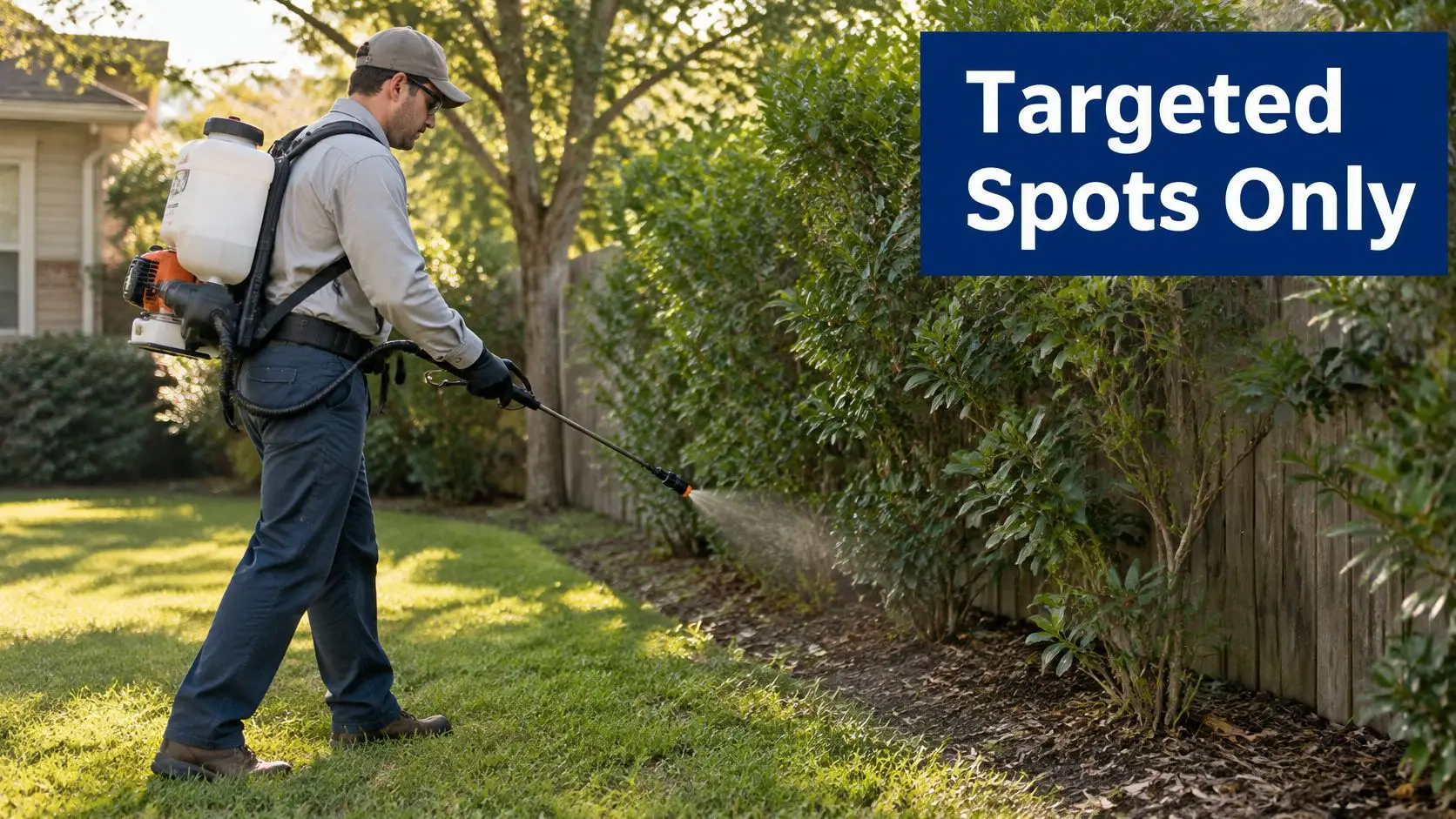
A residual barrier spray leaves insecticide on permitted vegetation and other resting surfaces, where mosquitoes can contact it after application. Its useful duration is best judged by continued suppression, not whether an application occurred recently.
In a Rutgers field study of suburban New Jersey properties, lambda-cyhalothrin reduced adult Aedes albopictus abundance by roughly 74–78% relative to untreated controls and maintained at least 70% control for 2–4 weeks, according to the Journal of Medical Entomology study. Those are population-reduction results in a specific setting, not a guarantee that every Texas property will follow the same timetable.
Translate the finding into a yard plan
Suppression means the treated properties had fewer mosquitoes than untreated properties. It doesn't mean all mosquitoes disappeared, or that every nearby breeding location was treated. Mosquitoes can enter from neighboring vegetation and containers even while residue remains active.
For a Southeast Texas yard, inspection should focus on shaded foliage, dense ornamental plants, fence lines, and other adult resting sites. The application must reach appropriate surfaces at the labeled rate. Adding more product isn't a substitute for finding the places mosquitoes use.
Standing-water removal belongs alongside that work. Otherwise, a treatment can keep killing exposed adults while replacement mosquitoes continue emerging nearby.
Track performance instead of guessing
Use this as an example monitoring routine, not a mandatory pesticide schedule:
- Mark the treatment date. Record the product name and any rain or irrigation afterward.
- Walk the yard around day 10. Note where adult activity is concentrated without deliberately exposing yourself to bites.
- Compare conditions at two weeks. Use the same observation locations and similar times of day as your pretreatment check.
- Choose the next visit from observations and label limits. Don't automatically spray again because a calendar reminder appeared.
For complementary approaches around outdoor seating, MODERN LYFE's guide to the best mosquito and fly deterrents can help frame options to evaluate alongside habitat reduction. Check each option's intended use rather than assuming every deterrent provides residual yard control.
Success means fewer bites and more usable outdoor time, not how long spray remains visible on a leaf.
Weather, Vegetation and Surfaces That Shorten Protection
| Condition | Effect on protection | What to do |
|---|---|---|
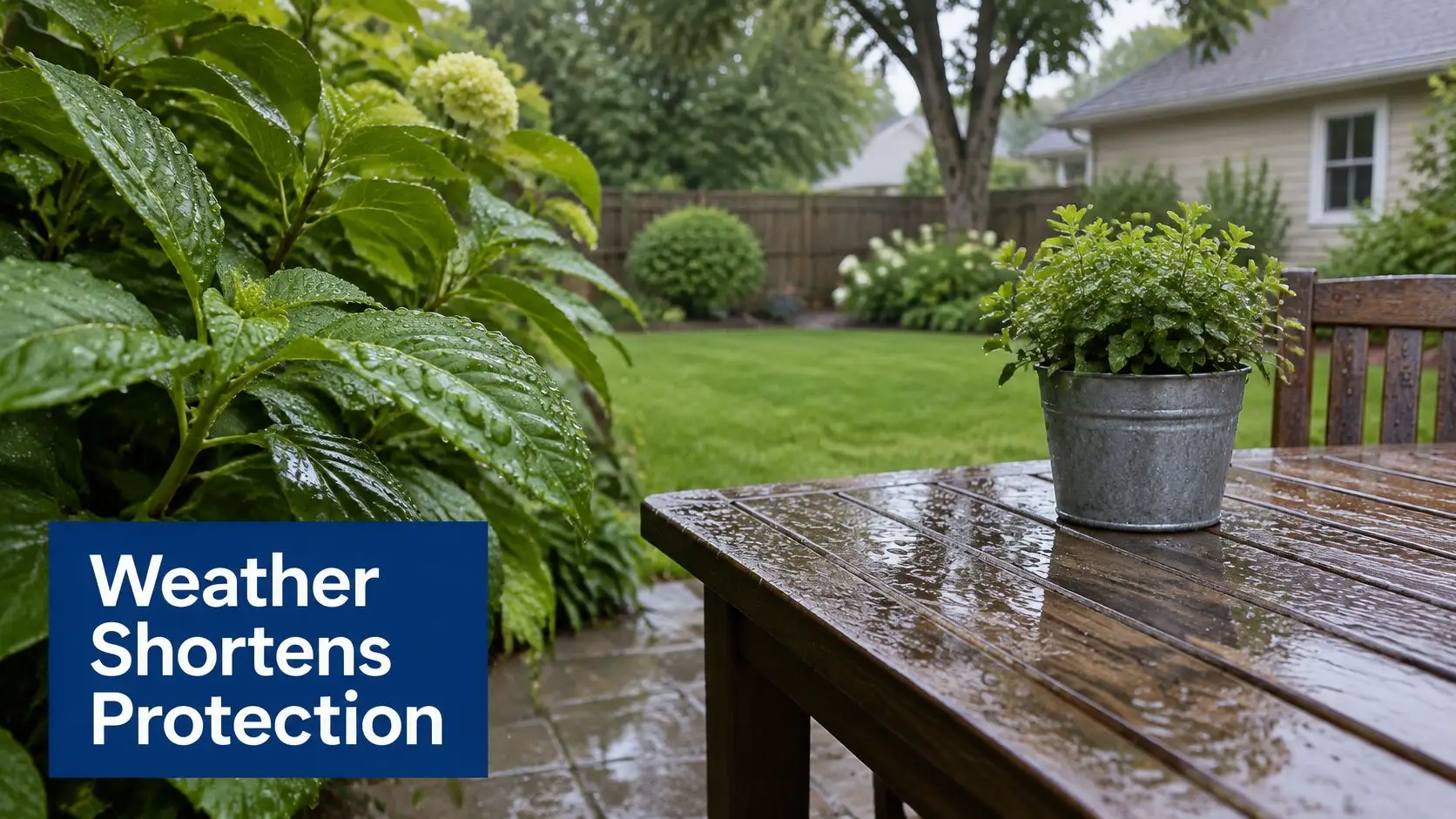
| Regular rainfall | Can wash residues off and jeopardize continued efficacy | Reassess activity after storms; retreat early only if needed and label-permitted |
| Intense sunlight | Speeds breakdown on exposed surfaces | Prioritize appropriate shaded foliage and leaf undersides |
| Frequent irrigation | Can shorten the practical interval on watered beds | Identify watered treatment areas and recheck them sooner |
| Dense foliage and sheltered structures | Provides resting habitat and may protect residues | Inspect under decks, dense shrubs, and fence lines; treat only permitted sites |
| Active ingredient and formulation | Persistence differs widely between products | Confirm the exact product and its labeled application interval |
Rain doesn't give every treatment the same expiration date. Its effect changes with the product, exposure, and treated surface, so a storm should prompt reassessment rather than an automatic extra application.
A controlled barrier-treatment study published in Environmental Entomology found that Demand CS retained significant effectiveness through 8 weeks, although mortality fell to approximately 55%, while Talstar Professional reached control-level performance after approximately 2 weeks. This is why product-specific results matter more than a generic claim that professional spray lasts a month.
Read the exposure pattern
Sunlight creates uneven performance. Exposed beds receive more intense light than shaded leaf undersides or sheltered landscaping. Don't use the condition of a protected corner as proof that an open bed still has equivalent protection.
Irrigation adds another source of water exposure. Tell the technician which beds receive frequent overhead watering. Don't change watering or application timing without considering the plant's needs and the pesticide's drying and application directions.
Dense foliage creates a trade-off: it can shelter residues, but it also provides adult resting habitat and makes thorough coverage more difficult. A protected surface helps only if the application reaches the appropriate mosquito resting area.
Formulation changes the interpretation
Different formulations can perform differently even when they're used for the same broad purpose. Ask which exact product was applied and what the label allows, rather than asking only whether the treatment was professional strength.
If activity increases after a storm, understanding why mosquitoes become more noticeable after rain helps separate possible residue loss from changes in mosquito pressure.
Planning rule: Use the most exposed area you need protected to trigger inspection, not the average condition across the property.
The same visit can produce a longer useful result beneath a covered patio and a shorter result in an exposed, frequently watered bed.
Why Mosquitoes Return Before the Spray Wears Off
Are mosquitoes back because the treatment failed, or because new adults arrived? Seeing mosquitoes again doesn't answer that question by itself.
Outdoor adult treatments don't eliminate eggs and larvae in every nearby water source. Adults can emerge outside the treated footprint or enter from adjoining properties, creating renewed biting pressure without proving that all remaining residue has stopped working.
The CDC's homeowner mosquito-control guidance describes professional spraying aimed at cool, dark, humid resting sites, including beneath decks, furniture, sheds, and play equipment, and says it usually kills mosquitoes for several weeks. That's a conditional description of control, not a promise that no mosquito will cross the property line.
Use the return pattern as a clue
- Widespread activity after heavy rain. Suspect reduced residual performance, but don't treat the timing as proof. Record the rainfall and ask for a review of application coverage and treated areas.
- Gradual activity along the lot edge. Look for adjoining vegetation, water-holding containers, or other potential sources. This pattern can justify a perimeter inspection rather than indiscriminate spraying throughout the yard.
- New activity near household clutter. During a weekly walkthrough, empty water from containers, plant saucers, toys, and folded tarps. Clear clogged gutters safely or arrange professional help.
- A recurring increase before the next visit. Keep notes on where biting occurs and what changed. Set the next treatment from pressure, weather, and label directions instead of a universal calendar promise.
These are diagnostic clues, not definitive tests. A homeowner can document where mosquitoes appear, but that observation alone can't identify the species, measure remaining residue, or establish the cause of a rebound.
For apartment communities and commercial grounds, include irrigation zones and shaded common areas in the record. A report that mosquitoes are back is less actionable than identifying the affected courtyard, nearby water, and recent watering changes.
No spray can compensate for a property that continually produces new mosquitoes.
Magnolia, TX Yards and Realistic Spray Timelines
Two yards sharing a Magnolia mailing address can age a treatment very differently. Magnolia sits in southwestern Montgomery County, Texas, at the junction of Farm-to-Market roads 1774 and 1488; the City of Magnolia's location guide places it approximately 25 miles southwest of Conroe and 45 miles northwest of Houston, while the Texas State Historical Association places it about 20 miles southwest of Conroe. Spray longevity here is a property question, and location alone will not answer it.
The population figures make the same point. The U.S. Census Bureau's Magnolia profile reports 2,359 residents in the incorporated city in 2020; the Texas State Historical Association records 2,153 in 2019. Development beyond that small boundary follows the same roads and creeks, so addresses carrying the Magnolia name range from compact in-town lots to wooded acreage.
That spread is why a single day count misleads. On skin, lasting means hours of repellency; on treated surfaces, days of knockdown; for a yard, it means weeks of suppression. Only the third applies to a barrier treatment, and each yard below reaches a different point inside that window.
Different yards need different checkpoints
A sheltered backyard. A covered patio ringed by shaded planting beds sits at the longer end of a product's treatment window, since the residue is shielded from direct sun and rain. At the midpoint of that window, compare activity around the seating area with activity at the shaded perimeter.
An exposed, irrigated lawn. Sun and frequent watering pull this yard toward the shorter end of the same window, so schedule the midpoint check earlier and add an inspection after storms. Compare the watered beds with sheltered planting before judging the whole yard's performance.
A creekside or wooded-edge property. Adults arriving from resting habitat past the boundary can make suppression look weaker even where the residue still works. At the midpoint, check whether biting stays concentrated along the edge or has reached the areas you use.
When edge pressure persists across visits, an automatic mosquito misting system applies treatments on a timer through positioned nozzles. That changes how often the yard is treated; it says nothing about how long a single application lasts.
Local takeaway: Match the inspection calendar to the property's exposure and mosquito pressure; a Magnolia mailing address predicts neither.
Seasonal weather still shifts the answer. Adjust each checkpoint to what the yard shows, and keep every treatment inside its label directions.
Set Your Retreat Schedule Before Mosquito Season Peaks
- Decide the job. Do you need personal bite protection for an event or lower mosquito counts across the property?
- Choose the category. Use an appropriate personal repellent for the person and consider residual treatment for yard suppression.
- Record the treatment and permitted retreat window. Keep the product name with your weather and activity notes.
- Confirm the service terms. Ask us to identify the product, label interval, and applicable follow-up policy in writing.
We're FullScope Pest Control, a licensed pest management company serving Southeast Texas. We offer Mosquito Control Barrier Spray and Mosquito Misting Systems by MistAway. Barrier sprays and automated systems reduce seasonal mosquito populations and are popular for homes near creeks, wooded lots, and lake properties.
Our policy provides retreatment at no additional cost if pests return between treatments. Confirm in writing how that policy applies to your mosquito service, rather than assuming a particular guarantee.
Magnolia isn't named among our listed service areas, which include Conroe, Montgomery, and Porter, so confirm coverage for your exact Magnolia address before booking.
Contact us to confirm your address and arrange a yard assessment. Share where you're getting bitten, which beds receive irrigation, and whether you have a covered patio, creek, or wooded boundary so we can recommend an appropriate treatment and inspection schedule.