1500+ reviews

On a January morning in Magnolia, you may find a spider in the garage, tucked beside a bathroom window, or resting in a quiet corner that looked empty the day before. Then, as spring warms the yard, webs and wandering spiders seem to return all at once. That pattern can make it feel as though spiders disappear for winter and somehow reappear from nowhere.
The answer to how do spiders survive the winter is more varied. Some slow their metabolism in leaf litter or soil, some shelter as eggs inside silk sacs, and some use natural antifreeze chemistry to stay functional in freezing conditions. In Southeast Texas, a protected garage, shed, woodpile, or indoor corner can matter more than the calendar.
Why Spiders Seem to Vanish When Winter Arrives
A Magnolia homeowner might notice fewer webs after a run of cold nights. Outdoor prey becomes harder to find, spider movement slows, and many individuals retreat into places where wind, moisture loss, and rapid temperature changes are less severe. The yard looks quiet, but the spiders haven't necessarily vanished.
A spider under loose bark is following a different survival plan from a house spider behind a storage box. One may enter diapause, a dormancy-like state that reduces feeding and movement. Another may remain active because a garage stays mild and insects still reach the light near the door. A third may already have completed its adult life cycle, leaving eggs protected inside a silk sac.
That difference explains why a bathroom sighting in January doesn't contradict the quiet garden outside. The spider indoors has access to a buffered microhabitat, while its outdoor relatives may be conserving energy beneath leaves or inside a crack in the soil. Your home can function as an accidental winter shelter, especially around garages, sheds, attics, and undisturbed storage.
A useful question: Don't ask only whether spiders hibernate. Ask which species, which life stage, and which shelter are involved.
Seasonal pest movement can also bring other insects toward protected areas around buildings, which may indirectly give hunting spiders a reason to remain nearby. This overview of fall overwintering pests and their shelter-seeking behavior helps explain why a winter spider sighting can be part of a broader shelter pattern.
The practical lesson is simple. Winter sightings tell you where conditions are favorable, not necessarily how large the outdoor population is. Understanding the biology helps you decide whether to leave an occasional harmless visitor alone, remove a web and egg sac, or inspect the places that repeatedly offer shelter.
How Cold Blooded Biology Shapes Winter Survival
Spiders are ectotherms, so they don't generate enough internal body heat to keep their temperature steady like mammals do. Their activity follows the temperature around them. As the environment cools, muscles work more slowly, digestion changes, and movement becomes expensive.
Diapause reduces the winter bill
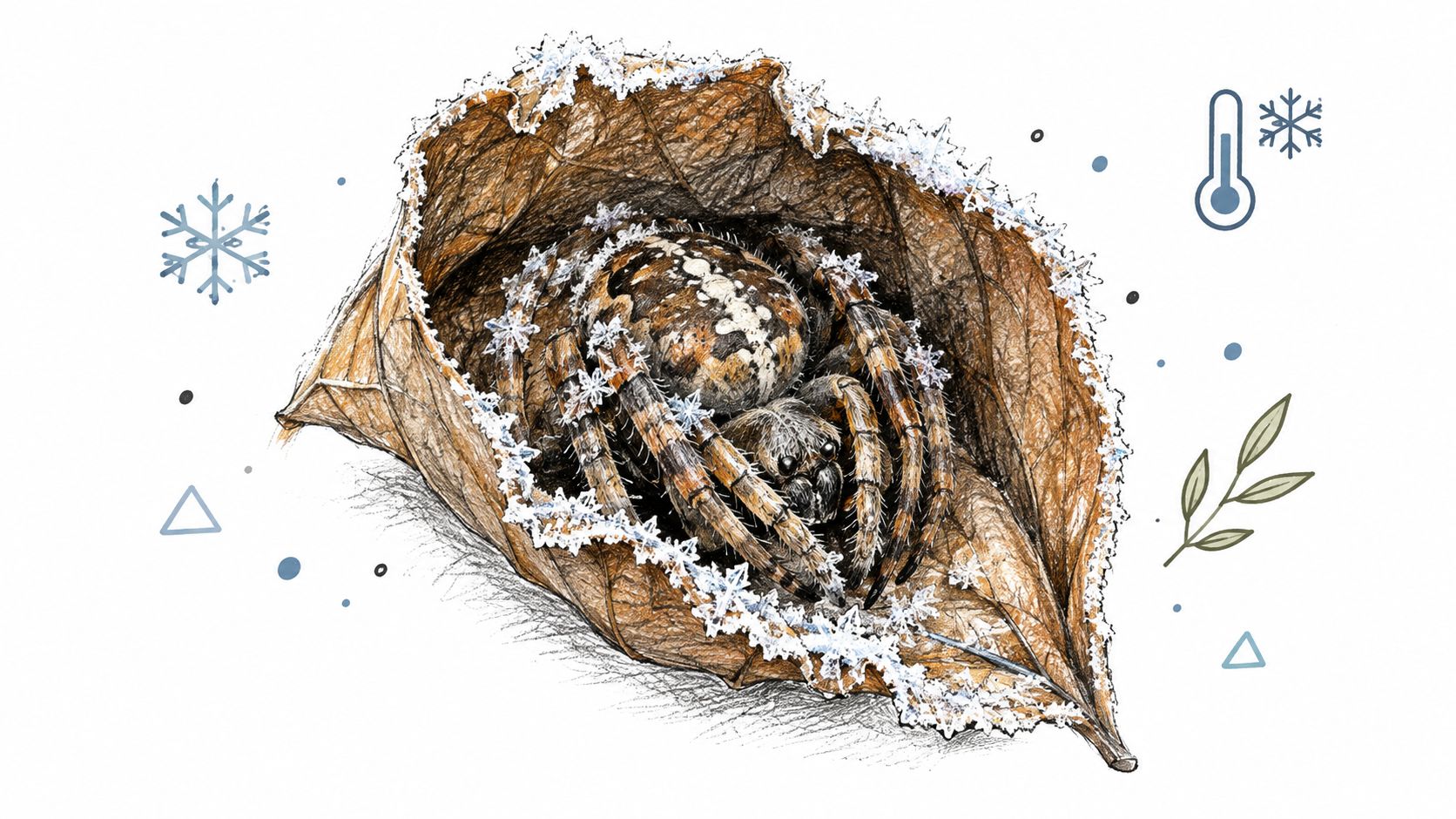
Most temperate-zone spiders survive winter by entering dormancy and suppressing metabolism, a cold-season strategy commonly described as diapause. Growth, movement, and feeding decrease, which lowers energy demand when prey is scarce and temperatures approach or fall below freezing. Spiders also use leaf litter, logs, bark crevices, and soil spaces that buffer temperature swings and reduce desiccation risk, as described by the University of Cincinnati's explanation of winter spider survival.
Think of diapause as putting a house into low-energy mode. The thermostat drops, lights stay off, and only essential systems keep running. A dormant spider isn't necessarily asleep in the mammal sense. It has reduced its demands so stored energy lasts through a period when insects are difficult to catch.
Some spiders pull their legs close to the body while activity slows. That posture reduces exposed surface area and helps the animal remain still inside its shelter. The spider's survival depends on the combination of lower energy use and a location that protects it from the worst outdoor conditions.
Shelter completes the strategy
Cold alone isn't the only problem. A spider can lose water, experience repeated freeze and thaw cycles, or spend valuable energy responding to temperature changes. Leaf litter, rotting wood, bark gaps, and soil spaces provide a more stable pocket than an exposed plant stem or open wall.
This is why two nearby spiders may experience the same weather differently. One is exposed and vulnerable, while another is insulated by layers of leaves. In a Magnolia home, the same principle applies to the gap beneath a door, a garage corner, or a box that hasn't moved in months. Protection changes the conditions the spider must survive.
The Hidden Science Behind Staying Alive in Freezing Temperatures
“Hide or hibernate” is a useful starting point, but it doesn't describe every spider. Some species combine shelter with biochemical cold hardening, adjusting their body fluids as temperatures fall gradually.
Natural compounds protect delicate tissues
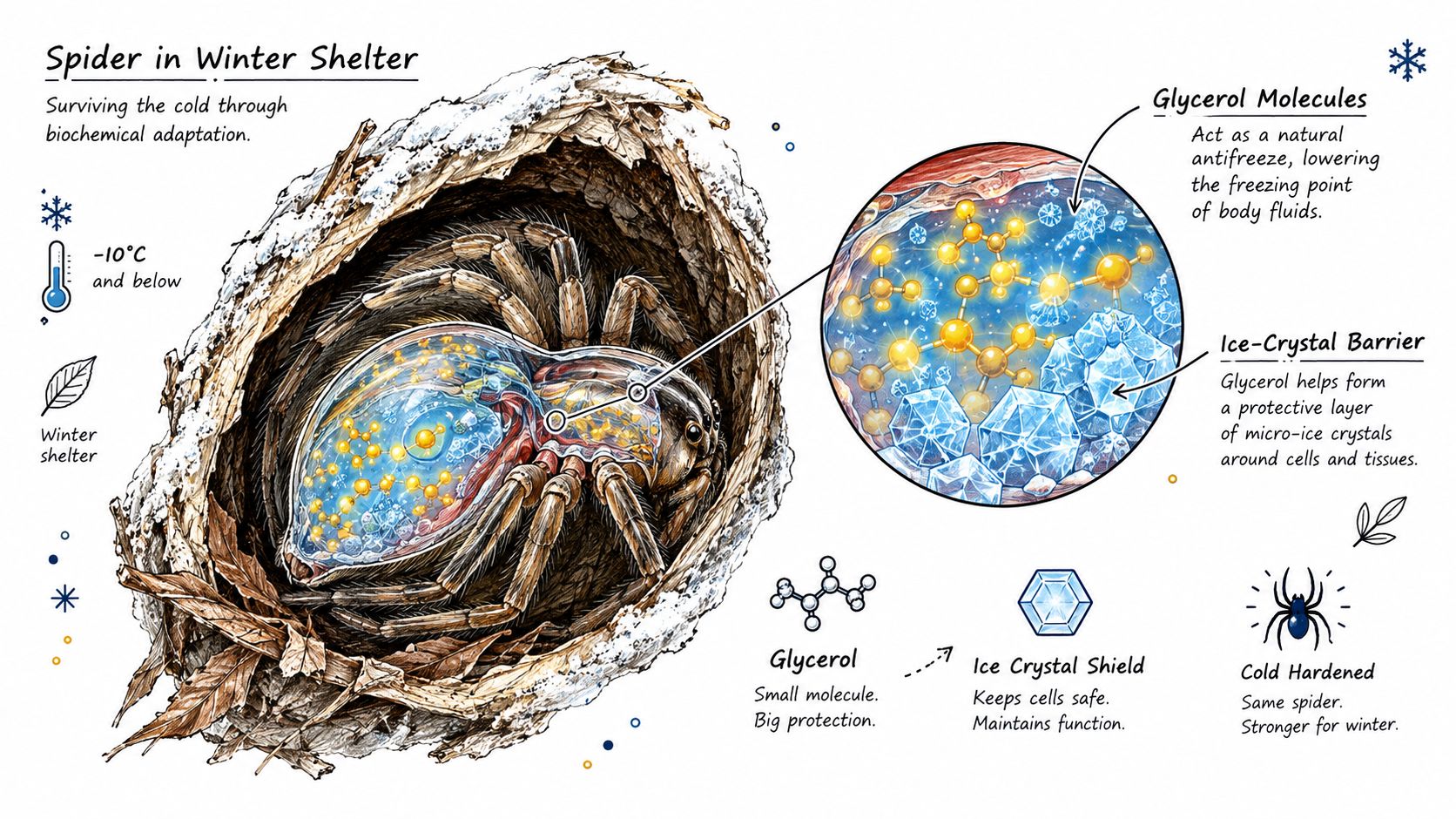
Some spiders accumulate cryoprotective compounds, including glycerol or antifreeze proteins, during gradual cooling. These substances lower the freezing point of body fluids and can interact with ice crystals, preventing them from growing and rupturing tissues. That mechanism lets certain winter-active spiders remain functional at sub-zero temperatures instead of freezing solid, according to this Wiley account of cold survival in winter-active spiders.
The chemistry doesn't make every spider invulnerable. Producing and maintaining protective compounds has a biological cost, and the benefit depends on the species, the rate of cooling, and the conditions inside the shelter. A spider exposed to gradual cooling may adjust more successfully than one struck by a sudden freeze.
This distinction matters because “cold tolerant” doesn't mean “active in every freeze.” Some spiders remain almost motionless in protected spaces, while others can continue limited movement or feeding. A winter-active species may pay for that activity with greater energy use, while a dormant species avoids the expense but gives up growth and reproduction until conditions improve.
Survival is a tradeoff, not a switch
Research summarized in reporting from Queen's University on spider antifreeze and overwintering describes winter survival as species-specific and dependent on life stage and location. One overwintering study reported overall survival ranging from 0.31 to 0.75, with older stages surviving substantially better than younger ones, so a spring increase doesn't mean every individual made it through.
Some species may continue growing through winter instead of shutting down completely. Others survive primarily as eggs or juveniles. The result is a patchwork of outcomes. Average winter temperature alone can't tell you which spiders will be visible in March, because shelter quality, sudden cold, moisture, and life stage all influence the result.
A related preprint examining a cold-adapted northern spider population found that different winter temperature regimes didn't change survival probability or body lipid stores in that population, while other winter-active spiders may still face stress during harsh cold spells. The reported overwintering findings support a careful conclusion: a warmer winter isn't automatically easier, and a brief freeze can matter even when seasonal conditions seem mild.
For homeowners, this science explains why winter control can't rely on one assumption. A spider in an insulated garage may be active, an egg sac outdoors may be waiting for spring, and a sheltered individual may be conserving energy without moving at all.
Where Different Spiders Spend the Winter and Which Life Stage Makes It
The best winter shelter is often small, layered, and easy to overlook. Leaf litter cushions temperature changes. Soil cracks limit exposure to wind. Rotting logs and loose bark create enclosed spaces, while stone walls offer narrow gaps that remain more stable than open ground.
A widely cited estimate says about 85% of overwintering spiders spend the coldest months under leaf litter, and about 85% of temperate spider species may go dormant for winter, according to this overview of spiders in winter. Those figures describe broad temperate patterns, not a prediction for every Texas yard or every species in it.
Shelter and life stage work together
Eggs, juveniles, and adults don't have identical needs. A silk egg sac can protect developing young while the adult that produced it no longer survives the coldest period. Juveniles may remain hidden and delay growth, while older spiders can have more stored energy or stronger cold tolerance.
| Shelter Type | Primary Life Stage Protected | How It Helps Survival |
|---|---|---|
| Leaf litter | Dormant juveniles and adults | Insulates against rapid temperature shifts and limits exposure |
| Soil cracks | Small juveniles and adults | Provides a narrow, buffered space away from wind and drying air |
| Rotting logs | Adults and juveniles | Offers enclosed shelter with moderated temperature and moisture |
| Loose bark | Adults and juveniles | Creates protected pockets above the ground |
| Stone walls | Adults and juveniles | Supplies crevices that reduce direct exposure |
| Silk egg sacs | Eggs and developing young | Surrounds the next generation with a protective structure |
Spiders may pull their legs tight and reduce activity inside these shelters. Others remain protected as eggs that hatch when spring conditions support feeding and growth. This helps explain the spring rebound. The population you notice later may include survivors from several life stages, not just adults that endured every cold night.
Use care around egg sacs
A rounded silk bundle in a quiet corner may contain eggs rather than a cluster of adult spiders. If you want to remove it from a home, use a vacuum with care and empty the canister or bag promptly according to the equipment instructions. For a closer look at safe removal considerations, see this guide to removing spider eggs from indoor spaces.
The location also gives you a clue. An egg sac in a garage points to a sheltered breeding site, while repeated sacs near a window, vent, or door suggest an entry route or a nearby insect source.
What Winter Looks Like for Spiders in Southeast Texas and Magnolia
A Magnolia winter doesn't create the same conditions as a consistently frozen northern environment. Spider activity often drops after sustained cold, but a protected structure can remain suitable for hiding or movement. In Texas, sheds, garages, woodpiles, and undisturbed spaces can keep spiders active or concealed, so visibility depends more on protection from the elements than on the season itself, as explained in this Texas spider activity guide.
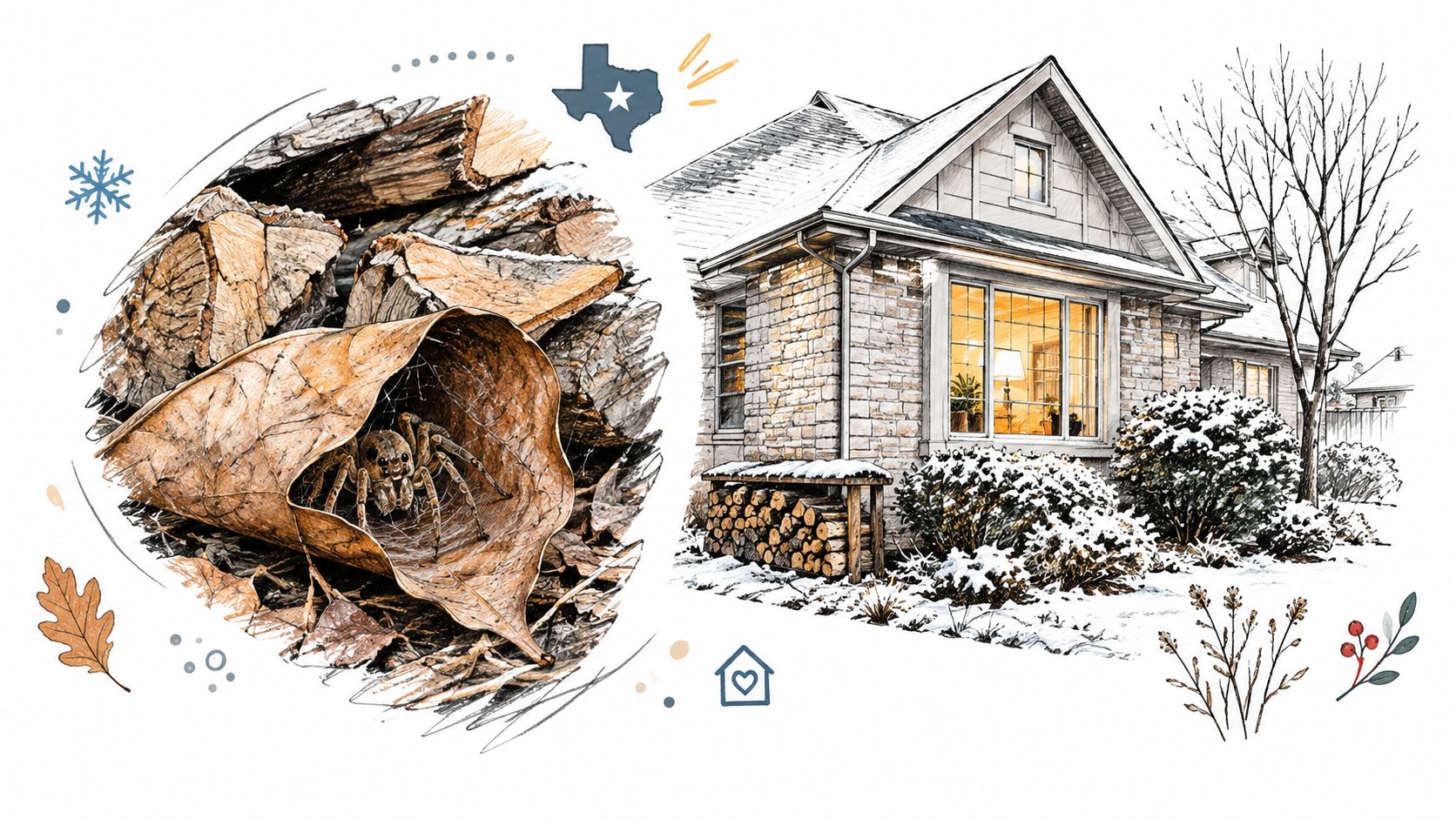
Consider two Magnolia homes on the same street. In the first, the garage door seals well, stored items sit on shelves, and the wall corners stay dry. A spider may still appear because the garage offers shelter and occasional prey. In the second, boxes rest on the floor beside a damp wall, firewood sits near the foundation, and leaves collect around the exterior. That property offers more concealed places for spiders and the insects they hunt.
Texas has almost 900 spider species, while only 2 groups are considered venomous to humans, according to Texas Parks and Wildlife's arachnid safety information. That combination means residents should avoid panic when they see a spider, while still treating uncertain specimens carefully and keeping children and pets from handling them.
Winter sightings often come from house-associated spiders that tolerate indoor conditions, or from outdoor species temporarily using a protected structure. Other spiders may remain outside in egg sacs or sheltered vegetation, so you won't see them until warmer weather brings movement and prey back.
The pattern is local and visual. A spider in a bathroom may indicate a gap, a nearby insect, or a warm undisturbed corner. A web in a woodpile may reflect a stable outdoor shelter. Look at the surrounding conditions before assuming the season itself caused the sighting.
Keeping Spiders Out of Your Magnolia Home This Winter
Winter prevention works best when you remove the shelter features spiders use. You don't need to eliminate every leaf or insect from the property. Focus on the routes and pockets that connect outdoor habitat with indoor rooms.
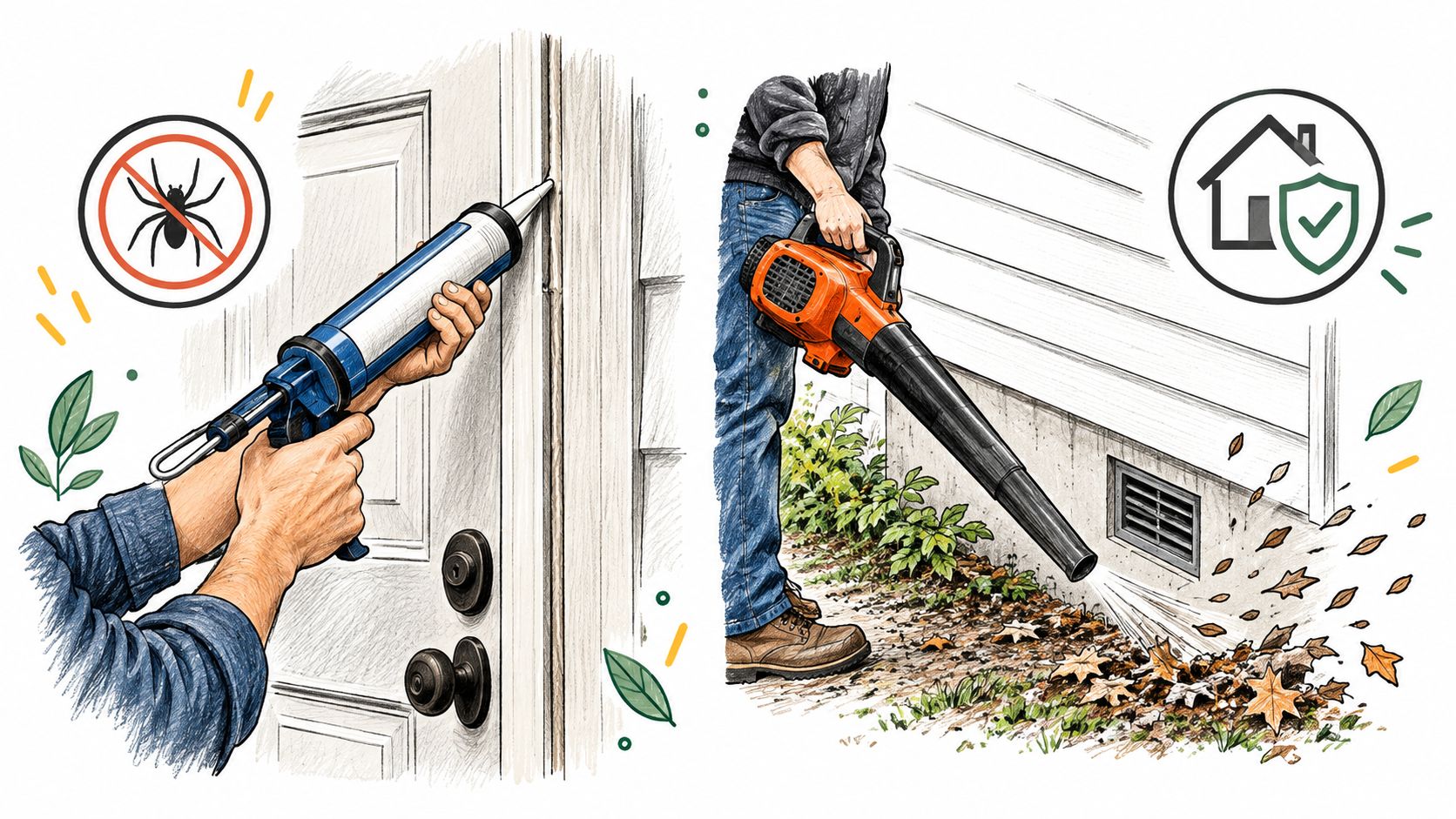
Start at the exterior boundary
Walk around the house during daylight and check where walls meet doors, windows, vents, utility penetrations, and the foundation. Add suitable caulk or weather stripping to small gaps, repair damaged screens, and make sure exterior doors close against a continuous seal. A door sweep can close the low gap that lets insects and spiders move between the garage and living areas.
Move leaf piles, loose boards, and wood storage away from the foundation where practical. Trim vegetation that touches siding or blocks inspection areas. You aren't trying to make the yard sterile. You're reducing the protected, connected pathway that leads toward the house.
Make indoor shelters easier to inspect
Garages and storage rooms deserve special attention because they combine darkness, clutter, and infrequent disturbance. Keep boxes off the floor when possible, leave space around walls, and vacuum webs and egg sacs from corners, ceiling edges, and behind stored materials.
Manage moisture in damp areas, especially around plumbing, doors, and poorly ventilated storage spaces. A dry, accessible corner is easier to monitor than a crowded one, and regular inspection helps you notice whether sightings are isolated or recurring.
Use a flashlight and vacuum rather than reaching into a dark stack by hand. If you can't identify a spider, don't handle it. Capture a clear photo from a safe distance or leave the specimen undisturbed until it can be assessed.
For broader entry-point work, use this home pest-proofing guide as a practical checklist.
Choose the right level of control
An occasional web can often be handled with cleaning and exclusion. Repeated sightings, multiple egg sacs, or activity in several rooms suggests that the property may be supplying both shelter and prey.
FullScope Pest Control offers residential spider control, inspections, targeted treatments, and recurring quarterly or biannual plans, with service locations that include Magnolia and nearby communities such as Cleveland, Kingwood, Conroe, and Porter. A licensed technician can inspect likely entry points and harborage areas, then discuss integrated pest management and lower-toxicity options for households with children or pets.
Practical rule: Seal the route, reduce the shelter, and address the insects that provide food. Spraying visible webs alone won't correct the conditions that keep bringing spiders back.
What to Remember Before Spring Brings Spiders Back
Spiders don't use one universal winter switch. Their survival depends on a combination of species, life stage, physiology, and shelter. Some enter diapause, some remain protected in egg sacs, and some use cryoprotective chemistry to tolerate freezing conditions.
For a Magnolia homeowner, the most useful seasonal checklist is straightforward:
- Inspect seals: Check garage doors, exterior doors, window screens, vents, and foundation gaps.
- Reduce harborage: Move woodpiles and debris away from the house, and keep leaf buildup from collecting against walls.
- Organize storage: Raise boxes, clear corners, and make garages easier to vacuum and inspect.
- Control moisture: Investigate damp areas instead of allowing them to remain undisturbed.
- Remove carefully: Vacuum webs and egg sacs, and don't handle unidentified spiders.
- Watch the pattern: Note whether sightings stay in one area or spread through the home.
Texas residents face a diverse spider population, but only two groups are considered venomous to humans. That should reduce unnecessary alarm, not replace sensible caution.
If spiders continue appearing after you improve exclusion and storage conditions, schedule a home inspection with a local QualityPro certified pest provider. For Magnolia homeowners who want a one-time assessment or ongoing protection before spring activity increases, contact FullScope Pest Control to discuss an inspection and a plan suited to the property.
Call FullScope Pest Control to arrange spider control for your Magnolia home, identify the shelter and entry conditions behind recurring sightings, and choose between targeted service and scheduled protection.