1500+ reviews

Yes, armadillos do dig holes, and they're prolific diggers. They dig for two main reasons: to find food in shallow holes that are 1 to 3 inches deep and 3 to 5 inches wide, and to create shelter in much larger burrows that can reach up to 7 feet deep and 20 feet long.
If you're in Southeast Texas and you've walked outside to find fresh holes across the lawn, around flower beds, or near the slab, you're probably trying to answer two questions fast. What's making these holes, and how serious is it? That's a fair concern, especially in places like Kingwood, Conroe, Porter, and nearby communities where soft soil, moisture, and active insect life can make a yard very attractive to wildlife.
Most homeowners first notice the surface damage. The bigger issue is what that digging means. Sometimes it's just overnight feeding in the yard. Sometimes it's a shelter burrow tucked under shrubs, beside a sidewalk, or near a structure. Knowing the difference matters, because the right response depends on what the animal is doing.
Your Guide to Mysterious Holes in the Lawn
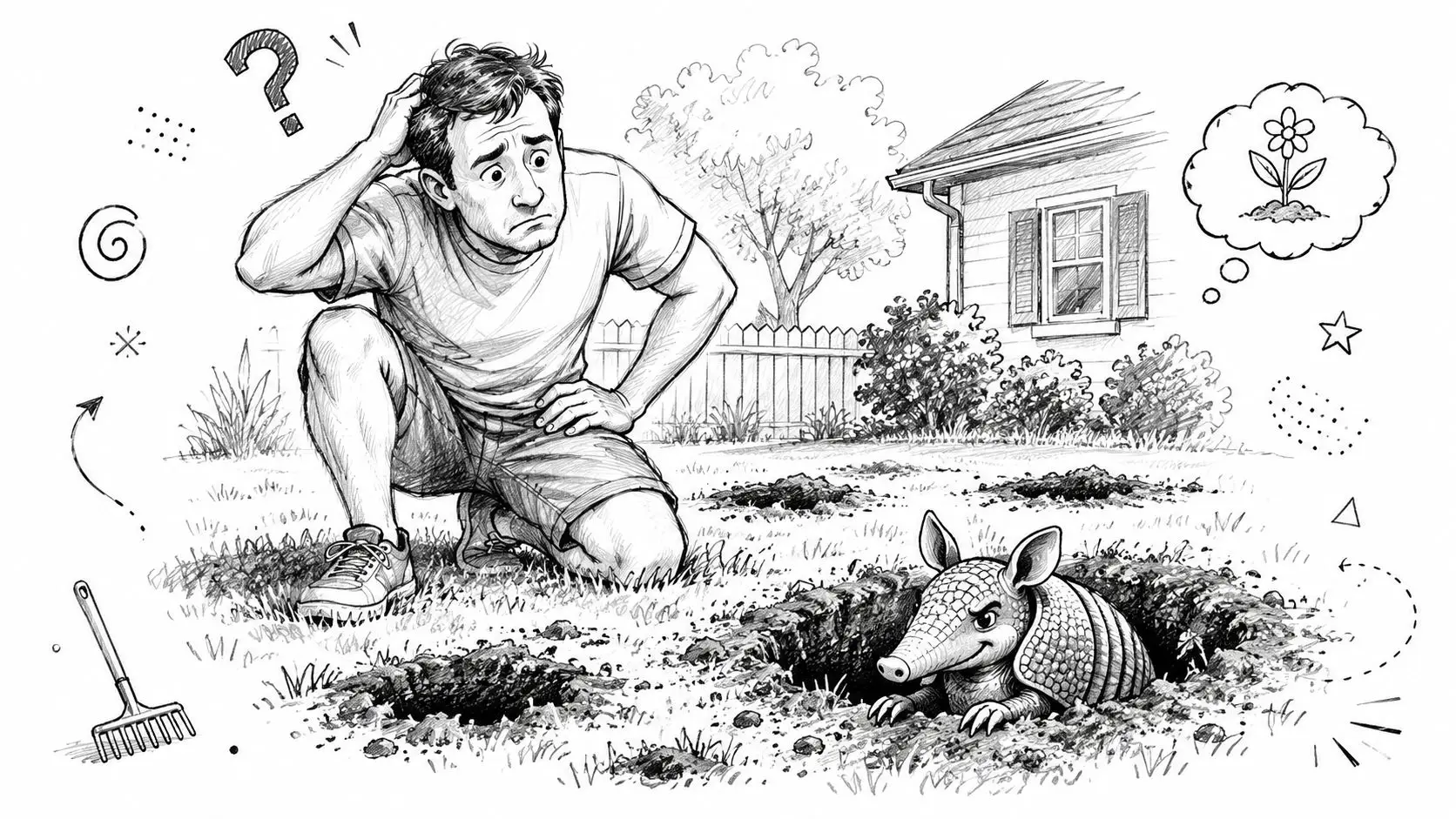
You step into the backyard with coffee in hand, and the lawn suddenly looks peppered with little scoops of missing soil. The grass isn't fully torn up. There's no big mound. Just a patchwork of odd holes that weren't there yesterday.
That pattern often points to an armadillo.
What those holes usually mean
Armadillos don't dig at random. They use smell to locate insects and other prey in the soil, then dig just enough to reach what they're after. In practical terms, that means a yard with repeated shallow holes is often acting like a buffet.
In Southeast Texas, that's easy to understand. Many properties have a mix of moisture, mulch, irrigated beds, and loose soil. Those conditions can support the insects and worms armadillos want. If your lawn stays damp in spots or has beds with softer soil, those areas often get hit first.
Practical rule: Small, repeated holes across the yard usually mean feeding. Larger openings near cover or hardscape deserve closer attention.
What homeowners usually get confused about
The main confusion is this: people see holes and assume every hole means a full burrow under the house. That's not always true. Some damage is surface foraging. Some damage is denning. The two look different and carry different risks.
A second point of confusion is timing. In Texas, many homeowners notice activity when insect life is active and the ground is easy to work. If your yard seems worse after wet periods or in seasons when the soil stays workable, that lines up with normal armadillo behavior.
Keep your eye on three things:
- Hole size and shape: Small cone-like holes suggest feeding.
- Location: Damage near shrubs, sidewalks, decks, or foundations can point to shelter burrows.
- Repeat activity: If holes keep showing up in the same places, the animal has likely learned your property offers easy food or cover.
Why Armadillos Dig Holes for Food and Shelter
Homeowners often ask one simple question: if armadillos are in the yard, why are they digging so much? The answer becomes clearer once you separate feeding holes from living burrows.
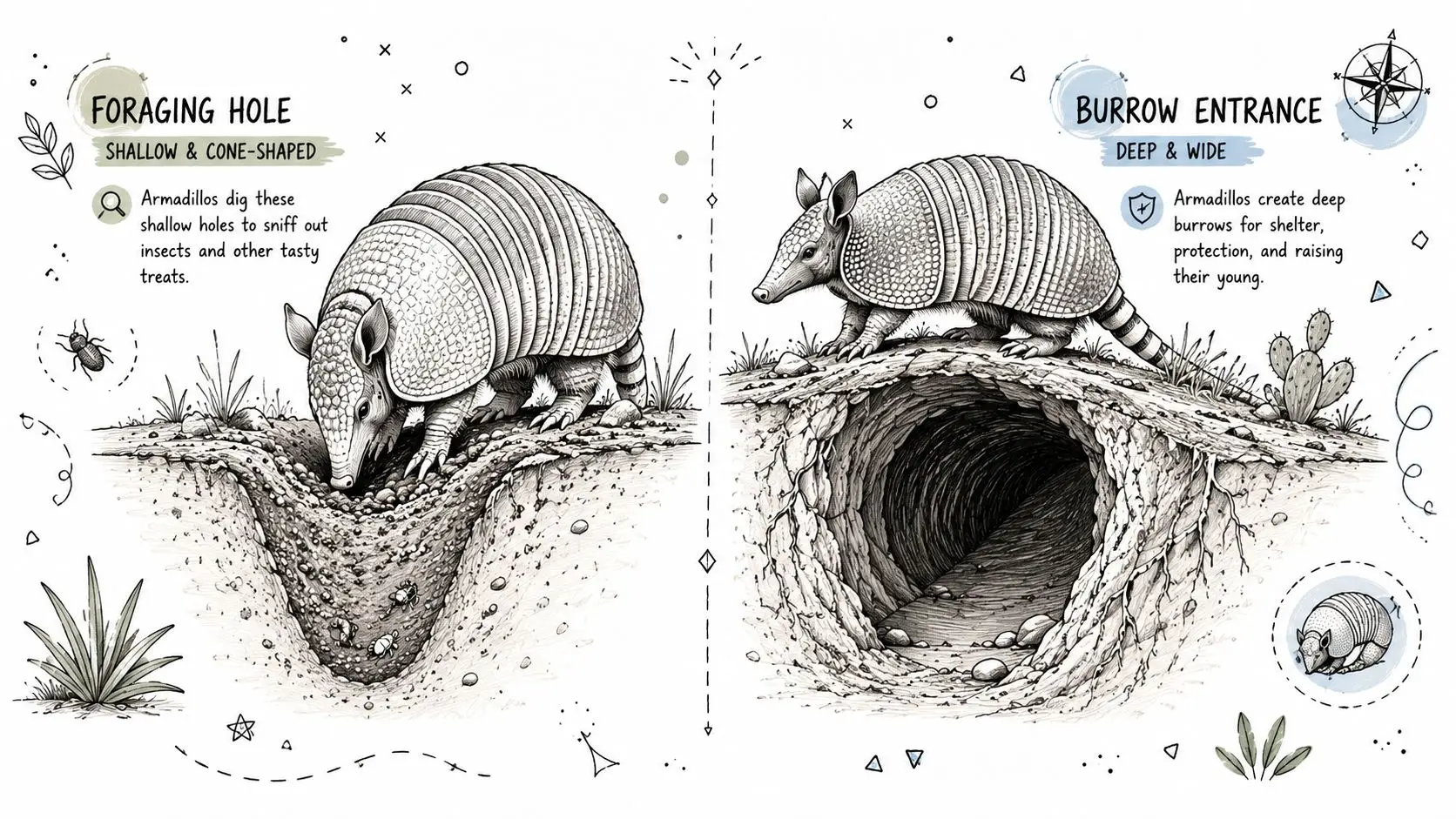
Shallow holes mean they're hunting food
Armadillos are prolific diggers that excavate shallow holes for foraging, and those holes typically measure 1 to 3 inches deep and 3 to 5 inches wide, according to the University of Missouri Extension armadillo guide. That same source notes that over 90% of their diet consists of animal matter, including insects, grubs, beetles, and worms.
That detail explains a lot. An armadillo isn't trying to wreck your lawn for fun. It's following scent, pushing into loose ground with its claws and snout, and making a hole just large enough to reach prey. If your yard has lots of these little holes, the digging is telling you something about what's in the soil.
In Southeast Texas, homeowners often see this in irrigated turf, mulched beds, and softer ground around landscaping. The armadillo is reacting to food availability, not just open space.
Deep burrows mean shelter
Feeding holes are one thing. Burrows are another.
A shelter burrow is larger, deeper, and more serious. These are the spaces armadillos use to rest, hide, and stay protected. They're commonly placed where the soil holds together and where cover makes the entrance less exposed, such as near brush, low shrubs, sidewalks, or structures.
A simple way to understand this is:
| Digging type | What it's for | What you'll notice |
|---|---|---|
| Foraging holes | Finding insects and worms | Small holes scattered in lawns or beds |
| Shelter burrows | Living space and protection | A larger opening, often near cover or structure |
That distinction matters because the solution changes with the behavior. Surface feeding can sometimes be reduced by changing yard conditions. A settled burrow near a structure is less of a simple yard nuisance.
Their digging style leaves clues
Armadillos don't move soil the same way every other yard pest does. Their body shape and digging motion produce a look that's often different from a mole run or a random patch of torn turf.
They're purposeful diggers. When the hole fits the head, the nose does the rest.
That's why a lawn can look dotted rather than bulldozed. Homeowners expect dramatic trenching, but armadillo feeding damage is often a series of targeted holes.
Why this matters in Southeast Texas
Local soil conditions make this more than a wildlife curiosity. In many Southeast Texas neighborhoods, the ground can stay soft enough for easy excavation, especially in shaded, watered, or low-lying spots. That means a yard can support both the food source and the digging conditions armadillos prefer.
If the damage is small and scattered, you're probably looking at feeding. If there's a larger opening near cover, especially around structures, you're looking at a situation that deserves quicker action.
How to Identify Armadillo Holes from Other Pests
Correct ID matters. A homeowner who treats for the wrong animal usually wastes time and money, and the holes keep showing up.
One of the easiest clues is the overall pattern. Armadillo damage often looks like someone pressed a series of small scoops into the lawn overnight, not like a tunnel system pushing soil upward.
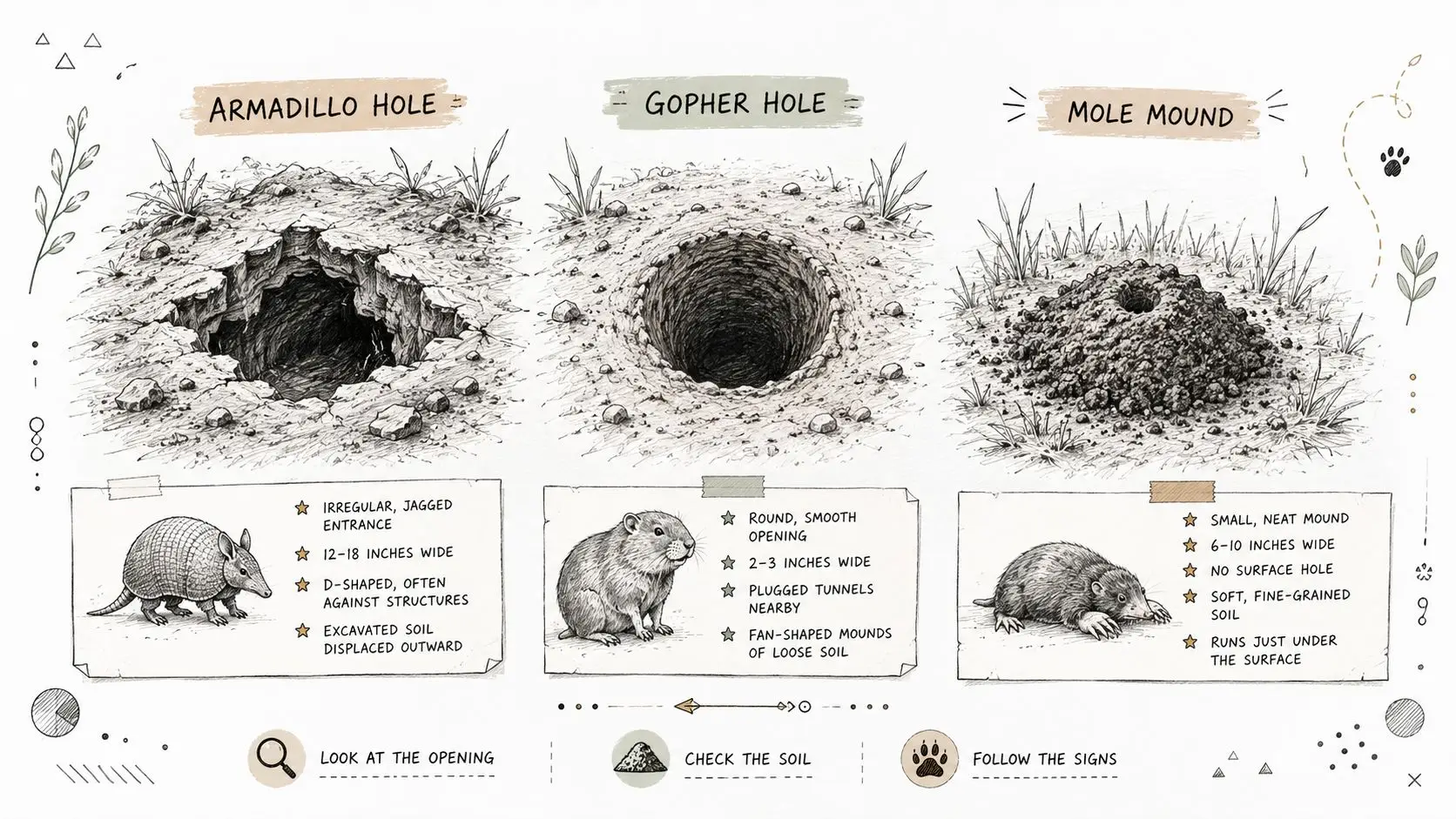
What makes an armadillo hole look different
The nine-banded armadillo uses its forefeet to dig and its hindfeet to throw soil directly behind, creating distinct U-shaped burrows with a single opening or conical feeding holes, as described in this armadillo digging behavior reference.
That tells you what to look for in the yard:
- Conical feeding holes: These usually look scooped out, not like raised tunnels.
- Single-opening burrows: A den entrance tends to be more defined than scattered lawn pecks.
- Soil placement: The dirt often ends up behind the digging direction rather than forming the raised ridges people associate with moles.
Compare the common suspects
In Southeast Texas lawns, homeowners often confuse armadillos with moles, gophers, or skunks. Here's a simple side-by-side check:
| Yard sign | More likely armadillo | More likely another pest |
|---|---|---|
| Many shallow scooped holes | Yes | Sometimes skunk, depending on pattern |
| Raised surface ridges | No | More typical of moles |
| Single larger burrow opening near cover | Yes | Could also be another burrowing animal, depending on site |
| Loose dirt thrown from active digging | Often | Possible with several species |
If your yard has raised travel ridges, start by comparing that damage with this guide on how to get rid of moles. Mole damage and armadillo damage are easy to mix up from a distance.
A quick visual helps
Watch the digging motion and the shape of the hole. Once you've seen it, the difference is easier to recognize.
Where they tend to dig first
Armadillos usually don't choose a yard evenly. They favor places where the soil is easier to work and where food is easier to smell. In Southeast Texas, that often means:
- Mulched beds
- Edges of lawns near shrubs
- Moist areas near irrigation
- Protected zones beside patios, decks, or sidewalks
If the holes are small, repeated, and concentrated in softer parts of the yard, armadillos move to the top of the suspect list.
The Real Damage Armadillo Burrows Cause in Texas
A lot of homeowners start by seeing this as a lawn problem. That's understandable. The first sign is usually cosmetic damage. But the risk changes when an armadillo stops making feeding holes and starts building shelter close to a structure.
What happens when a small yard problem gets ignored
A common Texas scenario goes like this. A homeowner notices a few holes near a flower bed and fills them in. A week later, there's a larger opening by the side yard shrub line. Then the dog starts sniffing the same corner every evening, and the soil near the sidewalk feels softer than it should.
That progression matters because a burrow can be much more than a surface nuisance. According to Havahart's armadillo facts page, armadillos can create burrow systems that reach up to 7 feet deep and 20 feet long, and an individual animal may maintain multiple burrows, averaging about ten per home range. The same source notes that this activity can damage underground wires, pipes, foundations, and concrete sidewalks.
Why Southeast Texas properties are vulnerable
In this part of Texas, many homes have decorative borders, slab foundations, irrigation zones, and shaded side yards. Those features can create exactly the kind of protected spots where a burrow entrance goes unnoticed at first.
The damage usually shows up in practical ways:
- Lawn instability: Soil settles where digging has removed support below the surface.
- Hardscape stress: Sidewalks, edging, or driveways can lose support near excavation zones.
- Root disturbance: Plants and shrubs may weaken when repeated digging affects root areas.
- Utility risk: Burrowing near buried lines is never something to ignore.
The issue isn't only depth
What worries professionals isn't just how deep a tunnel can be. It's location.
A shallow feeding hole in the back corner of the yard is one category of problem. A burrow beside a foundation, under a concrete edge, or near utility runs is another. Once digging shifts into those areas, the cost and complexity of repair can rise fast even if the original opening looked minor.
A small entrance can hide a much larger void underground.
Why repeat activity matters
Armadillos often return to places that have already worked for them. From a homeowner's point of view, that means filling a hole without changing the conditions around it may only delay the next round of digging.
If you're seeing repeat activity near the same cover line, same slab edge, or same planted bed, treat that as a warning sign. The pattern suggests the property is offering both what they want and a path back in.
DIY Prevention and How to Repair Armadillo Damage
If the problem is still at the feeding stage, you may be able to reduce activity by making the yard less inviting. The best DIY work focuses on conditions, not gimmicks.
Start with the yard conditions they like
Armadillos stay where food, moisture, and cover line up. In Southeast Texas, that often means irrigated lawns, thick planting beds, brushy corners, or areas where the soil stays damp longer than the rest of the yard.
A useful first pass looks like this:
- Trim hiding spots: Reduce dense cover near the house, under shrubs, and along fence lines.
- Clean up debris: Brush piles, stacked materials, and neglected corners give wildlife a place to approach unnoticed.
- Watch irrigation patterns: If one part of the yard stays soggier than the rest, that area may keep drawing activity.
- Protect vulnerable spots: Gardens, crawlspace edges, and deck areas usually need a barrier more than a spray.
Use exclusion where it matters most
Fencing and barrier work can help when you install it in the right places. Homeowners usually get the best result by protecting a specific target area rather than trying to fortify an entire property at once.
Good candidates include:
| Area | Why protect it |
|---|---|
| Garden beds | Loose, rich soil attracts digging |
| Under decks or sheds | Covered space can become shelter |
| Foundation-adjacent soft spots | These areas matter most if burrowing begins |
If you want a long-term barrier plan around structures and entry points, this overview of wildlife exclusion in Texas is a practical place to start.
Pay attention to moisture near the foundation
This is one point many homeowners miss. The relationship between soil moisture and digging depth doesn't get explained often, but it matters. The Trutech armadillo prevention article notes that drying soil near foundations can reduce burrow depth by over 40% compared to saturated conditions, making targeted soil drying a low-toxicity prevention method.
That doesn't mean you should let your yard suffer. It means you should avoid creating consistently saturated zones near the structure if they're also vulnerable to digging.
Keep water where plants need it, not where wildlife can turn soft soil into a burrow site.
Repair the damage the right way
Once activity stops, repair is straightforward:
- Check that the hole is inactive before filling it.
- Backfill shallow lawn holes with compatible soil.
- Tamp lightly so the spot doesn't sink immediately after rain.
- Replace or reseed turf if the grass cover is broken.
- Monitor the area for fresh disturbance before calling it solved.
If holes return right away, the repair wasn't the fix. It was only a patch.
When to Call a Professional for Armadillo Control
DIY methods make sense when the problem is limited to scattered feeding holes and the digging is happening away from structures. They stop making sense when the risk shifts from turf damage to property damage.
The line between manageable and risky
Call a professional when any of these conditions show up:
- The burrow is near the house: Foundations, sidewalks, patios, and utility paths raise the stakes.
- The same area keeps getting hit: Repeat activity usually means the animal has settled into a pattern.
- You can't confirm what made the hole: Misidentifying the pest leads to the wrong fix.
- The opening is large or tucked under cover: That's often where homeowner access and visibility get worse.
This is also where Texas homeowners need to think beyond convenience. Wildlife control can involve legal and practical requirements that aren't obvious from a trip to the hardware store. Methods that seem simple on paper can become a bad idea fast if relocation, handling, or exclusion is done incorrectly.
Why professional help is often the safer move
A trained technician doesn't just remove an animal. A good wildlife service checks the full site, identifies whether the issue is feeding or denning, looks for structural risk, and builds a prevention plan around how the property is laid out.
That usually means a combination of:
- Inspection of burrow locations
- Humane removal strategy
- Exclusion work around vulnerable areas
- Recommendations for moisture and habitat changes
- Follow-up to confirm the problem is resolved

A clear decision framework for Southeast Texas homeowners
Use this simple rule of thumb:
| Situation | DIY may be enough | Professional help is the better choice |
|---|---|---|
| A few shallow lawn holes | Yes | If it keeps recurring |
| Digging near flower beds only | Often | If barriers and cleanup fail |
| Burrow near slab, sidewalk, deck, or utilities | No | Yes |
| You're unsure of legal or humane next steps | No | Yes |
If you're in north Houston or nearby Southeast Texas communities and want experienced help with inspection, humane removal, and prevention, see FullScope's rodent and wildlife control service.
The biggest mistake homeowners make is waiting until the issue moves from small holes in the lawn to a larger burrow beside something expensive. If the digging is close to the home, keeps coming back, or doesn't clearly match a simple feeding pattern, it's time to bring in a licensed wildlife professional.
If you're dealing with mysterious yard holes in Kingwood, Conroe, Porter, Cleveland, or nearby Southeast Texas communities, FullScope Pest Control can inspect the damage, identify whether you're dealing with armadillo activity or another burrowing pest, and recommend the safest next step for your property.