1500+ reviews

You hear light scratching over the ceiling just after sunset. Then it stops. At dawn, it starts again. A few dark droppings show up on the patio below the roofline, and now you're searching for bat removal near me because you need a straight answer, not vague advice.
In Southeast Texas, that answer depends on two things that most generic bat articles skip. First, bats in a house aren't handled the same way as rodents or raccoons. Second, the timing matters, especially for homeowners in Magnolia, Conroe, Kingwood, and nearby communities where summer exclusions can create a bigger problem if they're done the wrong way.
If bats are using your attic, soffits, vents, or chimney area, the right response is careful inspection, legal timing, humane exclusion, and proper cleanup. That's how you get them out and keep them out.
Hearing Noises? How to Tell if You Have Bats
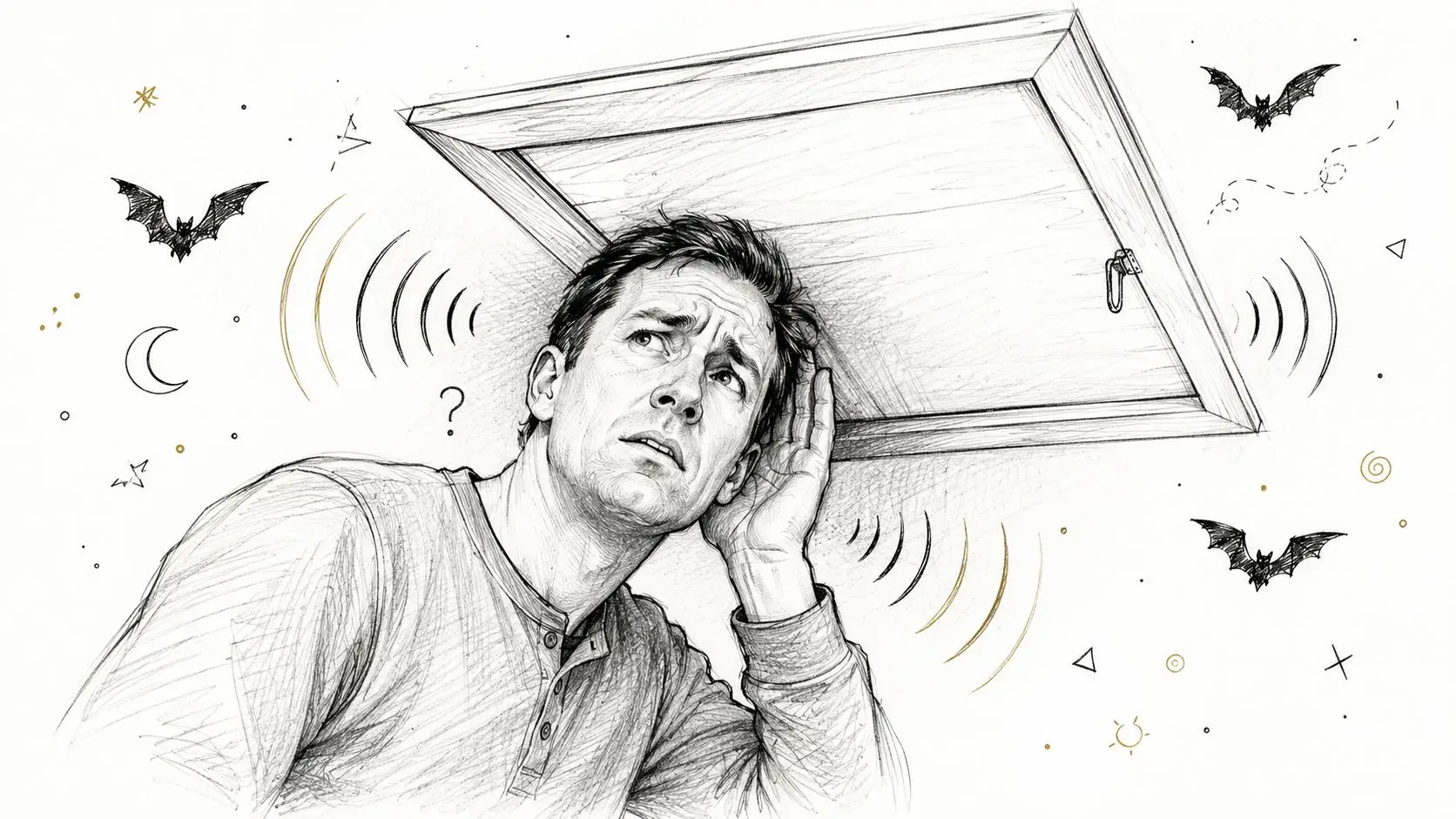
A lot of homeowners first notice bats by sound. The noise is usually light, quick, and easy to confuse with mice for a day or two. In bat jobs around Southeast Texas homes, the pattern matters as much as the sound itself. Bat activity often shows up around dusk and dawn, when the colony is leaving or returning.
If you're still trying to confirm what you're hearing, this guide to signs that you may have bats is a useful starting point.
What to look for outside
Start at the roofline and work slowly. Bats don't need a big opening, so the evidence is usually subtle.
- Droppings below an entry point. Bat guano often collects on window sills, patios, fascia ledges, or the ground below soffits and vents.
- Greasy staining. Repeated contact can leave dark rub marks around the edge of a gap where bats squeeze in and out.
- Evening flight activity. Stand outside for a few minutes near sunset and watch roof gaps, vent edges, and chimney lines.
- Small gaps at construction joints. Pay close attention to soffits, loose flashing, ridge vents, and trim transitions.
What it sounds like inside
Bat noise usually doesn't sound like heavy walking. Raccoons thump. Squirrels run with more force. Bats tend to make lighter scratching, faint rustling, and occasional chirping.
Practical rule: If the noise is strongest around sunset and daybreak, and quiet in the middle of the day, bats should be on your suspect list.
A colony can sound like paper shifting, tiny nails tapping, or soft movement in a wall void. In attics, people often hear them near the outer edges rather than in the center.
Quick comparison
| Pest | Usual sound pattern | Typical clue |
|---|---|---|
| Bats | Dusk and dawn activity | Guano and rub marks near roof gaps |
| Mice or rats | More random overnight movement | Gnawing, interior droppings, wall travel |
| Squirrels | Daytime running and chewing | Heavier foot traffic, roofline damage |
| Raccoons | Nighttime thumping | Loud movement and torn access areas |
If you've got the timing, the droppings, and visible roofline activity, don't start sealing holes yet. The next step is understanding the health risk and the legal side, because bats in Texas are handled under a very specific set of rules.
Health Risks and Texas Bat Removal Laws
The biggest mistake homeowners make is treating bats like just another attic pest. They aren't. Bat issues combine air quality concerns, contamination concerns, and wildlife law.
The health side of the problem
The immediate panic is usually rabies. The more common attic concern is guano buildup and what happens when someone disturbs it. Dry droppings can break apart during sweeping, vacuuming, or insulation work. That sends dust and debris into the air where people can breathe it.
That's why amateur cleanup goes wrong so often. A homeowner sees droppings, grabs a shop vacuum, and turns a confined attic into a contaminated work area.
Other problems show up fast too:
- Odor buildup from accumulated droppings and urine
- Staining around entry points and attic surfaces
- Parasite concerns associated with an active roost
- Contaminated insulation that may need removal or treatment
The safest rule is simple. Don't handle a live bat with bare hands, and don't disturb guano without the right protective setup.
What Texas law requires
Texas is not vague about bat removal. In Texas, it is legally mandated that bats must be removed from structures using nonlethal exclusion methods. Regulations effective September 1, 2025, explicitly prohibit lethal control and restrict bat valve installation between May 1 and August 31 to protect nursing pups, as outlined in this Texas bat removal law summary.
That matters in real life because the timing changes the job. During the maternity period, young bats may be present and unable to leave on their own. If someone blocks the openings or installs devices at the wrong time, the adults can get out while the young remain trapped inside.
Bats have to be removed humanely and on the right schedule. A fast job done at the wrong time can turn into a dead-animal odor problem and a legal problem at the same time.
Why this is a bigger issue in Southeast Texas
In Magnolia, Conroe, and nearby parts of North Houston, bat calls tend to spike during warm months because homeowners are outside more, attic temperatures are high, and evening activity is easier to notice. That creates pressure to “do something now,” even when now is the wrong time for exclusion work.
A licensed wildlife operator looks at three things before making a plan:
- Where the bats are roosting
- Whether they're entering living space
- Whether the calendar allows legal exclusion
If bats are staying in a non-living section of the structure and not entering occupied rooms, the right move may be temporary monitoring and scheduling exclusion for the proper window. That's not delay for delay's sake. That's how you solve the problem without creating a worse one.
Why DIY Bat Removal Is a Dangerous Idea
DIY bat removal looks simple online. Buy a tube. Seal a gap. Spray a repellent. Done. In the field, it almost never works that cleanly.
The problem is that bats don't use a house the way homeowners think they do. A visible gap at one soffit may be the main exit, but it may not be the only opening. If you seal first and inspect later, you can trap bats inside wall voids, spread them deeper into the structure, or force them into a bedroom or garage.
Where homeowners get into trouble
One common mistake is sealing the obvious hole and missing the secondary holes. Another is trying to remove bats in summer without understanding maternity timing. Existing guidance rarely warns that removing bats during Texas's maternity season May through August can trap non-viable young and create serious risk for homeowners in areas like Kingwood and Conroe, as noted in this discussion of Texas maternity season timing issues.
That's the kind of detail national articles skip, and it's exactly why local experience matters.
DIY methods that fail
A few methods show up again and again, and they usually make the job harder:
- Foam and caulk too early. Sealing before all bats are out can trap animals inside.
- Store-bought repellents. These don't solve the entry-point problem.
- Traps. They don't address the full colony or the structure defects that allowed access.
- Bright lights or loud sound devices. Homeowners try them because they're easy, but the bats often stay put or shift deeper into the structure.
If you're weighing whether to tackle it yourself, this page on what to do about bats gives a practical overview of the right first steps.
The hidden risk most people don't consider
The cleanup side is where DIY jobs often become expensive. Once droppings are disturbed, you're no longer just dealing with an animal issue. You're dealing with sanitation, attic contamination, and potentially damaged insulation.
If you can't identify every active entry point from the exterior, you're not ready to exclude bats from the structure.
That's why licensed wildlife work is more than installing a one-way device. The inspection, timing, and final seal-up are the actual job. The device is just one piece of it.
The Professional Bat Exclusion and Cleanup Process
Professional bat removal is a sequence. Skip one step, and the colony often comes back.
Inspection comes first
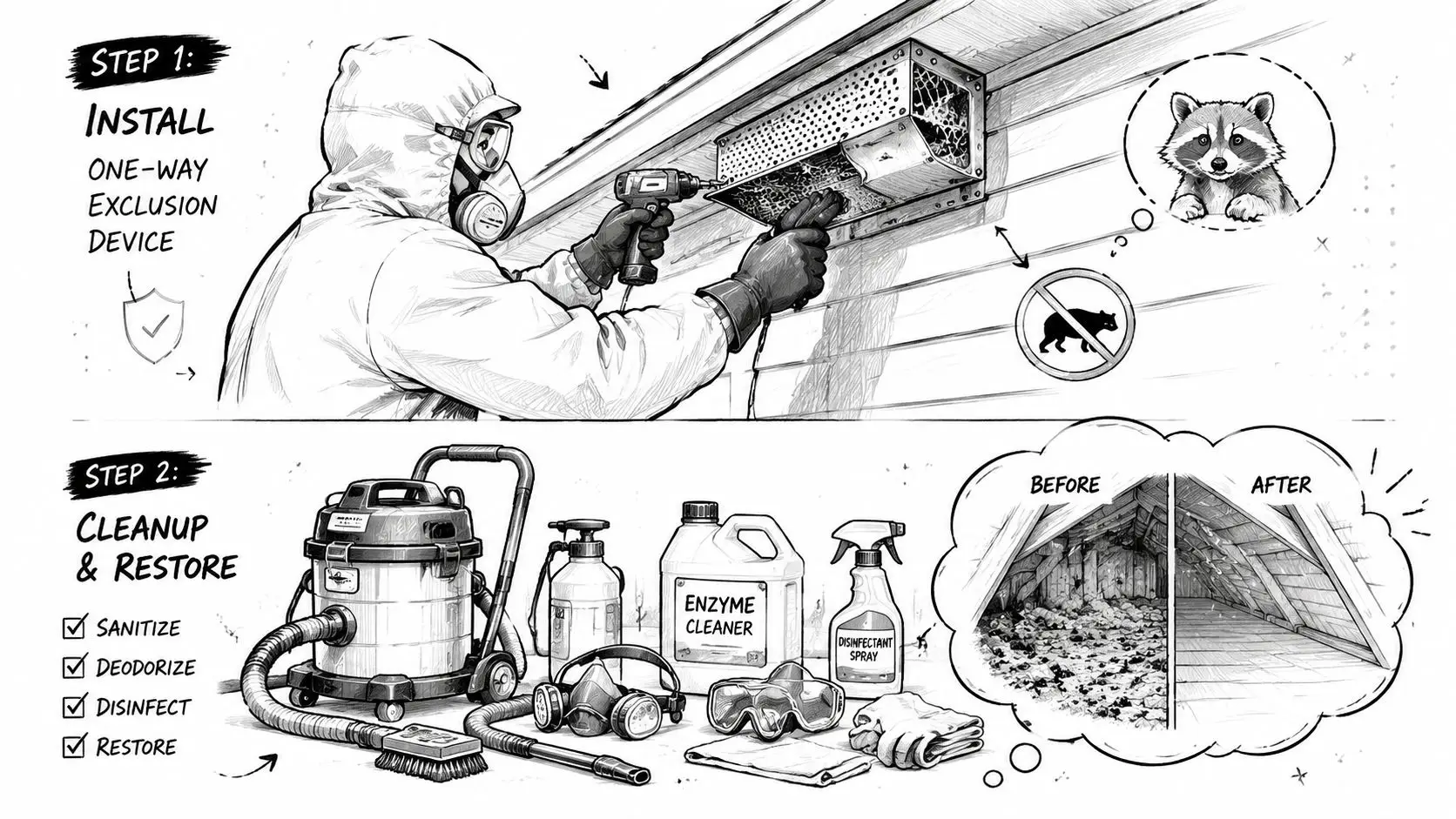
The first job isn't removal. It's mapping the structure. The City of Houston notes that effective bat removal requires one-way chutes or bat valves over entry points such as roof gaps, soffits, vents, and chimneys, and that those openings can be as small as half an inch. The same guidance explains that devices should remain in place for at least one week during warm weather before permanent sealing, and that guano should be lightly dampened with a 10% bleach solution to minimize dust and spores, following CDC guidance, as described on the City of Houston's bat exclusion and cleanup page.
That's why a real inspection is slow. A technician checks fascia transitions, ridge vents, gable intersections, soffit returns, chimney flashing, and any construction seam that could function as an access point.
Then the bats are funneled out
A one-way device works like an exit lane. Bats leave to feed, but they can't work their way back into the opening. Depending on the structure, that may involve a bat valve, netting, or a chute-style exclusion device.
The important part is not just placing the device. It's also sealing the non-primary gaps so the bats don't relocate to another crack a few feet away.
A homeowner looking for professional bat removal should expect that full approach, not just a quick install at one visible hole.
What the schedule usually looks like
- Full exterior inspection to identify active and potential entry points
- Exclusion setup on the main exits
- Secondary sealing on gaps the colony could reuse
- Waiting period while the colony exits
- Final seal-up after activity stops
- Cleanup and sanitation inside the attic or void
Here's a short visual overview of humane exclusion in action:
Cleanup is controlled work, not basic housekeeping
Once the bats are gone, the contamination has to be addressed correctly. That means dampening waste before removal, controlling dust, and isolating the work area as needed. Anyone doing this work should understand using personal protective equipment before they step into an attic with guano and disturbed insulation.
Cleanup may include:
- Guano removal from attic floors, insulation surfaces, and corners
- Treatment of affected areas to reduce residual contamination and odor
- Bagging and disposal of waste materials
- Evaluation of insulation condition where droppings have accumulated
- Final exclusion review to make sure the structure is closed up
Some operators, including FullScope Pest Control, provide bat exclusion work built around one-way devices and permanent re-entry prevention. That's the standard you want to ask for, regardless of who you hire.
Expected Costs and Timelines in Southeast Texas
The two questions homeowners ask first are fair. How long will this take, and what will it cost?
The honest answer is that bat removal pricing depends on the structure, not just the bats. A small, accessible roofline with one clear exit is a different job from a steep home with multiple dormers, high fascia lines, contaminated insulation, and several active gaps.
What changes the cost
A bat exclusion proposal usually moves up or down based on factors like these:
- Height and roof complexity. Multi-level homes take more time and equipment.
- Number of entry points. More gaps mean more seal-up work.
- Where the colony is roosting. Attic access is easier than hidden wall void access.
- Amount of cleanup needed. Light droppings are one scope of work. Heavy contamination is another.
- Repair conditions. Rotten trim, failed vent screens, or damaged soffits often need attention before the exclusion can hold.
If someone gives a firm quote over the phone without seeing the structure, be careful. Bat work is detail work.
Timing matters as much as price
In Southeast Texas, a project found in spring may move quickly. A project discovered in early summer may have to wait for the legal exclusion window. That frustrates homeowners, but it's better than forcing an illegal or failed removal.
There's also an important local trade-off that gets overlooked. Bat Conservation International states that “small bat colonies can usually be tolerated and left alone, but bats should always be prevented from entering human living quarters”, which you can read on their page about bats in homes and buildings. In practice, that means not every attic sighting demands immediate full-scale action the same day.
A professional assessment can save money by separating “I saw bats outside” from “this structure needs exclusion and cleanup now.”
A practical timeline view
| Situation | Typical scheduling reality |
|---|---|
| Active entry into living space | Needs immediate professional assessment |
| Roost in attic during legal exclusion window | Inspection, device install, wait period, final seal |
| Roost identified during summer restriction period | Inspection now, exclusion scheduled for the proper window |
| Minor activity in a non-living area | May be monitored until exclusion timing is appropriate |
That's why “bat removal near me” is not just a service search. It's a timing search. You need someone local who understands what can be done today, what has to wait, and how to keep the issue from getting worse in the meantime.
Your Local Bat Removal Experts in Magnolia and Beyond
If you're in Magnolia, Texas, you don't need a national call center reading generic wildlife scripts. You need someone who understands North Houston structures, attic heat, roofline construction, and Texas bat rules.
FullScope Pest Control explicitly lists Magnolia, Texas as a current service area, with a dedicated Magnolia location for pest control services including nuisance pests, as shown on their Magnolia service area page. Magnolia also falls within the company's broader North Houston corridor that includes communities such as The Woodlands, Conroe, Spring, and Magnolia.

That local coverage matters when you're trying to coordinate inspection timing in Magnolia, Conroe, Kingwood, The Woodlands, Spring, and nearby Southeast Texas communities. A local operator can evaluate whether you're dealing with active exclusion work, a maternity-season hold, cleanup needs, or a monitoring situation.
If you're hearing dusk-and-dawn attic noise, seeing guano below the roofline, or finding bats in occupied areas, call for an inspection now. Waiting usually doesn't make the entry points smaller.
For help in Magnolia and surrounding North Houston communities, contact FullScope Pest Control at (281) 973-1533 or use the FullScope contact page.
Southeast Texas Bat Removal FAQs
Can you remove bats during the summer in Texas
Sometimes you can inspect and plan during summer, but exclusion timing is restricted during the maternity period. In Southeast Texas, that's the first thing a licensed wildlife operator should verify before any device or seal-up work begins. If young bats may be present, the right move may be to schedule exclusion for the proper legal window and reduce immediate risk in the meantime.
What does humane bat exclusion actually mean
It means bats are allowed to leave on their own through a one-way device, and then the structure is sealed so they can't re-enter. It does not mean poison, glue boards, or routine trapping. Humane exclusion focuses on exit, permanent repair, and keeping bats out of human living areas.
How do you safely clean an attic after bats are gone
Cleanup starts with controlling dust, not sweeping it around. Guano should be handled carefully, with proper protective gear and methods that reduce airborne contamination. In many homes, the cleanup scope also includes treating affected surfaces and checking whether insulation has been compromised.
Do all bats in an attic need immediate removal
Not always in the same way or on the same day. The key question is whether bats are entering living quarters, how active the colony is, and whether the timing allows legal exclusion. Some situations require urgent response. Others require a scheduled exclusion plan so the job is done correctly and doesn't create a worse problem.