1500+ reviews


The technician packed up twenty minutes ago. The kitchen still smells faintly of product, the baseboards look slightly damp, and you're standing in the driveway wondering whether the dog can go back in. Then you walk past the dishwasher and see a cockroach on the tile, alive and moving. Your stomach drops.
That moment is where most homeowners get the wrong idea about what to expect after pest control treatment. A treatment isn't a switch that flips the house from infested to clean. It's a process with a reentry rule, a drying or ventilation period, an observation window, and a follow-up check. Once you know which stage you're in, the sightings stop feeling like evidence of failure and start reading like data.
Reentry Times by Treatment Type
The clock is set by the product label and the application method, not by your nose. Odor fading and safe reentry are two different things. The EPA-registered product label examples show people and pets staying away for the interval the label specifies, with treated indoor areas adequately aired out afterward.
The label sets the clock
For an ordinary liquid spray, the milestone is usually a dry surface. One EPA-registered household label permits people and pets to return after the spray has dried. Aerosol methods work differently because the product hangs in the air before it settles. An EPA fogger label specifies no reentry for at least 2 hours, followed by opening windows, vents and doors and ventilating for another 2 hours. A separate EPA label for space sprays requires at least 60 minutes of ventilation before reoccupation.
Those are product-specific instructions, not house rules for every job. Your service record and the label on the container the technician carried in control the actual interval.
| Treatment type | Reentry rule | Ventilation or extra wait |
|---|---|---|
| Household liquid spray | Return once the spray has dried | Air out treated rooms with windows and fans when the label permits |
| Fogger or total-release aerosol | Stay out for at least 2 hours | Ventilate open windows, vents and doors for another 2 hours |
| Space spray | Stay out until the label interval ends | At least 60 minutes of ventilation |
| Outdoor perimeter barrier | Keep children and pets off treated surfaces until dry | No published ventilation interval, ask the technician for the drying time on your service record |
| Bait stations | Keep out of reach until the label allows | No published reentry wait for placed stations, keep children and pets away from the station itself |
Matching your service to a row
Read the table as a set of patterns, then find the row that matches what was done. A crack-and-crevice treatment along kitchen baseboards behaves like the liquid spray row. A total-release aerosol set off in a closed garage behaves like the fogger row, and the extra ventilation hours are part of the wait, not optional. Where a cell says no interval is published, that's a question for the technician, not a guess you should make while standing in the driveway.
Write it down before the truck leaves: product name, label reentry time, treated rooms, and whether windows or fans should run. Two lines on a sticky note beat a memory at 9 p.m.
During the wait, keep children and pets away from wet residues, treated surfaces, dusts, vapors and mists. Food and drinking water left exposed in the treatment area should have been removed or covered before application. If it wasn't, wash or discard it rather than serving it.
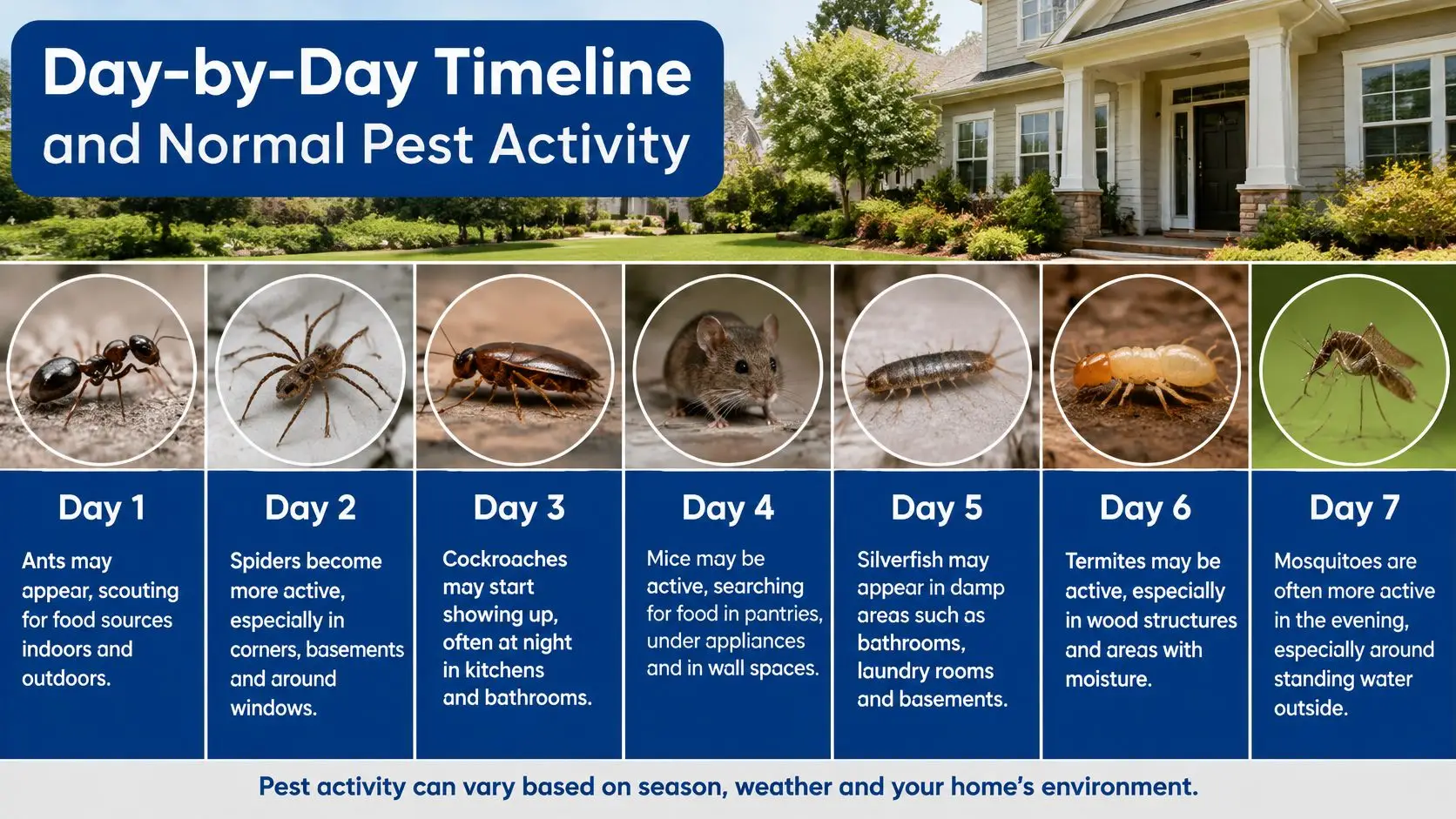
Day-by-Day Timeline and Normal Pest Activity
Activity often looks worse before it looks better, and that's the part nobody warns you about. Here's the shape of a typical month after service.
Day of treatment
Pests may scatter into the open while the product is still wet. Your job is narrow: stay out until the reentry time, keep the pets out with you, and make sure food, dishes and pet bowls were covered or moved before the visit. Don't mop the treated baseboards to tidy up. Don't add a can of store-bought spray on top of the professional application, because you can contaminate bait placements and push insects deeper into wall voids.
First 24 to 48 hours
A few sightings are common as survivors move out of treated cracks, wall voids and harborages. The roach on the tile is often an insect that has been driven out of the gap behind the dishwasher, not one that shrugged off the treatment. Log it. Note the room, the time and how many. Resist the urge to spray, scrub or vacuum the treated perimeter, since that removes product from exactly where it was placed to work.
| Window | Normal activity | What you do |
|---|---|---|
| Day of treatment | Treated areas are wet or dry and pests may scatter | Keep people and pets out until reentry time and cover food |
| First 24 to 48 hours | Some sightings as survivors move from treated spots | Log species, location and count; avoid deep cleaning treated spots |
| Days 3 to 7 | Activity should trend downward | Watch entry points and food sources; report any increase |
| Around day 30 | Follow-up inspection confirms the result | Share your log and schedule retreatment if activity persists |
Days 3 to 7
The trend should bend downward. This is the window to fix the conditions that fed the problem: wipe the syrup ring under the bottle in the pantry, empty the trash nightly, pull the firewood off the exterior wall, and note the gap under the back door where the light shows through. If counts climb instead of falling, report it rather than waiting for the next scheduled visit. Roaches follow their own pattern here, and the timing of how long cockroaches take to die after pest control explains why bait-based work needs patience that a contact spray doesn't.
Around day 30
A follow-up inspection is what turns "I think it worked" into a confirmed result. In a recent Kingwood, TX ant treatment, we recommended a follow-up in 30 days to confirm full elimination. That's the model to expect: the first visit places the treatment, the return visit measures it.
The CDC's integrated pest management guidance describes IPM as inspection, monitoring, reducing clutter, physical barriers and carefully selected pesticide use, and it treats evaluating each action as part of the program. Purdue University Extension gives a plain example: after a food source is removed and a crack is sealed, someone inspects the ant problem again, and if ants are still active, more action follows. That's the logic behind your day-30 appointment. It matters most with ants, cockroaches, rodents, bed bugs and termites, where an untreated food source, a structural gap or a neighboring harborage can keep reinfesting a treated home.
A short walkthrough of what monitoring looks like in practice:
Start a log today and keep it for the first two weeks. Five fields are enough: species, life stage, count, location and date. "Three adult roaches, kitchen, Tuesday night" tells a technician far more than "I still see bugs." A notebook page or a phone note both work, as long as the entries are dated.
Keeping Children, Pets and Air Safe
Protection order matters here, because the smallest occupants contact the most product. Infants and crawling children put hands directly on treated floors and then into their mouths, and EPA-linked technical guidance notes that children breathe more air relative to body weight than adults do. Keep them out of the treated zone entirely until the label interval has passed, not just away from the wet spot.
Pets need the same separation, plus a plan for the yard. A dog that rolls on a freshly treated perimeter strip undoes the point of waiting indoors. Birds and fish need their own arrangements: cover or move the aquarium and shut off its air pump before any aerosol work, and take the bird cage out of the treated space rather than draping a towel over it.
Air, HVAC and the dust exception
Ask one specific question before the technician starts: should the HVAC run or stay off? In older Southeast Texas homes and tightly sealed newer builds, a running system moves indoor air quickly through every room, which is helpful for some applications and wrong for others.
More ventilation isn't automatically safer. The same EPA-linked guidance explains that ventilation is useful for liquid pesticide applications, but moving air can spread dry pesticide dust. Don't fan, blow, sweep or vacuum a dust treatment without professional direction. Windows and fans are for after the application, when the label permits them.
Before you hand over the keys, get answers to these:
- Product name: the exact name on the container, so you can read the label yourself.
- Label reentry time: the interval and the drying or ventilation condition attached to it.
- HVAC instruction: on, off, or off until a set time.
- Surfaces to wash: which counters, toys or food-contact items need cleaning before use.
Households with asthma or other respiratory sensitivity should say so up front and get the ventilation instruction in writing. Our guidance on safety precautions during pest control covers the prep steps in more detail, and if you're also rethinking your household cleaning products around animals, this rundown to compare natural cleaners around pets from Maid in America is a useful companion read.
Some symptoms override the waiting schedule completely. Breathing difficulty, vomiting, confusion, or unusual pet behavior means leave the area and call poison control or your veterinarian right away. Don't wait for the label interval to expire, and report what happened to us the same day.
What to Clean and What to Leave Alone
Immediate deep cleaning is the most common way homeowners undo a good treatment. Use this as the quick reference.
| Surface or item | What to do | Why |
|---|---|---|
| Kitchen counters and eating surfaces | Wash before food contact | Residue can reach food |
| Dishes, utensils and food-contact items | Wash or cover before use | Prevents accidental exposure |
| Baseboards and treated cracks | Do not scrub unless the technician instructs | Keeps product where it was placed |
| Carpets | Confirm with the technician before steam cleaning or heat | Heat and steam may affect the treatment |
| Bleach in bedbug-treated areas | Avoid | Official bedbug guidance warns against it |
| Clothing from treated rooms | Separate and launder as the technician advises | Stops pests or residue traveling into untreated rooms |
The EPA's Protect Your Family From Pesticide Exposure fact sheet separates routine post-treatment hygiene from suspected over-application, and it's the reason the food-contact rows sit at the top of that table. Wash what touches food. Leave the placements alone.
The three surprises
Scrubbing is not helping. A residual product along a baseboard works because insects cross it. Mopping that strip with cleaner removes the treatment and leaves you with a clean floor and a live population.
Bleach isn't a universal answer. Official bedbug guidance specifically warns against using bleach in pesticide-treated areas. If a bedroom was treated for bed bugs, launder bedding and clothing on the schedule the technician gives you and bag clean items separately, rather than reaching for a bleach bucket.
Heat needs permission. Steam cleaning a carpet or running a heat treatment on top of an existing application can change how the product behaves. Ask first. Take shoes off at the door of a treated room so you're not tracking material through the house.
A written post-service checklist should name the treated zones, the products, the drying time, the cleaning limits and a follow-up contact. Reassurance that everything is safe isn't a record.
Signs the Treatment Has Not Worked
A single sighting on a single day proves very little. These patterns are the ones worth a phone call:
- Flat or rising counts: numbers stay the same or increase across the agreed follow-up interval instead of trending down.
- Fresh evidence: new droppings, new gnaw marks, new wood damage or new shed skins appear after service.
- Activity outside the treated scope: pests show up in rooms or on the side of the building that wasn't part of the plan.
- New rooms involved: the problem spreads to a space that was quiet before treatment.
The UF/IFAS guidance on pest monitoring frames monitoring as regular inspection that detects presence, tracks location and movement, and evaluates whether earlier control measures reduced the population. It also points at the causes chemistry can't fix: moisture sources, food residues, entry gaps, vegetation touching the structure, and structural defects. A drip under the sink or a hedge pressed against the siding will keep a population going through any spray program.
What correction actually looks like
When the signals are real, the fix isn't automatically more product. Corrective work may mean sanitation, exclusion, moisture reduction, habitat modification, or a targeted retreatment chosen for the identified pest and the specific site. Our approach starts with finding entry points, understanding the activity and identifying the conditions that let an infestation continue, which is why a follow-up visit sometimes ends with a door sweep and a plumbing referral rather than another application. Understanding what makes pest control successful helps you read your own log with the same lens.
Bring the log to the call. Species, count trend, location and date turns "it didn't work" into a diagnosis the technician can act on. Sticky monitors left in consistent spots give you that trend line without guesswork, and comparing week two against week one is far more informative than reacting to one bad evening. If pests come back between treatments, we retreat at no additional cost, so there's no reason to sit on a worsening pattern to avoid a fee.
What to Confirm for Magnolia Properties
Magnolia is a compact city, not a county-wide label. The city's official 2025 At a Glance profile places it in southwestern Montgomery County within the Houston metropolitan area and lists an area of approximately 5.5 square miles. That small footprint is exactly why coverage should be confirmed by address rather than by city name.
The area is also filling in fast. Magnolia's official demographics page reports a 2020 population of 2,359 and a 2024 population of 5,836. More rooftops means more new construction, more disturbed soil, more freshly planted yards, and more properties where the first pest service is happening this season.
Why the street address decides it
A property advertised as Magnolia can sit in unincorporated Montgomery County, outside the city limits. That distinction affects routing, scheduling and whether a return visit fits inside the same trip. Conroe, Montgomery, Tomball and The Woodlands should each be checked as their own market rather than folded into one north-Houston assumption.
Ask about the follow-up mechanics, not just the first appointment. Are return visits included for outlying properties? How far does the crew travel for a re-service? Is the follow-up window committed in writing? We offer follow-up visits if pests return within a specified period after service, and ongoing regular visits let our specialists track changes and make small adjustments before a problem rebuilds.
Confirm these four items before you book:
- Full street address with ZIP code: the exact address, not the subdivision name.
- Jurisdiction: inside Magnolia city limits or in unincorporated Montgomery County.
- Confirmed coverage for that address: stated by the provider, not inferred from a service-area map.
- Included follow-up visits and the written follow-up window: what's covered and by when.
Confirm Your Checklist and Follow-Up Visit
The last five minutes of a service visit are the most valuable ones. Before the technician leaves, get these seven items in writing:
- Product names used inside and outside.
- Label reentry time for each application, including any ventilation hours.
- Treated zones, room by room and around the exterior.
- HVAC instruction, on or off and for how long.
- Ventilation instruction, windows and fans or leave the air still.
- Cleaning limits, what to wash and what to leave untouched.
- Date of the next inspection, anchored to the day-30 check.
Keep that page with the service record and the product label in one folder or one phone note. Anyone in the household should be able to find the reentry time without calling you at work. That's the difference between a household that guesses and a household that knows.
Book the follow-up while the treatment is fresh, not after activity returns. A scheduled return visit gives the technician a baseline to compare against your log, and it's the point where a persisting problem gets a different control step instead of a repeat of the same one.
Practical rule: if you can't name the product and the reentry time from memory or from a note, you don't yet have what you need to bring the family and the pets back inside.
Ready to get a documented plan for your property? Request an inspection through the FullScope Pest Control website and include your full Magnolia street address with ZIP code so we can confirm coverage before the visit. One of our pest control specialists reaches out shortly after a request is submitted, and we provide prompt responses for urgent infestations. Tell us what you're seeing, where, and since when, and we'll build the treatment plan and the follow-up schedule around it.