1500+ reviews


Mosquito misting systems can reduce adult mosquitoes in the yard they treat, with weekly reductions running from 14% to 98% in a 35-week Florida field study, but no federal agency treats them as proven protection against mosquito-borne disease. Those two findings are not in conflict, and the distance between them is where most buying decisions go wrong.
A misting system is a localized exposure tool. It interrupts the moment a mosquito meets an insecticide cloud on your property, which is a real and useful thing to interrupt. It's a much smaller claim than the one printed on most sales pages, and it's the one the field data supports.
Do mosquito misting systems work? Partly, in some yards, in some weeks. Reading the evidence gives you something more valuable than a yes or no: a way to specify, calibrate, and test a system against your own property across a full season.
Whether Misting Systems Reduce Mosquitoes, in Short
The question splits into two claims that carry very different levels of support. That misting lowers adult mosquito counts in a treated yard has field evidence behind it. That a misting system protects a household from disease does not.
| Question | Evidence answer | Confidence |
|---|---|---|
| Does misting reduce adult mosquitoes in the treated yard? | Yes in some trials: lower counts than controls in 30 of 35 weeks | Moderate, six yards in one region |
| How large is the reduction? | Weekly reductions from 14% to 98%, about 71% to 98% in the first three weeks | Variable, not guaranteed |
| Does it prevent mosquito-borne disease? | Not scientifically proven, according to the EPA | Low |
| Does it stop mosquitoes drifting in from neighbors? | Not addressed by the trial; neighboring breeding sites can refill treated yards | Low |
| Does it replace removing standing water? | No; EPA guidance recommends integrated control | High |
Read the third column as carefully as the second. Moderate confidence on mosquito reduction reflects a genuine trial with genuine control yards, run on a small number of properties in a single region. High confidence on standing water rests on mosquito biology rather than on any product test: larvae have to develop in water, and no adulticide changes that.
Notice what the table doesn't claim. It doesn't say a system works everywhere, and it doesn't say a system is worthless. It says the effect is real where mist reaches resting mosquitoes at the right hour, and it says the effect is inconsistent enough that you cannot buy a guaranteed percentage.
The rule that matters: judge a system by its measured results in your own yard over a full season, not by a single percentage quoted at the kitchen table.
How Automated Misting Systems Deliver Treatment
Think of a lawn sprinkler on a timer, with one substitution. The thing being sprayed is the air and the shaded vegetation mosquitoes move through, not the turf.
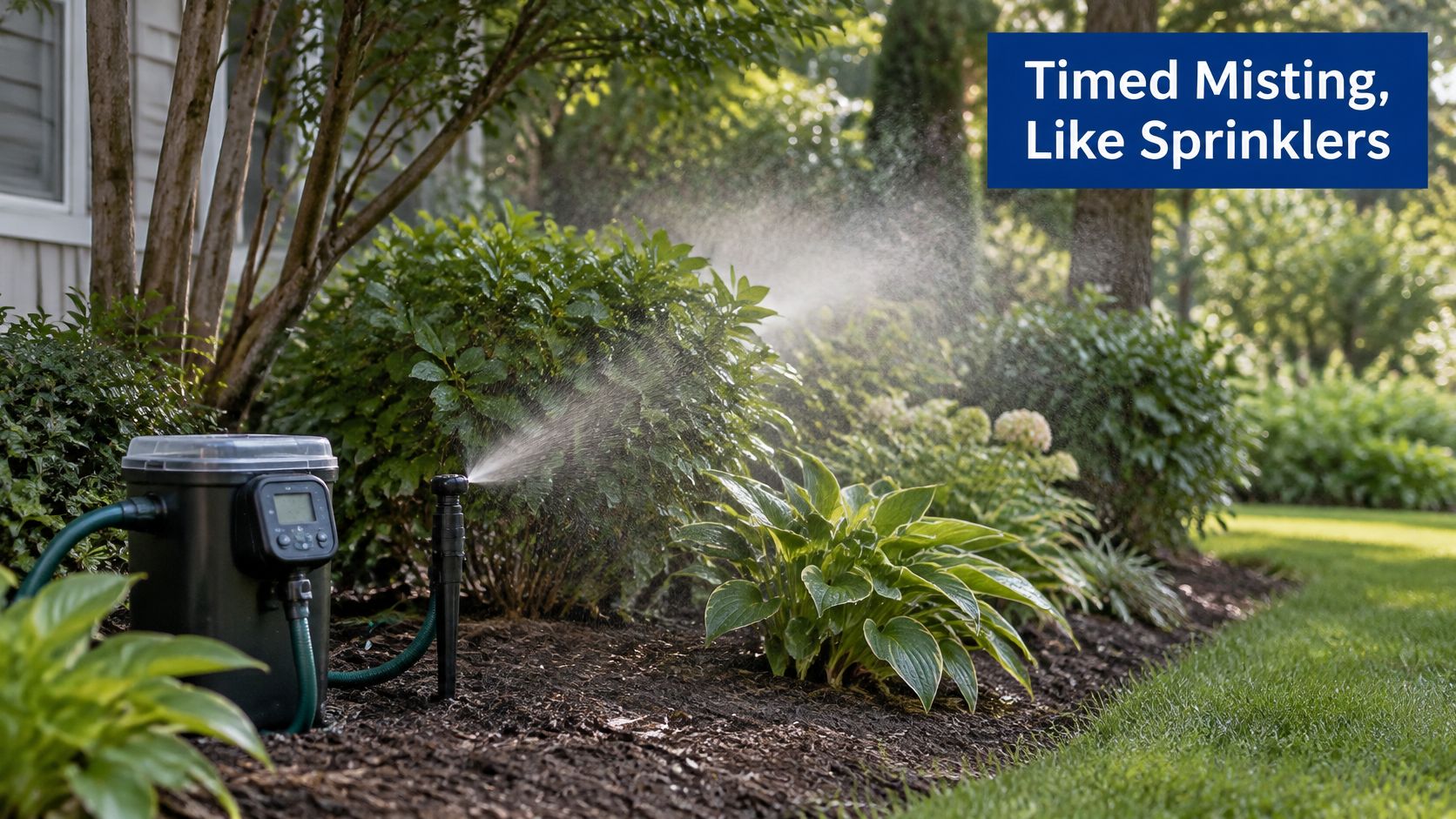
The hardware in plain terms
The components are simple enough that most homeowners can name them after one walkthrough:
- Controller and pump: mounted together at the reservoir, they pressurize the line and open the nozzles on a schedule.
- Reservoir: holds the concentrate, which is diluted to the label rate rather than used neat.
- Tubing: runs the perimeter, usually tucked along fence lines, foundation edges, and bed borders where it stays out of the mower's path.
- Nozzles: the only part that decides where the mist lands, and the part most worth walking and inspecting yourself.
The chemistry is usually a pyrethrin, the insecticide derived from chrysanthemum flowers, or a related pyrethroid. These materials knock mosquitoes down quickly and break down quickly in sunlight, which is why the schedule carries so much of the workload.
Why timing carries more weight than volume
Mosquitoes do most of their host-seeking between dusk and dawn, so a timed cycle set for early morning and again at dusk aims at the hours of greatest exposure. A system that fires at noon is spraying when the target is least likely to be in the air.
The mechanism is contact during application, not a lasting residue on leaves. That distinction matters more than any spec sheet: a misting system doesn't coat the yard with a barrier the way a residual spray does, so it doesn't keep killing for days after the timer stops.
The test of a nozzle plan: stand where you get bitten at dusk and look for a nozzle aimed at the vegetation within a few feet of you. If there isn't one, the plan is decorative.
A useful mental picture is a fine mist that has to reach the places mosquitoes rest, at the right hours, every day of the season. Everything else about the system is machinery in service of that one moment.
What the Florida Field Study Measured
The most-cited field evidence for residential misting comes from a 35-week operational field study of automatic timed applications conducted from March 22 through November 16, 2007, at three residences in northwestern Florida.
The design
Commercially installed systems released a mist containing 0.05% synergized pyrethrins for 45 seconds at dawn and again at dusk. Researchers compared twice-weekly mosquito-trap collections from the treated backyards against collections from three untreated control yards.
That control group is the reason this study is worth discussing at all. Anecdotes about a system that "seemed to help" are everywhere. A paired comparison of trapped counts, repeated twice a week across 35 weeks, is a different category of evidence.
The results
Weekly mosquito reduction ranged from 14% to 98%. During the first three weeks, treated yards recorded reductions of roughly 71% to 98%. Across the study as a whole, mosquito abundance was lower in treated yards than in controls during 30 of the 35 weeks.
Three findings deserve to be held together rather than quoted separately. The effect was often large. It was never uniform. And it held in the great majority of weeks even when it was modest.
What six yards can't tell you
The trial involved six yards in one Florida region. Weather, mosquitoes immigrating from surrounding properties, vegetation, system coverage, and application timing all influenced the weekly numbers, and none of those variables were held constant.
So the honest reading is this: automated misting can substantially reduce adult mosquitoes in some residential settings, and performance is inconsistent rather than guaranteed. The study is field evidence of potential effectiveness. It is not proof that your installation will deliver any particular percentage.
A homeowner in a wooded Southeast Texas subdivision and a homeowner on an open Florida lot are running different experiments. Both can expect an effect. Neither can expect a specific number without measuring it.
Why Misting Results Swing From 14% to 98%
The same model of system, installed by the same crew, can post very different numbers from one yard to the next and from one month to the next. That spread isn't noise around a hidden true value. It's the product of factors you can list, inspect, and partly control.
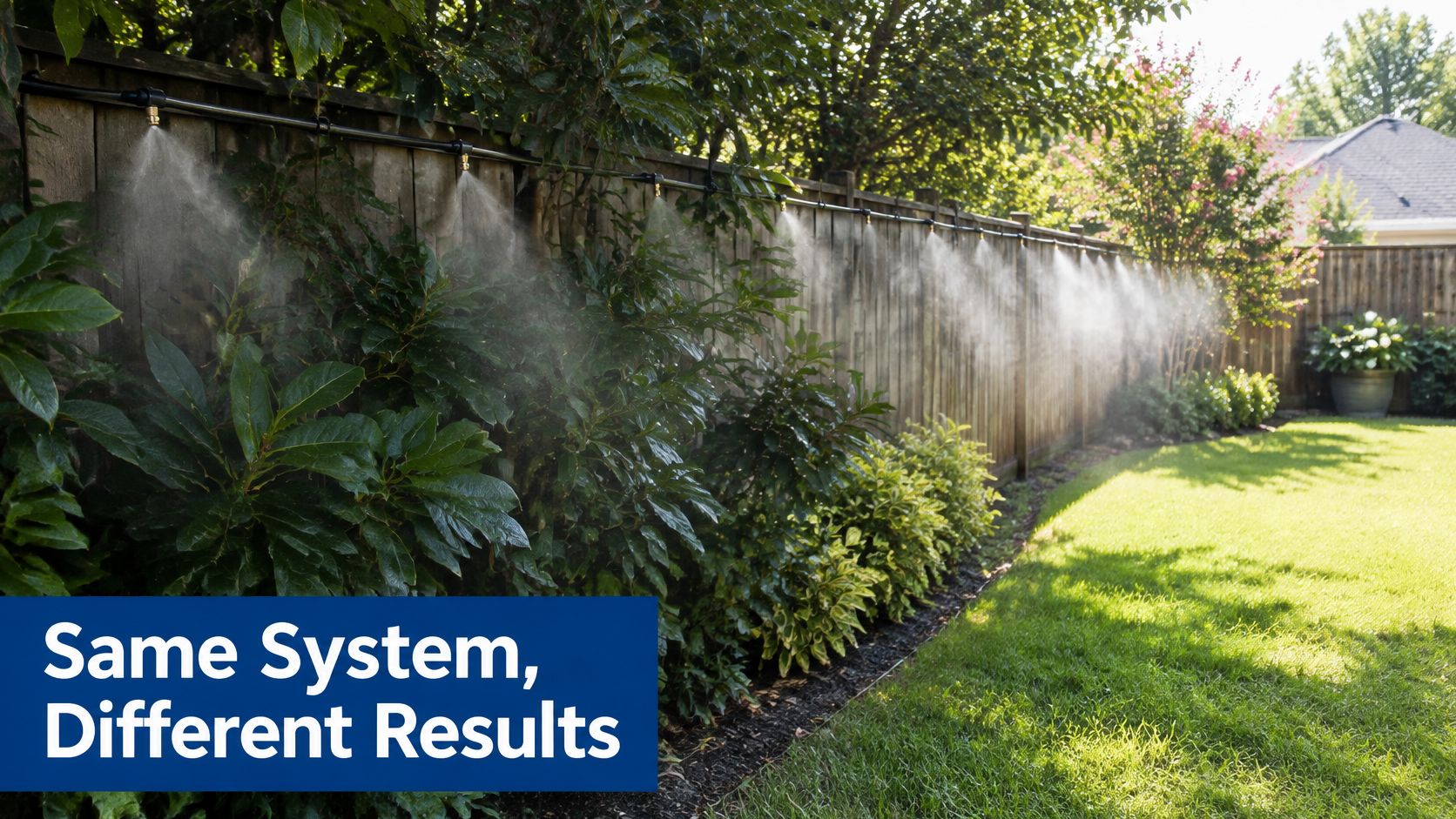
Droplet size sits near the top of that list. Follow-up laboratory and field observations attributed the mosquito effect mainly to direct spray exposure and identified droplet size as a likely determinant of inconsistent results, as summarized in EPA mosquito misting system guidance. Droplets that are too coarse fall out of the air before they travel. Droplets that are too fine drift off target. Either way, the mosquito that stays home survives.
A short walkthrough of how a season plays out makes the variability concrete.
The factors that decide the outcome
| Factor | Why it matters | What to check |
|---|---|---|
| Nozzle coverage | Mist must reach shaded and dense resting zones | Unobstructed spray across shrubs, shade and fence lines |
| Droplet size and output | Likely cause of inconsistent results in trials | Calibrated output per nozzle and service records |
| Timing | Mosquitoes are most active from dusk to dawn | Dawn and dusk cycles set correctly and reviewed each season |
| Wind and weather | Wind carries mist away and rain dilutes it | Review settings after storms and windy periods |
| Standing water and drainage | Repeated rain creates new breeding sites | Empty containers, clear gutters and fix low spots |
| Vegetation growth | Dense growth shelters mosquitoes and blocks nozzles | Trim plants so nozzles stay clear |
| Neighboring properties | Mosquitoes move in from untreated sources | Track counts and address nearby breeding sites |
Coverage and calibration are hardware problems, and they're the most fixable. A nozzle buried under an overgrown viburnum, or a tip partially clogged with dried concentrate, reduces output across the whole zone it serves. Calibrated output per nozzle, plus a written service record, is what lets you tell the difference between a bad season and a failing system.
Weather and vegetation are the moving parts. Wind carries mist off target, rain dilutes what's in the air, and a hedge that grew two feet since spring can shadow a spray pattern that worked in April. Timers set in March deserve a second look in July.
Drainage and neighboring properties are the factors a system cannot touch. Water that sits in a gutter, a plant saucer, or a low corner of the yard produces adults faster than any nozzle can intercept them, and an untreated wooded lot next door keeps exporting mosquitoes regardless of what happens on your side of the fence. The chemistry itself matters too, which is why the mosquito control chemicals used in these systems should be matched to the label rate and the target species rather than topped up by feel.
The habit that settles arguments: log mosquito activity once a month, ideally at the same hour, and compare it with a pre-install baseline. Rising counts tell you to adjust coverage, timing, and drainage, in that order.
Misting Compared With Other Mosquito Controls
Federal guidance places residential misting in a limited evidence category, and it's worth reading that position in full rather than hearing it secondhand. The CDC page on misting systems for mosquitoes records that the U.S. Environmental Protection Agency states outdoor residential misting systems had not been studied sufficiently to document their effectiveness in controlling mosquitoes or other yard pests, and had not been scientifically proven to prevent West Nile virus or other mosquito-borne diseases. The same page notes that local governments and mosquito-control professionals generally don't evaluate or collect effectiveness data for routine residential misting systems.
The approaches side by side
| Approach | Coverage | Timing | Main limit |
|---|---|---|---|
| Automated misting system | Fixed zones around one property | Scheduled dawn and dusk releases | Results vary; needs upkeep and calibration |
| Residual barrier spray | Foliage and shaded surfaces around the yard | Set intervals between service visits | Wears off; needs reapplication |
| Fogging | Open air, short range | Short, as needed | Brief knockdown; little lasting protection |
| Source reduction | Breeding sites on the property | Ongoing | Does not kill adults already present |
| County area spraying | Public spray routes across an area | Night routes on a fixed product interval | Not property-specific; periodic |
An automated system earns its place on lots with recurring pressure and plenty of shade, particularly wooded parcels and properties near creeks or water, where the resting habitat a mist can reach is abundant. Its weakness is equally clear: results vary, and the equipment needs calibration and upkeep to stay useful.
A residual barrier spray trades automation for persistence. It treats foliage and shaded surfaces and keeps working between visits, then wears off and needs reapplying. Fogging is the opposite trade: fast knockdown in the open air, with very little left behind once the cloud clears.
Source reduction is the cheapest and least glamorous option, and it's the one that removes larvae rather than adults. Emptying containers and correcting drainage doesn't touch the mosquitoes already flying, which is exactly why it pairs well with anything that does. County spraying, meanwhile, runs area routes rather than property-specific service, so it isn't a substitute for work inside your fence line.
The EPA's own recommendation is integrated pest management: habitat reduction, elimination of standing water, personal protection, and professionally appropriate control methods combined, rather than one system carrying the whole load. Personal protection still covers the hours and places a system can't, and a practical guide to how to avoid bites during monsoon conditions is a sensible layer for humid stretches when mosquito activity outlasts the timer. Homeowners weighing a barrier program against a permanent installation can compare schedules and expected persistence in this guide to mosquito barrier treatments.
The defensible conclusion is narrow and useful. Misting may produce measurable, localized reductions in adult mosquitoes, and the evidence does not establish consistent community-wide control or disease prevention.
Magnolia Texas Service Area and Local Mosquito Programs
Magnolia sits in Montgomery County inside the Houston metropolitan area, and the city's municipal footprint covers 2.87 square miles, according to U.S. Census Bureau QuickFacts. The same profile records 2,359 residents in the 2020 Census and a July 1, 2025 population estimate of 8,095.
City limits and the wider footprint
Those figures are a snapshot, not a description of every property in the conversation. A service plan that covers "Magnolia" may mean the city itself, the unincorporated county around it, or a set of routes that crosses both, and the difference decides whether your address is included.
The local housing pattern reinforces the point. Larger residential lots, outdoor living areas, and drainage features give mosquitoes plenty of shaded resting cover and plenty of water-holding sites, from planters and gutters to low spots that hold water for days after a storm. Our listed service area across the region includes Conroe, Montgomery, Willis, New Caney, Porter, Cleveland, Kingwood, Spring, and Humble, so a Magnolia address needs to be checked against those routes rather than assumed from the city name.
When pressure builds
Rainfall drives the local cycle more than any other variable. Texas A&M AgriLife reports that water availability is a major factor in determining which mosquito species may be reproducing around a home, and that repeated storm systems which saturate or flood areas can produce a sharp increase in mosquito populations. The same guidance notes that disease carriers commonly become a concern in late summer and early fall.
What the county runs
Public mosquito work in the area operates on its own rhythm. Montgomery County Precinct 4 states that mosquito spraying is performed between dusk and dawn, when disease-carrying species are most active, and that the type of treatment used for truck or area spraying can be applied only every five to six weeks to help prevent mosquitoes from developing tolerance.
That interval is an operational detail of public spraying, not a rule for private systems, whose schedules are set by product labels, application rates, and equipment settings. The distinction that matters for a Magnolia homeowner is simpler: county work is periodic and area-based, while a private system is localized and automated, and the two address different scales of the same problem.
Confirm Coverage and Choose a Misting Plan
A misting system is a localized exposure tool. It can lower mosquitoes in one yard. It does not replace disease surveillance, and a quote is not a result until you can measure it. Five checks turn that quote into a plan you can hold someone to.

- Confirm coverage for your exact address. Ask whether Magnolia addresses inside city limits and properties in nearby unincorporated Montgomery County are both included, because coverage does not follow municipal boundaries. Get the answer for your street, not for the town.
- Ask for an inspection before a purchase. The inspection should identify resting zones, shade, fence lines, and drainage so the nozzle plan targets real mosquito habitat. A quote built without that walkthrough is a guess with a price.
- Ask how the system is timed. You want a timer-based nozzle network running dawn and dusk cycles, with the schedule set by the product label and the equipment, not by a county spray calendar. We offer Mosquito Misting Systems by MistAway, and every plan starts with an inspection of resting zones, shade, fence lines, and drainage.
- Set a measurement plan before you rely on results. Log mosquito activity monthly, compare the counts against a pre-install baseline, and judge the system over a full season. A single bad week after heavy rain is weather, not failure. Falling yard counts still do not show whether local mosquitoes carry disease.
- Keep source reduction going regardless. Empty containers, clear gutters, and fix low spots after storms, especially during stretches of repeated rain. Nozzles treat air around the yard. Standing water is what refills it.
If coverage is not available for your address, Montgomery County mosquito control runs a dedicated abatement program that identifies local species and traps and tests mosquitoes for mosquito-borne disease. The public contact number for the program is 281-364-4203. Use it for local surveillance information, and handle the source-reduction steps yourself in the meantime. Property managers comparing options across several addresses can start with mosquito control near you to see how a scheduled program is scoped.
Homeowners who get a readable result treat the system as equipment to time, measure, and supplement with habitat work. FullScope Pest Control starts that decision with an inspection: technicians walk the resting zones and drainage, talk through what is biting and when, and then build a plan around the yard. The licensed, QualityPro certified team works out of Cleveland, Kingwood, Conroe, and Porter. If a barrier spray or source work fits the address better than misting, that is the first recommendation. Call and describe where you sit, city limits or county, and ask whether your street is on the routes before anything is quoted.