1500+ reviews


You walked out to the mailbox in sandals and found out the hard way. The grass was still wet from Tuesday's storm, and the soft pile of dirt that wasn't there last week turned out to be full of ants. By the time you got back inside, your ankle was on fire and you'd spotted three more of those piles along the driveway.
That's usually the moment people start searching for how to get rid of fire ants, and it's also the moment most of them buy the wrong thing. A single mound looks like the whole problem. It isn't. The colony under that mound is one of several on your lot, and workers from the ones you can't see are foraging across your lawn right now.
The approach that holds up in Southeast Texas is unglamorous and it works: treat the entire yard with bait to knock down the colonies you never located, then handle the urgent mounds near doors and play areas as exceptions. Here's how to do it in the right order.
How to Spot Fire Ant Mounds in Your Yard
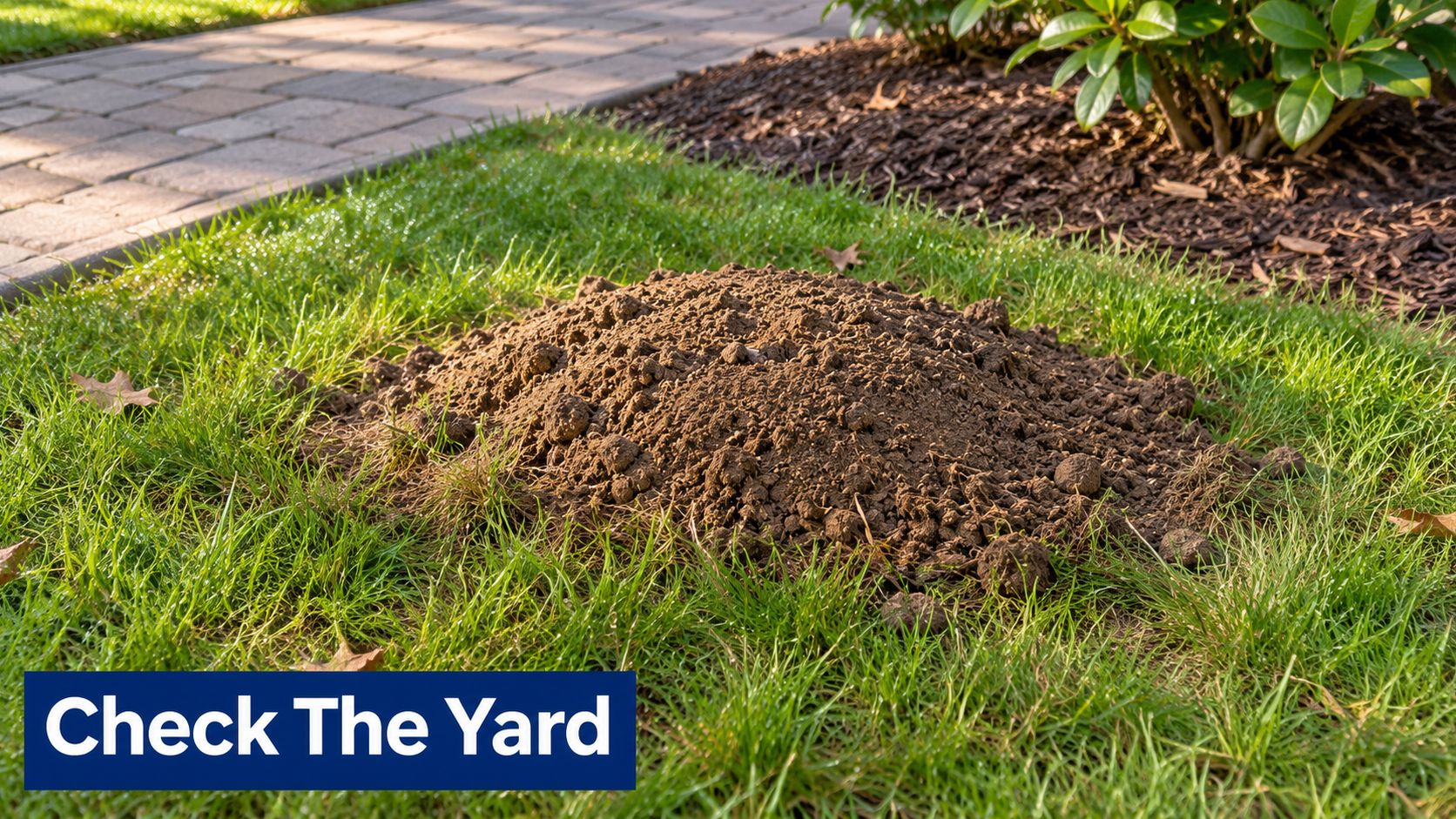
Walk the yard on a cool morning, before the sun bakes the soil and the workers drop deeper. Zigzag the front lawn, then the back, then the beds, the pavers, the fence line, and the utility boxes. You want a loose, crumbly dome of soil, usually with no obvious hole in the middle, from a few inches to more than a foot across. A fresh mound looks like someone dumped a scoop of sifted dirt on the grass and left.
Fire ants rebuild after rain, after mowing, and after any soil disturbance. A yard that was clean in March can show six new piles in May. They favor sunny, open ground: sidewalk joints, the strip against the slab, irrigation heads, utility boxes, and the bare patch where the mower turns. One dome near the mailbox is not the inventory. Workers from mounds you have not found are still foraging across the lawn, so a mound-only count will look finished while the yard is not.
Mounds get misread constantly, and a misread wastes the bait. Treat a mole ridge or a native ant nest and the product looks like a failure when the target was wrong.
| Feature | Fire ant mound | Other ant nest | Mole or gopher tunnel |
|---|---|---|---|
| Shape | Loose, crumbly dome | Small packed rim around an opening | Long ridge or tunnel line |
| Central opening | Usually none | Visible central opening | None on the ridge; the entry hole sits off to the side |
| Size | A few inches to more than a foot across | An inch or two across | Ridge can run several feet |
Step 1. Flag every mound. A stake, a plastic knife, a golf tee, anything you can still see next week. Flagging makes you cover the whole property, not just the two paths you always walk.
Step 2. Count by zone. Front lawn, back lawn, beds, fence line. Note how many sit within about 20 feet of doors, play sets, pet runs, or the patio. Those get priority later. The rest of the flags still matter, because they show where foraging colonies sit away from the house.
Step 3. Run the tap test. Lay a stick across the top of one mound and tap twice. Fire ants boil out fast and climb the stick. Native ants usually send a few scouts and quit. Do this on one mound per zone, not every flag. Enough to confirm the species, not enough to stir every nest.
Step 4. Sketch the property. Rough is fine. Mark the flags, the zones, and the count, then keep the sketch where you will find it.
That sketch is your baseline. Without it you cannot tell whether the yard is improving or whether you stopped looking. Fire ant stings leave a pustule a day later rather than a single welt, and anyone with a known allergy should stay off an active mound. If the dome still does not match the table, this breakdown of the different types of ants in Texas sorts species before you buy product.
Choosing the Right Fire Ant Treatment
The useful question isn't which product kills fire ants fastest. It's which product matches the job in front of you: reducing colonies across a property, or removing one nest that's in the way.
| Option | Best use | Timing | Safety notes | Main limit |
|---|---|---|---|---|
| Broadcast bait | Whole lawn, reducing colonies across the yard | Once or twice a year, when ants are actively foraging | Low risk when applied as labeled; keep pets and children off treated areas until it is settled | Works slowly; colonies take weeks to months to decline |
| Mound bait | Single mound in an open area away from doors | When the mound is active and workers are foraging | Low to moderate; keep bait off hard surfaces and sweep up spills | Only covers the mound and nearby foragers, not the whole yard |
| Contact insecticide mound drench | Urgent mound near doors, play areas or livestock | Immediately, when the mound is a direct hazard | Higher exposure; keep people and pets away until the label allows reentry | Can scatter the colony and does not protect untreated areas |
| Boiling water | Isolated mound far from structures, as a last resort | Immediately | Scald risk to people, pets and roots; not for use near foundations | No residual effect; can damage turf and nearby plants |
| Professional integrated pest management | Property-wide infestations, repeat mounds, or households that cannot control contact | Scheduled inspection, then treatment and follow-up | Handled by licensed technicians using the lowest effective product level | Costs more than DIY and depends on the service plan chosen |
Read that table by job, not by strength. The most aggressive product on the shelf is the wrong tool when the problem spans the lot, and the cheapest bait is the wrong tool when a mound sits against the back door where a four-year-old plays.
Texas A&M AgriLife Extension treats fire ant control as a recurring program, not a one-time hit on visible mounds. Their two-step method broadcasts a labeled bait across the entire yard once or twice a year, then treats individual mounds as needed. It works because foraging workers carry the bait back to the queen and the brood in colonies you never found. The Texas A&M AgriLife fire ant control guide reports approximately 80% to 90% fewer colonies when broadcast bait is applied correctly and repeated before populations rebound. Mound-only drenching protects the treated circle and nothing else.
Decision rule: bait the lawn, treat the mound that's genuinely in the way, and bring in help when the same mounds return after two full bait cycles.
Boiling water earns its reputation and deserves a narrow role. It kills what it touches, has no residual effect, and can scald roots and turf, so it belongs on an isolated mound far from foundations, not on a schedule. Product choice sinks more DIY attempts than effort does, which is why this look at what DIY ant killers will and won't do is worth five minutes before you buy anything.
How to Broadcast Fire Ant Bait Across a Lawn
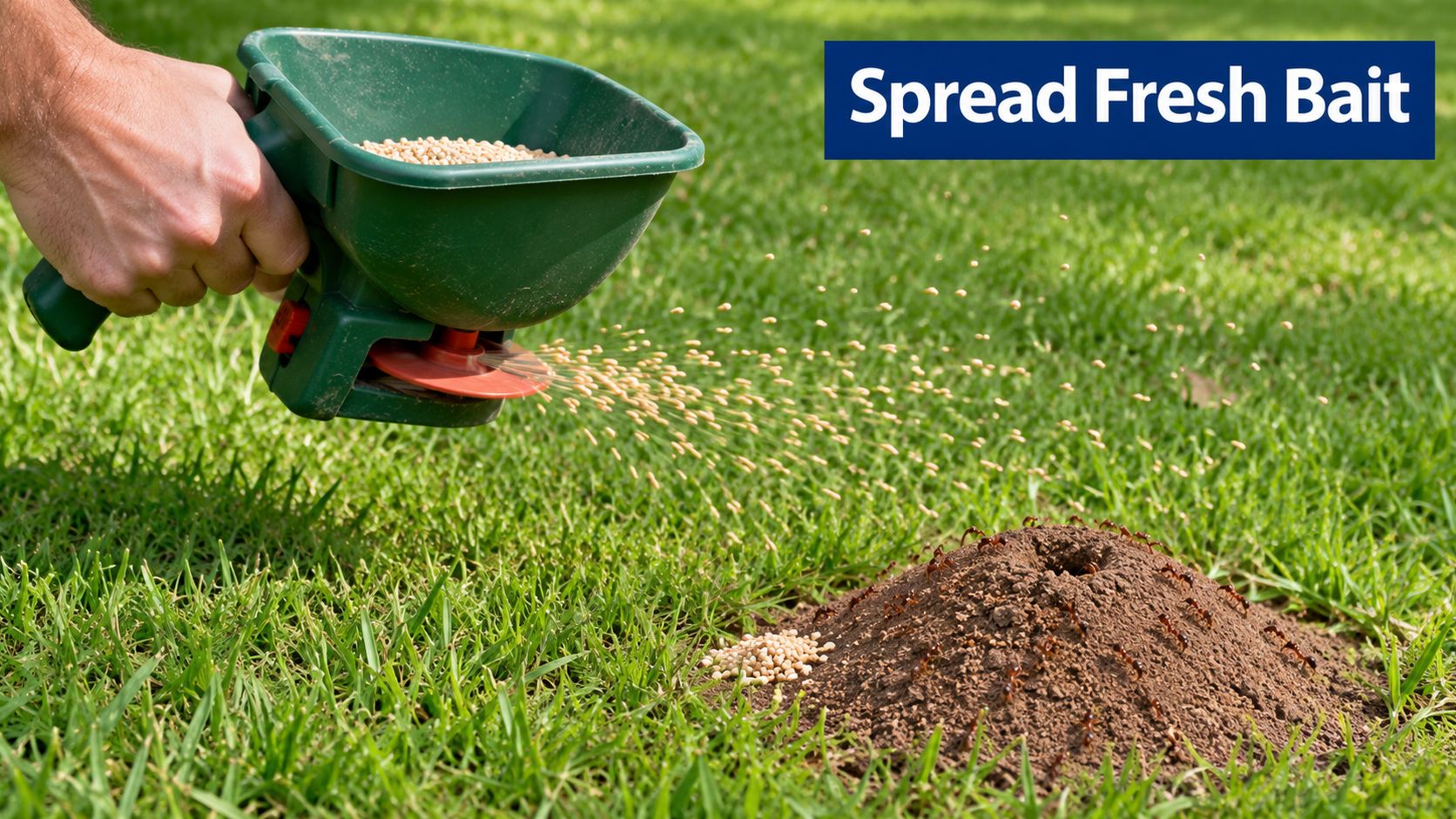
Saturday on a typical Texas lawn: a dozen mounds along the fence, one beside the swing set, and a handheld spreader still in the garage. I would bait the whole yard first. A mound-only pass can look finished while colonies you never saw keep foraging across the grass. Yard-wide bait puts product in the path of workers from every colony, including ones that never built a crater. The swing-set mound is the urgent exception, not the plan.
1. Buy fresh bait and check the date. Bait is a food product. The oil that attracts ants goes rancid, and rancid bait gets ignored no matter what it cost. Buy only what you'll use this season, and don't leave the bag in a hot truck while you run other errands.
2. Test whether the ants are taking it. Put a small pinch of bait beside an active mound and check it in about 30 minutes. If workers are carrying it away, treat. If they clean up a potato chip and ignore the bait, the bait is stale. If they ignore both, conditions are wrong and you should wait.
3. Check conditions before you open the bag. Grass and soil should be dry, no rain expected for 24 to 48 hours, and warm enough that ants are out. Cool weather below about 65°F shuts the pickup down. Late afternoon and early evening usually beat midday, when the lawn is hot and traffic is low.
4. Measure the lawn and follow the label rate. Pace off the area or pull the lot size from your survey, then calculate the amount that covers it at the label rate. Spread it evenly. Piling extra on the biggest mound wastes product and kills foragers before they haul anything home.
5. Scatter around mounds instead of dumping on top. A concentrated pile on the crater disturbs the colony and can trigger a move. A light, even pass works with foraging behavior instead of against it. The mound by the swing set still gets its own treatment later. The broadcast is for the rest of the yard.
6. Don't water for at least 24 hours. Irrigating or drenching right after a broadcast kills the workers carrying bait down to the queen. Wait a day, then resume normal watering.
7. Sweep the hard surfaces and set the next date. Granules on driveways and patios get tracked indoors. Sweep them back onto the lawn, then write the next round on the calendar while you remember it.
Done that way, the Texas A&M AgriLife broadcast bait guidance reports roughly 80% to 90% fewer mounds, with the honest caveat that eradication is uncommon and reinvasion happens. Expect the count to fall over months, not days. A spring treatment often needs the rest of the warm season before colonies are fully suppressed. A fall treatment can still be working into the following year.
Here's the application in motion if you'd rather watch it before buying a spreader.
Four causes account for most failed broadcasts, and none of them is the product: stale bait, cool or wet conditions, watering too soon, and treating only the visible mounds while satellite colonies keep foraging.
Bait is a delivery system, not a contact killer. Spray or water it before the workers carry it underground and you've paid for expensive grit on your lawn.
How to Treat Individual Mounds Safely
The most common mound-treatment mistake happens before the package is open. Kicking the mound, poking it with a shovel to see how deep it goes, or spraying half of it and walking away can push workers to move the queen or start satellite colonies nearby. You treat one mound and end up with three.
Where Exposure Actually Happens
Extension sources describe fire ant bait as low risk when it's applied correctly, and they also name the failure modes that cause trouble in real yards: visible piles, spilled granules, incorrect mound applications, and pets left outside during treatment. Some products can be toxic to a pet if enough is ingested, and granules left sitting on the surface are a bigger concern than product worked into the ground exactly as labeled. The homeowner guide to imported fire ants is blunt about one thing worth repeating: product labels, not internet advice, control dosage, watering, reentry, and storage.
- Confirm the product is labeled for mounds, then read the reentry and pet instructions on the panel before you carry it outside.
- Move children and pets indoors or to the far side of the property. A dog that investigates the application is the most likely exposure in the whole process.
- Wear gloves, long sleeves, and closed shoes. Disturbed colonies defend the mound, and a sting on the ankle is a bad trade for a five-minute job.
- Apply exactly the label amount. More product is not more effective, and going past the labeled area is a violation, not a shortcut.
- Keep granules off driveways, sidewalks and patios, and sweep any spill into a sealed bag rather than hosing it away.
- Store the product locked and out of reach, away from pet food and away from anything a child can climb to.
- Record the date and the mound location so the follow-up check is a comparison rather than a guess.
"Natural" and "homemade" aren't automatically safer or more effective. A properly selected bait can lower total pesticide exposure because it's targeted and leaves little residue when used correctly. That matters most in homes with digging dogs, barefoot kids, vegetable beds, or wildlife passing through.
If your household can't reliably keep people and pets off a treated area, that's the clearest signal to hand the job to a licensed technician with targeted application. Rental and multi-occupant properties should keep product labels and safety data on file for tenants and staff.
Preventing Fire Ants From Coming Back
A June yard can look finished and still be full of new mounds by September. You knocked down every dome you could see, the grass closed over, and foragers still showed up at the patio. That is the limit of a mound-only plan. The dome by the steps is the urgent exception. The colony still working the rest of the lawn is what a yard-wide bait round has to reach, and that round expires.
In a USDA field comparison, ten weeks after treatment, broadcast applications produced population-index reductions of 71.5% for Logic bait and 89.7% for Amdro bait, while single-mound treatments delivered 87.7% and 79.4%. By 46 weeks, populations had gradually returned to or exceeded pretreatment levels, according to the USDA fire ant research summary. Treatment buys suppression. Suppression has to be renewed.

MSU Extension's 2024 guidance on baits and mound treatments describes three granular bait rounds a year, spread across the lawn and applied correctly, rather than a single pass on the mounds in view.
| Timing | Action | Purpose |
|---|---|---|
| Spring | Broadcast bait across the whole lawn | Cuts colonies before the summer peak in activity |
| Midsummer | Broadcast bait, second round | Holds suppression through the hottest weeks, when bait dries out and pickup gets unreliable |
| Early fall | Broadcast bait across the whole lawn | Lowers colony numbers before cooler months and the next spring |
| Ongoing, every few weeks | Spot-treat new mounds as they appear | Handles satellite colonies and mounds near traffic that broadcast bait has not finished |
The spring round does the heavy lifting. Colonies are expanding and foragers are hungry, so a broadcast bait has something to work with. I would not skip the midsummer round. Heat dries granules fast, and a lawn that looked quiet in May can rebuild while you wait for fall. The early fall round lowers the starting count for next year, which means fewer mounds beside the steps when warm weather returns.
Mound counts lie if you only walk the obvious domes. Gaps between rounds, churned soil from irrigation repair, untreated lots next door, and satellite colonies you never mapped all put ants back on a "clean" lawn. Keeping mulch off the slab, sealing cracks, and clearing debris close the indoor routes, and these simple prevention tips you can do today to reduce ants cover that half of the job. One spring baiting beside three untreated yards gets re-seeded by summer. Mississippi State University Extension's fire ant control page points to that same block-level timing in spring and fall. It is the cheapest upgrade on the calendar.
The workable target is a low count, with the mound by the steps treated before anyone steps in it. A yard baited once and then left alone looks fine for a season and then starts over.
What Magnolia Homeowners Should Know
Magnolia is an incorporated city in southwest Montgomery County, Texas, with its municipal offices at 18111 Buddy Riley Boulevard, according to the City of Magnolia. That makes it a specific place with its own development pattern, not a stand-in for "the Houston area."
The growth has been steep. The U.S. Census Bureau counted 2,359 residents in 2020 and estimated 8,095 for July 1, 2025, an increase of 5,736 people, or about 243%, per U.S. Census Bureau QuickFacts for Magnolia. All those new residents mean new subdivisions, graded lots, fill dirt, and fresh sod, which is precisely the disturbed, irrigated ground fire ants colonize first.
Three things follow for a Magnolia yard:
- Map your own lot before comparing notes. Pressure varies block to block, and a new build on fill can carry different activity than an established lot two streets over.
- Coordinate the bait window with neighbors. Untreated lots re-seed treated ones, and the calendar only works if the surrounding properties aren't running a constant nursery.
- Give extra attention after construction or landscaping. Any project that moves soil opens ground for new colonies, and new sod brings its own risk.
Gulf Coast heat and humidity can shorten the usable bait window, so check the forecast before each round rather than trusting a date on a calendar. If your home is newly built, a baseline inspection before the first full season tells you what you're starting with instead of what you hope you have.
Build Your Fire Ant Plan This Season
The DIY path suits a smaller lawn with a handful of mounds, a homeowner who'll follow the calendar, and no one in the house at risk from exposure. Four steps cover it.
- Map the yard using the morning walk-through, with every mound flagged and counted by zone.
- Book the first bait round and pick a day with a dry forecast window, since rain after application wastes the product and the money.
- Schedule the follow-up mound check, so each flagged mound is logged as gone, active, or new.
- Record the count at every round and compare it against the baseline sketch. Numbers, not impressions.
When to Hand It to a Professional
Hand it over when mounds sit against doors or in play areas, when the same mounds return after two complete bait cycles, when nobody can reliably keep kids and pets off treated ground, or when the property is too large to walk with a spreader.
FullScope Pest Control works from an integrated pest management approach and applies the lowest level of insecticide and baiting needed to resolve the problem. In a recent Kingwood, TX ant treatment, the team applied granular bait along the perimeter, laid a liquid barrier around the foundation, treated two active mounds, and sealed the garage door threshold with foam, with a follow-up recommended in 30 days to confirm the activity was gone. For that home, quarterly preventive service was advised given the level of ant pressure. Before you call, confirm that your Magnolia address falls inside the service coverage, which runs through Conroe, Porter, Cleveland, Kingwood, and the surrounding communities.
If your yard has more mounds than you can flag in one morning, or the same ones keep rebuilding after two full bait rounds, book an inspection with FullScope Pest Control and ask for a walk of the property before anything is applied. Bring your sketch, mark where the mounds were, and keep the dates of every application. A yard baited on schedule twice a year, with the urgent mounds handled in between, is the difference between managing fire ants and fighting them every single summer.