1500+ reviews


Yes, professional pest control can eliminate an active mouse infestation, but only when inspection, sealing, and trapping are combined to remove the mice inside and block replacements outside. If a service only traps or baits, it can reduce numbers without solving the reason mice keep entering.
Why do so many homes look clear for two weeks and then have droppings again? The missing question isn't whether the traps worked. It's whether anyone closed the route that let the next mouse walk in.
When Pest Control Gets Rid of Mice and When It Doesn't
Can a treatment get rid of mice and keep them from returning? Those are two separate outcomes. Trapping reduces the mice already inside; sealing and correcting conditions that attract them helps prevent replacements. A treatment can appear successful at first while leaving the route open for new activity.
A study of six buildings with 156 apartments in a low-income New Jersey community reported mouse-infestation rates after 12 months of 2% for traps and bait, 2% for traps, bait, and exclusion, and 44% for the control group. The figures show the reported rates for each group; they do not show a lower rate for the combined program than for traps and bait alone. Building conditions, neighboring units, sanitation, and repairs can also affect whether mice return.
What Pest Control Can and Cannot Do by Situation
| Situation | What pest control usually does | What else decides the result |
|---|---|---|
| Mice seen in kitchen or living areas | Traps mice indoors and may use bait where appropriate | Sealing entry points and removing crumbs, pet food, and clutter |
| Mice in attic, garage, or crawlspace | Checks likely travel routes and places traps near signs of activity | Closing gaps around utilities, vents, and rooflines |
| Sightings return after cleanup | Rechecks for activity and adjusts trap locations or monitoring | Finding an entry point or food source that was missed |
| Multi-unit building or shared walls | Coordinates inspection and control across affected units | Cooperation from residents and timely repairs in neighboring units |
| Mice inside walls with no visible entry | Monitors for signs that can help locate access routes | Reaching concealed gaps may require building repairs |
For renters, responsibility for repairs can affect whether gaps get sealed. Bed bug repair obligations in Texas concern a different pest, so they do not establish who is responsible for mouse-related repairs. Check the relevant lease and local requirements for your situation.
Progress is easier to assess through several signs together: fewer droppings, no fresh gnaw marks, and no catches during follow-up checks. If fresh evidence appears again, the treatment needs another look.
How a Professional Mouse Service Runs From Inspection to Follow-Up
A good visit follows a clear order, and you can judge a provider by whether they stick to it. The U.S. Environmental Protection Agency four-step approach is inspect for evidence, seal openings and travel pathways, remove food and water through sanitation, and trap mice inside the structure and around its perimeter. There's a reason trapping comes after inspection. You can't place devices well if you don't know where mice travel.
Our approach at FullScope Pest Control follows that logic. We find entry points, understand the activity, and identify the conditions that let infestations continue before building a plan for removal and lasting protection. That sequence keeps the technician from treating a sighting in one room while mice keep entering somewhere else.
Here's a technician checking one of the low-traffic spots mice use first.
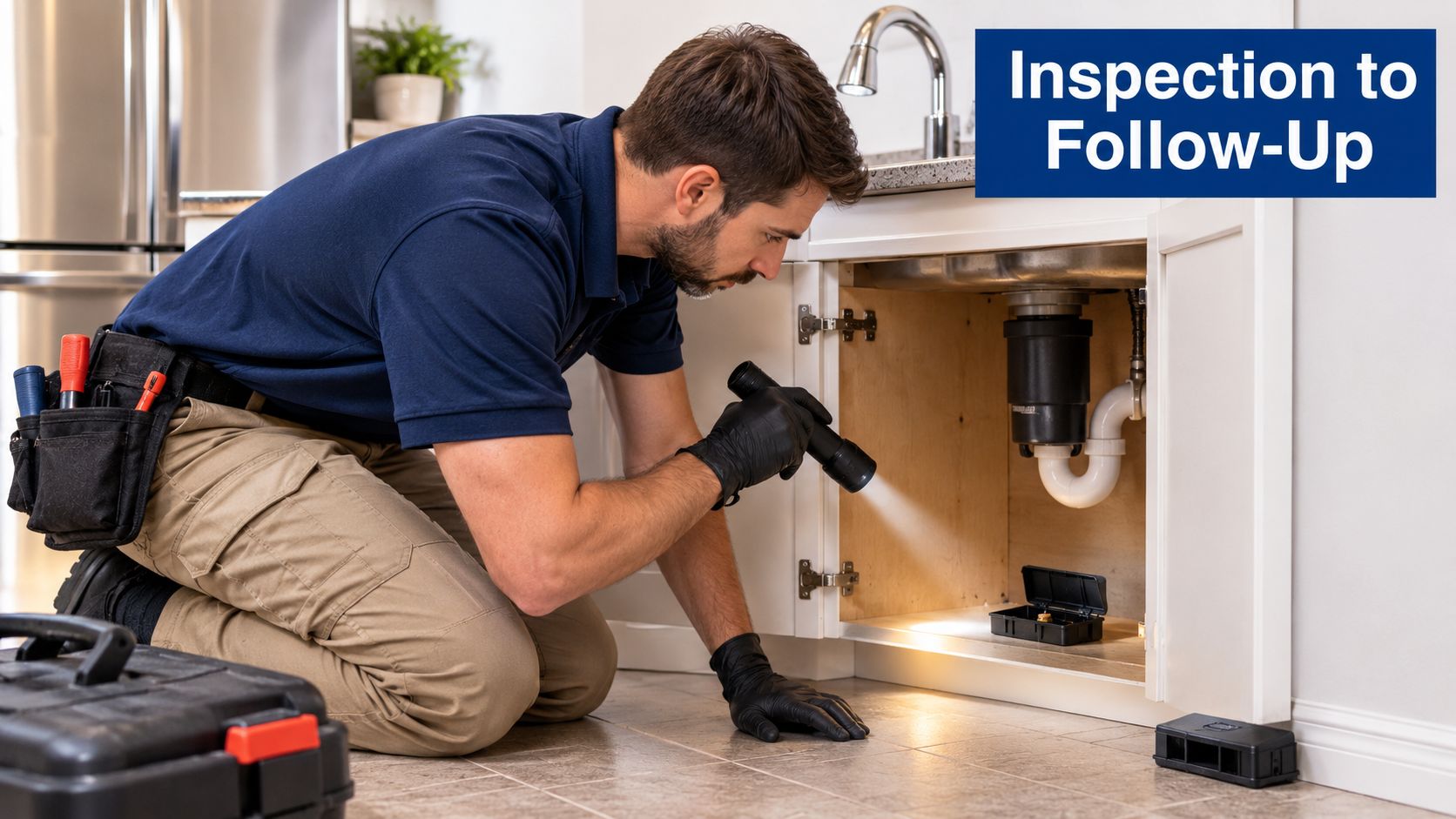
The Six Steps You Should See
Inspect for evidence. The technician looks for droppings, urine stains, gnaw marks, nesting material, and worn travel routes along walls. Fresh, soft droppings point to current activity, while old signs help map where mice have been.
Map activity and entry points. Foundation cracks, utility penetrations, vents, door thresholds, attic interfaces, and rooflines all get checked. Mapping matters because a mouse in the pantry may be entering through a pipe chase two rooms away.
Seal openings. Durable materials such as metal mesh, concrete, or flashing close the gaps mice use. This is the step that stops replacements, so skipping it turns trapping into a revolving door.
Remove food, water, and clutter. Pet food, birdseed, spills, and stored cardboard give mice a reason to stay and breed. Securing food in hard containers and clearing nesting cover makes the house support fewer mice between visits.
Set and check traps. Traps go inside and around the perimeter where evidence shows movement, then get checked on schedule. Each catch location tells the technician whether activity is shrinking or shifting.
Confirm activity has stopped. The service shouldn't end on a guess. The technician verifies that droppings, gnawing, and catches have stopped before closing the job.
Practical rule: If a provider sets traps on day one without writing down entry points, ask what stops the next mouse. A clear answer names specific gaps and materials, not just a return visit.
Typical Timing for Each Phase of a Mouse Service
| Phase | Typical timing | What confirms progress |
|---|---|---|
| Inspection and activity mapping | Day 1, usually one visit | Evidence logged by location and type |
| Exclusion repairs | Days 1 to 3 for most ground-level and wall openings | Every listed opening sealed and documented |
| Trapping | Checked daily and continued until no rodents are caught | No catches across consecutive checks |
| Sanitation and food removal | Completed alongside exclusion | Food sources secured and clutter cleared |
| Post-treatment monitoring | 2 to 4 weeks after the last catch | No fresh droppings, gnaw marks or new runways |
You should leave the first visit with three things. Ask for a written list of entry points, a sanitation checklist you can complete the same day, and a monitoring plan with dates. Those documents turn a vague promise into work you can verify.
Sealing Entry Points Before Mice Come Back
Exclusion is the step that makes results last. Trapping removes mice you already have. Sealing decides whether you get new ones.
University of Missouri Extension guidance on house mouse management identifies sanitation, mouse-proof construction, and population reduction as the three components of effective house-mouse management, and describes exclusion as the most successful and permanent control measure. It also notes openings of approximately 1/4 inch or larger can permit mouse entry. That's smaller than most homeowners expect, which is why a quick glance around the foundation misses real access points.
Think in size thresholds rather than obvious holes. A mouse can enter through a hole about the diameter of a dime. Door gaps should generally be reduced to less than 1/4 inch. If you can slide a pencil under a door, a young mouse may not need much more room.
Opening Sizes and How to Close Them
| Opening | Mouse access | Repair |
|---|---|---|
| Hole about the diameter of a dime | Enough for a mouse to enter | Seal with metal mesh, concrete or flashing |
| Opening of 1/4 inch or larger | Enough for a mouse to enter | Seal with a durable material matched to the gap |
| Door gap of 1/4 inch or more | Above the recommended limit | Fit a door sweep or threshold so the gap drops below 1/4 inch |
| Gap under 1/4 inch | Limits entry | Recheck seasonally and after building or repair work |
Walk the building in a fixed route so you don't skip the boring spots. Check foundation cracks, utility penetrations where pipes and conduit enter, vents, door thresholds, the attic interface, crawlspaces, and roofline details where different materials meet. Pay close attention to garage corners and the gap where siding meets the slab.
In Southeast Texas, garages, crawlspaces, dense vegetation, and weather-related building gaps create repeated access routes. Shrubs or branches touching siding act as bridges to vents and rooflines, so trim vegetation back from the wall. Standing water and cluttered storage against the foundation also give mice cover while they test for openings.
Materials matter because mice gnaw soft barriers. Expanding foam or caulk alone can be chewed through, so use them to seal air gaps around a hard core rather than as the barrier itself. Copper or stainless mesh packed into a pipe gap, then finished with mortar or flashing, holds up far better. A detailed walkthrough of identifying and sealing common entry points for rodents can help you match the material to the opening before you buy supplies.
Your Weekend Check
- Garage door bottoms: Look for daylight at the corners and replace cracked seals.
- Weatherstripping: Press each exterior door shut and check for gaps along the threshold.
- Pipe collars: Inspect under sinks and behind appliances where plumbing passes through walls.
- Vents and screens: Replace torn screens and confirm covers sit flush.
- Stored food: Move pet food and birdseed into sealed, hard containers.
Trap Placement and Monitoring That Actually Work
A trap in the middle of a room rarely catches anything, and that's not bad luck. House mice travel along protected edges and established runways, so placement has to intersect that movement.
This is the basic setup against a wall where mice already run.
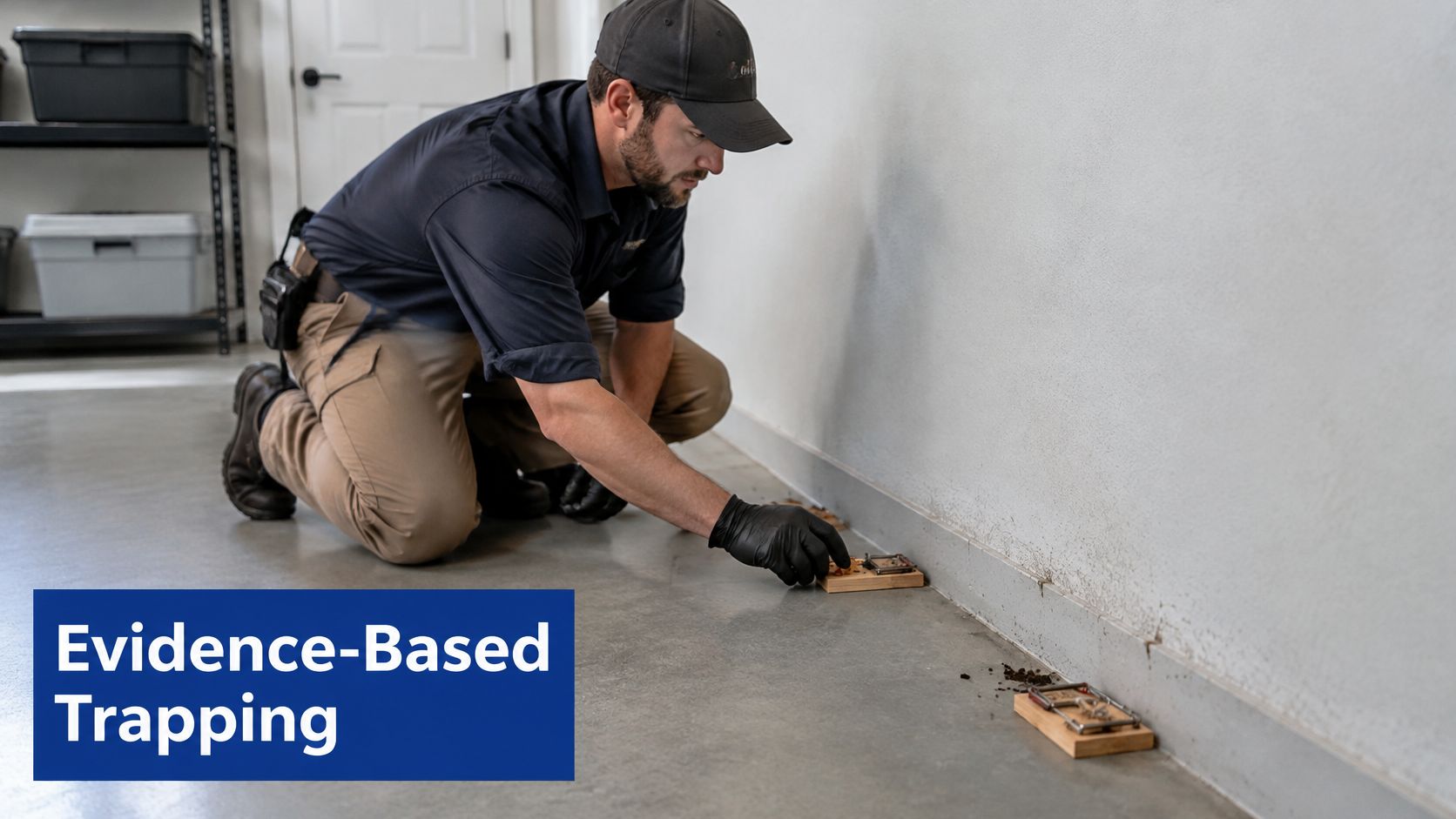
CDC trap-up guidance recommends inspecting for droppings, urine, nesting material, gnaw marks, and travel routes, placing traditional snap traps along walls and near appliances, cabinets, attics, crawlspaces, and other low-traffic locations, and continuing until no rodents remain. Nebraska Extension recommends concentrating traps where activity is evident and spacing them no more than about 10 feet apart in active areas. Set each trap perpendicular to the wall with the baited end adjacent to it, so a mouse following the edge meets the trigger head-on.
Density matters more than a clever bait. Two traps in a pantry with droppings along both walls will underperform a tight line of traps along the active runway. When you ask whether can pest control get rid of mice with traps alone, the honest answer is that it can clear the indoor population if traps are dense, correctly placed, and checked daily, but it still won't block new entry.
Three Mistakes That Stall Progress
- Scattering traps in open rooms: Mice avoid exposed floor, so devices sit empty while activity continues along the baseboards.
- Moving traps too early: One catch doesn't mean that runway is finished. Leave productive locations set and add traps nearby instead.
- Stopping because the house looks clear: Quiet nights can mean mice shifted to a wall void. Keep checking until catches and fresh signs stop together.
Watch how placement and daily checks work together in practice.
Check traps daily, record each catch and its location, and dispose of captured rodents promptly. A simple log works fine. Sketch each room, number every trap, and write the date, catch result, and any fresh droppings beside it. That map shows whether numbers are falling in one zone or appearing somewhere new, and it also helps you choose the best mouse bait for snap traps based on what mice are taking.
Bait stations have a narrower role. They're generally reserved for infestations that persist after trapping and exclusion, with placement governed by label and safety requirements. If traps are still producing catches after entries are sealed, that's the signal to discuss the next step, not the starting point.
Safe Methods Around Children, Pets and Wildlife
Poison isn't the fastest fix just because you don't see a carcass. A mouse that dies inside a wall leaves odor and cleanup problems, and bait placed where a child or dog can reach it creates a risk you didn't need to take.
The EPA guidance on safely using rodent bait products warns that mouse and rat poison can harm people, children, and pets if misused, and says products must be kept inaccessible, placed only where children and pets cannot reach them, and used according to the label. Traditional snap traps are the initial option, while poison or bait stations are reserved for infestations that persist. Prompt carcass removal also reduces risks to pets and wildlife that might encounter a dead rodent.
Use this decision order instead. Start with exclusion and sanitation, then add appropriately positioned traps in places children can't access, such as behind locked appliance panels or inside secured cabinets. Consider tamper-resistant, EPA-registered bait stations only when monitoring shows continued activity after those steps. Professional pest control doesn't automatically mean indoor poison, and a technician should be able to explain why bait is or isn't needed in your house.
A safer plan isn't a weaker plan. It's the same removal work, sequenced so the lowest-risk tools get used first and bait only earns its place when traps and sealing haven't finished the job.
Cleanup is part of safety, not housekeeping you handle however you like. Rodent urine, droppings, carcasses, and nesting material are potential health hazards. Wear gloves, wet contaminated material with disinfectant before removal, and avoid dry sweeping or vacuuming, which can stir particles into the air. Bag the waste, wash your hands, and keep children and pets out of the area until surfaces are clean and dry.
If you're comparing lower-toxicity options for a home with kids or animals, eco-friendly pest control that's safe around children and pets explains how those choices fit into a broader plan. Before work starts, ask three direct questions. Where would any bait be placed, how are carcasses retrieved, and how are occupants protected during treatment? Vague answers are a reason to pause.
When Mice Keep Returning and Ongoing Service Is Needed
Returning mice don't always mean the first treatment failed. Sometimes they mean the treatment was never completed. Learn to read the signal before you pay for a repeat of the same visit.
Fresh droppings or gnaw marks after the 2 to 4 week monitoring window usually point to an open entry point or food source the first clean-up missed. The right response is re-inspection and resealing, not just more traps in the same spots. Ask the technician to compare the new evidence location with the original entry list.
Match the Signal to the Next Action
- Fresh droppings in the same room: Re-inspect nearby pipe gaps, appliance lines, and door thresholds for a missed opening.
- Catches in a room that was clear: Activity may have spread or shifted, so move traps to the new runway and extend monitoring.
- Scratching inside walls with no visible entry: A hidden route may sit behind siding or in a ceiling void, and opening a small section of wall or ceiling may be needed to reach it.
- No catches but new gnawing on stored food: Sanitation likely lapsed, so secure the food source and reset traps along the nearest wall.
Mice that persist after trapping and exclusion may justify tamper-resistant, EPA-registered bait stations placed under label and safety rules. That decision should follow documented monitoring, not frustration. If you're in a multi-unit building, persistent activity can trace to neighboring units, waste storage, or repairs outside your unit, so every unit needs inspection before anyone promises control.
Ongoing service makes sense when a property keeps creating access. Older garages, crawlspaces with multiple utility penetrations, wooded lots, and fast-growing areas with frequent construction all produce new gaps and displaced rodents. Regular visits let specialists track changes, catch fresh activity early, and make small adjustments before the problem builds back up.
Get the monitoring schedule and re-treatment terms in writing. You should know who checks traps, how often, what counts as a return, and what happens next. A written plan prevents the common gap where the homeowner thinks follow-up is included and the provider thinks the job ended at the last catch.
Confirm Magnolia Coverage and Book Your Free Inspection
Before booking, ask FullScope Pest Control whether your specific Magnolia address falls within its service area. The company serves communities across north Houston and Southeast Texas, but Magnolia is not among its listed locations.
The City of Magnolia departments page lists the city's municipal address as 18111 Buddy Riley Boulevard, Magnolia, Texas 77354, in southwestern Montgomery County. The U.S. Census Bureau QuickFacts for Magnolia reports 2,359 residents in the 2020 Census and an estimated population of 8,095 as of July 1, 2025. Growth and construction can create new gaps around buildings and utility lines, giving mice routes indoors.
Local conditions can also shape a mouse-control plan. Wooded lots may offer cover near a home, while garages and crawlspaces can provide sheltered areas. Effective control addresses both the mice already inside and the routes that could let others enter.
FullScope Pest Control offers a free rodent control estimate. Rodent and wildlife service starts with an inspection and assessment, followed by recommendations based on what the technician finds.
Prepare Before the Visit
- Note the timeline: Record when and where you first noticed activity.
- Photograph evidence: Take clear pictures of droppings or gnaw marks before cleaning.
- List occupants: Mention children, pets, and wildlife concerns.
- Sketch sightings: Mark locations on a simple floor plan.
Ask what the recommended service includes, how traps will be monitored, and whether bait is part of the plan. Before booking, confirm that your address is served and request the free estimate.
If you see droppings, hear scratching, or find fresh gnaw marks, contact FullScope Pest Control to ask whether it serves your Magnolia address. If it does, request a free inspection and estimate. A sound plan should address current mouse activity and the entry routes that could allow it to return.