1500+ reviews


It's Saturday morning, you're loading groceries in Magnolia, and a thin line of ants is crossing the center console toward yesterday's soda cup. Your first instinct is probably to grab whatever spray is under the sink and fog the whole cabin. Don't. Getting rid of ants in car interiors safely starts with figuring out why they're there, because a crumb trail from the driveway and fire ants riding in soil under the mats need completely different responses. Treat the wrong one and you'll add chemical residue to your seats while the colony keeps sending workers.
Sort the Ants Before You Treat
Say you're parked off FM 1488 and you spot that line on the console. Pause before you spray. Ants in a vehicle are usually visitors, not residents. They've followed a scent trail in from outside, found food or moisture, and they're carrying it back to a nest that's rarely in the seats themselves.
What they look like and where the car has been tells you more than color alone. Tiny dark ants headed for a soda ring are typically sugar-loving nuisance ants. Reddish ants plus grit on the mats after parking beside a mound, pasture, or landscaping load point toward fire ants that may have ridden in with soil. Large dark ants around a damp spare-tire well suggest moisture is drawing them, not a colony living in your dashboard.
If the ants vanish on the highway and return only in one parking spot, the colony is almost certainly in the yard, curb, or shrub bed. You're treating a parking spot problem, not a cabin problem.
Read the Clues First
A crushed ant that smells like rotten coconut fits odorous house ants. A painful sting and a soil mound fit fire ants. Neither clue is a full species identification on its own, and guessing wrong leads to the wrong bait later. If you want help narrowing the group before you buy anything, our guide to common ant types in Texas homes and yards walks through the traits that separate them.
What the ants in the car mean
| What you see | Likely group | Where to look | First move |
|---|---|---|---|
| Tiny dark ants on crumbs or a soda ring | Sugar-loving nuisance ants | Console, mats, door pockets | Vacuum, wash the film, bait the trail |
| Ants only in one parking spot, gone after a drive | Colony outside the car | Curb, shrub bed, driveway pad | Treat the parking spot, not the cabin |
| Reddish ants plus soil after a mound or job site | Fire ants possible | Mats, wheel wells, soil underneath | Knock off soil and inspect before driving on |
| Large dark ants and a damp trunk or spare well | Moisture followers, carpenter ants uncommon in cabins | Trunk seams, spare-tire well | Dry the area and find the outdoor source |
| Trail into a dash gap or vent | Foragers following a scent | Gap edge only, not the wiring | Bait at the edge, never aerosol inside |
Pick one row before any cleaner or bait comes out. That choice decides whether you clean, dry, inspect soil, or leave the cabin alone entirely.
Ants on the console don't mean ants live in the console. Find where the trail starts and ends, and you've found the real problem.
Skip Sprays That Stain Paint and Miss Nests
Plenty of quick tips tell you to fog the cabin and shut the doors. That advice skips the only document that matters: the product label. The label, not a video or a forum post, decides where a product can go.
EPA pesticide safety materials state that pesticide use must follow the product label, including permitted application sites, frequency, protective equipment, and exposure controls. For a car, that standard raises the bar fast. Aerosol solvents and propellants can stain trim and haze finishes they were never formulated to touch, and a sealed cabin lets vapors and residue settle onto surfaces your hands contact every drive. If accidental overspray lands on paint, rinse it off right away rather than letting it dry. Unless a label expressly lists vehicles as an application site, that product stays out of the cabin entirely, both in use and in storage.
That's a very different picture from "spray until they stop moving." If the mound sits beside your driveway, interior spray loads cloth and plastic with residue while the colony outside stays untouched. Bait earns its place instead: ants carry it home themselves, so treatment reaches the nest when it's placed where ants already travel.
Match the Move to the Surface
Safe and unsafe moves by vehicle surface
| Cabin or exterior area | Do this | Do not do this |
|---|---|---|
| Floor mats and carpet | Vacuum, then soap and water | Soak with insecticide |
| Trails on plastic trim | Tiny bait beads if the label allows vehicles | Broadcast spray along the dash |
| Dashboard gaps and vents | Bait at the gap edge | Aerosol into electronics or wiring |
| Paint, wheels, and panels | Rinse accidental spray off immediately | Leave pesticide to dry on paint |
| Passenger area storage | Keep pesticides out of the cabin | Carry open containers on the seat |
Never aim aerosol into vents, fuse boxes, seat motors, or wiring. Ants in a dash gap are following a scent along an edge. They aren't nesting on a circuit board, and flooding that gap puts solvent and propellant where they don't belong.
The safer order is simple. Remove food, trash, and moisture first. Vacuum ants and clean trails second. Figure out whether activity is confined to the cabin or starts in the parking area third. Only then consider a product, and only one whose label expressly permits the surface you're treating.
Practical rule: If you can't find vehicles listed on the label, that product doesn't go in your car, no matter how well it worked in a kitchen.
Save the professional call for now. But if you're seeing stinging ants in soil on the vehicle, or trails that survive a full, undisturbed bait cycle, that's no longer a cleaning problem.
How to Clear the Cabin Step by Step
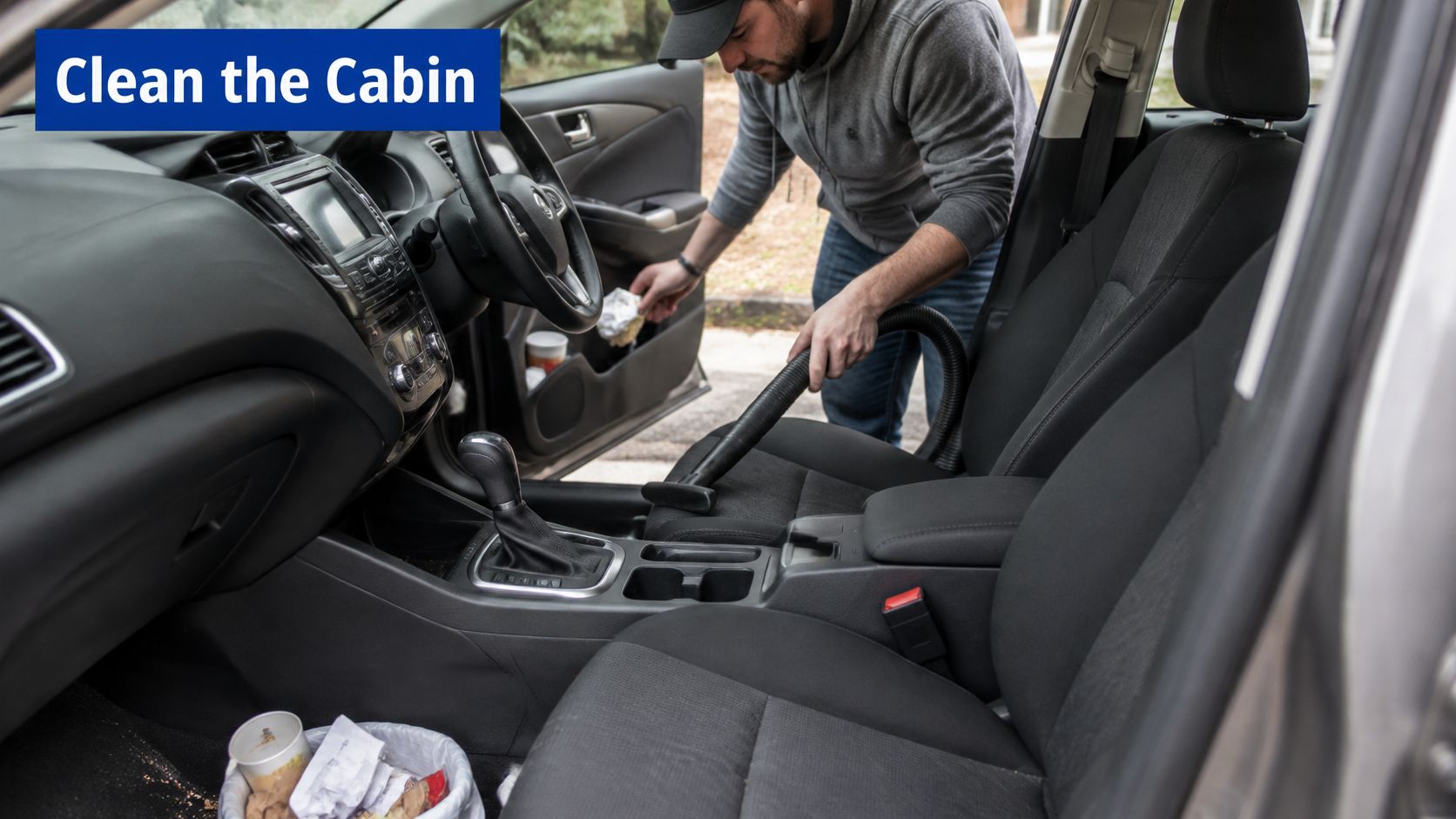
Work the cabin only when ants are inside it. If your table row pointed to a colony in the yard, deep-cleaning the seats won't fix your parking spot. For a genuine crumb trail, here's the order that works, and why each step matters.
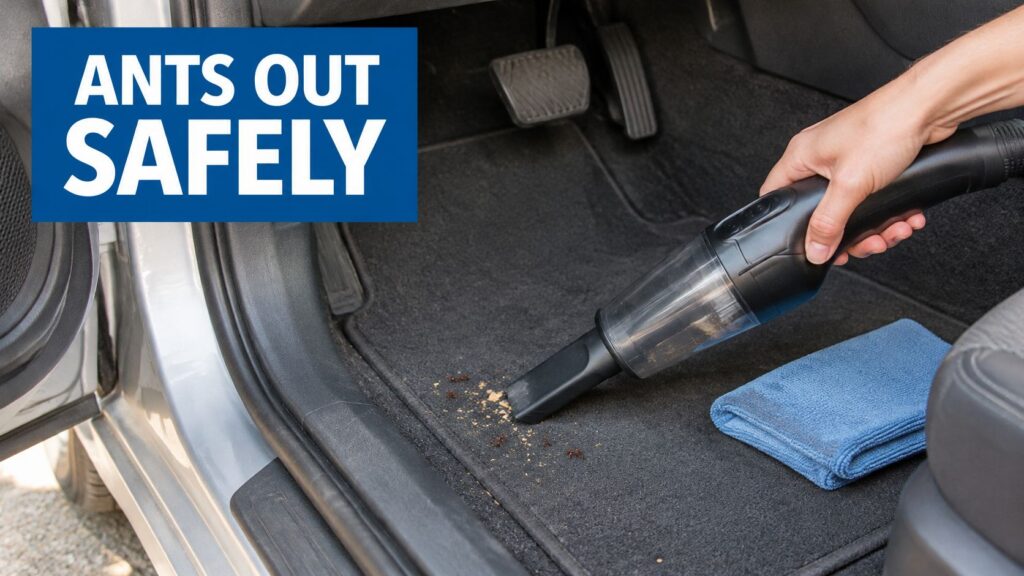
A thorough vacuum is the core of the job, as this cabin cleanup shows.
Clean First, Bait Second
- Pull every food source. Empty cups, wrappers, pet treats, and kids' snack bags from door pockets, under seats, and the trunk. Bait can't compete with a free meal.
- Vacuum thoroughly. Hit seats, mats, console seams, and carpet edges with a crevice tool. Empty the canister outdoors, away from the garage door, so live ants don't walk back inside.
- Wash the sticky film. Use mild soap and water on cup holders, console plastic, and door pockets, then dry everything. You're removing food residue and the scent film ants follow, and soap does that without adding pesticide to surfaces hands touch all day. For seams and textured trim where a cloth just smears residue around, SwiftJet's interior brush selection guide helps you pick a brush stiffness that lifts grit from stitching and vents without scratching plastic.
- Watch for two minutes. Sit still and mark the route with small pieces of tape beside the trail, not on the ants. You need to know exactly where they travel before you place anything.
Place Bait Only Where the Label Allows
- Check the label for vehicles. The U.S. Environmental Protection Agency label for Maxforce Quantum lists transportation equipment, including cars, trucks, vans, buses, and recreational vehicles, as approved treatment sites for that bait. It directs users to place bait near active foraging trails, nest sites, cracks, crevices, holes, and other small openings where ants travel, at 0.6 grams per 10 linear feet of ant trail, in several small spots or beads. That same label says the product controls several ant species, excluding fire, carpenter, and harvester ants, so skip it if those are your suspects.
- Keep bait contained and out of reach. That label warns the bait can harm people if swallowed or absorbed through skin, may irritate eyes, and must be kept inaccessible to children and pets. Place beads along trim edges and seam lines, never in cup holders still in use or where a child's hand sweeps for dropped snacks.
- Leave the trail alone. Don't wipe the route, spray over it, or vacuum that spot for days. Workers need an undisturbed path to find the bait and carry it home.
- Air the car out. Ventilate before the next regular ride, and remove leftover bait once activity stops.
Done looks like this. No fresh crumbs anywhere. Dry upholstery. Bait only in tiny beads on the marked route, and nothing sprayed across seats, carpet, or the dash.
Give the Bait Time to Reach the Colony
A bait bead under the seat works like a courier route. Workers find it, feed, and carry a share back to nestmates and the queen, so the actual result happens out of sight over days to weeks. A quieter console an hour after placement tells you almost nothing about the colony.
For a realistic clock, look at field data. A Texas A&M linked field study of rover ants found that imidacloprid bait reduced foraging ants by an average of 83.0% over 28 days and left approximately 25% of the original colonies standing. Colonies whose trails ran within 1.5 m of a bait station were more likely to be eliminated. That work was done around residential structures rather than vehicles, so read it as a rough calendar for your car: meaningful reduction builds over days to weeks when bait reaches the nest.
Habits That Interrupt Transfer
- Stacking products on day one: Offer one bait formulation at a time. If a sweet gel sits ignored, switch later to a protein or grease bait based on what the ants are taking.
- Wiping the route too soon: Cleaning right after placement erases the scent path workers use to recruit nestmates, and fewer recruiters means slower delivery to the colony.
- Adding a fast-kill spray: Spraying foragers mid-trail kills the couriers before they deliver anything, and the colony sends replacements.
- Washing the car mid-cycle: A wash, a spilled drink, or rain soaking an exterior placement can dilute or ruin bait. Sheltered, dry placement is the safer choice through a humid Southeast Texas week, when a storm can scrub an exposed bead in minutes.
Distance matters as much as patience. Some colonies are polydomous, meaning they spread across multiple nests. One bead under a seat may suppress the foragers visiting your console while a second nest by the curb keeps producing them. That is a reach problem, and it is why placement beside an active, undisturbed trail outweighs quantity.
While you wait out the transfer window, our breakdown of what DIY ant killers will and won't do explains why borax mixes and vinegar sprays so often scatter a trail without touching the colony.
Judge bait at four weeks. Ants still recruiting strongly after about a month of undisturbed bait usually mean the nest sits outside the car.
Check the Undercarriage and Stop Repeat Visits
Here's the question most quick guides skip. Can your car spread ants to your driveway, workplace, or another property? Sometimes, yes, and it depends on the species and what your vehicle has touched.
Recent entomological research in the Journal of Economic Entomology identifies vehicles and shipping containers as possible hitchhiking pathways for imported fire ants, especially when vehicles have contacted infested soil, hay, or agricultural material. A passenger car that picked up foragers in a residential driveway is a lower risk than a truck, trailer, lawn-care vehicle, or off-road vehicle carrying soil.
The pattern isn't theoretical. ExplorersWeb's report on a 2024 Ecological Entomology study documented 52 cases of ants hitchhiking on 44 cars and 8 scooters in Taiwan from 2017 through 2023. Virginia Tech's summary of that study identified 9 ant species using vehicles, including 7 species considered invasive in the places where they were found. Those counts come from Taiwan, but the mechanism is the same one that matters in Montgomery County. Cars move ants.
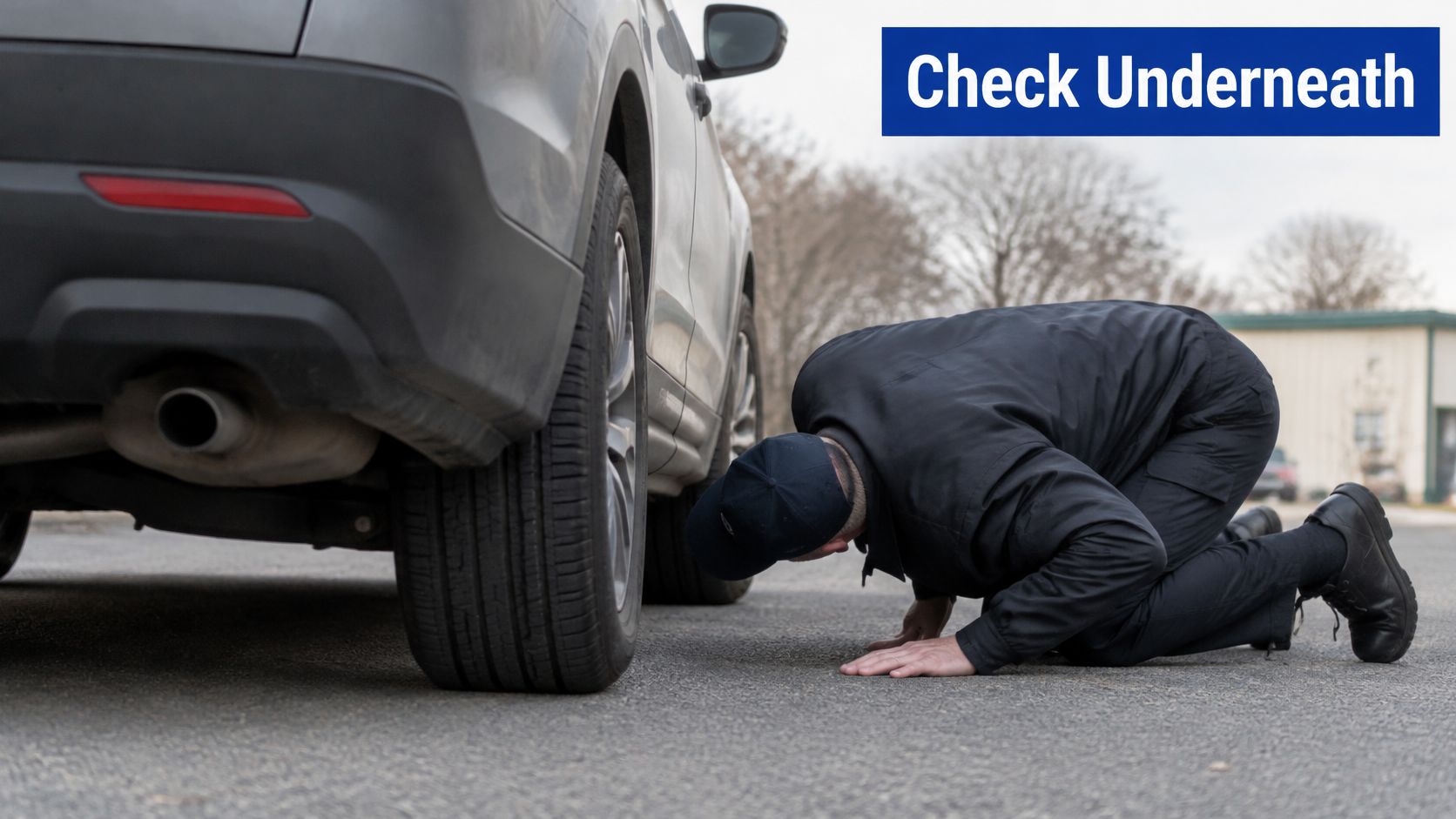
Start your inspection low, where soil and debris collect out of sight.
The Undercarriage Checklist
- Inspect the hiding spots. Check wheel wells, floor mats, trunk seams, and the spare-tire well for ants, grit, and plant debris. Look at any soil caked beneath the vehicle, not just the carpet.
- Knock soil off before you leave. After a pasture, new lawn, job site, or landscaping run, clear tires, boots, tools, and mower decks before you drive home. Soil is the vehicle ants travel in.
- Check the parking spot itself. Walk the pad, curb, and nearby shrub bed for mounds or trails heading toward where your tires sit overnight.
- Never haul loose soil in the cargo area. Bag it, tarp it, or use a trailer you can wash out. Loose soil in a trunk or truck bed is an open invitation.
While you're under there knocking off packed mud, it's worth checking exposed metal too, since trapped wet soil against the frame accelerates rust. T1A Auto's guidance on how to protect high-wear parts against corrosion covers the coatings and wash habits that keep that damage from taking hold.
This short video walks through where ants hide on and under a vehicle and what to look for during your own check.
Habits That Stop the Next Visit
- Bring food inside nightly: Snack bags, kids' cups, and drive-through trash don't stay in the car overnight.
- Shake mats weekly: A two-minute shake-out catches crumbs before a scout does.
- Vacuum after messy trips: Drive-through runs and beach days leave exactly the residue trails are built on.
- Fix moisture sources: Leaking bottles, a wet trunk seal, or AC drips pooling in a footwell give ants a second reason to stay.
- Park off grass when you can: Tires on pavement put distance between the car and ground colonies.
- Pull vegetation back: Keep mulch and shrubs from touching the parking spot through Montgomery County summers, so branches don't become bridges to your mirrors and door seals.
Skip monthly preventive cabin sprays. They add residue without a target and do nothing about the mound by the curb.
Food out, soil off, nest outside. Cover those three and most car ant problems don't come back.
If stinging ants and fresh grit keep appearing after short stops, stop treating it as a nuisance. That's a spread risk, and it calls for a local inspection rather than another round of cabin cleaning.
Call FullScope When the Colony Stays
Stop the home routine when you hit any of three triggers. Ants still trail after about four weeks of undisturbed bait. Stings or fresh soil keep appearing around the car. Or the house and the car are active at the same time. Each one points to a colony outside the vehicle that cabin work can't reach. If you're unsure which side of that line you're on, our guide on when to hire pest control for your home lays out the same decision for indoor trails.
FullScope serves Montgomery County communities including Conroe, Montgomery, Splendora, and Willis. Think of the service call as the step after the bait. Cabin bait reaches the scouts that climb aboard; a yard treatment reaches the nest that keeps sending them.
Our residential service treats ants from fire ants to carpenter ants, eliminating colonies and preventing future infestations. In a recent Kingwood, TX ant treatment, our team applied granular bait along the perimeter, a liquid barrier spray around the foundation, treated two active mounds, and sealed entry points along the garage door threshold with foam, with a follow-up recommended in 30 days to confirm full elimination. That visit is the pattern to expect. Treatment goes where ants travel, nest, and keep their activity going, which means the yard mound, the curb, and the garage threshold, not just the scouts crossing your dashboard.
If you've cleaned the cabin, baited by the label, knocked the soil off, and the trail still returns to your driveway, request an inspection through fullscopepestcontrol.com. Tell us where you park, what the ants look like, and whether soil or stings are part of the picture, and we'll trace the colony to its source and treat it there.