1500+ reviews


You open the pantry for a bag of rice and find dark pellets behind the shelf liner. A cereal box has a chewed corner. You haven't seen an animal, but now every sound behind the refrigerator seems suspicious.
Knowing how to know if you have rats or mice starts with those clues, not a nighttime sighting. The useful questions are which animal fits the evidence, whether it's still active, and whether you can inspect safely without spreading contamination.
Rat or Mouse Signs Compared at a Glance
Start with the pantry evidence. Small, narrow pellets beside damaged food packaging suggest mice. Larger deposits accompanied by substantial chewing or greasy marks along a garage wall point more toward rats. Neither combination tells you how many animals are present.
The EPA's rodent monitoring guidance supports checking concealed travel routes and combining signs rather than waiting to see the animal. Rodents are mainly active after dark, so homeowners often find their evidence first.
Mouse vs rat signs at a glance
| Sign | Mouse | Rat |
|---|---|---|
| Droppings length | About 1/4 inch | About 3/4 inch |
| Droppings shape | Small, narrow, pointed ends | Larger, capsule-shaped, blunter ends |
| Gnaw mark width | Roughly 1 to 2 mm | Roughly 3.5 to 4 mm |
| Hind footprint, approximate screening clue | Small, delicate print | Larger, broader print |
| Nesting material | Finely shredded material in small, hidden nests | Larger accumulations, sometimes associated with burrows or tunnels |
| Movement and sound | Light scratching and squeaking inside walls | Heavier scurrying, thumping, or dragging at night |
| Typical hiding spots | Cabinets, drawers, pantry boxes, behind appliances | Garage, shed, crawlspace, wall voids, along foundations |
The dropping measurements are screening references, not hard boundaries. For tooth marks, Cornell Integrated Pest Management measurements summarized alongside the EPA's infestation indicators put adult mouse marks at approximately 1–2 millimeters and adult rat marks at approximately 3.5–4 millimeters.
Match a cluster, not just a row
Compare what you found with the whole column. Pantry pellets, finely shredded packaging, and delicate chewing support a mouse assessment more strongly than pantry location alone. A larger print beside substantial gnawing and an exterior burrow supports a rat assessment.
Sound is the weakest way to estimate size. Wall cavities can amplify a small animal, and plumbing or building movement can sound surprisingly similar. FullScope's explanation of whether rats make noise can help you describe what you're hearing without treating the sound as a diagnosis.
Practical rule: Use the table to choose where to inspect next, not to decide which poison or trap to buy.
Reading Droppings and Gnaw Marks by Size
Say you move stacked garage boxes and find chewed cardboard corners beside dark pellets along the wall. The important detail isn't just that something chewed a box. It's that feeding damage and waste occur along the same protected route.
Look closely without touching or disturbing the deposits.
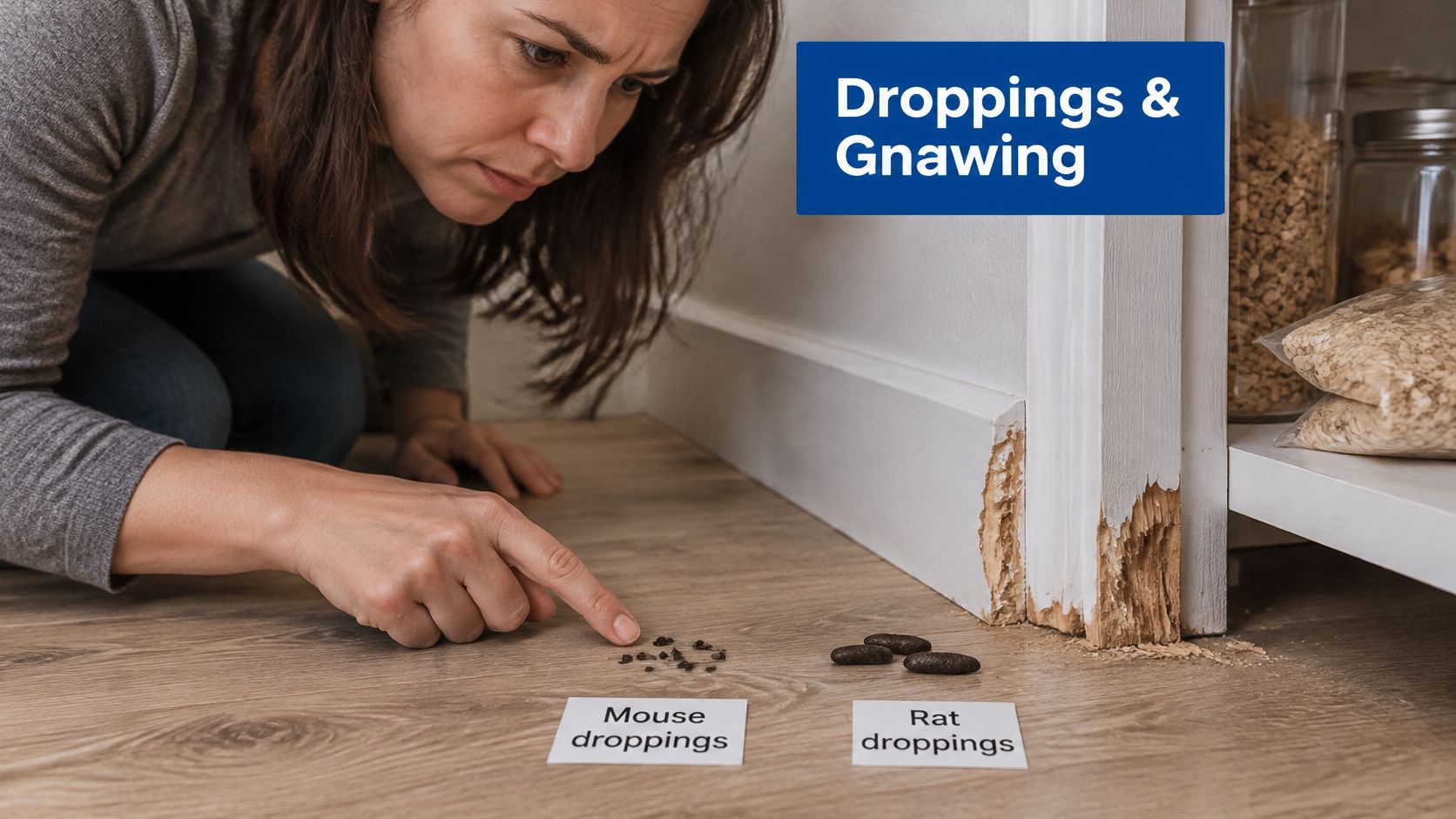
What the pellets tell you
Use a ruler beside the deposit for a photograph, without placing it in the waste. Record whether pellets are narrow or broad, pointed or blunt, scattered or concentrated. Dark, moist-looking deposits deserve attention, but appearance alone doesn't reliably establish when they were left.
Don't squeeze a pellet to test its softness. Humidity, drying, and the surface beneath it can change its appearance. A photograph and a location note are more useful than handling it.
What the chewing tells you
Examine door bottoms, baseboards, stored cardboard, wood, insulation, and accessible utility openings. Look for parallel tooth grooves rather than judging only the overall hole. Rodents chew to gain access and maintain their continuously growing incisors.
Use a flashlight held at a low angle to make shallow grooves easier to see. Check nearby wiring visually, but don't touch exposed conductors or move damaged cables.
- Tracks: Compare print scale with the pellets and tooth marks. Smudged prints aren't dependable measurements.
- Nests: Finely shredded paper tucked into an appliance gap supports a different assessment from a substantial burrow beside the foundation.
- Sounds: Record the location and timing. Don't assign a species from volume alone.
In the garage example, damaged boxes without any other evidence might reflect an old problem. Matching waste, travel marks, and newly damaged packaging makes the finding more significant.
Size remains a screening clue. A small pellet doesn't automatically mean a mouse, and a large chewed opening doesn't automatically mean a rat.
How to Run a Two-Stage Activity Check
Separate finding evidence from confirming continuing activity. You can complete the initial inspection in an evening, but the confirmation stage requires returning to the same locations.
Use a flashlight, phone camera, notebook, and painter's tape. Keep children and pets away from suspected contamination.
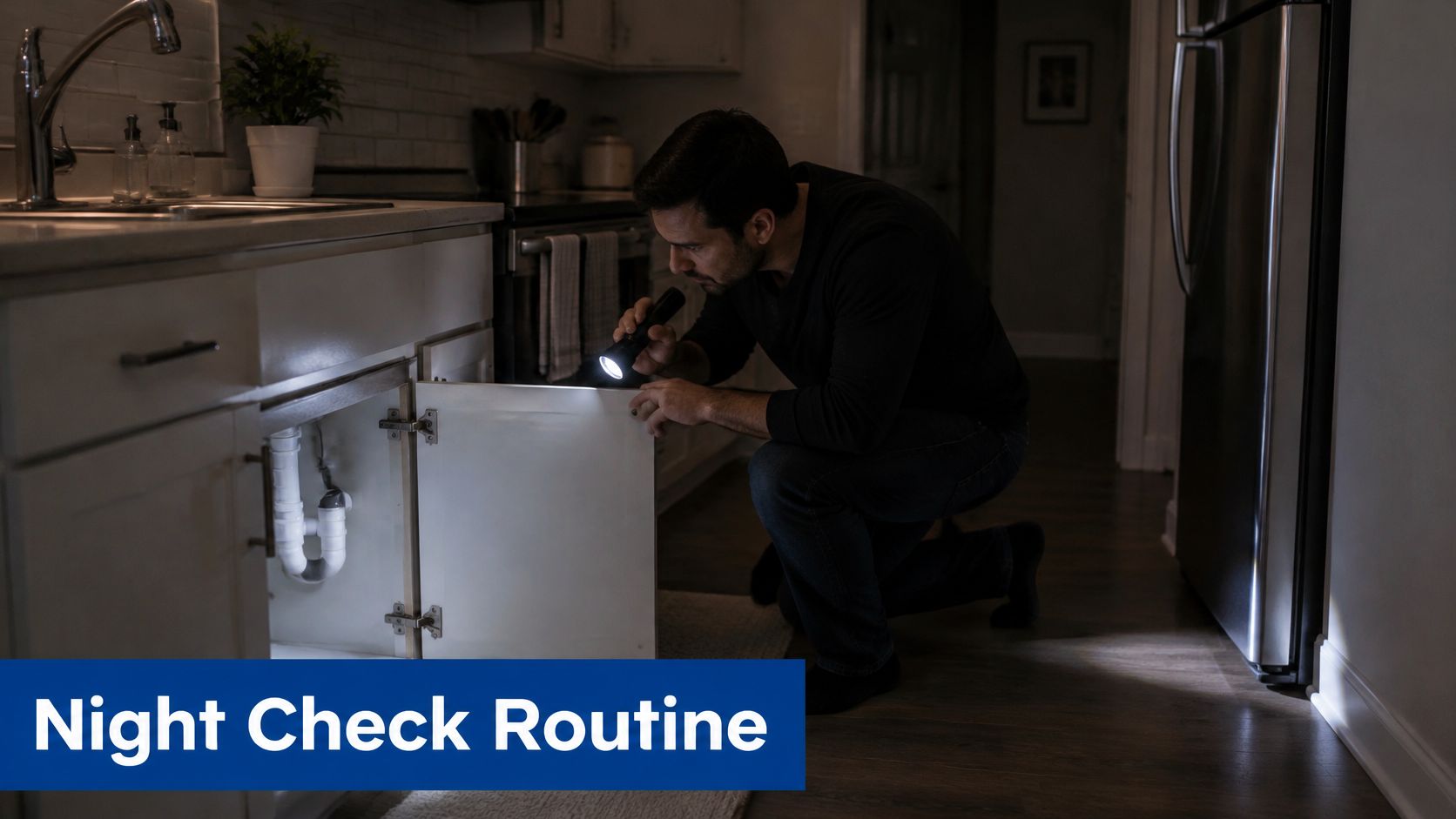
Stage one documents the route
Walk concealed areas first. Inspect under sinks, inside cabinets, behind the refrigerator and stove, and along wall-floor junctions. Check pipe and wire openings, then accessible exterior foundation edges; don't enter a contaminated attic or unsafe crawlspace.
Record each type of sign. Note pellets, gnawing, shredded material, urine-like odor, greasy rubs, tracks, sounds, and holes. Write “behind dishwasher, beside supply pipe” rather than “kitchen.”
Photograph and mark the location. Put painter's tape nearby, not on the contamination. Take a wider photograph showing the room location and a closer photograph showing the evidence.
The Utah State University Extension rodent guidance identifies droppings as a useful identification clue, with typical house-mouse pellets about 1/4 inch long and rat pellets commonly about 3/4 inch long. Those dimensions help classify a find, but accumulated deposits don't establish the number of animals.
Stage two tests whether evidence returns
Clean only manageable deposits safely. Follow the wet-cleaning routine below. Leave extensive contamination undisturbed for professional assessment.
Set a reinspection appointment. A practical homeowner schedule is to revisit the marked spots after three to five days, keeping the locations and camera angles consistent. That's a monitoring routine, not a guarantee that a quiet interval means the building is clear.
Look for new deposits or damage. Droppings appearing on a properly cleaned surface confirm continuing rodent activity. Expand the inspection around that route rather than scattering traps throughout unrelated rooms.
An optional tracking check uses a very thin flour line on a removable tray along a suspected path overnight. Keep it away from food preparation, children, and pets; don't use loose talc or spread powder across contaminated flooring. Tracks show passage, but they're supporting evidence rather than a species verdict.
For another inspection reference, the following video can accompany your walkthrough.
Inspect around dusk when practical, and don't depend on a single visit or a UV flashlight. Document openings using this guide to identifying and sealing common rodent entry points, but coordinate sealing with removal so you don't trap animals inside.
Clean Up Safely Without Spreading Contamination
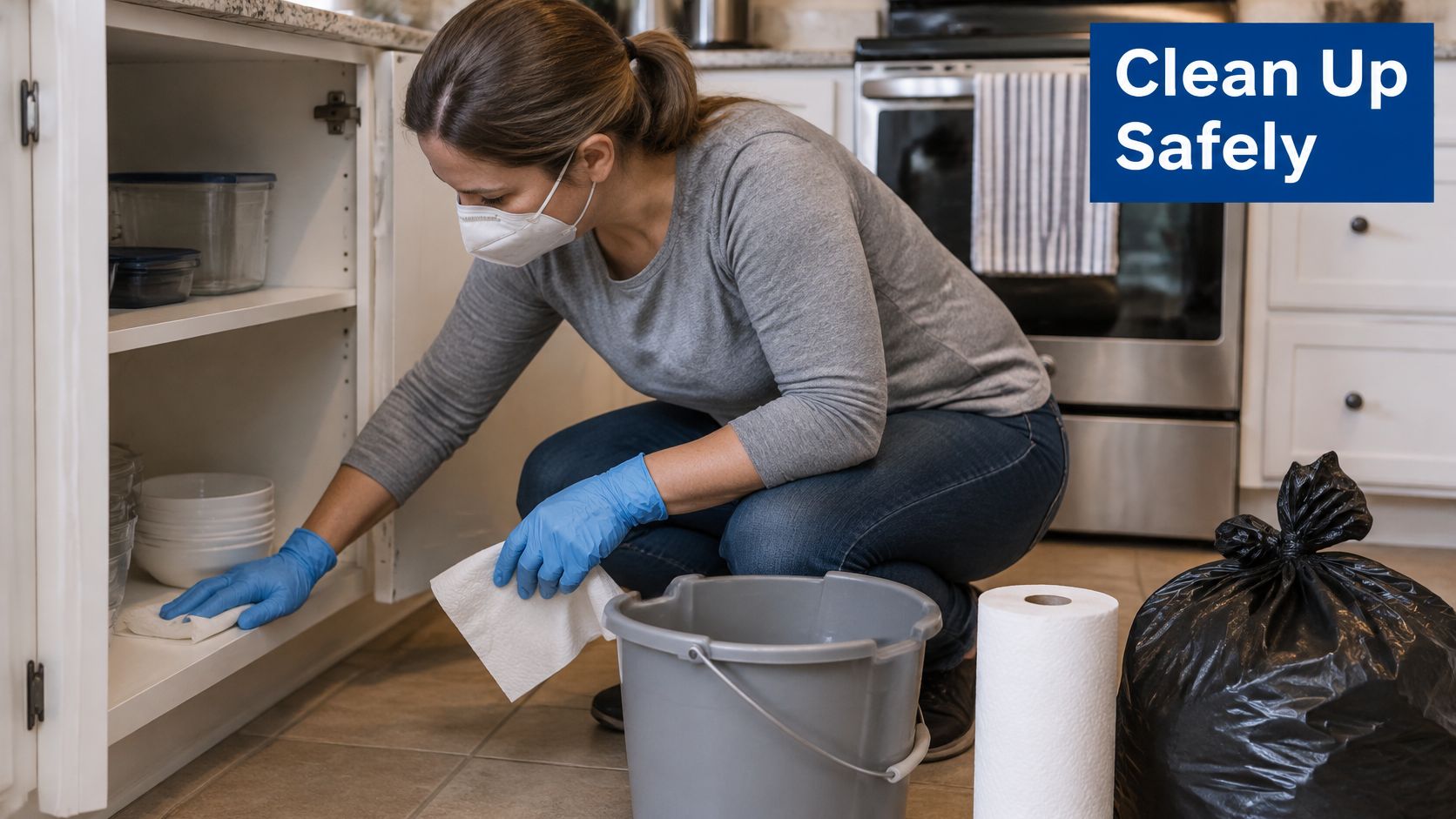
The CDC's rodent-control guidance explains that rodents can transmit disease through droppings, urine, saliva, bites, and contaminated food, including exposure to particles released when waste is disturbed. Wet cleaning, not dry sweeping, is the starting point.
- Ventilate and protect yourself. Open exterior doors or windows where practical, then leave the area while it airs out. Wear disposable or washable protective gloves; an ordinary face covering doesn't make heavy contamination safe to handle.
- Leave the vacuum and broom put away. Don't dry-sweep droppings, shake nests, or use compressed air.
- Wet the material thoroughly. Apply a suitable household disinfectant until the waste is saturated. Keep it wet for the product's stated contact time; never mix bleach with ammonia or other cleaners.
- Lift it with paper towels. Place waste and used towels in a sealed bag, then put that bag in a covered waste container.
- Clean surrounding surfaces. Disinfect the affected cabinet or floor and mop suitable hard flooring. Don't soak electrical components.
- Finish without transferring contamination. Wash gloved hands before removing gloves, then wash bare hands. Keep food, dishes, and pet bowls away from the work area.
Know when to leave the area alone
Waste may remain after rodents leave, while active nests can be hidden in wall voids or attic insulation. Don't pull contaminated insulation apart to improve your inspection.
VirusFAQ.com's guide to protecting your health from cross contamination provides additional context for keeping contaminated gloves and cleaning tools away from clean household surfaces.
Widespread waste, persistent strong odor, inaccessible nests, or chewed wiring calls for professional assessment, not a more aggressive DIY cleanup.
Use a lower threshold for help when children, older adults, or people with weakened immune systems live in the home.
Matching Signs to a Likely Verdict
Small pantry droppings that return on a cleaned shelf make a stronger case for active mice than an isolated pellet beneath an old cabinet. The next move should reflect both your confidence in the identification and the consequences of being wrong.
Sign combinations and likely conclusions
| Signs found | Likely conclusion | Next move |
|---|---|---|
| Small pantry droppings, fresh and repeating after cleaning | Likely mice, active | Tighten food storage and coordinate entry sealing with control |
| Large fresh droppings along garage wall, with rub marks | Likely rats, active | Arrange inspection and exclusion; check outside for burrows |
| Old droppings only, none return after cleaning | Past activity, possibly inactive | Schedule another check and retain the location log |
| Small dry pellets with ridges, no gnawing or nests | Probably insect droppings, such as cockroach | Identify the insect source before choosing treatment |
| Mixed sizes with gnaw marks and new burrows | Possibly both species, or different ages of one species | Request professional identification |
| Only a UV glow on the floor, no droppings or marks | Inconclusive | Seek physical evidence before treating |
Why apparently clear clues can mislead
The University of Arkansas rodent guidance explains that young rats can produce smaller droppings and that many cockroach droppings have ridges. It also cautions against relying on ultraviolet inspection: rodent urine may fluoresce blue-white, but other substances fluoresce too.
A glowing patch could therefore send you toward unnecessary rodent treatment. Likewise, mixed pellet sizes don't prove that mice and rats share the building. Compare deposit shape, distribution, nearby damage, and the condition of the surrounding material.
Choose the next action by consequence
- Manageable uncertainty: An isolated, old-looking deposit with no associated damage warrants documentation and monitoring.
- Treatment uncertainty: Ridged pellets without rodent signs call for identification before buying rodent-control products.
- Higher-consequence evidence: Burrows, recurring food-area contamination, or damage in inaccessible spaces justify an inspection.
Don't keep repeating home tests when the result won't change the decision. If you already have recurring contamination or concealed structural activity, professional identification is more useful than another flashlight or powder test.
When to Call a Licensed Rodent Professional
Recurring deposits after cleanup and entry repairs, activity in several rooms, or sounds and signs inside walls, attics, or crawlspaces are good reasons to arrange an inspection. Chewed wiring and contamination near food preparation call for prompt attention. A sale or lease inspection may also require a documented assessment.
FullScope Pest Control offers rodent services that include inspection, exclusion, sanitation guidance, and trapping. Its listed service locations include Cleveland, Kingwood, Conroe, and Porter, Texas, with service coverage across several nearby communities. Ask whether the company serves your exact address before booking. A licensed technician should assess interior travel routes and exterior access points, identify the likely species, and explain how removal and sealing will be coordinated.
What a useful visit should include
Ask for more than trap placement. The inspection should address foundation gaps, utility penetrations, garage access, and other openings indicated by the evidence. The treatment plan should explain trap type and placement, sanitation steps, and the materials planned for exclusion.
FullScope is QualityPro certified and offers low-toxicity options for homes with children and pets. Product choice and placement still depend on the home. Discuss access restrictions and ask what follow-up service applies to the proposed plan.
Before comparing proposals, read about whether pest control can get rid of rats.
Ask before booking: Who handles removal, who seals openings, and how will you check that activity has stopped?
Confirm the service address
FullScope lists service locations in Cleveland, Kingwood, Conroe, and Porter, and coverage across communities including Atascocita, Humble, Montgomery, New Caney, Spring, and Willis. Magnolia is not named in that coverage description, so confirm your exact street address when calling.
Have these details ready:
- Property: Full address, building type, and accessible attic or crawlspace areas.
- Evidence: Photos, when signs first appeared, and which rooms are affected.
- Household needs: Children, pets, vulnerable occupants, and areas that must remain accessible.
- Previous work: Traps used, openings sealed, cleaning completed, and whether signs returned.
Exclusion addresses how rodents get back in. Trapping alone does not seal openings. A useful proposal should connect removal with exclusion, sanitation, and a clear recheck plan.
If signs return after safe cleaning and coordinated entry repairs, request a rodent inspection. Confirm address coverage when booking, and mention food-area contamination, inaccessible activity, or wiring damage so the technician can plan the assessment.