1500+ reviews


You've had the kitchen treated, but ants are back near the window. Outside, mosquitoes keep everyone off the patio, and something has left droppings in the garage. You don't necessarily need the whole property sprayed again. You need to know what's returning, where it's coming from, and what should happen next.
A pest control management plan puts those decisions in writing. For a Magnolia homeowner or property manager, its value is practical: everyone knows what to watch, who fixes the underlying conditions, and what evidence will justify treatment.
Why Magnolia Properties Need a Written Plan
Consider a Magnolia storefront where employees keep reporting pests near the rear door. A treatment may address the activity they can see, but it won't tell the manager whether someone repaired the door gap or changed the waste-storage routine. Without a written record, the next technician may have to start the investigation again.
Magnolia deserves a specific service-area conversation. It's an incorporated city in southwestern Montgomery County, at FM 1774 and FM 1488, approximately 45 miles northwest of Houston and 25 miles southwest of Conroe, with road access toward Interstate 45 and U.S. 290, according to the City of Magnolia's location information.
Growth makes property-specific planning useful
The city reports 5,836 residents in 2024, compared with 2,359 in the 2020 Census, a 147.4% increase, across approximately 5.7 square miles, in its Magnolia demographics profile. That growth is a reason to plan for changing inspection and maintenance needs, not proof that every property has an infestation.
A new home, an established rental, and a recently occupied storefront can need different support. Construction, household use, and commercial activity should prompt questions about exterior prevention, termite monitoring, rodent exclusion, and mosquito management.
- For a homeowner: Record where activity returns, rather than requesting the previous treatment again.
- For a rental manager: Separate occupant responsibilities from repairs that require owner approval.
- For a business: Keep complaints and corrective work attached to the affected part of the building.
A plan is more than service history
Invoices show that someone visited. A useful plan records pest identification, site conditions, action thresholds, treatment timing, and follow-up results.
That distinction matters when different people report the same problem. “Pests returned” is difficult to act on. “Fresh activity appeared beside the repaired rear entrance” gives the technician something specific to investigate.
Local planning rule: Name Magnolia and the actual property address when arranging service. Don't assume a broad “north Houston” description confirms coverage.
Properties beyond Magnolia's municipal boundary should also have their location confirmed, including nearby Montgomery County addresses and the Conroe corridor.
How an Integrated Pest Management Plan Works
Think of Integrated Pest Management, or IPM, like a thermostat. You agree on the condition that requires action instead of switching treatment on whenever someone feels uneasy. The comparison isn't perfect, but it explains why observation comes before intervention.
The operating loop looks like this:
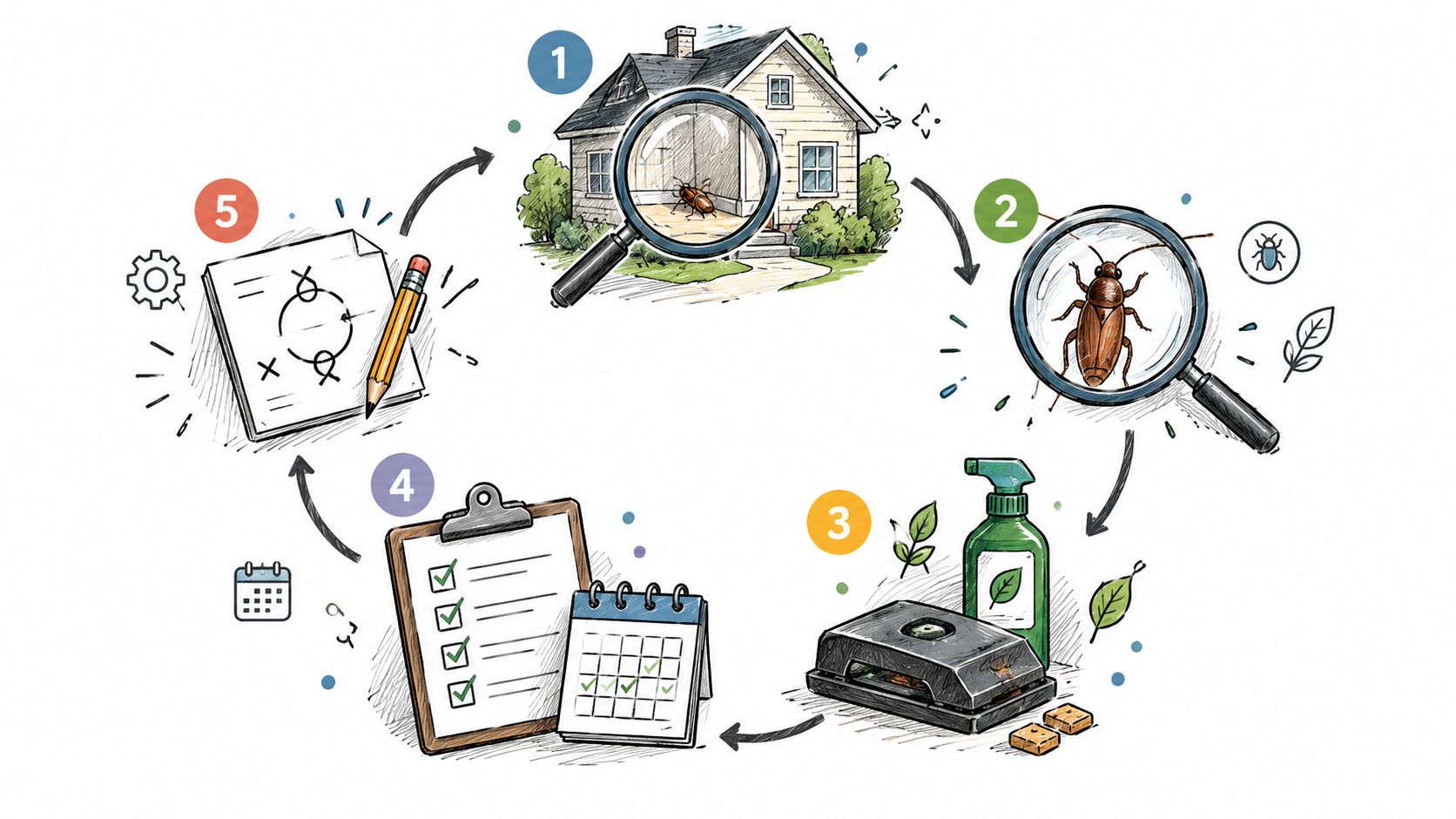
Move from evidence to a decision
Begin by inspecting and identifying the pest. A photograph or description can help, but the technician still needs to connect the pest with its location and the conditions around it.
Next, document vulnerable spots and evidence. Then agree on an action threshold, meaning the condition at which intervention becomes necessary.
- Identify accurately: Record the species when confirmed, not just “bugs.”
- Document the setting: Note the affected room, entrance, storage area, or outdoor zone and any contributing conditions.
- Define the trigger: Agree on what observation requires action.
- Choose proportionate control: Select the least-risk effective option, including physical or nonchemical work where appropriate.
- Verify the result: Check whether activity and contributing conditions changed.
The EPA's IPM principles explain that thresholds determine when action is needed and monitoring evaluates both pest populations and the effectiveness of prevention and control. A single sighting therefore shouldn't automatically trigger broad pesticide application.
Match the threshold to the property
A Magnolia homeowner might first correct the conditions around a nuisance ant trail and monitor the result. A food business or healthcare-related space needs a different response to activity in a sensitive area. Commercial owners must also consider structural and economic risks.
Useful triggers can include repeated trap captures, fresh droppings, live sightings in sensitive areas, or evidence of structural entry. These are examples to discuss with the technician, not universal treatment rules.
The service record should capture species, location, counts or trap activity, conducive conditions, corrective actions, the product or nonchemical method used, and post-treatment findings. If the agreed control fails, revise the threshold or response rather than repeating it without review.
For a practical explanation of combining these methods, review integrated pest management practices. The important distinction is between a scheduled inspection and an automatic application. A visit can be worthwhile even when monitoring doesn't justify pesticide use.
Components That Make a Plan Actionable
A workable plan answers a deceptively simple question: Who does what before the next visit? If the technician recommends a repair but nobody accepts responsibility for arranging it, the written recommendation hasn't become a corrective action.
Keep the main document short enough to use. Attach a site sketch, treatment records, and photographs rather than burying the decisions in a long narrative.
What Each Plan Component Decides
| Component | Question it answers | Owner | Review trigger |
|---|---|---|---|
| Pest identification | What are we managing? | Technician | New or uncertain evidence |
| Site map | Where are entry points and harborage? | Technician and property contact | Repairs, construction, or activity in a new zone |
| Action threshold | What requires intervention? | Client and technician | Continued activity or changed site risk |
| Monitoring calendar | When should conditions be checked? | Service coordinator | Rainfall, standing water, seasonal changes, or construction |
| Control selection | Which product or nonchemical method fits? | Technician | Inadequate results or exposure concerns |
| Corrective-work log | Who fixes sanitation or building defects? | Occupant, owner, or maintenance staff | Unfinished work |
| Results log | Did the action work? | Technician and property contact | Follow-up findings or repeated complaints |
A home plan may include quarterly or biannual protection with urgent response when necessary. A commercial facility needs scheduling shaped by its use, sanitation duties, and applicable requirements. Neither should assume that every scheduled visit requires the same treatment.
The occupant or facility contact reports sightings and sanitation concerns. The technician inspects, applies the agreed response, and documents findings. The property manager coordinates repairs and escalates repeated complaints from the same zone.
Make the results usable
For rental properties, connect pest records with the broader condition inspection. The rental inspection tips from Royal LePage Brookside, from Royal LePage Brookside Realty, can serve as a companion resource when organizing that broader inspection.
Commercial records should identify the reporting employee, affected zone, observation date, assigned corrective action, responsible person, and review window. That gives a manager a way to distinguish unresolved maintenance from treatment failure.
Build a simple failure scorecard into the agreement:
- Roach activity: Live roaches remain after the pest-specific follow-up interval agreed with the technician.
- Rodent evidence: New droppings appear after exclusion work.
- Termite monitoring: A monitoring finding requires specialist review.
- Mosquito pressure: Agreed monitoring or occupant reports show continued unacceptable activity.
- Zone complaints: The same location continues generating reports despite corrective work.
Write down what would make you change the plan before you decide that another identical treatment is the answer.
Record where the evidence appeared, what was done, and whether it worked. The USDA's explanation of IPM supports this approach of combining tools and strategies rather than relying on an isolated control method.
Rodent Exclusion Rules for Southeast Texas Buildings
A trap addresses an animal. An exclusion plan addresses the building conditions that allow the problem to continue. For a Magnolia garage, storage room, or commercial rear entrance, both belong in the same work order.
This illustration shows the kind of sealing work to discuss during the inspection:
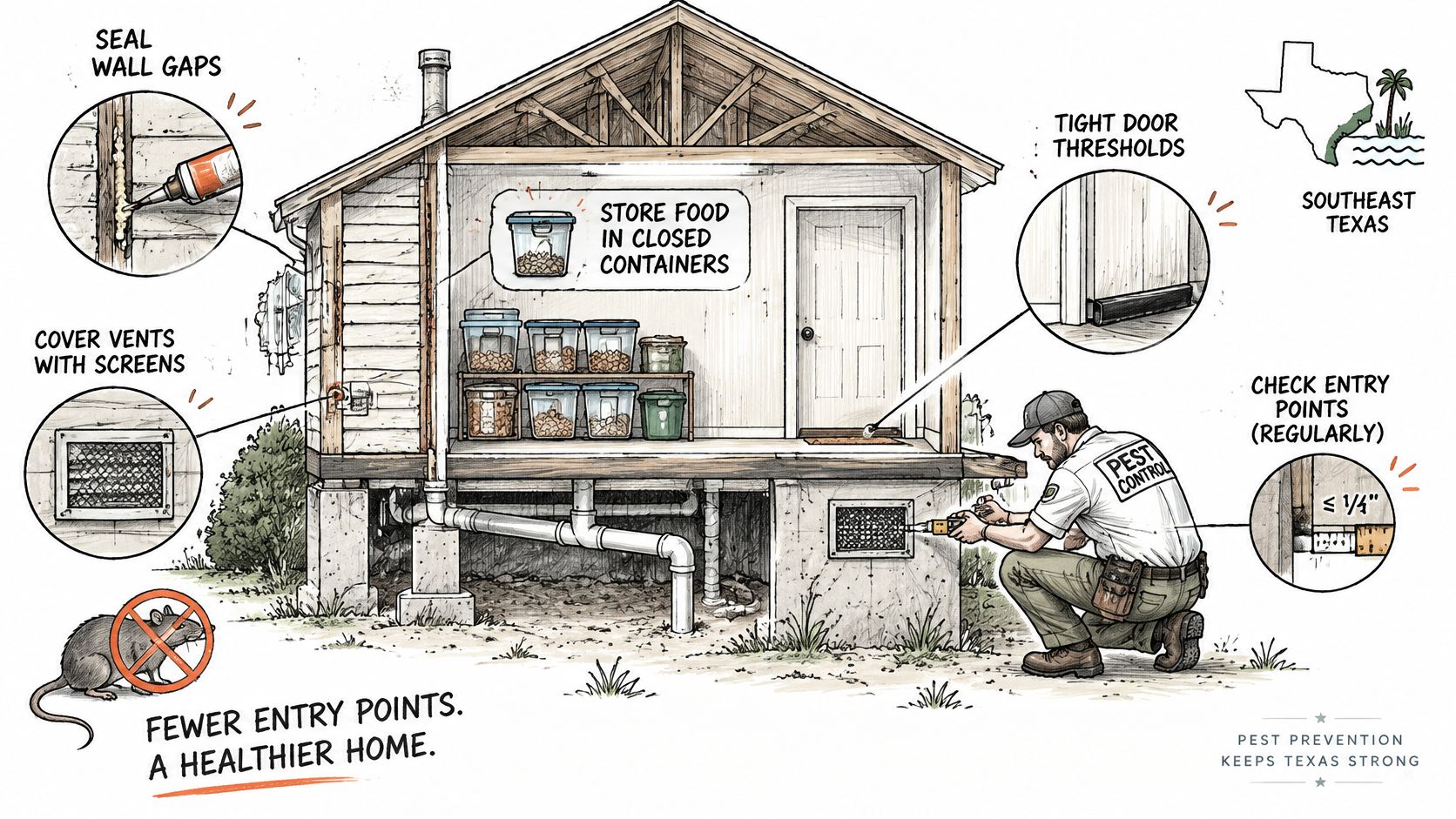
Turn openings into a repair specification
CDC technical guidance specifies openings of less than 19 mm for adult Norway rats, less than 13 mm for adult roof rats, and less than 6 mm for adult mice, with openings within 1.5 m of ground level sealed or protected with mesh; its facility benchmarks include no more than 2% of premises with active exterior rodent signs, 15% with exposed garbage, and 30% with unapproved refuse storage, as detailed in the CDC rodent-management manual.
Those facility benchmarks aren't permission to leave a particular house partly infested. They're a way to discuss inspection and sanitation performance across premises.
Have the technician survey foundations, utility penetrations, vents, doors, roof-wall junctions, and low openings. Each defect needs a location, species-risk assessment, repair method, and person responsible for completion.
For help recognizing inspection locations, review identifying and sealing common rodent entry points. The Wildlife Control Services mouse exclusion resource from Wildlife Control Services, LLC offers an additional exclusion-focused explanation to discuss with your provider.
Verify repairs and conditions together
Ask for rodent-resistant repair materials appropriate to each opening. Don't judge success only by trap results while access routes remain unresolved.
A useful defect log includes:
- Building defects: Mark each opening and photograph the finished repair.
- Food and water conditions: Assign responsibility for exposed waste, leaks, and drainage problems.
- Harborage: Note vegetation or stored materials that need attention.
- Follow-up evidence: Compare fresh activity with completed repairs and trapping records.
Use this video as a discussion aid when reviewing the proposed work:
Follow-up should establish both declining activity and closed pathways. A quiet night or an empty trap doesn't, by itself, confirm that the building is protected.
Sample Plans for Homes and Commercial Sites
The following are illustrative planning examples, not customer case studies. Their purpose is to show how the same decision method produces different work orders.
A Magnolia home with children and pets
Start with the places the family uses: kitchen, bedrooms, garage, patio, and yard. Ask the technician to evaluate exterior barrier work for identified ants, roaches, spiders, fleas, or seasonal invaders, rather than authorizing treatment for every pest on a general list.
For mosquitoes, document standing water and when yard use becomes difficult. Discuss whether barrier sprays or a MistAway automated misting system fit the observed pressure, exposure concerns, and maintenance commitment. Add a termite inspection question if there's wood contact or prior evidence, without assuming that general pest service answers it.
The written sample should distinguish targeted crack-and-crevice or bait applications from broad indoor spraying. EPA reports that as much as 80% of many people's pesticide exposure occurs indoors, and measurable levels of up to 12 pesticides have been detected in indoor air, in its guidance on pesticides and indoor air quality.
That's a reason to plan exposure controls carefully, not to assume every application creates the same exposure.
- Kitchen and dining areas: Seal food, move pet bowls, and obtain instructions for food-contact surfaces.
- Children's rooms and bedrooms: Remove toys from proposed treatment areas and protect bedding as directed.
- Living areas: Identify untreated spaces and explain relevant asthma or other exposure concerns.
- HVAC and ventilation: Ask whether the specific application requires ventilation or HVAC precautions. Don't improvise a universal shutdown or airing-out period.
- Before re-entry: Obtain product-specific directions for people and pets, treated locations, and cleaning restrictions.
Record the product and application locations. Re-entry and cleaning instructions should come from the product label and technician, not a generic waiting time.
A small commercial or multi-site account
Consider a small business with repeated complaints near a storage area. Give that zone a consistent name, assign sanitation work to a named employee, and make maintenance responsible for documented building defects.
The technician's record should distinguish verified evidence from an unconfirmed complaint. If the same zone continues to fail, the manager should request a review of access, sanitation, monitoring placement, and treatment selection.
Exposure control belongs in the work order, not in an improvised conversation after application.
Commercial after-treatment instructions also need a staff contact, restricted-area communication, and any facility-specific sanitation requirements. Keep those records available for compliance conversations without assuming that a service invoice guarantees compliance.
In both examples, prevention and monitoring remain primary. Treatment is a defined response within the plan, not the entire plan.
How to Choose Local Pest Control Support
The right level of help depends on what you can identify, document, and correct yourself. Compare the work involved, not just whether a company offers a recurring schedule.
| Approach | Useful role | Main trade-off |
|---|---|---|
| Homeowner log and occasional retail products | Tracking limited, clearly understood activity | You handle identification, label directions, exposure controls, and follow-up |
| One-time remediation | Addressing a defined problem or corrective task | Later monitoring and repair verification need explicit arrangements |
| Ongoing preventive program | Coordinating inspections, records, intervention, and follow-up | The agreement needs clear scope, responsibilities, and treatment triggers |
A recurring agreement isn't automatically excessive, and a retail product isn't automatically a simpler choice. Ask who will interpret the evidence and what happens if the initial approach doesn't work.
Match services to the written scope
FullScope Pest Control is a licensed, regionally based, QualityPro certified option offering an inspection, treatment-plan, and ongoing-protection process. Its technicians use IPM and targeted chemistry, with lower-toxicity options to discuss for households with children and pets; those options still require label-based precautions.
The company website provides a starting point for reviewing service options:

Match the proposed agreement to the work you need:
- Homes and businesses: Residential control or commercial programs shaped by facility type and sanitation.
- Termites and transactions: Inspections, monitoring, targeted treatment, and wood-destroying insect reports for real estate.
- Outdoor areas: Mosquito barrier sprays, MistAway systems, and lawn-care planning.
- Rodents: Inspection, exclusion, sanitation guidance, and trapping.
- Service timing: Quarterly or biannual packages, or emergency response when current conditions require urgent attention.
Use these considerations when choosing a pest control company to ask about scope, follow-up terms, and documentation. Don't interpret “lower toxicity” as “no precautions” or “ongoing protection” as an instruction to spray regardless of findings.
Confirm the actual Magnolia address
Magnolia is a distinct Montgomery County service destination. County civic locations include the Precinct 2 office at 19110 Unity Park Drive, Magnolia, Texas 77355, and the tax office branch at 19100 Unity Park Drive, identified in the county's administrative-location information.
These are civic reference points, not pest-company offices. Confirm your property's coverage directly, particularly for locations outside city limits, travel toward Conroe, or urgent response. Local support is most useful when someone can connect the inspection findings with repairs and verification, rather than assign a generic schedule.
Start Your Pest Control Management Plan
This week, make a property walk with a notepad and your phone. Your job isn't to diagnose every insect or select a pesticide. It's to bring organized observations to the first inspection.
Write down the pests you've seen and separate those observations from suspicions. Mark entry concerns, standing water, damaged areas, and the rooms or outdoor spaces people use most.
Prepare a useful inspection packet
Collect information that changes the service decision:
- Evidence: Photos of droppings, insects, damage, and the locations where you found them. Don't handle droppings to collect evidence.
- Occupant concerns: Notes about children, pets, asthma, and access restrictions.
- Property responsibilities: The person who can authorize repairs and the person who will complete them.
- Business requirements: Relevant sanitation procedures, operating constraints, and reporting expectations.
- Past work: Available treatment records and notes about what did or didn't change.
Draft a threshold you can discuss with the technician, including a condition that won't justify treatment by itself. For example, you might want an uncertain outdoor sighting identified before authorizing an indoor application. Don't use that boundary to postpone an urgent health or structural concern.
Choose the next commitment
Ask whether the evidence supports a one-time correction, a seasonal mosquito or termite check, or a recurring residential or commercial agreement. Have the provider explain the choice in terms of your property rather than a package name alone.
Before approving work, request a written scope that names the affected locations, required owner actions, exposure precautions, and follow-up window. The first visit should leave you with a decision record, even if the technician recommends monitoring before treatment.
Use the company's inspection and service website to request an appointment and confirm coverage for Magnolia, nearby Montgomery County properties, and the Conroe corridor. Bring your photographs and occupant concerns, ask for the findings in writing, and agree on the action threshold before treatment begins. Schedule the inspection with a clear expectation: the next visit should verify a result, not merely repeat an application.