1500+ reviews

The first step in how to fix termite damage is to eliminate or contain the active colony and verify structural safety before repairing any wood. Subterranean termites account for approximately 95% of termite damage to U.S. buildings, and termite-related residential and commercial losses exceed $1 billion annually.
You notice a soft spot near a baseboard, a floorboard that sounds hollow, or a thin mud tube climbing a foundation wall. The natural reaction is to pull out the damaged board and replace it. That approach can waste money if termites are still moving through the soil, wall cavity, crawl space, or concealed framing.
Termite damage repair has two separate jobs. First, stop the infestation and identify how the termites reached the house. Second, determine which wood can remain, which wood has lost strength, and which repairs require a contractor or structural engineer. Southeast Texas adds another complication because moisture and fungal decay can soften wood in ways that resemble termite damage.
The Critical First Step in Termite Repair
Replacing visible wood before controlling termites is the most common repair mistake. A new baseboard, sill section, or floorboard can look perfect while termites continue using an untreated foundation crack, plumbing penetration, damp crawl space, or soil-to-wood contact point.
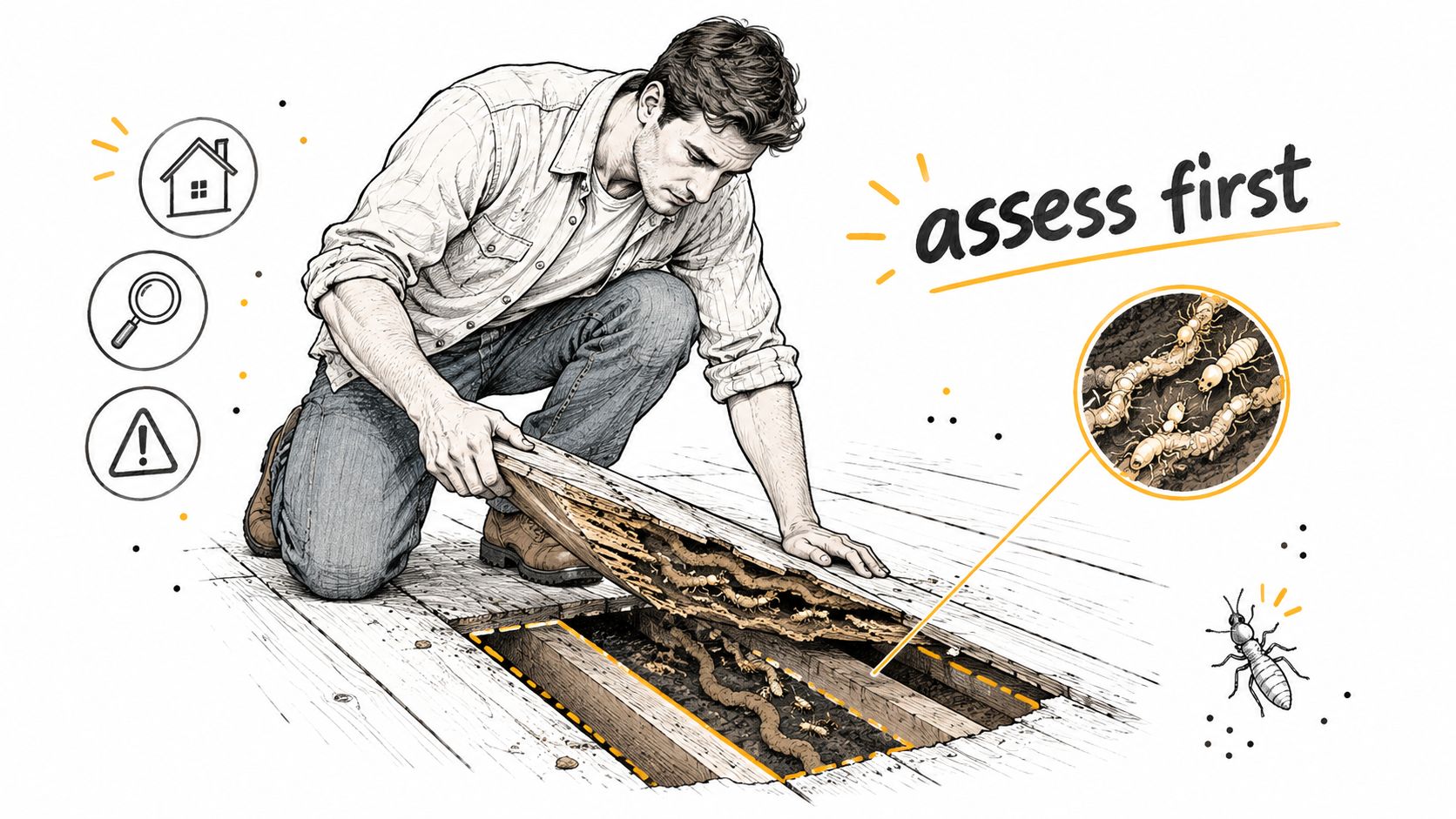
A sound repair sequence begins with a qualified pest inspection and a structural assessment. The pest professional looks for active termites, mud tubes, swarmers, galleries, moisture conditions, and entry routes. A qualified building professional evaluates whether the affected wood supports floors, walls, roofs, porches, or other parts of the load path. The University of Nebraska–Lincoln termite guidance recommends checking basements, crawl spaces, sills, joists, support posts, porch structures, window frames, foundation cracks, mud tubes, and areas where swarmers appear.
Control first, rebuild second
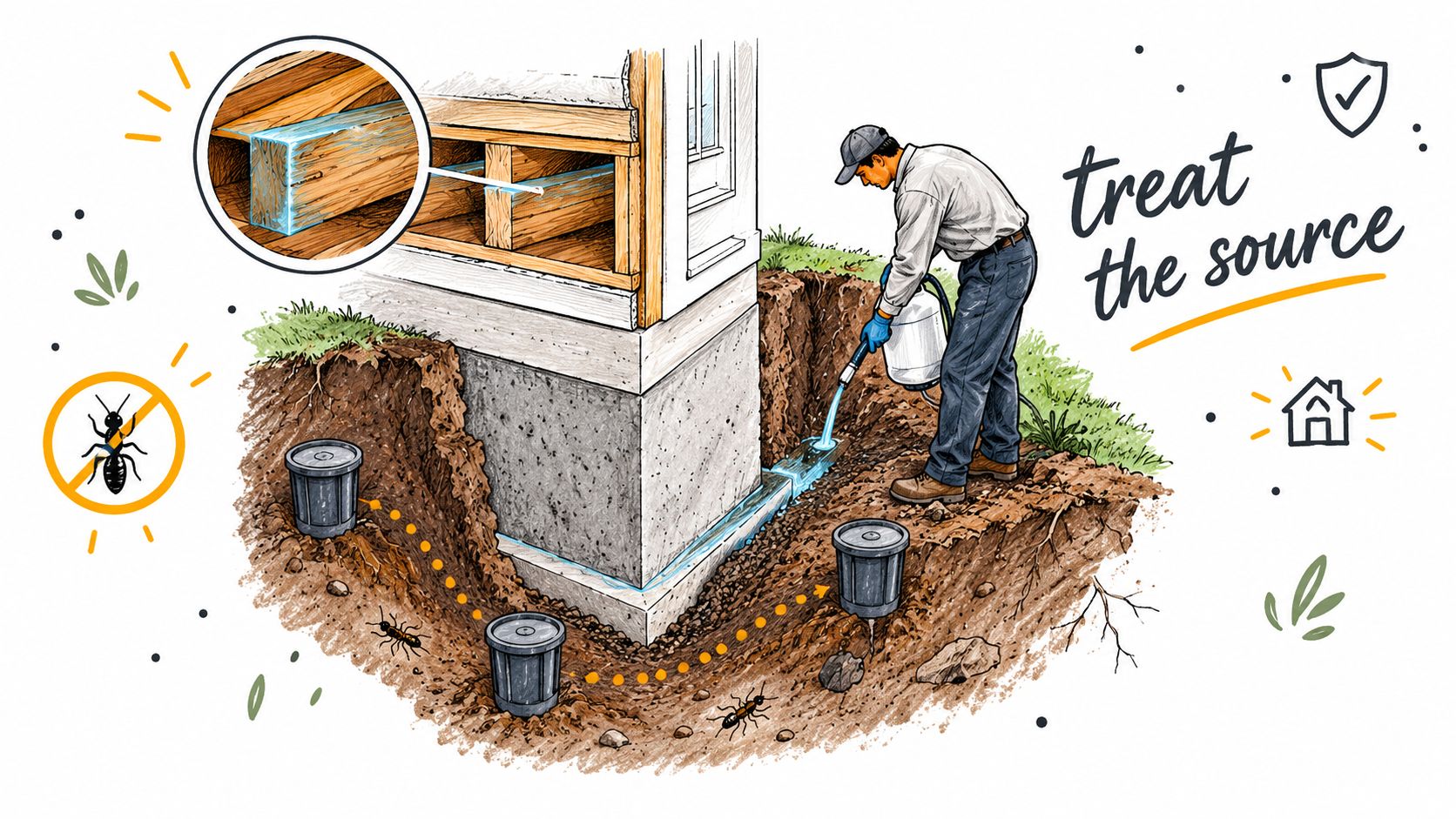
The colony must be eliminated or contained before reconstruction. Subterranean termites often live in soil rather than inside the damaged board, so removing that board doesn't remove the source. Effective treatment aims to create a continuous barrier between the colony and the building's wood. Depending on the property, treatment may include soil-applied termiticide, baiting, localized wood treatment, mechanical corrections, or a combination.
A complete liquid barrier can require hundreds of gallons of termiticide injected 3 to 5 feet into the ground beside foundations and beneath slabs, according to Iowa State University Extension information included in the UNL bulletin. That doesn't mean every home needs the same treatment. It means the applicator must account for the home's construction, slab edges, crawl spaces, plumbing penetrations, drainage, wells, and access conditions rather than spraying only the termites that are easy to see.
Practical rule: A replacement board is not proof of a completed termite repair. The treatment record and structural assessment matter just as much as the new lumber.
Verify the wood before closing walls
After treatment, don't immediately cover suspect framing with drywall, insulation, flooring, or trim. The inspection should identify whether activity is current, estimate the extent and age of damage, and separate cosmetic deterioration from compromised structural members.
Keep photographs of the original damage. Ask for a written treatment diagram, the affected areas, the recommended repair scope, and the follow-up plan. This documentation gives the contractor a reliable starting point and makes it harder for concealed damage to disappear behind a finished surface.
Identifying Active Infestation Versus Old Damage
A damaged board doesn't tell you whether termites are still present. It only tells you that something weakened the wood. In Southeast Texas homes, the competing explanation may be fungal decay caused by persistent moisture, poor drainage, plumbing leaks, or damp crawl-space conditions.
Active subterranean termite evidence commonly includes mud tubes, live termites, fresh galleries containing soil-like material, discarded wings near windows or light sources, and new swarmers. A tube that has been repaired after breaking can suggest current movement, but a professional needs to inspect the surrounding structure before calling the infestation active or inactive.
Old damage may appear dry, weathered, and disconnected from current entry routes. That still doesn't make it harmless. A sill plate or joist damaged in the past may remain too weak to carry its intended load, even if no live termites are visible.
What homeowners can check safely
Use observation first, then limited probing. A screwdriver, ice pick, or knife can help identify wood that is soft, hollow, or easily penetrated, but probing isn't a substitute for a qualified inspection. Don't pry apart structural framing, remove load-bearing components, or disturb treated soil to search for insects.
Look at the pattern, not just the softness:
- Mud tubes: Check foundation walls, piers, slab edges, crawl spaces, and concealed corners.
- Hollow sound: Tap solid-looking wood and compare it with nearby sound lumber. A hollow sound is a warning sign, not a diagnosis.
- Swarm evidence: Discarded wings and dead swarmers near windows or doors can indicate a nearby colony, but they don't identify the full extent of damage.
- Gallery damage: Channels running through the grain, especially with soil or debris, deserve professional evaluation.
- Moisture exposure: Check leaks, wet insulation, blocked drainage, damp soil, and areas where framing touches masonry or soil.
Why moisture changes the diagnosis
Southeast Texas conditions can make termite and decay damage overlap. The USDA guidance referenced in the provided repair information identifies wood above 20% moisture content as susceptible to decay, so a damp sill or crawl-space joist may have both fungal deterioration and termite damage. A pest professional may identify insect evidence, while a contractor or engineer determines whether the remaining wood can safely carry its load.
Don't use the absence of live termites as permission to repair blindly. The EPA's termite identification and control guidance calls for a thorough structural inspection before treatment and distinguishes treatment of the colony from repairs to damaged building components.
The right question isn't just, “Does this board look bad?” Ask instead: Is the damage active, what caused the access, and does the wood still perform its structural job?
Treatment Options and Structural Safety
Once the inspection identifies the source, treatment should match the construction and the infestation. EPA-approved control categories include liquid soil termiticides, bait systems, treated building materials, and wood treatments. Most termiticide applications require a trained pest-management professional because the applicator must follow the registered product label, state requirements, site restrictions, and rules concerning wells, cisterns, drainage, and occupied structures.
Liquid treatment can create a treated zone around the foundation and at known entry points. Baiting uses monitored stations to target termite activity over time. Localized wood treatment or injection may address known galleries, while mechanical work corrects conditions such as soil-to-wood contact, slab gaps, drainage problems, or moisture sources.
Why a continuous barrier matters
The purpose of soil treatment isn't to spray every visible termite. It is to establish an unbroken treated zone between soil-dwelling colonies and the structure's cellulose. One EPA label specifies a vertical treated zone and, for certain applications, 4 gallons of diluted solution per 10 linear feet per foot of trench depth. The same label requires treatment extending at least 3 feet on both sides of an identified infested site. Those specifications apply to that registered product and application, not to every property or treatment plan.
Slab penetrations, cracks, utility entries, crawl spaces, wells, cisterns, runoff, and untreated voids can interrupt the protection. The applicator should provide a written diagram showing treated perimeter segments, penetration points, spot treatments, repair areas, product, dilution, volume, and follow-up date.
A homeowner comparing methods can review termite treatment options that don't require tenting to understand how targeted approaches differ from whole-structure fumigation. FullScope Pest Control is one local option that provides termite inspections, soil and perimeter treatments, liquid termiticides, and Sentricon baiting and monitoring.
Coordinate pest control with construction
Construction should follow treatment verification, not run ahead of it. In Montgomery County, framing or foundation repairs may involve contractor licensing, inspections, or permits depending on the work and the property's circumstances. A pest professional doesn't replace the contractor or engineer who must evaluate a damaged beam, joist, sill plate, header, or foundation component.
An incomplete perimeter is a treatment defect to investigate, not protection to assume.
Use the treatment diagram and structural report together. If a repair requires opening a wall or slab, coordinate the work so the contractor doesn't block access to a treatment area or conceal an untreated penetration. The final repair should remove the damaged material, preserve the load path, correct moisture and access problems, and leave monitoring or inspection points available where practical.
Repairing Minor Versus Major Wood Damage
Termite damage ranges from damaged trim to a failed load-bearing member. Treating both situations as a carpentry patch creates risk. The repair decision depends on structural impact, not how small the visible opening appears.
Cosmetic damage may include baseboards, nonstructural trim, isolated door or window casing, or surface finishes. After treatment and moisture correction, a capable homeowner may handle limited finish work if the wood doesn't support a load and the repair won't conceal unresolved damage.
Structural damage is different. Compromised sill plates, joists, rim joists, headers, beams, roof framing, and load-bearing studs can change how forces travel through the house. A contractor should assess the repair, and a structural engineer may be necessary when the load path is uncertain, multiple members are affected, settlement is present, or the proposed repair changes the original framing.
| Damage Type | Structural Impact | Required Professional |
|---|---|---|
| Baseboard, trim, or isolated finish damage | Usually cosmetic when surrounding framing is sound | Homeowner or finish carpenter after treatment verification |
| Non-load-bearing stud or light framing damage | May affect the wall finish or attachment points | Qualified contractor |
| Sill plate, rim joist, joist, header, beam, or post damage | Can compromise the load path and connected components | Licensed contractor, with structural-engineer evaluation when needed |
| Extensive concealed damage or uncertain framing condition | The visible area may not represent the full failure | Pest professional plus qualified contractor or structural engineer |
Sistering is not an automatic solution
“Sistering” means installing a new member alongside an existing one. It can work when the remaining member has enough sound material for secure fastening, the new member bears correctly, and the design restores the intended load path. It fails as a shortcut when the original wood is crumbling, the ends don't bear properly, fasteners miss sound material, or moisture and termite access remain.
Full replacement may be necessary when a beam, joist, post, or sill has lost substantial capacity. The contractor may need temporary support, demolition beyond the visibly damaged area, treated or naturally resistant replacement lumber, approved connectors, and inspection before finishes are restored.
For homeowners also dealing with wet drywall or wall finishes, H-Towne & Around Remodelers' guide to repairing water-damaged walls can provide useful context on why moisture remediation and finish replacement should follow, rather than conceal, the underlying repair.
Use the visible damage as a starting point
Don't authorize a cosmetic patch because it produces the cleanest estimate. Require the scope to identify each affected member, the treatment status, moisture corrections, temporary-support requirements, replacement material, connectors, and finish restoration. A new surface should be the last step after the framing has been evaluated and approved.
HomeGuide's termite-damage repair guidance places minor cosmetic repairs at about $300 to $2,000, major structural repairs at $5,000 to $15,000 or more, and structural-engineer assessments at approximately $350 to $900. These are cost guidance ranges, not a diagnosis or a guaranteed bid, and the same source emphasizes that structural concerns require qualified evaluation.
Navigating Insurance and WDI Reports
Most standard homeowners policies treat termite damage and termite treatment as maintenance exclusions. That doesn't mean every event connected to a termite problem receives the same answer. A resulting covered peril, such as a fire, may be evaluated separately, so homeowners should read their policy and ask the carrier how the specific loss is classified.
A Wood-Destroying Insect, or WDI, report documents visible evidence, inspected areas, findings, and sometimes recommendations or treatment history. Buyers, sellers, lenders, and warranty providers may use it during a real-estate transaction, but a WDI report isn't a substitute for a structural engineering assessment. It identifies insect-related concerns. It doesn't certify that a damaged beam can safely support a floor.
Preserve the repair record
Before demolition, save photographs that show the damage in context. Keep the inspection report, treatment proposal, label information where provided, treatment diagram, invoices, warranty or service agreement, contractor scope, permits, engineer's letter, and completion photographs.
The EPA's guidance on selecting a pest-control service advises homeowners to check whether a service agreement states inspection frequency, guarantees, annual fees, and responsibility for structural damage if treatment fails. It also warns that improperly applied treatments can contaminate homes or drinking-water wells, and that reentry timing depends on the product label.
If you need background for budgeting or transaction planning, this guide to wood-destroying insect inspection costs can help you frame questions for the inspection provider without treating an online estimate as a promise.
Decide who should handle the work
| Situation | Appropriate next step |
|---|---|
| A small area of nonstructural trim after treatment is verified | Homeowner or finish carpenter may repair it |
| Soft subfloor, damaged porch framing, or uncertain wall framing | Qualified contractor assessment |
| Damaged sill plate, joist, beam, header, post, or load-bearing stud | Contractor and, where structural capacity is uncertain, structural engineer |
| Active termites, mud tubes, or untreated access routes | Licensed pest professional before reconstruction |
| Suspected claim or warranty dispute | Preserve records, notify the relevant party, and avoid premature demolition |
A homeowner who wants broader business-risk context can review information on how to cover your pest control business, although business insurance guidance doesn't determine whether a residential policy covers a particular termite loss.
Long-Term Prevention for Southeast Texas Homes
A repaired home can develop the same problem again if water, soil, and wood still meet at the foundation. In Kingwood, Conroe, Magnolia, and nearby Montgomery County communities, prevention starts with the conditions around the structure, not just the new lumber inside it.
Consider a Magnolia property where a repaired sill looks sound but a downspout sends water toward the crawl space. The owner may have corrected the visible damage while leaving the moisture and access route intact. A follow-up inspection can identify new tubes or activity before the area is covered by insulation, flooring, or finished walls.
Build prevention into the property routine
- Control drainage: Keep roof runoff away from the foundation and correct low areas that hold water.
- Manage landscaping: Keep mulch, soil, vegetation, and stored cellulose from concealing foundation edges or contacting wood.
- Improve crawl-space conditions: Address leaks, standing water, poor ventilation, and damp insulation.
- Maintain treatment monitoring: Follow the provider's inspection or bait-monitoring schedule instead of waiting for another visible tube.
- Keep records current: Add photographs, follow-up reports, invoices, and warranty documents to the home file.
The Southeast Texas termite prevention guide offers additional context on moisture, wood, soil contact, and other conditions that can increase risk. Prevention doesn't guarantee that termites won't return, but it gives the homeowner more opportunities to catch access before structural damage expands.
Be precise about Magnolia service coverage
Magnolia, Texas, is a municipality in Montgomery County, not just a generic label for the north Houston region. The Texas Municipal League lists the City of Magnolia at 18111 Buddy Riley Blvd., Magnolia, TX 77354, while the city's location information places it at the junction of FM 1774 and FM 1488, approximately 45 miles northwest of Houston and 25 miles southwest of Conroe. The city also identifies about 20 miles separating Magnolia from both Interstate 45 and U.S. 290.
The city limits cover approximately 5 square miles, and the city's extraterritorial jurisdiction extends one-half mile beyond those limits, according to the Magnolia business welcome packet. Service descriptions should therefore say Magnolia and nearby Montgomery County communities when coverage extends beyond the municipal boundary.
Magnolia's population was 2,359 in the 2020 census, compared with 1,393 in 2010, and the Census Bureau lists a 2023 estimate of 5,320. Those figures make clear why homeowners should confirm the exact service address, especially in subdivisions and unincorporated areas near the city.
If you found mud tubes, soft framing, or suspected termite damage in Kingwood, Conroe, Magnolia, or a nearby Southeast Texas community, schedule a written termite and structural assessment before replacing wood. Ask the pest professional to document active evidence and treatment access, then have a qualified contractor or structural engineer evaluate any member that carries a load. Keep the reports and photographs, correct the moisture source, and complete reconstruction only after the treatment and structural conditions have been verified.