1500+ reviews

You notice a soft spot near the back door, a few discarded wings on the windowsill, or a thin line of mud along the foundation. The house still looks fine, so it's easy to sweep the evidence away and move on. In Southeast Texas, that delay can turn a small access problem into concealed damage inside framing, subfloors, wall voids, or roof structures.
Wood destroying pest control isn't just about killing visible insects. It combines inspection, identification, exclusion, treatment, moisture management, and follow-up. The right plan protects the home as an asset, especially in Magnolia, Conroe, Kingwood, and the surrounding communities where heat, humidity, drainage problems, and slab construction create conditions that pests can exploit.
The Hidden Threat in Your Home
A home in the Magnolia area can look perfectly maintained while wood-destroying insects work out of sight. Termites may enter through soil contact or concealed foundation access. Carpenter ants may use damp framing near a plumbing leak. Beetle larvae can remain inside lumber until adults emerge through small exit holes. By the time a homeowner sees insect activity, the original entry point may be difficult to identify.
Subterranean termites deserve particular attention because one review estimates that they cause nearly 80% of termite-related destruction worldwide. The same source estimates that termites cost the global economy more than USD 40 billion each year through structural damage, crop losses, and preventive treatment, while annual termite prevention and repair spending in the United States approaches USD 5 billion. These figures are reported in the review of termite damage and management.
Why local conditions matter
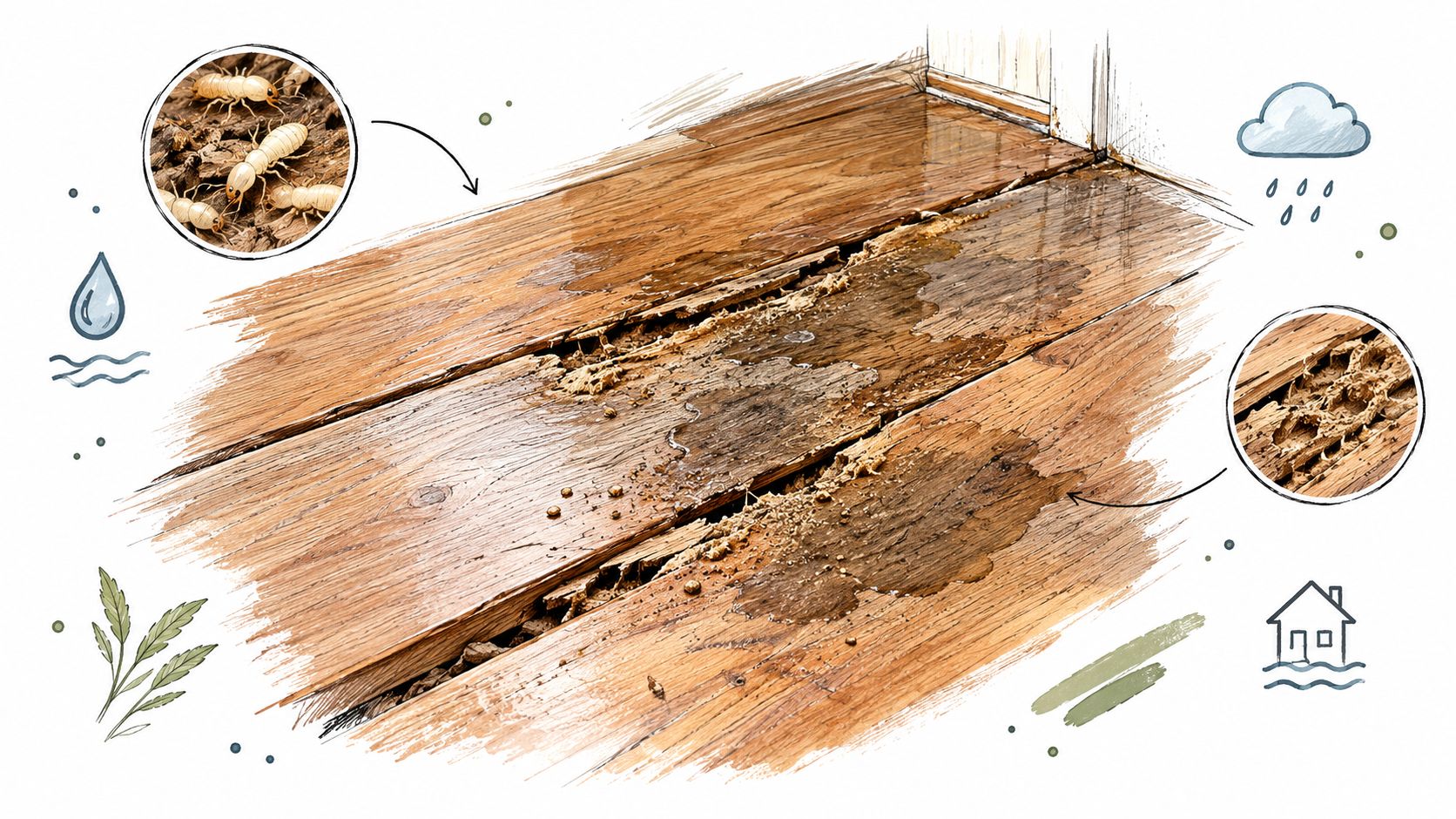
Humidity doesn't create termites by itself, but it helps preserve the conditions termites and other wood-destroying insects seek. Leaking hose bibs, clogged gutters, damp crawlspaces, poor grading, wet mulch against siding, and wood that touches soil all reduce the margin of safety around a structure. A shaded side of a home may dry slowly after rain, while a poorly ventilated attic or enclosed porch can hold moisture for long periods.
I've seen homeowners focus on the insect and overlook the building defect that attracted it. Treating the visible activity without correcting the leak or drainage issue can leave the property vulnerable to reinfestation. The most reliable plans address both the pest and the environment that lets it survive.
Practical rule: A treatment should answer two questions, not one. What is active today, and what will make the structure attractive to pests again?
The cost of waiting
The hidden cost of inaction isn't limited to a treatment invoice. A delayed response can require access to enclosed areas, removal of damaged wood, repairs to trim or flooring, moisture correction, and additional inspections before a buyer or lender accepts the property. Damage can also complicate a sale when a report identifies evidence that wasn't visible during a casual homeowner walkthrough.
For local operators, the service area isn't a single point on a map. Magnolia sits in Montgomery County and functions as part of a broader suburban cluster that reaches toward Conroe, The Woodlands, and nearby unincorporated subdivisions. The broader Magnolia area extends about 12 miles in all directions and has an estimated population above 138,000, according to Montgomery County geographic information from the Texas Almanac. That makes local knowledge valuable when inspecting older homes, new construction, rural properties, and subdivisions with different drainage and foundation conditions.
Homeowners also need to know how a pest company generates visibility and responds to service requests in a crowded local market. For a practical overview of how to find pest control clients online, Transactional LLC provides useful context for evaluating how a provider communicates its services. The more important question for the homeowner, however, is whether the company can connect an inspection finding to a specific treatment and maintenance plan.
Identifying the Main Wood-Destroying Pests
Different insects leave different evidence, and the distinction affects treatment. Termites consume wood as food. Carpenter ants excavate wood to create nesting space but usually forage elsewhere. Wood-boring beetles spend part of their development inside wood, where the visible sign may be an exit hole rather than an active insect.
Subterranean termites
Subterranean termites usually approach from the soil and exploit concealed routes into the structure. Inspectors look for mud tubes, damaged wood, sheltering conditions, discarded wings, and other evidence of current or past activity. A hollow sound, blistered surface, or weakened trim doesn't prove termites by itself, but it can justify closer examination.
Their damage often follows concealed paths. Floor systems, sill areas, wall penetrations, porch connections, and additions deserve careful attention because they can provide access without obvious interior signs. Treatment may involve soil applications, baiting, repairs, or a combination of measures, depending on construction and activity.
Carpenter ants
Carpenter ants are more like remodelers than wood eaters. They excavate galleries in damp or compromised wood to establish nests, and they may maintain a parent colony outdoors while using satellite nests inside wall voids, framing, or roof areas. Sawdust-like material near a void, ant activity at night, or rustling sounds around damaged wood can point to a nesting site.
The practical response is different from termite control. A technician needs to locate the colony or active satellite nest, correct the moisture source, and reduce exterior access. Spraying ants that appear on a countertop may kill foragers without reaching the nest, so the visible insects can disappear while the structural risk remains.
Wood-boring beetles
Wood-boring beetles can leave small round exit holes and fine powder from larval activity. The location, condition, and species of wood matter because some beetles prefer seasoned hardwoods while others affect structural lumber or stored wood products. Active emergence, fresh powder, and the age of the wood help determine whether the problem is current or historical.
The three categories can overlap in one property, but they shouldn't be treated as interchangeable. A useful Texas reference is this guide to types of wood-destroying insects in Texas, which helps homeowners compare signs before deciding what kind of inspection they need.
A tree-related insect resource can also clarify why species identification matters outside the structure. For example, information about professional EAB removal options addresses a different pest and setting, but it reinforces the same principle: the right response depends on the insect's biology, host material, and location.
What works: Identify the organism, find the source of activity, and treat the route or colony. What doesn't work is choosing a product based only on the fact that an insect was visible.
Understanding the Wood Destroying Insect Inspection
A Wood-Destroying Insect inspection is valuable because it creates a documented assessment for a buyer, seller, lender, or property owner. It isn't the same thing as a structural engineering evaluation, a complete building inspection, or a moisture audit. The difference matters most when the report finds no visible evidence but the structure contains inaccessible areas.
What the inspector actually does
The inspection generally begins with a review of the property and accessible interior and exterior areas. The technician looks for live insects, damage, shelter tubes, exit holes, frass, conducive conditions, moisture concerns, wood-to-soil contact, and evidence of previous treatment. Accessible structural members may be sounded to identify suspicious changes in density or condition.
North Carolina's official guidance illustrates the level of care expected in a formal report. It calls for a careful visual examination of accessible areas and sounding accessible structural members adjacent to slab areas, while also requiring reporting of visible evidence and conditions conducive to subterranean termites. The North Carolina homeowner guide to the Wood-Destroying Insect Report provides that framework.
The report's limits are just as important as its findings. Inspectors generally can't see inside sealed wall cavities, under permanently installed flooring, behind stored materials, beneath certain slabs, or inside inaccessible crawlspace sections. Hidden decay, concealed termite galleries, plumbing leaks, and fungal damage may require a contractor, moisture professional, or additional invasive investigation.
Inspection costs and scope
Independent market data places the average termite inspection at USD 133, with a typical range of USD 110 to USD 156. Transaction-linked inspections commonly range from USD 100 to USD 325, while a post-treatment reinspection commonly ranges from USD 75 to USD 150, as reported in the same market summary. Those figures describe typical pricing, not a guaranteed quote for every property.
| Service Type | Cost Range | Primary Focus |
|---|---|---|
| Standard termite inspection | USD 110 to USD 156 | Accessible areas and visible termite evidence |
| Average termite inspection | About USD 133 | Typical inspection benchmark |
| Transaction-linked inspection | USD 100 to USD 325 | Documentation for a sale or loan |
| Reinspection after treatment | USD 75 to USD 150 | Review of accessible areas after corrective work |
A transaction report is a risk document, not a promise that the home has no hidden defects. Buyers should read the limitations, ask which areas were inaccessible, and arrange follow-up evaluation when the report identifies moisture, suspected structural damage, or concealed construction. If a suspected route runs beneath a slab, a specialist resource on Advanced Foundation Repair under slab tunneling can help explain why foundation access questions may require a separate contractor.
For a deeper look at documentation and reporting, review this guide to wood-destroying insect inspections and reports. The key is to treat the report as one part of a property decision, not as a substitute for every other form of evaluation.
Treatment and Prevention Strategies
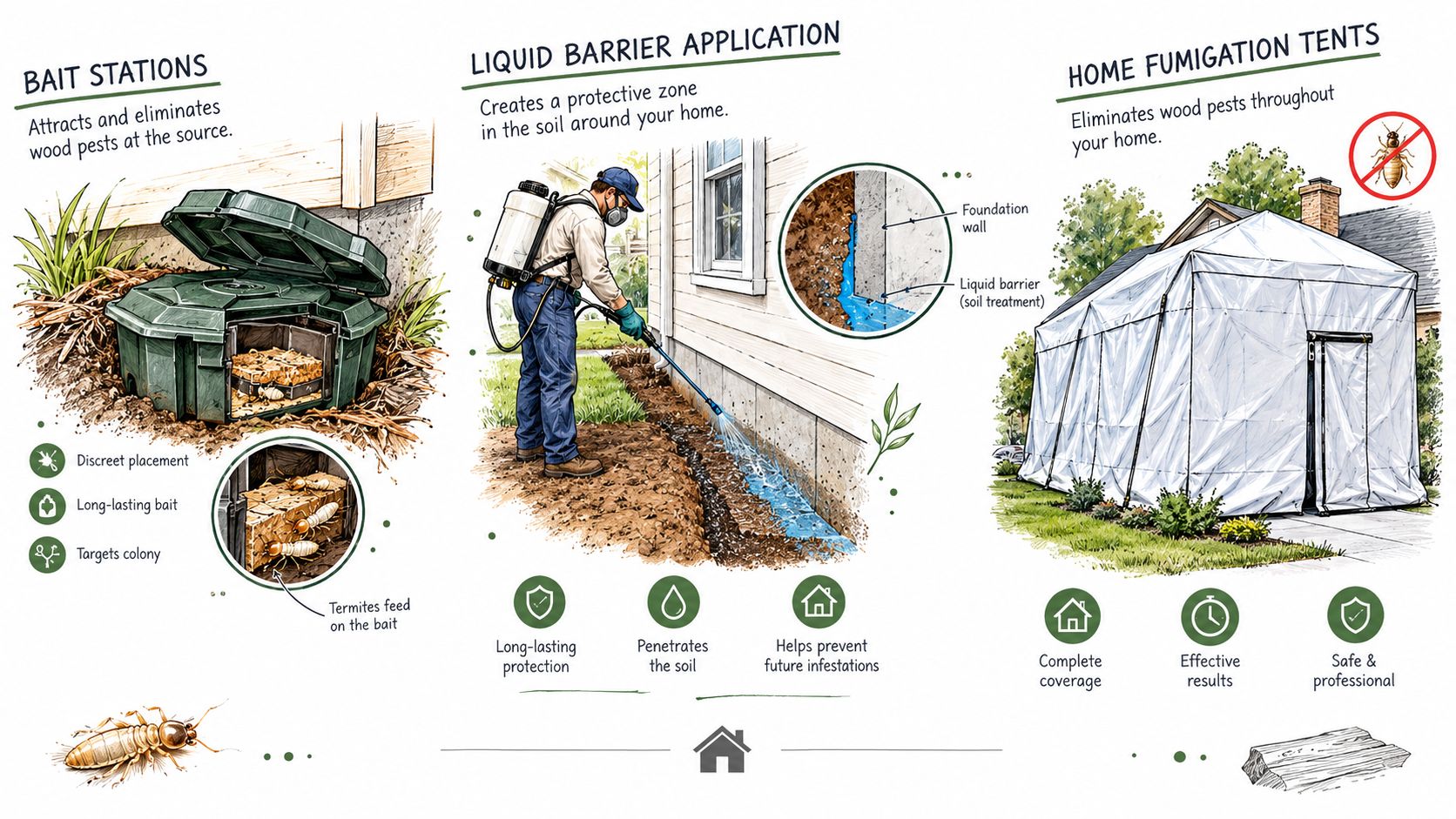
No single termite method fits every home. A slab foundation, crawlspace, detached garage, heavily planted perimeter, and inaccessible addition each create different treatment constraints. The practical approach combines baiting, liquid barriers, and exclusion, then adds repairs where the structure provides a route back inside.
Baiting systems
Bait stations use termite feeding behavior to deliver an insect growth regulator or other approved bait through a monitored system. The technician places stations where termite activity or likely foraging routes justify them, then checks them according to the service plan. Baiting can be useful where drilling, trenching, or extensive liquid application would be difficult.
The trade-off is patience and monitoring discipline. Baiting isn't a quick surface spray, and an unmonitored station doesn't provide the same value as a maintained program. A homeowner should ask how stations will be inspected, what activity changes trigger action, and what happens if termites continue to approach the structure.
Liquid soil barriers
Liquid treatments create a treated zone in soil or construction interfaces where termites may enter. They can provide a direct defensive route around vulnerable areas, but application must account for plumbing, slabs, wells, landscaping, drainage, and access. Poorly executed treatment can leave gaps at porches, additions, utility penetrations, or disturbed soil.
Liquid barriers often make sense when there's confirmed activity or a clear entry route. The technician should explain where treatment will occur, whether drilling or trenching is needed, and how the plan addresses sections that can't be treated conventionally.
Exclusion and targeted repairs
Exclusion removes the conditions and pathways that make entry easier. Useful work may include replacing water-damaged wood, separating soil from structural wood, sealing penetrations, correcting door and utility gaps, improving drainage, and moving stored lumber away from the building. Exclusion doesn't replace termite treatment when a colony is active, but it makes the treatment more durable.
Fumigation is a specialized option for certain pests and structures, not a default response to every termite concern. It requires strict preparation, professional application, and careful clearance procedures. A technician should explain why it's being considered and whether a localized or soil-based approach is more appropriate.
A combined plan usually performs better than a single tactic because each method covers a different weakness. Baiting monitors activity, liquid treatment addresses entry zones, and exclusion reduces the opportunities that let pests reach the structure.
This video offers another visual explanation of common termite control approaches:
FullScope Pest Control is one local provider that offers termite inspections, monitoring, targeted treatments, and ongoing protection plans across north Houston and nearby Southeast Texas communities. Homeowners should compare any provider by licensing, inspection detail, treatment explanation, follow-up schedule, and the clarity of its written agreement.
Beyond Spraying and the Importance of Moisture Control
Spraying is visible, so homeowners often assume it is the main solution. In a humid climate, that assumption misses the building conditions that keep attracting pests. A chemical treatment can address current activity, but it won't repair a leaking supply line, dry a wet crawlspace, redirect roof runoff, or remove wood that rests against soil.
Find the condition that keeps returning
Start outside. Check whether downspouts discharge beside the foundation, whether gutters overflow onto siding, and whether irrigation keeps one section of the perimeter damp. Look for mulch or soil covering the lower edge of siding, vines touching the structure, and wooden steps or retaining timbers pressed against the home.
Inside, inspect areas near bathrooms, kitchens, laundry rooms, water heaters, HVAC equipment, and exterior doors. Soft trim, staining, swollen flooring, musty odors, peeling paint, or recurring condensation can indicate a moisture problem that deserves attention even if no insects are visible.
Moisture principle: If a leak or drainage defect remains, the property can continue offering wood-destroying insects the shelter they need after treatment.
Maintenance that supports treatment
Good maintenance doesn't eliminate the need for professional control when activity is present. It improves the conditions around the treatment and makes future inspections more informative.
- Repair leaks promptly: Plumbing leaks and failed seals can keep framing damp long after the surface appears dry.
- Improve drainage: Direct roof and surface water away from the foundation instead of allowing it to collect beside the structure.
- Reduce wood-to-soil contact: Keep structural wood, steps, stored lumber, and outdoor materials from creating a concealed bridge.
- Improve ventilation: Crawlspaces, attics, garages, and enclosed porches need enough air movement to avoid persistent dampness.
- Replace damaged materials: Decayed wood can attract carpenter ants and provide easy access for other organisms.
The North Carolina Cooperative Extension guidance on selecting pest control services emphasizes moisture correction, leak repairs, drainage, vegetation management, and replacement of water-damaged wood as core parts of pest management. That advice applies directly to Southeast Texas homes, where rain, irrigation, and humidity can maintain conducive conditions.
A professional should document these conditions rather than just recommend another application. If the report says “moisture problem,” ask where the moisture is, what evidence supports the finding, and who should correct it. Sometimes the right next step is a plumber, roofer, drainage contractor, carpenter, or moisture specialist, not another pesticide treatment.
Protecting Your Home in Magnolia and Beyond
A practical protection plan begins with the property, not a package name. In Magnolia, a technician may encounter slab homes, crawlspaces, detached workshops, new subdivisions, older rural properties, and homes surrounded by heavy landscaping. Each setting changes how the inspector evaluates access, moisture, soil contact, and treatment options.
Start with a documented inspection
Ask for an inspection that identifies accessible and inaccessible areas, visible evidence, conducive conditions, and recommended next steps. If you're buying or selling, confirm whether you need a transaction-specific Wood-Destroying Insect report and whether the lender has a preferred form. The widely recognized NPMA-33 is used by certified pest professionals for many real estate transactions, but the exact reporting requirements can depend on the transaction and jurisdiction.
A report should help you make decisions. It should distinguish active evidence from old damage, explain whether treatment is recommended, and identify repairs that belong to another trade. Avoid accepting a vague recommendation that doesn't show the suspected entry point or explain how the proposed method fits the construction.
Build the plan around risk
Homeowners in Magnolia, Conroe, Kingwood, Montgomery, and nearby areas can use this sequence:
- Walk the perimeter: Check downspouts, grading, mulch, irrigation, foundation penetrations, porches, and wood-to-soil contact.
- Review accessible interior areas: Look at plumbing zones, crawlspaces, garages, attic edges, baseboards, and utility penetrations.
- Separate evidence types: Note live insects, discarded wings, mud tubes, exit holes, frass, damaged wood, and moisture staining.
- Correct building conditions: Repair leaks, improve drainage, replace damaged wood, and improve ventilation where needed.
- Choose treatment deliberately: Compare baiting, liquid treatment, localized work, exclusion, and monitoring based on the findings.
- Schedule follow-up: Confirm how often the property will be checked and what evidence will trigger additional service.
The wider service area includes nearby communities such as Conroe, The Woodlands, Porter, Montgomery, New Caney, Spring, Humble, Atascocita, and Kingwood. A company with local technicians should be able to explain how it handles the different construction types and environmental conditions found across those communities, rather than applying the same script to every home.
Keep monitoring after the problem is quiet
A quiet wall doesn't prove that the risk has disappeared. Keep records of treatments, repairs, inspections, moisture corrections, and areas that couldn't be accessed. Recheck vulnerable locations after major weather events, plumbing repairs, landscaping changes, or renovations that disturb soil around the foundation.
For planning purposes, homeowners can review this resource on termite inspection costs and then request a property-specific quote rather than relying on a generic price. The right provider will explain the inspection scope, treatment limitations, preparation requirements, and follow-up schedule before work begins.
Magnolia homeowners who have seen mud tubes, discarded wings, damaged trim, carpenter ants, beetle holes, or recurring moisture should schedule an inspection before making repairs that could erase evidence. Contact a licensed local pest professional, request a written evaluation of accessible and inaccessible areas, and pair any treatment with the moisture and maintenance corrections that keep wood-destroying insects from finding the same route again.
Protect your home before a hidden pest problem becomes a repair problem. If you live in Magnolia, Conroe, Kingwood, or a nearby Southeast Texas community, arrange a documented wood-destroying insect inspection, ask what the report cannot determine, and choose a treatment plan that includes both pest control and moisture management.