1500+ reviews

You're standing in the kitchen in Magnolia, watching ants cross the counter after a wet spell, or hearing scratching near the attic at night. The first question is usually simple: should you pay for one treatment or sign up for pest control service plans? The harder question is what the plan really protects.
A recurring charge doesn't automatically include termites, rodents, mosquitoes, or every room and structure on your property. Providers often separate general pests from specialty services, and some plans promise year-round coverage while excluding the pests most expensive to control. For Magnolia homeowners and property managers, the right choice depends on pest pressure, construction, landscaping, nearby woods, and how clearly the contract defines both inclusions and exclusions.
Understanding Pest Control Service Plan Types
The common Magnolia dilemma is one-time relief versus ongoing prevention. A one-time treatment can make sense when ants appear after a specific weather event or a new tenant reports an isolated issue. It becomes a weak strategy when pests return because the technician treated visible activity without addressing entry points, moisture, nesting areas, or exterior pressure.
One-time treatments focus on a defined problem. A technician may inspect the property, apply interior or exterior treatment, remove visible webs, and recommend repairs or sanitation changes. This option gives you a clear starting point, but it usually doesn't provide scheduled monitoring or a continuing response if activity returns.
Quarterly plans create a repeating perimeter and inspection routine. Visits commonly include exterior barrier applications, checks around doors and windows, attention to eaves and foundation lines, and interior service when evidence justifies it. In Southeast Texas, that schedule is the practical default for homes with recurring ants, roaches, spiders, or seasonal invaders.
Biannual plans reduce the number of scheduled visits. They can work for a well-maintained home with limited pest history, minimal vegetation against the structure, and no recurring complaints. They're less suitable for properties beside wooded lots, homes with crawl spaces, older structures, or buildings where occupants notice activity quickly.
Why schedule alone doesn't define protection
Two providers can both advertise quarterly pest control and deliver very different programs. One may perform a quick exterior spray. Another may inspect conducive conditions, document pest evidence, treat cracks and crevices when appropriate, remove wasp nests, and return between visits under a service guarantee.
Ask what happens during each appointment:
- Inspection: Does the technician check entry points, moisture, harborage, and signs of activity?
- Prevention: Does the visit include a barrier treatment or only spot treatment?
- Follow-up: Is a callback included if pests reappear?
- Specialty coverage: Are termites, rodents, mosquitoes, and bed bugs excluded?
- Documentation: Will you receive service notes and recommendations?
A plan built around integrated pest management, or IPM, uses inspection, monitoring, exclusion, sanitation, and targeted chemical treatment rather than automatic blanket spraying. One market analysis estimated that IPM-based contracts represented about 41% of professional pest management engagements in 2025, compared with roughly 29% in 2019, and reported potential pesticide-exposure reductions of 50% to 75% versus conventional calendar spraying when IPM methods are properly applied. Those figures come from the global professional pest control market analysis.
For homeowners comparing lower-toxicity approaches, a resource such as Barefoot Organics pest control service can help clarify how treatment philosophy affects product selection, inspection, and prevention. The key is to compare the actual scope of work, not just the label attached to the plan.
Quarterly vs Biannual vs One-Time Plans Compared
Quarterly service is usually the strongest general-purpose choice for Magnolia homes with repeated pest activity. Biannual service suits lower-pressure properties. One-time treatment belongs to isolated problems, property turnover, or a clearly defined infestation that doesn't justify a maintenance agreement.
The table below uses the recurring-plan cost ranges reported in market guidance. Routine quarterly or monthly maintenance visits are commonly priced from $40 to $300 per visit, while standard annual service contracts commonly range from $300 to $700. See the pest control service plan worth guide for a separate discussion of recurring service decisions.
Service Plan Comparison Matrix
| Plan Type | Frequency | Typical Cost Range | Key Inclusions |
|---|---|---|---|
| One-time treatment | As needed | Varies by inspection and treatment scope | Targeted interior or exterior treatment, visible pest response, recommendations for exclusion and sanitation |
| Biannual plan | Twice yearly | Varies by property and contract | Scheduled inspections, preventive exterior work, seasonal adjustments, limited follow-up depending on agreement |
| Quarterly plan | Every three months | $300 to $700 annually for standard general coverage, according to market pricing guidance | Recurring perimeter protection, inspection, targeted interior service, monitoring, service documentation, and possible callback protection |
The table doesn't mean every quarterly plan includes rodent exclusion or termite monitoring. Those are separate deliverables that must appear in writing. A provider may inspect for rodents but charge separately for sealing gaps, installing traps, removing contaminated material, or monitoring an attic. A provider may identify termite conditions but exclude termite treatment and baiting from the general pest contract.
Which plan fits active Southeast Texas conditions
Choose quarterly service when your property has a history of ants or roaches, heavy landscaping, standing water, frequent tenant turnover, or structural gaps that take time to correct. The point isn't to spray on a fixed calendar without thought. The point is to create repeated opportunities to detect changes before a small issue becomes a persistent one.
Choose biannual service when the building has low activity, good drainage, sealed penetrations, limited vegetation against the foundation, and an owner who will act quickly on recommendations. This arrangement gives you scheduled professional eyes on the property without paying for a higher-touch program.
Choose one-time service when the issue is genuinely narrow. Examples include a small, isolated ant trail, a wasp nest, or treatment before a home sale when an inspection identifies a specific concern. Don't use one-time service as a substitute for termite protection, rodent exclusion, or recurring commercial compliance work.
Practical rule: If the contract doesn't identify covered pests, visit tasks, callback terms, and exclusions, you aren't comparing plans. You're comparing sales labels.
For commercial properties, frequency should follow risk. Guidance for facilities recommends weekly interior and monthly exterior checks for food manufacturing and processing, monthly interior and quarterly exterior checks for healthcare facilities, weekly-to-biweekly interior and monthly exterior checks for restaurants, and monthly interior and quarterly exterior checks for offices. The commercial facility pest management guidance connects those schedules to drains, loading docks, waste areas, and entry points.
What Each Service Plan Actually Covers
The most expensive misunderstanding is assuming “year-round protection” means every pest, every structure, and every treatment is included. Standard recurring plans generally target common household pests. Termites, mosquitoes, rodents, bed bugs, and wildlife often require separate inspections, equipment, warranties, or treatment methods.
Barrier treatments and inspections
A perimeter barrier treatment places attention on the exterior zones pests use to enter. The technician may treat foundation lines, thresholds, utility penetrations, door and window gaps, eaves, and other conducive areas. Quality depends on preparation and targeting. A spray applied without checking drainage, vegetation, cracks, or food sources won't solve the conditions bringing pests back.
A useful plan should also record findings. Look for service notes covering pest evidence, moisture, sanitation, exclusion needs, and areas requiring owner or manager action. IPM guidance commonly treats monthly inspections as a way to detect new activity early, while quarterly inspections can serve as a broader preventive baseline in building checklists. The Michigan IPM training manual also connects performance with capture rates, complaints, time-to-suppression, exclusion, and sanitation follow-up.
Specialty services need separate attention
Termite monitoring systems use stations or other monitoring methods to detect termite activity and support targeted intervention. They aren't the same as a general exterior pest spray. If a provider offers a baiting or monitoring system, ask how often technicians inspect it, what happens after activity is found, and whether treatment, damage coverage, and renewal terms are separate.
Rodent control should go beyond placing traps. A complete service may include attic or crawl-space inspection, entry-point identification, exclusion work, sanitation guidance, trapping, and follow-up monitoring. If the contract only promises “rodent inspection,” it may not include the work required to stop re-entry.
Use the guide to whether pest control includes termites when evaluating termite language, but read the provider's own agreement carefully. Termite protection is often a separate product.
One provider's public plan information illustrates the problem: its standard plans cover 25 pests, while premium plans add 14 more, and termite control is excluded from standard recurring plans. That example appears in the Terminix pest control service information. The lesson isn't that one company's structure applies everywhere. It's that buyers must request the pest list, exclusions, add-on prices, retreatment terms, and property boundaries before signing.
Real-World Scenarios for Different Property Types
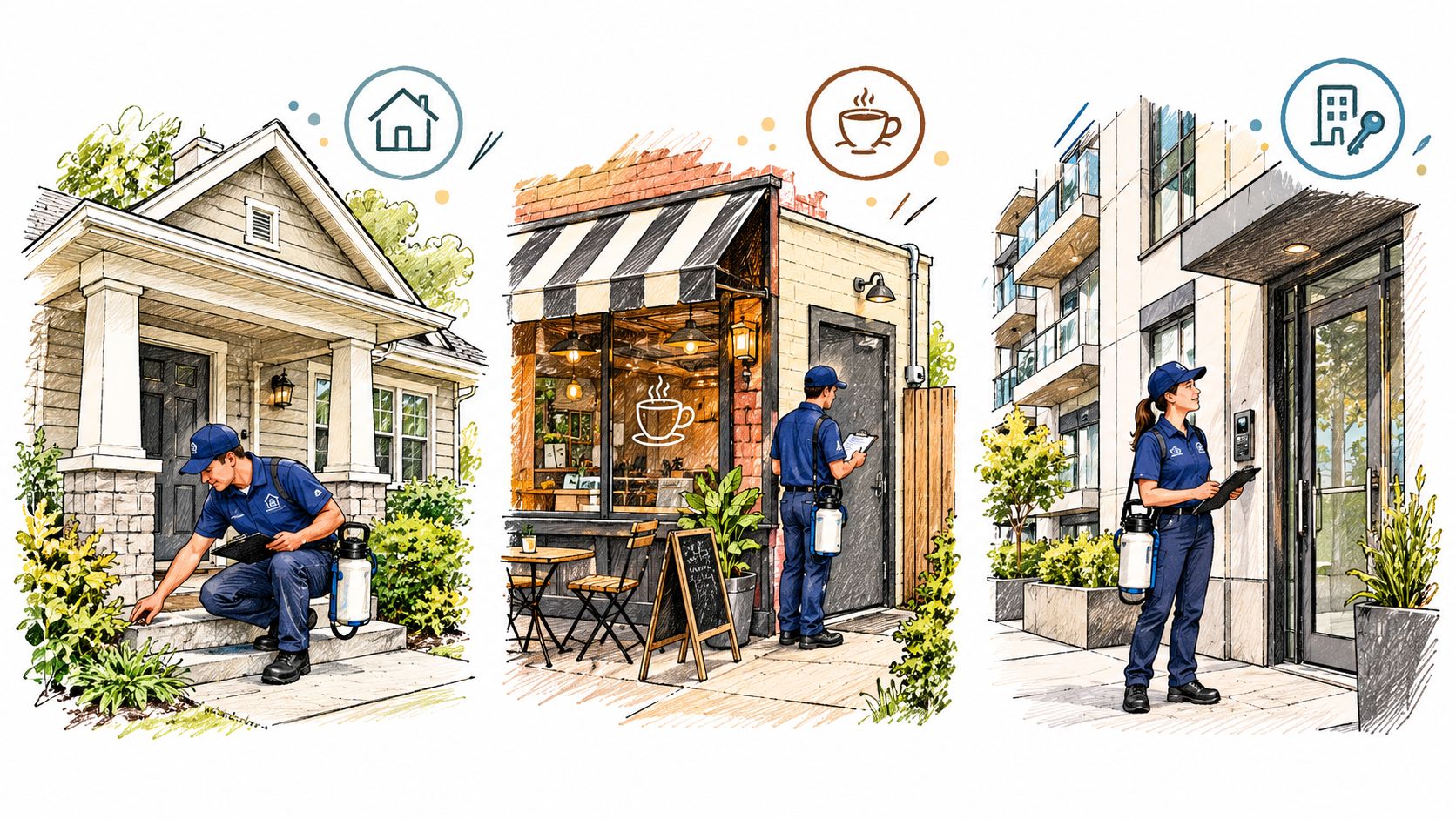
A Magnolia homeowner with a newer, well-sealed house notices ants around one kitchen window after rain. There's no history of recurring activity, no crawl-space concern, and no evidence of termites or rodents. A one-time inspection and targeted treatment is reasonable if the technician also identifies the entry route and the owner corrects the condition.
A different home sits beside trees and dense groundcover. The foundation stays damp, leaves collect near the structure, and spiders and roaches return after each treatment. Quarterly service is the better fit because the property needs repeated inspection and exterior attention, not a single reaction to visible pests.
A home with a crawl space, older foundation, or wooded boundary deserves a more detailed assessment. General pest service can address ants, roaches, and spiders, but it shouldn't be presented as termite protection or rodent exclusion unless those services are expressly included.
Property managers need a different standard
A Magnolia apartment manager can't evaluate a plan solely by the per-unit price. Shared walls, tenant turnover, trash areas, utility penetrations, and inconsistent housekeeping create pathways between units. The contract should define reporting, access procedures, complaint response, unit preparation, common-area coverage, and escalation for repeat activity.
A small cafe near a busy corridor has different exposure points. Drains, deliveries, waste storage, food handling, and customer traffic deserve documented checks. A generic quarterly exterior spray won't replace interior monitoring and corrective-action records.
For multi-property operators, the property management pest control resource is useful as a comparison point. Ask each provider to map service tasks to your actual sites rather than offering one universal schedule.
Magnolia's service geography matters
Magnolia sits in Montgomery County within the Houston-Pasadena-The Woodlands metropolitan statistical area. The city is at the junction of FM 1774 and FM 1488, approximately 45 miles northwest of Houston and 25 miles southwest of Conroe, according to the City of Magnolia location information.
That position makes nearby service areas relevant. Independent distance data places Pinehurst 4.87 miles away, Tomball 11.18 miles, Waller 14.91 miles, The Woodlands 16.01 miles, and Conroe 18.96 miles from Magnolia. Spring, Willis, and New Waverly are also listed at 21.85 miles, 21.97 miles, and 27.73 miles, respectively, in the Magnolia nearby-city directory. A provider should explain whether nearby ZIP codes, including 77353, 77354, and 77355, receive the same response terms and scheduled coverage. The Magnolia ZIP code reference identifies 77354 and 77355 as the main standard residential areas, while 77353 serves P.O. boxes.
How FullScope Plans Differ from Industry Standards
Most industry plans begin with a schedule. A stronger plan begins with a property assessment, then adjusts treatment to evidence, access points, pest pressure, and the building's operating requirements. That distinction matters in Magnolia, where a suburban home, wooded-lot residence, restaurant, and apartment complex don't share the same exposure profile.
FullScope Pest Control presents plans around inspection, treatment, and ongoing protection, with quarterly or biannual options plus urgent response. Its stated service scope includes general residential pests, termites, mosquitoes, rodents, lawn-related treatments, and commercial programs. For a buyer, the relevant comparison isn't the brand name. It's whether the written plan connects each pest concern to a defined inspection, treatment, monitoring, and follow-up process.
IPM changes the service conversation
A licensed IPM approach should identify conducive conditions before recommending broader treatment. For example, a technician might document a gap under a garage door, vegetation touching siding, a leaking outdoor faucet, or waste storage that attracts pests. The plan then assigns treatment and corrective actions instead of treating every visit as an identical application.
FullScope also identifies QualityPro certification, technician training, targeted chemistry, and low-toxicity options as part of its operating approach. Those details can matter to homes with children or pets and to facilities that need a documented program, but customers should still ask for the specific products, preparation requirements, re-entry instructions, and records supplied for their property.
Regional coverage should be explicit
FullScope lists service locations in Cleveland, Conroe, and Porter, with coverage extending across communities including Kingwood, Spring, Atascocita, Humble, New Caney, Montgomery, Willis, and other nearby areas. Magnolia customers should confirm the exact service boundary, arrival windows, emergency response process, and whether the same technician or local office handles recurring visits.
For a commercial account, compare inspection points and reporting rather than choosing on frequency alone. A restaurant may need drain and waste-area attention. An office may need entry-point monitoring. A multi-site operator may need standardized reports across locations.
One plan can combine general pest prevention with separate termite monitoring, mosquito management, or rodent exclusion. Don't accept “complete protection” until every component appears in the agreement, including what triggers an extra charge.
Making the Right Plan Choice for Your Property
Use four questions to choose a plan:
- What keeps returning? Repeated ants, roaches, spiders, or complaints favor quarterly service. A single isolated issue may justify one-time treatment.
- What does the property invite? Wooded boundaries, crawl spaces, older construction, moisture, dense landscaping, and shared walls raise the need for inspection and prevention.
- What must the plan cover? List general pests separately from termites, rodents, mosquitoes, bed bugs, and wildlife. Assume specialty pests are excluded until the contract says otherwise.
- What response do you need? Homeowners may accept scheduled visits and callbacks. Managers may need documented inspections, tenant coordination, common-area coverage, and compliance records.
Choose biannual service only when the property has low activity and strong exclusion. Upgrade to quarterly service when pests recur, occupants report problems between visits, or the building has conditions that keep recreating the issue.
Before signing, ask for the covered pest list, visit checklist, interior-treatment policy, callback terms, termite language, rodent-exclusion scope, cancellation rules, and service-area response commitments. Then compare the written answers, not the monthly-fee headline.
If your Magnolia property needs a clear recommendation, request an inspection and a written plan that separates general pest control from termite, rodent, mosquito, and other specialty coverage. Tell the provider your ZIP code, pest history, property type, landscaping conditions, and budget, then choose the schedule that matches your actual risk rather than paying for exclusions you assumed were included.